Editorial
Select search scope: search across all journals or within the current journal


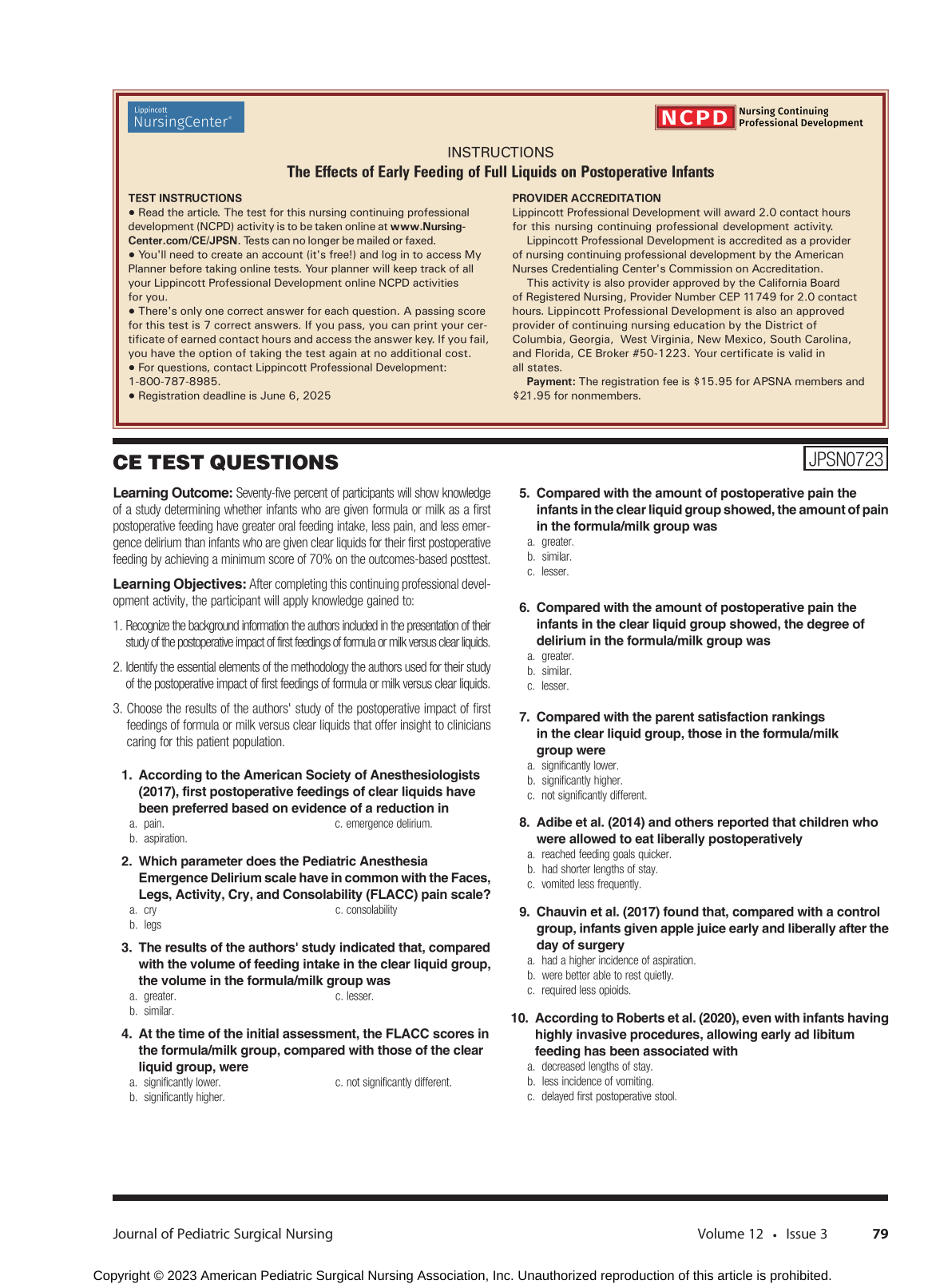
There is a lack of evidence-based guidance for postoperative feeding of infants after outpatient surgeries. This randomized controlled trial tested the hypothesis that infants, aged ≤12 months who are fed formula or milk at home, will have more oral intake, less pain, and less emergence delirium when fed formula/milk as compared with clear liquids in the postanesthesia care unit. Infants were randomized to receive formula/milk or clear liquids as first feeding after outpatient myringotomy and tube insertion. Pain (Faces, Legs, Activity, Cry, and Consolability) and emergence delirium (Pediatric Anesthesia Emergence Delirium) scores were recorded and compared immediately and again 15 and 30 minutes after arrival in the postanesthesia care unit. Infants randomized to the formula/milk first-feeding group had significantly more volume of oral feeding intake than infants randomized to the clear liquid first-feeding group (

Historical fasting practices before 1999 advised that surgical patients should have nothing to eat or drink after midnight to minimize the risk of aspiration. This practice can lead to prolonged fasting from food and liquids, which causes irritability, hunger, excessive thirst, and stress for the child and their caregiver. In addition, an increased inflammatory response and insulin resistance can occur during surgery. Research has demonstrated that fasting from clear liquids for 1–2 hours before surgery does not increase the risk of aspiration in children. A pre- and post-intervention quality improvement project was conducted in a pediatric surgical department in central Florida. From March to August 2022, 346 parents of children scheduled for general surgery were included in the project. Both groups received a reminder phone call the day before surgery with their preoperative instructions. In addition to a phone call, the post-intervention group also received an e-mail summarizing fasting instructions and times. This quality improvement project compared fasting times from food, nonclear liquids, and clear liquids before and after implementing an e-mail message reminder. The mean fasting times for clear and nonclear liquids did not change significantly from the baseline group to the post-intervention group. However, the mean solid fasting times did decrease significantly from 13.8 to 12.9 hours (
Adolescents undergoing surgery have expressed a willingness to obtain information about their surgery and to be involved in the decisions about their health care process. Around 80% of adolescents experience anxiety before undergoing surgery. On the basis of the adolescents' shared experiences, areas of possible nursing intervention have been identified to prevent anxiety and the multitude of adverse effects associated with it. The purpose of this study is to present a nursing intervention program to prevent perioperative anxiety in adolescents (3P2A) designed based on the first phase of the complex intervention's framework.
The design of this program followed the updated guidance for developing complex interventions issued by the Medical Research Council and the National Institute for Health Research. Five Portuguese nurses, experts in perioperative nursing, and pediatric specialists evaluated and validated the final version of this program.
The nursing intervention program to prevent perioperative anxiety in adolescents (3P2A) consists of three phases that correspond to the preoperative, intraoperative, and postoperative periods. The first phase includes conducting a preoperative nursing consultation to identify stressors, providing written and verbal information about the surgery, and applying nonpharmacological interventions to reduce anxiety. In the intraoperative period, nonpharmacological interventions are implemented in the anesthetic induction room immediately before the adolescent falls asleep. Finally, the postoperative period comprises a nursing visit to identify postoperative complications and promote the adolescents' well-being.
The program is structured with specific interventions to be implemented in each of the perioperative periods. Because of its flexibility, it may be fully or partially implemented considering the identified needs, priorities, and resources when caring for an adolescent with anxiety during the perioperative period.
Preoperative pregnancy status is a vital measure necessary for patient safety. At our institution, missing or delayed pregnancy test results, measured by human chorionic gonadotropin (HCG) levels, were identified as a contributing factor to surgical delays.
A quality improvement project was initiated in 2020 at a free-standing children’s hospital after missing or delayed HCG results were identified as a cause of surgical delays. A team was created to specifically evaluate this problem and devise an intervention. As a result, an automatically generated HCG test order was established to address surgical delays associated with missing or delayed HCG test results. The automatic order is triggered when the patient’s initial admission order is activated. For female patients 9 through 11 years of age, an order is automatically generated only if the admitting physician answers “No” to the question “Is the patient premenses?” when prompted. The system automatically generates an order for all female patients greater than 12 years of age regardless of menstruation.
Pre-intervention data revealed approximately 6% of surgical cases were delayed because of pregnancy test results; post-intervention data revealed approximately 2.6% of surgical cases were delayed because of pregnancy test results.
Initiation of an automatically generated HCG test order helped achieve the overall goal of reducing surgical delays linked to missing or delayed HCG results. Continued education and collective efforts are underway to help ensure the automatic order’s continued success.