Other
Select search scope: search across all journals or within the current journal


Ideal characteristics for long-term vascular access that can be managed in the home environment include a large vascular lumen in a high-flow blood system to minimize risks of obstruction and phlebitis, ease of sterile dressing maintenance, patient comfort, and longevity of the access site. Additionally, adaptation to placement at the bedside or in the home, technical ease and safety of placement, and minimal expense would be beneficial. With these considerations, possible anatomical sites would include the external and internal jugular veins, subclavian vein, cephalic vein, basilic vein, femoral vein, right atrial appendage, and translumbar and transhepatic access to the inferior vena cava. Of these, the internal jugular vein, subclavian vein, cephalic vein, basilic vein, and femoral vein would seem best suited for long-term venous access. (Journal of Parenteral and Enteral Nutrition 30:S7-S12, 2006)
Enteral nutrition is the delivery of nutrients through the gastrointestinal tract. For those patients who cannot or will not swallow, an enteral access device (EAD) is required. Some of these devices can be passed through the oral or nasal cavity into the stomach or small bowel. Alternatively, the devices can be percutaneously placed by an endoscopist or a radiologist into the stomach or small bowel. Knowledge of the appropriate use of these devices, the appropriate maintenance management of these devices, and the appropriate treatment of EAD-related complications is essential for the clinician to understand in order to provide effective nutrition therapy. (Journal of Parenteral and Enteral Nutrition 30:S13-S20, 2006)
Common to all pediatric patients receiving enteral nutrition is the inability to consume calories orally. This is often secondary to issues of inadequate weight gain, inadequate growth, prolonged feeding times, weight loss, a decrease in weight/age or weight/height ratios, or a persistent triceps skinfold thickness <5% for age. Enteral nutrition requires enteral access. In the neonatal period the nasoenteric route is usually used. In pediatric patients requiring long-term enteral access, surgically, endoscopically, or radiologically placed percutaneous feeding tubes are common. Jejunal feeding tubes are used in pediatric patients with gastric feeding intolerance or persistent gastroesophageal reflux. Low-profile enteral access devices are preferred by most pediatric patients because of their cosmetic appearance. For most children, a standard pediatric polypeptide enteral formula is well tolerated. There are specialized pediatric enteral formulas available for patients with decreased intestinal length, altered intestinal absorptive capacity, or altered pancreatic function. Weaning patients from tube feeding to oral nutrition is the ultimate nutrition goal. A multidisciplinary approach to patients with short bowel syndrome will maximize the use of enteral nutrition while preserving parenteral nutrition for patients with true enteral nutrition therapy failure. (Journal of Parenteral and Enteral Nutrition 30:S21-S26, 2006)
Placement of a percutaneous endoscopic gastrostomy (PEG) tube creates a controlled perforation of a hollow viscous organ and an acute surgical wound. Physicians who place PEG tubes endoscopically or fluoroscopically often do not have the opportunity to provide these patients with long-term follow-up care. Thus, nutrition support specialists who do treat these patients may be the one member of the health care team who is in the most advantageous position for ongoing inspection and maintenance of the access device. Carefully monitored surveillance and adherence to routine principles of wound care assure the health of the skin, the underlying tissue, and the tract into the abdominal cavity through which the PEG passes. Having knowledge of the types of tubes placed, performing a regular physical examination of the PEG site, and maintaining good communication with the endoscopist results in early identification of problems, promotes rapid simple strategies to correct deficiencies, and the opportunity to minimize long-term complications. Dietitians, wound-care ostomy nurses, and other nutrition support specialists are encouraged to be more proactive with their participation in the care and management of the PEG site. (Journal of Parenteral and Enteral Nutrition 30:S27-S38, 2006)

Successful long-term enteral nutrition requires enteral access that is comfortable and easy to maintain. However, to be successful, the enteral access must also satisfy conditions of gut anatomy and physiology. (Journal of Parenteral and Enteral Nutrition 30:S41-S46, 2006)
Milestones in the history of the development of vascular access and the subsequent advances in practical clinical applications of the knowledge, techniques, technology, and experience to the beneficial management of a variety of patients are described. The original achievements are presented and briefly discussed primarily, but not exclusively, in relationship to the successful development of parenteral nutrition (PN). Beginning with the discovery of the circulation of blood, landmark events, resulting from astute observations, experimentation, and ingenious technological advances, are summarized or outlined chronologically over the past 4 centuries, with emphasis on the many recent accomplishments of basic and clinical scientists during the past 6 decades. Brief descriptions of several seminal contributions to safe and effective IV access, management, and therapy acknowledge and recognize the historical highlights that have allowed a complex and potentially hazardous therapeutic modality to evolve into a commonly applied useful adjunct to our current inpatient and outpatient armamentarium. A comprehensive list of references documents the highlights of the development of vascular access for the student of history. (Journal of Parenteral and Enteral Nutrition 30:S47-S56, 2006)
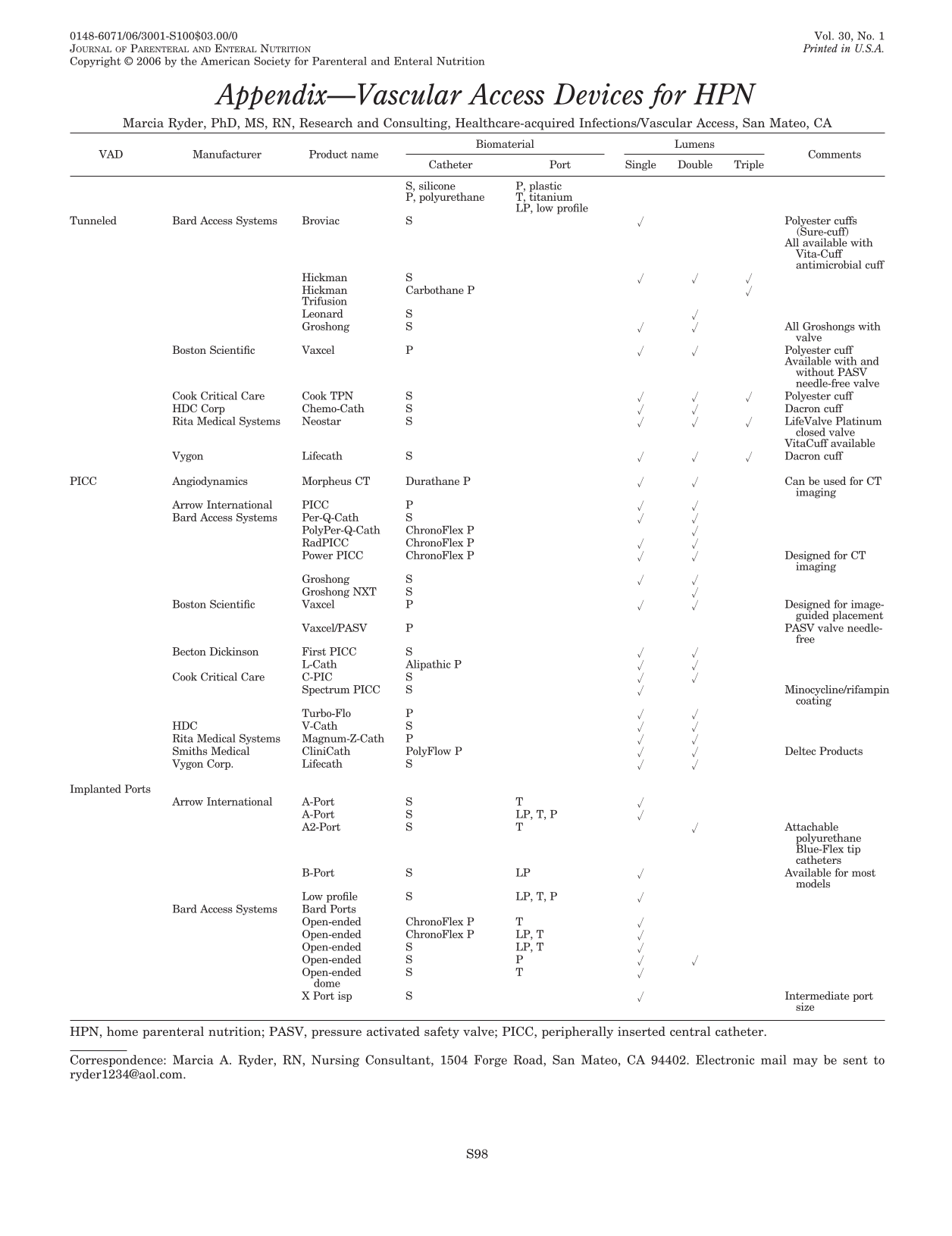
The dependence of IV hyperalimentation programs on the achievement and maintenance of reliable vascular access in the home infusion patient population has necessitated a review of the current methods used to establish and maintain adequate long-term vascular access. Vascular access device-related complications are significant contributors to the medical course and costs associated with the care of home parenteral nutrition (HPN) patients. The purpose of this manuscript is to review current thoughts on the establishment of long-term vascular access for HPN with regard to techniques used, device selection, and associated complications. (Journal of Parenteral and Enteral Nutrition 30:S57-S64, 2006)
This review article describes the vascular access devices available for long-term vascular access in children, describes the procedures for implanting them and the sites available for this purpose, discusses the complications associated with catheter placement and how to avoid them, and compares the various catheter systems in terms of their advantages and disadvantages. (Journal of Parenteral and Enteral Nutrition 30:S65-S69, 2006)
Catheter dysfunction occurs frequently in patients receiving home parenteral nutrition (HPN). Catheter-associated thrombosis can be life threatening and limit future vascular sites. Both of these complications can be minimized and treated by proper catheter placement and being aware of preventative and therapeutic measures. (Journal of Parenteral and Enteral Nutrition 30:S70 -S72, 2006)
A proper initial assessment of catheter occlusion is the key to successful management. The assessment screens are for both thrombotic and nonthrombotic causes (including mechanical occlusion). If mechanical occlusion is excluded, thrombotic occlusion is treated with alteplase. Nonthrombotic occlusions are treated according to their primary etiologies: lipid occlusion is treated with 70% ethanol, mineral precipitates are treated with 0.1-N hydrochloric acid (HCl), drug precipitates are treated according to their pH—acidic drugs can be cleared with 0.1-N HCl, basic medications can be cleared with sodium bicarbonate or 0.1-N sodium hydroxide (NaOH). Prevention of occlusion of central venous access devices is also critical. To date, no data conclusively show heparin flushes to be superior to saline flushes. No prophylactic regimen, including low-dose warfarin, low-molecular-weight heparin, or 1 unit heparin/mL of parenteral nutrition has been endorsed by any major medical, nursing, or pharmacy group due to lack of scientific evidence. The most encouraging information on decreasing occlusion rate comes from experience with positive-pressure devices that attach to the hub of most catheter lumens and prevent retrograde blood flow and, consequently, decrease the risk of thrombus formation in the catheter lumen. (Journal of Parenteral and Enteral Nutrition 30:S73-S81, 2006)
Catheter-related bloodstream infection and catheter occlusion are potential significant complications of parenteral nutrition therapy. The increased incidence and associated morbidity, mortality, increased costs, and qualityof-life issues experienced with these adverse events necessitate specialized management of vascular access devices. The host coagulation response to biomaterials and the associated development of biofilm on vascular devices are complex phenomena. Multiple interventions are required to prevent access of bacteria to both intraluminal and extraluminal catheter surfaces, and the occurrence of catheter occlusion. The discovery of the biofilm form of microbial life and the associated recalcitrance of biofilm bacteria to antimicrobials has provided insight into the failure of current prevention, diagnostic, and treatment protocols. Critical interventions are presented correlating current evidence with new discoveries in pathogenesis. (Journal of Parenteral and Enteral Nutrition 30:S82-S93, 2006)