Research article
Select search scope: search across all journals or within the current journal


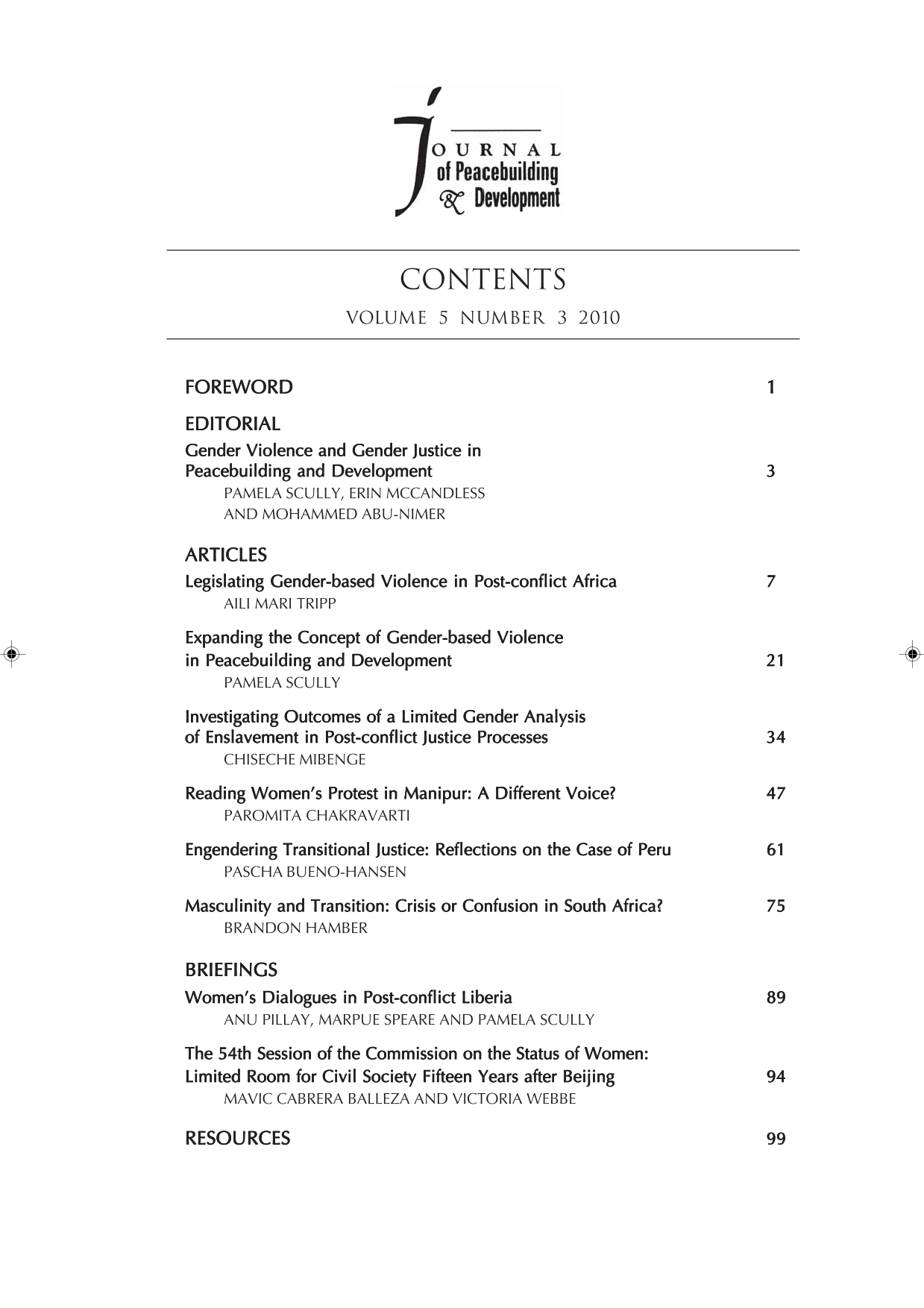
Much of the literature on post-conflict Africa has focused either on the backlash against women's rights or referred very generally to new openings for gender-related policy in particular countries. A closer look at developments across the continent shows that the steady demise of a significant number of major conflicts in Africa since the mid-1980s and especially after 2000 has been accompanied by a new focus on women's representation and woman-friendly legislation and policy. This article focuses on the adoption of gender-based violence legislation, which has not to date been examined cross-nationally. It argues that post-conflict countries have adopted legislation pertaining to gender-based violence at significantly higher rates than in other countries. The article shows how this is related to the legacy of conflict. The pressures to address GBV have come from 1) women's movements, 2) changing international norms and practices reflected in programmatic shifts within international bodies like the United Nations and among foreign donors, and 3) changing opportunity structures such as the holding of peace talks or rewriting of constitutions, which allowed women to push their agenda.
This article analyses key documents and field reports in order to make explicit the kinds of conceptual perspectives that frame the work on sexual violence against women. It explores the ways in which the Beijing Declaration on Violence and Security Council Resolution 1325, which focus on women as victims of sexual violence, have framed the work on gender-based violence in the international arena. The article argues that the focus on women as the sole victims of violence hampers sustainable peacebuilding and development in post-conflict societies. Such a focus fails to address the ways in which boys and men experience different forms of sexual violence and limits the potential efficacy of interventions around gender-based violence.
The image of women sex slaves or sexually violated women in armed conflict has begun to dominate and shape international interventions, including justice, peacebuilding and development processes in post-conflict societies. Such interventions respond to women as ‘rape victims’ when in fact women have more complex narratives of their wartime experiences – experiences that may indeed include rape but also embrace community leadership, anti-war protest, military training and economic profit from wartime livelihoods. Furthermore, an exclusive focus on ‘sex crimes’ precludes an analysis of femininity(ies) and masculinity(ies) and the ways these gender identities shape modes of violence and victimisation. This article provides a comparative overview of interdisciplinary research representing both narrow and broad gender analyses of enslavement as well as emerging legal definitions of enslavement provided by the case law, indictments and statutes of contemporary international tribunals in The Hague, Tokyo and Freetown respectively.1
This article revisits the Manipuri women's protest against the rape and killing of Thangjam Manorama Devi, a suspected Maoist insurgent, by the Indian Army in July 2004. The naked protest by the ‘Mothers of Manorama’ in front of the Indian Army headquarters, urging army men to come and rape them, represents a unique mode of non-violent protest. Its quiet aggression exposed the naked predatoriness of the Indian state against its own female citizens. By enacting the unnaturalness of violence on their bare bodies, they shocked the nation into realising the extraordinary conditions created in Manipur and elsewhere through the deployment of the army and the Armed Forces (Special Powers) Act of 1958, which grants them legal immunity. This article explores the significance of the Manipuri women's protest in the light of the history of both the colonial and the Indian state's exploitation of the region as well as the history of women's involvement in its social and economic development and peacebuilding activities.
This article probes the conceptual and methodological challenges of engendering transitional justice mechanisms, drawing referentially upon several years of research on Peruvian transitional justice initiatives. Most women affected by the internal armed conflict in Peru (1980-2000) were Quechua-speaking
The participation of women in social, political and economic life in South Africa since the transition to democracy in 1994 has been growing. However, gender equality has not been attained and violence against women remains extremely high. This article interrogates why this is the case by focusing on masculinity and particularly violent masculinities. Through presenting the findings of primary research with men and women in South Africa, the article shows how improvements in gender justice are creating new insecurities for some women, particularly in terms of domestic violence. The article critiques responses to violent masculinities that centre on the ‘crisis in masculinity’ discourse and calls for a nuanced understanding of masculinities in transition.