
Research article
 Restricted accessResearch articleFirst published April, 2026pp. 133-134
AEESP President’s Letter: Spreading Light
Kara L. NelsonORCID


Select search scope: search across all journals or within the current journal


 Restricted accessResearch articleFirst published April, 2026pp. 133-134
 Restricted accessResearch articleFirst published April, 2026pp. 135-148
Phosphorus (P) and fluoride (F) contamination in natural and industrial waters poses a serious environmental challenge. Mixed iron (Fe) and manganese (Mn) oxide composites have emerged as highly effective adsorbents for the removal of these pollutants from water. However, studies on real water system applications and the design of multicharged polymer-supported systems remain limited. In this work, FeMn-mixed oxides functionalized with polyacrylic acid (as a negative charge donor) and chitosan (as a positive charge donor) were engineered and applied as efficient adsorbents for the selective removal of P and F ions from both laboratory-prepared and real water samples. The as-prepared material was comprehensively characterized before and after adsorption using advanced analytical techniques. X-ray photoelectron spectroscopy and Fourier transform infrared spectroscopy analyses confirmed that carbon, nitrogen, and oxygen functional groups, together with the active participation of Fe and Mn ions, played central roles in the adsorption process. Real water samples collected from the Peshawar District (Khyber Pakhtunkhwa, Pakistan) were tested, and batch adsorption experiments validated the high removal efficiency of the composites. The composite exhibited a specific surface area ranging from 27.4 m2 g−1 before adsorption to 20.4 m2 g−1 after dye adsorption. Batch adsorption experiments demonstrated maximum removal efficiencies of 95–99% for both dyes under optimal conditions (pH 2–10, 298 K). Overall, this study presents a robust composite-engineering strategy and highlights the practical potential of the developed material for real-world water purification, particularly in industrial applications.
Restricted accessResearch articleFirst published April, 2026pp. 149-158The increasing environmental pollution caused by metal nanoparticles (NPs) has become a major concern, among which the ecological toxicity of zinc oxide (ZnO) NPs attracts particular attention. In this study, the Yellow River Estuary sediment was used as a research focus. A noncontact conductivity method was used to enable real-time, nondestructive monitoring of the growth kinetics of
This is a visual representation of the abstract.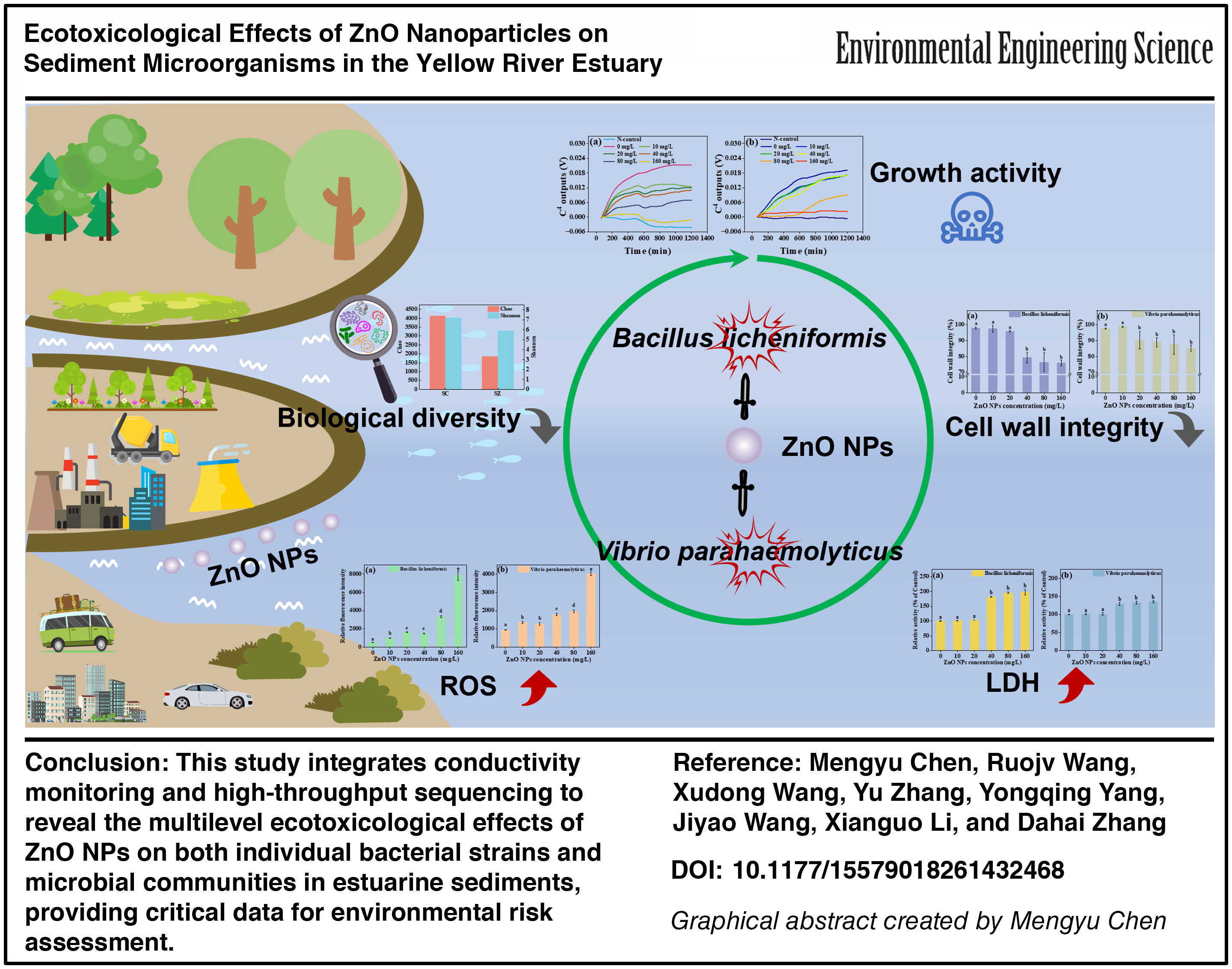
Restricted accessResearch articleFirst published April, 2026pp. 159-169Municipal wastewater sludge (MWS), an inevitable byproduct of municipal wastewater treatment plants, presents environmental and regulatory challenges due to its high biodegradable organic matter content. This study integrates real municipal wastewater characterization with process simulations to provide a predictive framework for evaluating treatment performance, scalability, and sustainability, advancing previous approaches to MWS stabilization and solidification (S/S). The main objective is to produce a nonhazardous solidificate that meets regulatory standards and is suitable for safe reuse or disposal. Simulations were conducted using HSC Chemistry and SuperPro Designer, incorporating characterization, process parameters, and thermodynamic properties to determine material flows. Simulation results indicate that the addition of 38% calcium oxide (CaO) yields a solidificate with 14.5% residual moisture and a final mass of 69.9% of the initial MWS. The solidificate is composed primarily of Ca(OH)2 (27.3%), CaCO3 (36.8%), and inorganic oxides (2.9%), exhibiting characteristics suitable for safe disposal or potential reuse. Experimental investigations, including the application of the solidificate as a partial replacement for fine aggregate in concrete, along with material characterization and unconfined compressive strength (UCS) tests, confirm the simulation predictions and demonstrate the practical applicability of the treated material. A screening life cycle assessment (LCA) estimated a climate change impact of 0.36 kg CO2-eq per kg of MWS, with CaO production being the main contributor. Techno-economic assessment demonstrated economic viability at 10 K t/year of MWS capacity, with a payback period of 12 years. Sensitivity and scenario analyses confirmed the robustness of the process under varying operational and financial conditions. Overall, this study demonstrates the feasibility of an integrated MWS treatment approach combining simulation, experimental validation, environmental assessment, and techno-economic evaluation. The proposed S/S approach provides a pathway toward sustainable waste management by reducing emissions, enhancing resource efficiency, enabling safe material recovery, and ensuring regulatory compliance, while maintaining economic viability.