Editorial
Select search scope: search across all journals or within the current journal

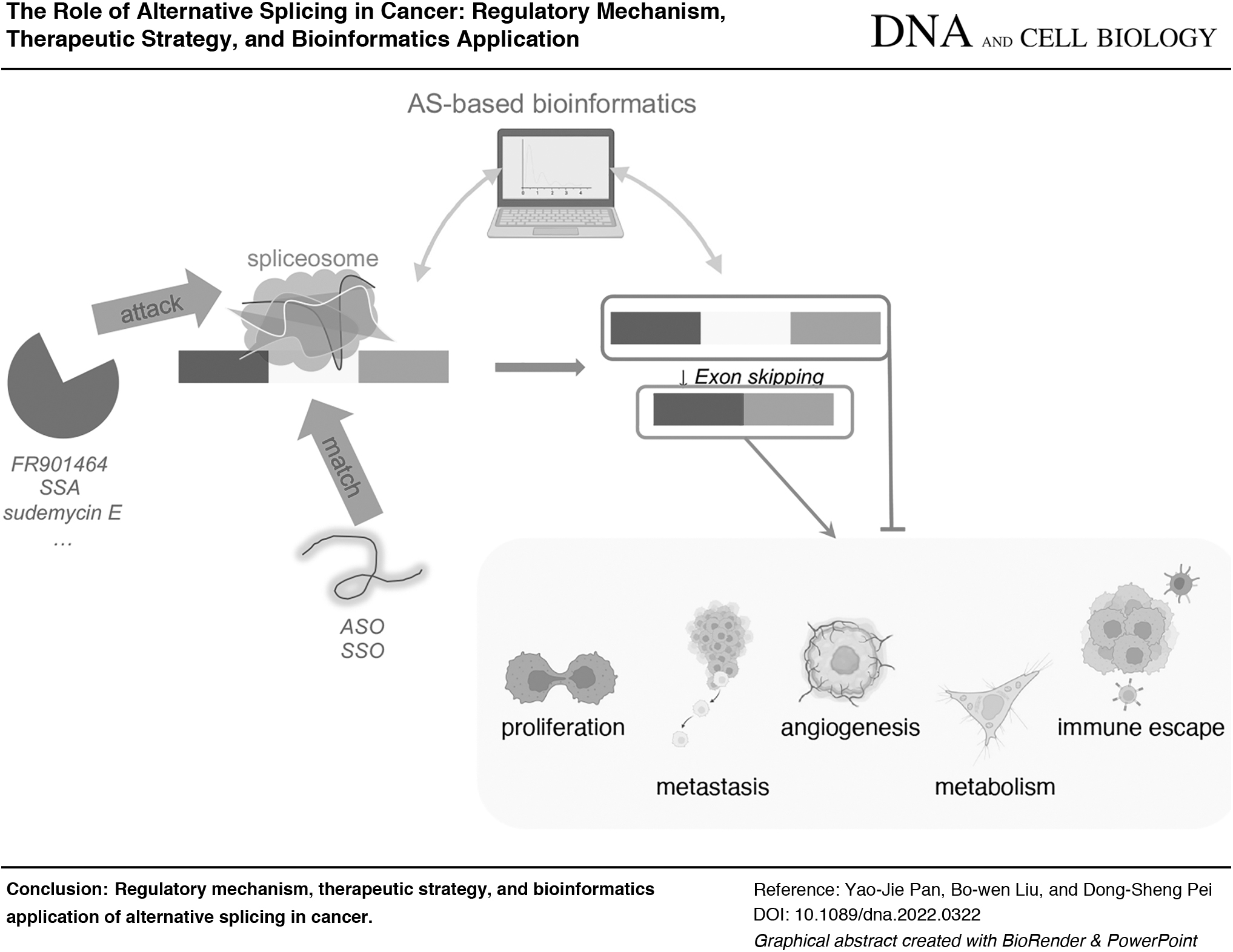
Alternative splicing (AS) can generate distinct transcripts and subsequent isoforms that play differential functions from the same pre-mRNA. Recently, increasing numbers of studies have emerged, unmasking the association between AS and cancer. In this review, we arranged AS events that are closely related to cancer progression and presented promising treatments based on AS for cancer therapy. Obtaining proliferative capacity, acquiring invasive properties, gaining angiogenic features, shifting metabolic ability, and getting immune escape inclination are all splicing events involved in biological processes. Spliceosome-targeted and antisense oligonucleotide technologies are two novel strategies that are hopeful in tumor therapy. In addition, bioinformatics applications based on AS were summarized for better prediction and elucidation of regulatory routines mingled in. Together, we aimed to provide a better understanding of complicated AS events associated with cancer biology and reveal AS a promising target of cancer treatment in the future.
MicroRNAs (miRNAs) are short non-coding RNAs that bind to the 3′ untranslated region (3′’ UTR) of target mRNAs to control gene expression post-transcriptionally. Recent indications have highlighted their important roles in a variety of pathophysiological conditions as well as human malignancies. Dysregulated miRNAs act as tumor suppressor genes or oncogenes in a variety of cancers. MiR-491 has been shown to have a major effect on tumorigenesis in multiple malignancies through binding to specific genes and signaling cascades, thereby preventing cancer progression. This review provides an overview of miR-491 expression in regulatory mechanisms and biological procedures of tumor cells, as well as the prospective possible treatment effects of various types of human cancers.
Atherosclerosis is a complex vascular inflammatory disease in which multiple cell types are involved, including vascular smooth muscle cells (VSMCs). In response to vascular injury and inflammatory stimuli, VSMCs undergo a “phenotypic switching” characterized by extracellular matrix secretion, loss of contractility, and abnormal proliferation and migration, which play a key role in the progression of atherosclerosis. DNA methylation modification is an important epigenetic mechanism that plays an important role in atherosclerosis. Studies investigating abnormal DNA methylation in patients with atherosclerosis have determined a specific DNA methylation profile, and proposed multiple pathways and genes involved in the etiopathogenesis of atherosclerosis. Recent studies have also revealed that DNA methylation modification controls VSMC function by regulating gene expression involved in atherosclerosis. In this review, we summarize the recent advances regarding the epigenetic control of VSMC function by DNA methylation in atherosclerosis and provide insights into the development of VSMC-centered therapeutic strategies.
Several studies indicated that autophagy activation participates in brain ischemic tolerance (BIT) induced by cerebral ischemic preconditioning (CIP). However, the mechanism of autophagy activation during the process still remains unclear. The present study aimed to evaluate the role of p38 MAPK–peroxisome proliferator-activated receptor γ (PPARγ) signaling cascade in autophagy during the CIP-induced BIT. The results shown that, initially, autophagy activation was observed after CIP in the model of global cerebral ischemia in rats, as was indicated by the upregulation of Beclin 1 expression, an increase in LC3-II/LC3-I ratio, the enhanced LC3 immunofluorescence, and a rise in the number of autophagosomes in the neurons of the hippocampal CA1 area. Besides, the inhibitor of autophagy 3-methyladenine obliterated the neuroprotection induced by CIP. Furthermore, the upregulation of p-p38 MAPK and PPARγ expressions was earlier than autophagy activation after CIP. In addition, pretreatment with SB203580 (the inhibitor of p38 MAPK) reversed CIP-induced PPARγ upregulation, autophagy activation, and neuroprotection. Pretreatment with GW9662 (the inhibitor of PPARγ) reversed autophagy activation and neuroprotection, while it had no effect on p-p38 MAPK upregulation induced by CIP. These data suggested that the p38 MAPK–PPARγ signaling pathway participates in autophagy activation during the induction of BIT by CIP.