Research article
Select search scope: search across all journals or within the current journal


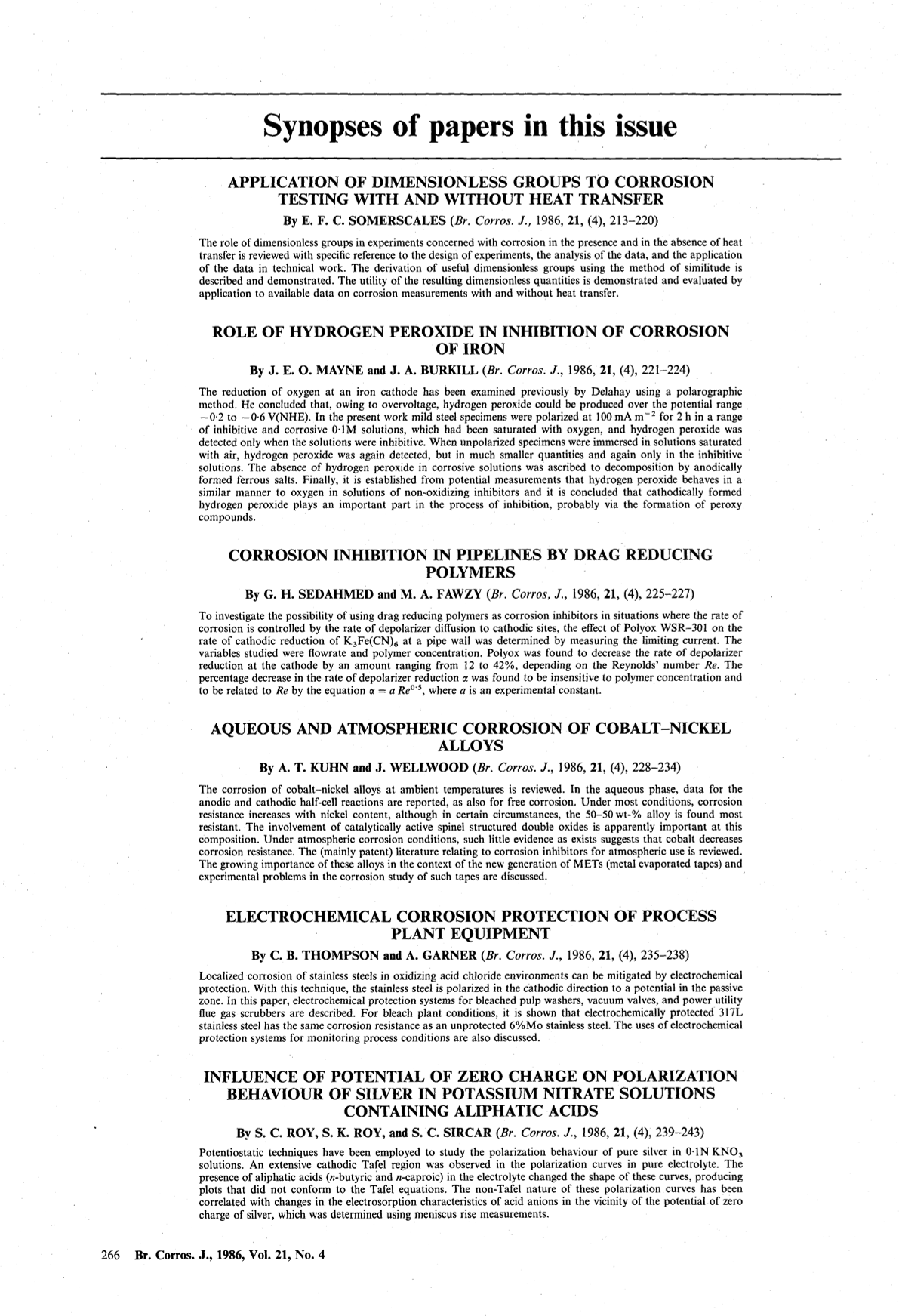
The role of dimensionless groups in experiments concerned with corrosion in the presence and in the absence of heat transfer is reviewed with specific reference to the design of experiments, the analysis of the data, and the application of the data in technical work. The derivation of useful dimensionless groups using the method of Similitude is described and demonstrated. The utility of the resulting dimensionless quantities is demonstrated and evaluated by application to available data on corrosion measurements with and without heat transfer.
The reduction of oxygen at an iron catbode has been examined previously by Delahay using a polarographic method. He concluded that, owing to overvoltage, hydrogen peroxide could be produced over the potential range −0·2 to −0·6 V(NHE). In the present work mild steel specimens were polarized at 100 mA m−2 for 2 h in a range of inhibitive and corrosive 0·1 M solutions, which had been saturated with oxygen, and hydrogen peroxide was detected only when the solutions were inhibitive. When unpolarized specimens were immersed in solutions saturated with air, hydrogen peroxide was again detected, but in much smaller quantities and again only in the inhibitive solutions. The absence of hydrogen peroxide in corrosive solutions was ascribed to decomposition by anodically formed ferrous salts. Finally, it is established from potential n1easurements that hydrogen peroxide behaves in a similar manner to oxygen in solutions of non-oxidizing inhibitors and it is concluded that cathodicallyformed hydrogen peroxide plays an important part in the process of inhibition, probably via the formation of peroxy compounds.
To investigate the possibility of using drag reducing polymers as corrosion inhibitors in situations where the rate of corrosion is controlled by the rate of depolarizer diffusion to cathodic sites, the effect of Polyox WSR–301 on the rate of cathodic reduction of K3Fe(CN)6 at a pipe wall was determined by measuring the limiting current. The variables studied were flowrate and polymer concentration. Polyox was found to decrease the rate of depolarizer reduction at the cathode by an amount ranging from 12 to 42%, depending on the Reynolds number Re. The percentage decrease in the rate of depolarizer reduction α was found to be insensitive to polymer concentration and to be related to Re by the equation α = a Re0–5, where a is an experimental constant.
The corrosion of cobalt-nickel alloys at ambient temperatures is reviewed. In the aqueous phase, data for the anodic and cathodic half-cell reactions are reported, as also for free corrosion. Under most conditions, corrosion resistance increases with nickel content, although in certain circumstances, the 50–50 wt-% alloy is found most resistant. The involvement of catalytically active spinel structured double oxides is apparently important at this composition. Under atmospheric corrosion conditions, such little evidence as exists suggests that cobalt decreases corrosion resistance. The (mainly patent) literature relating to corrosion inhibitors for atmospheric use is reviewed. The growing importance of these alloys in the context of the new generation of METs (metal evaporated tapes) and experimental problems in the corrosion study of such tapes are discussed.
Localized corrosion of stainless steels in oxidizing acid chloride environments can be mitigated by electrochemical protection. With this technique, the stainless steel is polarized in the cathodic direction to a potential in the passive zone. In this paper, electrochemical protection systems for bleached pulp washers, vacuum valves, and power utility flue gas scrubbers are described. For bleach plant conditions, it is shown that electrochemically protected 317L stainless steel has the same corrosion resistance as an unprotected 6%Mo stainless steel. The uses of electrochemical protection systems for monitoring process conditions are also discussed.
Potentiostatic techniques have been employed to study the polarization behaviour of pure silver in 0·IN KNO3 solutions. An extensive cathodic Tafel region was observed in the polarization curves in pure electrolyte. The presence of aliphatic acids (n-butyric and n-caproic) in the electrolyte changed the shape of these curves, producing plots that did not conform to the: Tafel equations. The non-Tafel nature of these polarization curves has been correlated with changes in the electrosorption characteristics of acid anions in the vicinity of the potential of zero charge of silver, which was determined using meniscus rise measurenlents.
The short term corrosion behaviour of four as-cast commercial aluminium bronzes has been examined by immersing the materials in artificial sea water for various lengths of time. Optical and scanning electron microscopy showed that the phases which underwent selective attack were: martensitiβ in the aluminium bronze, ABI; martensitic β and lamellar eutectoidal fcc α phase in nickel aluminium bronze; the cph y phase present both as a lamellar and matrix constituent in silicon aluminium bronze; and the ordered β phase and the fcc dendritic phase, rich in iron and manganese, in copper manganese aluminium bronze. The rates of corrosion of these phases were influenced by their volume fractions, morphologies, and distributions in the alloys.
The combined effects of strain rate, monotonic loading, and cathodic protection and overprotection on the mechanical properties of X65 linepipe steel parent plate and gas metal arc weld metal have been investigated in NaCl solution. The results obtained on longitudinal all parent plate and all weld metal specimens indicate that the latter material, having a higher hardness and strength level, is more susceptible to environmental cracking due to cathodically evolved hydrogen entering the steel. However, with transverse specimens, taken perpendicular to the weld, the gauge length contains parent plate, heat affected zone material, and weld metal. In this case, irrespective of the greater inherent susceptibility of the weld metal, environmental cracking and failure always occur in the parent plate. This result is attributed to the ultimate tensile strength of the lower strength parent plate being exceeded at stress levels significantly lower than the yield strength of the higher strength weld metal. The practical implications of these results are discussed. In addition, the results are presented of a fractographic analysis which relates the morphology of the environmentally induced fracture surfaces to microstructural features in the weld metal and the parent plate.
A number of duplex stainless steels, whoseferrite content ranged from 25 to 70%, were studied for evidence of corrosion in the aged and welded conditions. Microstructural reasons for differences in corrosion properties have been investigated, together with the influence of base alloy con1position. The corrosion performance of duplex stainless steels was tested in highly aggressive media: sulphuric acid andferric chloride solutions. It was found that the best corrosion resistance is obtained from alloys whose microstructures change little with increasing aging temperatures and whose composition is such as to give austenite/ferrite ratios close to 50:50. High chromium contents, which stabilize the passive film, and the addition of nickel and molybdenum have been observed to have a beneficial effect. Selective corrosion was observed in weldments and the heat affected zones of samples with adverse microstructural features. The average corrosion rates calculated from weight loss on as-received, aged, and welded samples after immersion in the abovementioned solutions and the critical pitting temperature measured in FeCl3 solution were in agreement with the above assertions.