
Other
 Restricted accessOtherFirst published June, 2014pp. 211-211

Select search scope: search across all journals or within the current journal


 Restricted accessOtherFirst published June, 2014pp. 211-211Restricted accessEditorialFirst published June, 2014pp. 212-214
 Restricted accessOtherFirst published June, 2014pp. 215-222
To study the analgesic effect of electroacupuncture (EA) as perioperative adjunctive therapy added to a systemic analgesic strategy (including tramadol and ketamine) for postoperative pain, opioid-related side effects and patient satisfaction.
In a sham-controlled participant- and observer-blinded trial, 75 patients undergoing radical prostatectomy were randomly assigned to two groups: (1) EA (n=37; tramadol+ketamine+EA) and (2) control (n=38; tramadol+ketamine). EA (100 Hz frequency) was applied at LI4 bilaterally during the closure of the abdominal walls and EA (4 Hz) was applied at ST36 and LI4 bilaterally immediately after extubation. The control group had sham acupuncture without penetration or stimulation. The following outcomes were evaluated: postoperative pain using the Numerical Rating Scale (NRS) and McGill Scale (SF_MPQ), mechanical pain thresholds using algometer application close to the wound, cortisol measurements, rescue analgesia, Spielberger State Trait Anxiety Inventory (STAI Y-6 item), patient satisfaction and opioid side effects.
Pain scores on the NRS and SF_MPQ were significantly lower and electronic pressure algometer measurements were significantly higher in the EA group than in the control group (p<0.001) at all assessments. In the EA group a significant decrease in rescue analgesia was observed at 45 min (p<0.001) and a significant decrease in cortisol levels was also observed (p<0.05). Patients expressed satisfaction with the analgesia, especially in the EA group (p<0.01). Significant delays in the start of bowel movements were observed in the control group at 45 min (p<0.001) and 2 h (p<0.05).
Adding EA perioperatively should be considered an option as part of a multimodal analgesic strategy.
Restricted accessOtherFirst published June, 2014pp. 223-226To evaluate whether electroacupuncture (EA) at ST36 can accelerate the recovery of gastrointestinal motility after colorectal surgery.
Forty patients of American Society of Anesthesiologists physical status II and III undergoing elective open resection of malignant colorectal tumours were included in this study. Using a sealed envelope method, the patients were randomly divided into two groups either receiving EA (EA group) or sham EA (SEA group). Data regarding the recovery of bowel function (times to the first bowel sounds, passage of flatus and defaecation) were collected and analysed.
In the EA group, the time intervals from surgery to the first bowel movement and passage of flatus were shorter than in the SEA group (13±10 h vs 19±13 h, p<0.05 and 23±14 h vs 32±18 h, p<0.05, respectively). There was no significant difference between the groups regarding the time to first defaecation (68±45 h vs 72±53 h, p>0.05).
EA at ST36 accelerates the recovery of gastrointestinal motility after colorectal surgery.
JJ22011-15.
Restricted accessOtherFirst published June, 2014pp. 227-235Chronic uncomplicated musculoskeletal pain in the spine (cervical, thoracic or lumbar) is highly prevalent and may severely limit the daily activities of those affected by it.
To evaluate the efficacy and safety of treatment with auriculopressure applied to patients with non-specific spinal pain.
A multicentre randomised controlled trial with two parallel arms (true auriculopressure (TAP) and placebo auriculopressure (PAP)) was performed. The intervention phase lasted 8 weeks and outcomes were measured 1 week after the last intervention (T1) and 6 months after baseline (T2). The primary outcome measure was change in pain intensity according to a 100 mm visual analogue scale (pain VAS) at T1. Secondary outcome measures were the Lattinen index, the McGill Pain Questionnaire and the SF-12 health-related quality of life scale (Spanish version in every case).
There were 265 participants (TAP group, n=130; PAP group, n=135). Pain was most frequently located in the upper back (55.1%, n=146), followed by the lower back (25.3%, n=67) and the dorsal area (12.5%, n=33). Nineteen patients (7.2%) reported pain affecting the entire spine. There were statistically significant differences between TAP and PAP in the change in the pain VAS at T1 of 10 mm (95% CI 2.8 to 17.3, p=0.007) and in the change in the pain VAS at T2 of 7.2 mm (95% CI 0.02 to 14.3, p=0.049) in favour of TAP. We also observed a statistically significant difference of 3.4 points in the physical component of the SF-12 in favour of TAP at T2 (95% CI 0.45 to 6.3, p=0.024). No severe adverse effects were detected or reported during treatment.
The application of auriculopressure in patients with non-specific spinal pain in primary healthcare is effective and safe, and therefore should be considered for inclusion in the portfolio of primary healthcare services.
ISRCTN01897462.
Restricted accessOtherFirst published June, 2014pp. 236-241To compare the immediate effects of electroacupuncture and manual acupuncture on pain, mobility and muscle strength in patients with knee osteoarthritis.
Sixty patients with knee osteoarthritis, with a pain intensity of ≥2 on the pain Numerical Rating Scale, were included. The patients were randomised into two groups: manual acupuncture and electroacupuncture. Pain intensity, degree of dysfunction (Timed Up and Go (TUG) test), maximal voluntary isometric contraction and pressure pain threshold were assessed before and after a single session of manual acupuncture or electroacupuncture treatments.
Both groups showed a significant reduction in pain intensity (p<0.001) and time to run the TUG test after the acupuncture treatment (p=0.005 for the manual acupuncture group and p=0.002 for the electroacupuncture group). There were no differences between the groups regarding pain intensity (p=0.25), TUG test (p=0.70), maximum voluntary isometric contraction (p=0.43) or pressure pain threshold (p=0.27).
This study found no difference between the immediate effects of a single session of manual acupuncture and electroacupuncture on pain, muscle strength and mobility in patients with knee osteoarthritis.
RBR-9TCN2X.
Restricted accessOtherFirst published June, 2014pp. 242-249To examine the role of acupuncture in the treatment of diabetic painful neuropathy (DPN) using a single-blind, placebo-controlled RCT and to collect data that would be required in a future definitive study of the efficacy of acupuncture in DPN.
45 patients were allocated to receive a 10-week course either of real (53%) or sham (47%) acupuncture. Five standardised acupuncture points on the lower limb of each leg were used in the study: LR3, KI3, SP6, SP10 and ST36. Outcome measures included the Leeds Assessment of Neuropathic Symptoms and Signs (LANSS) scale, lower limb pain (Visual Analogue Scale, VAS); Sleep Problem Scale (SPS); Measure Yourself Medical Outcome Profile (MYMOP); 36-item Short Form 36 Health Survey and resting blood pressure (BP).
Over the 10-week treatment period, small improvements were seen in VAS −15 (−26 to −3.5), MYMOP −0.89 (−1.4 to −0.3), SPS −2.5 (−4.2 to −0.82) and resting diastolic BP −5.2 (−10.4 to −0.14) in the true acupuncture group. In contrast, there was little change in those receiving sham acupuncture. A moderate treatment effect in favour of active acupuncture was detected in MYMOP scores −0.66 (−0.96 to −0.35) but non-significant effect sizes in LANSS Pain Scale −0.37 (−2.2 to 1.4), resting diastolic BP −0.50 (−3.0 to 1.99) and the SPS −0.51 (−2.2 to 1.16).
We have demonstrated the practicality and feasibility of acupuncture as an additional treatment for people with DPN. The treatment was well tolerated with no appreciable side effects. Larger randomised trials are needed to confirm the clinical and cost-effectiveness of acupuncture in the treatment of DPN.
ISRCTN number: 39740785.
Restricted accessOtherFirst published June, 2014pp. 250-256To evaluate the feasibility of delivering acupuncture in an emergency department (ED) to patients presenting with pain and/or nausea.
A feasibility study (with historical controls) undertaken at the Northern Hospital ED in Melbourne, Australia, involving people presenting to ED triage with pain (VAS 0–10) and/or nausea (Morrow Index 1–6) between January and August 2010 (n=400). The acupuncture group comprised 200 patients who received usual medical care and acupuncture; the usual care group comprised 200 patients with retrospective data closely matched from ED electronic health records.
Refusal rate was 31%, with ‘symptoms under control owing to medical treatment before acupuncture’ the most prevalent reason for refusal (n=36); 52.5% of participants responded ‘definitely yes’ for their willingness to repeat acupuncture, and a further 31.8% responded ‘probably yes’. Over half (57%) reported a satisfaction score of 10 for acupuncture treatment. Musculoskeletal conditions were the most common conditions treated n=117 (58.5%), followed by abdominal or flank pain n=49 (24.5%). Adverse events were rare (2%) and mild. Pain and nausea scores reduced from a mean±SD of 7.01±2.02 before acupuncture to 4.72±2.62 after acupuncture and from 2.6±2.19 to 1.42±1.86, respectively.
Acupuncture in the ED appears safe and acceptable for patients with pain and/or nausea. Results suggest combined care may provide effective pain and nausea relief in ED patients. Further high-quality, sufficiently powered randomised studies evaluating the cost-effectiveness and efficacy of the add-on effect of acupuncture are recommended.
 Open accessOtherFirst published June, 2014pp. 257-266
Although there is a growing interest in the use of acupuncture during pregnancy, the safety of acupuncture is yet to be rigorously investigated. The objective of this review is to identify adverse events (AEs) associated with acupuncture treatment during pregnancy.
We searched Medline, Embase, Cochrane Central Register of Controlled Trials, Cumulative Index to Nursing and Allied Health Literature (CINAHL), Allied and Complementary Medicine Database (AMED) and five Korean databases up to February 2013. Reference lists of relevant articles were screened for additional reports. Studies were included regardless of their design if they reported original data and involved acupuncture needling and/or moxibustion treatment for any conditions in pregnant women. Studies of acupuncture for delivery, abortion, assisted reproduction or postpartum conditions were excluded. AE data were extracted and assessed in terms of severity and causality, and incidence was determined.
Of 105 included studies, detailed AEs were reported only in 25 studies represented by 27 articles (25.7%). AEs evaluated as certain, probable or possible in the causality assessment were all mild/moderate in severity, with needling pain being the most frequent. Severe AEs or deaths were few and all considered unlikely to have been caused by acupuncture. Total AE incidence was 1.9%, and the incidence of AEs evaluated as certainly, probably or possibly causally related to acupuncture was 1.3%.
Acupuncture during pregnancy appears to be associated with few AEs when correctly applied.
Restricted accessOtherFirst published June, 2014pp. 267-272There is insufficient evidence of a relationship between acupuncture needle sensations (
Twenty-two healthy participants received one acupuncture needle at LI10 with bidirectional rotation of the needle in one experimental session and one acupuncture needle at LI10 with mock rotation in a separate session, in a randomised order. Measurements of heat pain thresholds were taken before needle insertion, during needle retention and 15 min after needle removal. At each measurement time point, participants rated needle sensations using the Massachusetts Acupuncture Sensation Scale (MASS) and a visual analogue scale (VAS) of overall intensity of needle sensation.
Bidirectional needle rotation produced significantly higher scores for VAS, MASStotal, MASSpain and MASSsensation compared with mock rotation (all p<0.001). There were significantly higher pain thresholds relative to pre-intervention baseline during (p=0.014) and after (p<0.001) bidirectional needle rotation but not during (p=0.1) or after (p=0.62) mock bidirectional needle rotation. Bidirectional needle rotation increased the pain threshold relative to baseline 15 min after the needles were removed (p=0.009). A significant but low correlation between needle sensation and change in pain threshold after needling was only found when data from mock and rotation interventions were combined.
Needle rotation increases the magnitude of hypoalgesia. There is tentative evidence that needle sensation may be associated with the amount of change in pain threshold.
Restricted accessOtherFirst published June, 2014pp. 273-278To clarify changes in the cardiovascular autonomic nervous system function due to trigger point acupuncture, we evaluated differences in responses between acupuncture at trigger points and those at other sites using spectral analysis of heart rate variability.
Subjects were 35 healthy men. Before measurements began the subjects were assigned to a trigger point acupuncture or control group based on the presence/absence of referred pain on applying pressure to a taut band within the right tibialis anterior muscle. The measurements were conducted in a room with a temperature of 25°C, with subjects in a long sitting position after 10 min rest. Acupuncture needles were retained for 10 min at two sites on the right tibialis anterior muscle. ECG was performed simultaneously with measurements of blood pressure and the respiratory cycle. Based on the R–R interval on the ECG, frequency analysis was performed, low-frequency (LF) and high-frequency (HF) components were extracted and the ratio of LF to HF components (LF/HF) was evaluated.
The trigger point acupuncture group showed a transient decrease in heart rate and an increase in the HF component but no significant changes in LF/HF. In the control group, no significant changes were observed in heart rate, the HF component or LF/HF. There were no consistent changes in systolic or diastolic blood pressure in either group.
These data suggest that acupuncture stimulation of trigger points of the tibialis anterior muscle transiently increases parasympathetic nerve activity.
Restricted accessOtherFirst published June, 2014pp. 279-285The objectives of this research are, first, to establish if the extraordinary acupuncture meridian known as
Restricted accessOtherFirst published June, 2014pp. 286-289This report describes the use of acupuncture as an add on treatment for a patient with chronic schizophrenia. The 63-year-old woman suffered from persistent hallucinations and even physical pain as a result of the hallucination of a black bird that kept pecking her back. The patient received 12 weekly acupuncture treatments. A clinical diagnostic interview and psychological testing (on sleep quality, depression, and on positive and negative symptoms) were conducted before, immediately after and 3 months after the acupuncture treatment. The results of the diagnostic interview gave important insights into the treatment effects. The patient experienced improved daily functioning and noticed a change in hallucinations. Although the hallucinations still occurred, she felt less disturbed by them. Interestingly, pain decreased markedly. In addition, the results showed that the overall score of the positive and negative symptoms did not change immediately; however, a decrease in symptoms occurred 3 months after acupuncture treatment. Moreover, the patient described an immediate improvement in sleep; this was confirmed by a daytime sleepiness questionnaire. The patient was not able to complete a (longer) test on sleep quality beforehand but did so after the treatment period. Finally, a delayed improvement in the depression scale was found. Although larger clinical intervention studies on acupuncture and schizophrenia are needed, the results of this case study indicate that acupuncture may be beneficial as an add on treatment tool in patients with schizophrenia.
3132.
Restricted accessResearch articleFirst published June, 2014pp. 290-293 Restricted accessBook reviewFirst published June, 2014pp. 294-295
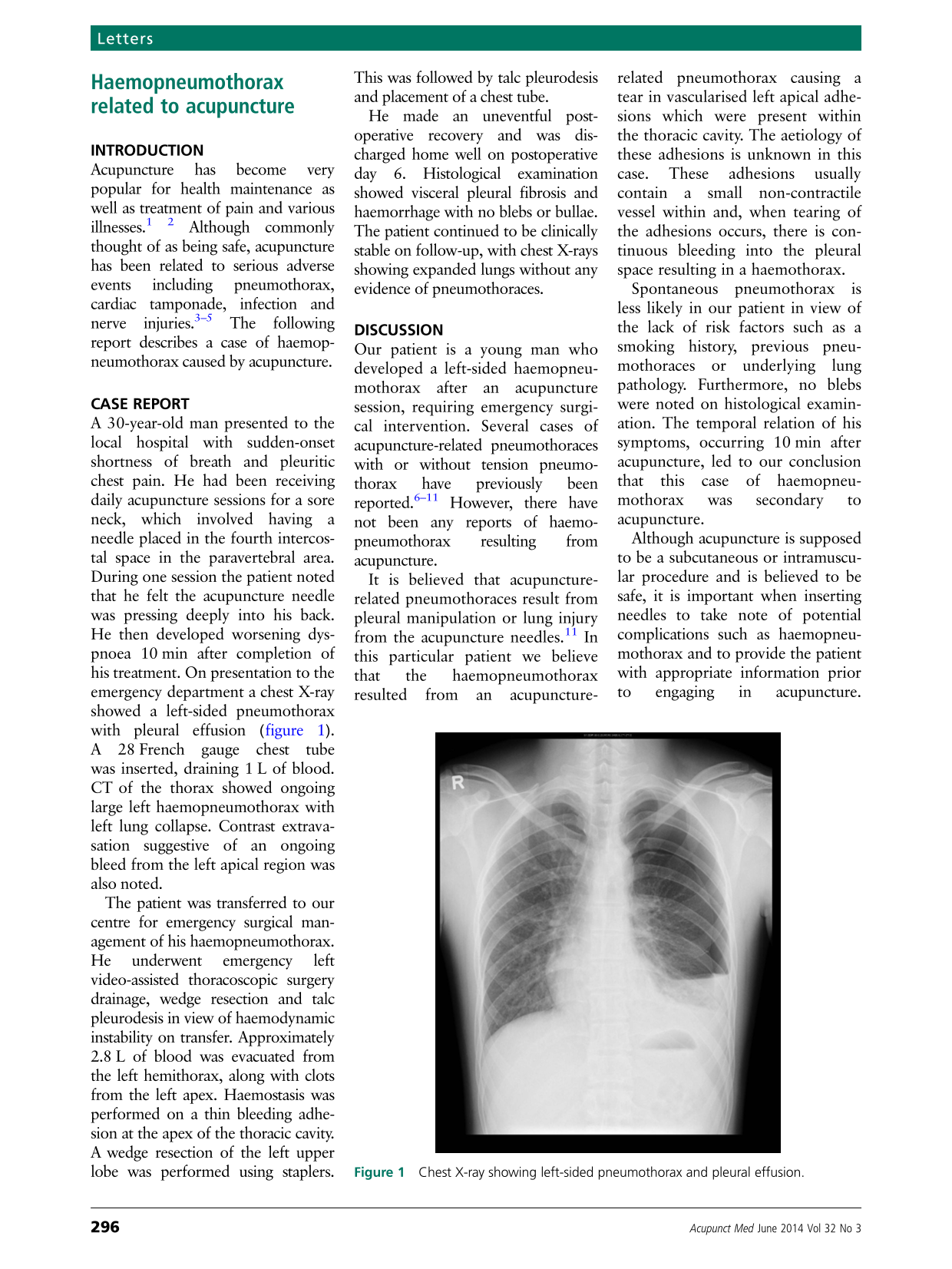
 Restricted accessLetterFirst published June, 2014pp. 296-297
 Restricted accessLetterFirst published June, 2014pp. 297-298
 Restricted accessMeeting reportFirst published June, 2014pp. 299-302