Submission guidelines
 Submit manuscript
Please read the guidelines in full before submitting your manuscript.
Manuscripts not conforming to these guidelines may be returned.
Manuscript Submission Guidelines: Personality Science
- Open Access
- Article processing charge (APC)
- What do we publish?
3.1 Aims & Scope
3.2 Paper Categories
3.3 Pre-registration and registered reports
3.4 Writing your paper - Editorial policies
4.1 Peer review policy
4.2 Transparent Peer Review
4.3 Open Science Policy
4.4 Transparency Standards
4.5 Authorship
4.6 Acknowledgements - Publishing policies
5.1 Publication ethics
5.2 Contributor’s publishing agreement - Preparing your manuscript
6.1 Formatting
6.2 Reporting Standards
6.3 Artwork, figures and other graphics
6.4 Supplemental material
6.5 Reference style
6.6 English language editing services - Submitting your manuscript
7.1 How to submit your manuscript
7.2 Title, Keywords, and Abstract
7.3 ORCID
7.4 Information required for completing your submission
7.5 Permissions - Appealing the publication decision
Only manuscripts of sufficient quality that correspond to the guidelines below and meet the aims and scope of Personality Science will be reviewed. As part of the submission process you will be required to warrant that:
- you are submitting your original work
- you have the rights in the work
- you are submitting the work for first publication in the Journal
- your work it is not being considered for publication elsewhere or has already been published elsewhere you have obtained and can supply all necessary permissions for the reproduction of any copyright works not owned by you
Any correspondence, queries or additional requests for information on the Manuscript Submission process should be sent to the Personality Science editorial office as follows: jjadenissen@gmail.com
Personality Science is a diamond open access, peer-reviewed journal. Each accepted article is published under a Creative Commons license and will be hosted online in perpetuity. There is no charge for accessing, submitting to or publishing a paper in the journal. For general information on open access at Sage please visit the Open Access page or view our Open Access FAQs.
Personality Science accepts submissions of papers that have been posted on preprint servers. In that case, please include the DOI for the preprint in the designated field in the manuscript submission system. Authors should not post an updated version of their paper on the preprint server while it is being peer reviewed for possible publication in the journal. If your paper is accepted, you will need to contact the preprint server to ensure the final published article link is attached to your preprint. Learn more about SAGE’s preprint policy here.
2. Article processing charge (APC)
There are no publication fees to publish in Personality Science. To accomplish this, financial support has been provided by a consortium of five personality psychology associations:
Australasian Congress on Personality and Individual Differences
Association of Research in Personality, European Association of Personality Psychology
European Association of Personality Psychology
Japan Society of Personality Psychology
Society for Personality and Social Psychology
Before submitting your manuscript to Personality Science, please ensure you have read the Aims & Scope.
Below, five different paper categories are listed. The paper category is indicated on the final, published paper. In certain cases (e.g., Theme Bundles, sets of papers that explore different facets of a single topic within personality science), papers can also be published alongside each other in a collection. Papers can be submitted any time, and they are published continuously (i.e., there is no traditional volume or issue ordering). The categories do not have a maximum word count, but the editors will ensure that the manuscript remains as concise as possible; authors may be asked to revise their submission to meet this requirement.

3.2.1 Theory and Review
Theory and Review papers can include a literature review, which can either be narrative or quantitative. Such a paper can also introduce a new theory, or criticize an existing one.
In the following, additional information is provided for two specific types of Theory and Review papers:
State of the art reviews summarize a research topic or field in personality science by showcasing (a) its importance and relevance, (b) the consensual cumulative knowledge base, (c) persistent or unanswered questions and controversies, (d) common and novel methodologies to get answers, and (e) future directions.
Meta-analyses aggregate quantitative information across different studies. Corresponding manuscripts must include a table of studies with the values of all descriptive statistics, moderators, and effect sizes. They should also include publication bias analyses, and authors must store data and scripts, code, or syntax in a permanent repository (unless they obtain an exemption). Papers reporting a meta-analysis should follow relevant guidelines (e.g., PRISMA) and APA reporting standards for quantitative meta-analyses (MARS, Table 9) or qualitative meta-analyses (QMARS, Table 2).
3.2.2 Methodological Contribution
A Methodological Contribution can be focused on news insights regarding methods, instruments, statistics, or psychometrics. Such contributions can use logical analysis, proof of concept, or simulations.
One specific instance of such a contribution is a tutorial paper. Such papers provide a “How to …” description and explanation for methodological issues (e.g., how to properly implement a certain research design, use a certain statistical technique, or derive valid conclusions from complex data). The idea is to make specialized methodologies – which are interesting, important, impactful, emerging/novel, and/or neglected – accessible to a broader readership and encourage using them correctly.
3.2.3. Empirical Study
An empirical study involves conducting original research or replication studies to observe specific phenomena on empirical evidence. In submitting a study, authors must ensure their manuscript clearly articulates the research question and provides a thorough methodology section that entails the procedures and statistical analyses used. The study should also incorporate a comprehensive review of relevant literature, positioning its contribution within the current understanding of personality science. A detailed discussion should interpret the findings, explaining their implications and how they relate to or challenge existing theories.
Personality Science explicitly welcomes replications of effects important to personality science. These replications may be “successful” or “unsuccessful”, but they need to be well-done and contain a discussion of the type of replications (e.g., conceptual, direct, etc.), the constraints on generality, and how this specific replication adds to the literature. Replication papers will always be empirical. Papers reporting a replication should follow relevant APA reporting standards (JARS, Tables 1 and 6).
Medical research involving human subjects must be conducted according to the World Medical Association Declaration of Helsinki. Submitted manuscripts should conform to the ICMJE Recommendations for the Conduct, Reporting, Editing, and Publication of Scholarly Work in Medical Journals, and all papers reporting animal and/or human studies must state in the methods section that the relevant Ethics Committee or Institutional Review Board provided (or waived) approval. Please ensure that you have provided the full name and institution of the review committee, in addition to the approval number. For manuscript submissions involving interventions, please adhere to the CONSORT guidelines to ensure transparency and quality reporting, which can be found here: https://www.goodreports.org/reporting-checklists/consort.
Authors are also required to state in the methods section whether participants provided informed consent and whether the consent was written or verbal. If applicable, authors are required to state in the methods section whether participants provided informed consent.
Information on informed consent to report individual cases or case series should be included in the manuscript text. A statement is required regarding whether written informed consent for patient information and images to be published was provided by the patient(s) or a legally authorized representative. Please do not submit the patient’s actual written informed consent with your article, as this in itself breaches the patient’s confidentiality. The Journal requests that you confirm to us, in writing, that you have obtained written informed consent but the written consent itself should be held by the authors/investigators themselves, for example in a patient’s hospital record. The confirmatory letter may be uploaded with your submission as a separate file.
See also the ICMJE Recommendations for the Protection of Research Participants.
3.2.4 Projects & Data
This type of paper describes ongoing or completed projects, resources, platforms, databases, or single datasets. The idea is to alert others to interesting data, but also to describe the full methodology of single projects that are useful to cite in subsequent empirical papers. These papers, if describing empirical projects or datasets, should outline the theoretical background, research questions and hypotheses, research design, data sources, instruments, variables, samples (including power considerations), sampling strategies, procedures, and any resources they wish to highlight. Data to be considered for this paper type will usually be large, complex, “multi” (e.g., multi-method, multi-time, multi-group, etc.), and/or of wide interest to many different personality scientists.
3.2.5 Comment
Commentaries address contemporary issues within the scope of the journal and are often solicited, although authors may initiate discussion with the editor in chief prior to submission. There are two types of commentaries, each with distinct objectives:
- One type of commentary reflects on a recent or forthcoming study to review deemed significant enough to prompt additional commentary or clarification. This commentary zooms in on particular issues within a subject rather than the entire domain, clarifies the repercussion of the article, and contextualizes it. It may examine recent progress or offer conjectures on future developments in certain subjects.
- The other type is akin to an editorial. It can be based on pertinent literature, focusing on a crucial element of implementation research practice within the aim of propelling the entire discipline forward. It is also possible to publish a stance that isn’t directly derived from empirical research. Such a commentary should encompass all facets of the topic, including ethical considerations, and articulate a cogent perspective or stance addressing the topic in either a supportive (‘pro’) or opposing (‘con’) manner.
3.3 Pre-registration and registered reports
The policy of Personality Science is to publish papers where authors indicate whether or not the conducted research was pre-registered with an analysis plan in an independent, institutional registry (e.g., http://aspredicted.org/, http://clinicaltrials.gov/, AEA RCT Registry, https://osf.io/, https://egap.org/registry/, http://ridie.3ieimpact.org/). Pre-registration of studies involves registering the study design, variables, and treatment conditions. Including an analysis plan involves specification of sequence of analyses or the statistical model that will be reported. A benefit of this process is that by bolstering research integrity by outlining plans pre-study, it enhances transparency, prevents bias, and facilitates reproducibility. A link to the frozen pre-registration at a registry must be made available to the journal prior to publication. The journal, or an entity acting on behalf of the journal, will verify that pre-registration adheres to the specifications for pre-registration and then provide certification of the pre-registration in the article.
-
Authors must indicate if they did or did not pre-register the research.
-
If an author did pre-register the research with an analysis plan, the author must:
-
confirm that the study was registered prior to conducting the research with links to the time-stamped pre-registration at the institutional registry, and that the pre-registration adheres to the disclosure requirements of the institutional registry or those required for the pre-registered badge with analysis plans maintained by the Center for Open Science.
-
Report all pre-registered analyses in the paper, or, if there were changes in the analysis plan following pre-registration, those changes must be disclosed with explanation for the changes.
-
Clearly distinguish in the paper between analyses that were pre-registered from those that were not, such as having separate sections in the results for confirmatory and exploratory analyses.
-
Registered reports are one particularly encouraged type of study. In this special type of article, a “shell” of the paper – either (a) before any data have been gathered (Registered Report - Pre-Data) or (b) before already existing data have been examined and analyzed (Registered Report - Post-Data) – is peer-reviewed first, the project is then formally pre-registered, and lastly the actual data analyses and the final write-up of the paper are performed. This means that a Registered Report is published regardless of the results and evaluated only on the basis of its conceptual and methodological merits. The pre-registered part of the project constrains the confirmatory analyses, but authors additionally have the flexibility to conduct un-registered and thus exploratory analyses (e.g., often as follow-up or in-depth analyses that could not have been anticipated in beforehand). A Registered Report thus offers both rigor and flexibility, coupled with full transparency.
Registered Reports are clearly marked as such and receive a pre-registration badge. They are submitted in two stages:
- Stage 1. In Stage 1, a “shell” of the intended paper and project files are submitted. Authors indicate in the online submission system that their submission be considered as a Stage 1 Registered Report and whether any analyzable data have been collected yet. The Stage 1 shell paper should contain a theoretical background, research rationale, questions and hypotheses, results from pilot studies (if any), methods (design, variables, measures, procedure, sample, power analyses, etc.), planned analyses, and guidelines for the interpretation of expectable (patterns of) results. The shell paper itself will later be published as a supplement and should be part of the formal pre-registration of the project. Further information on registered reports can be found here. Further, it should be used as a starting point for crafting the final Stage 2 paper. Thus, shell papers operate under the same restrictions as usual empirical papers in terms of word, references, table, and figure counts. Importantly, at submission of the shell paper, the authors additionally need to upload any materials, codebooks, and analyses scripts, code, or syntax that will be used in the proposed project. After the in-principle acceptance of the Stage 1 manuscript, authors must deposit a copy of their Stage 1 manuscript on a pre-print server (e.g., PsychArchives or OSF) before proceeding to Stage 2. This deposited version should be cited in subsequent stages and submissions. If the shell paper is accepted, this constitutes an in-principle acceptance of the intended paper under the conditions that the project closely follows the pre-registration (and openly discloses where it has diverged, if at all). The project should then be formally pre-registered in a repository (e.g., OSF) either publicly or under temporary private embargo. This formal pre-registration needs to be disclosed in the Stage 2 paper. The implementation of the project, potential data collection, analyses, and results interpretation should be followed as closely as possible to the peer-reviewed and pre-registered version. An in-principle-acceptance is valid initially for 9 months, but extensions can be granted at the discretion of the handling editor.
- Stage 2. After running their study or analyses as peer-reviewed and pre-registered, the authors complete their shell paper with the actual analyses, interpretations, and discussions and submit that paper (along with the data and any other files) as a Stage 2 Registered Report (this will also have to be indicated in the online submission system). Stage 2 papers operate under the same restrictions as usual empirical papers in terms of word, references, table, and figure counts. The paper should clearly distinguish between confirmatory analyses (i.e., those that were pre-registered) and exploratory analyses (i.e., those that were not pre-registered). Further, the authors should be transparent about any deviations from the pre-registration. In case of deviations deemed too strong by the editors or peer-reviewers, an in-principle acceptance may also be revoked; in such cases, the paper may still be publishable, but not as a Registered Report. Further, an in-principle acceptance from Stage 2 is usually peer-reviewed again (if possible by the same reviewers from Stage 1, but sometimes also by additional ones) and thus does not preclude revision rounds for Stage 2 manuscripts until they are fully accepted “as is”. This additional review stage is for quality control and ensuring that the paper has sufficiently followed the pre-registration, is readable, and conforms to the general guidelines of Personality Science.
Personality Science is a member of the Peer Community in Registered Reports (PCI RR), which performs Stage 1 and Stage 2 review of RR preprints.
As a ‘PCI RR-friendly’ journal, Personality Science will automatically offer Stage 1 in-principle acceptance (IPA) to any quantitative Stage 1 RR within the journal’s disciplinary scope that received IPA at PCI RR, and will accept without further peer review any Stage 2 RR that has been recommended by PCI- RR, subject to the manuscript meeting applicable journal requirements which can be found here.
Authors intending to publish in Personality Science via PCI RR should submit their manuscript to Personality Science only after a positive Stage 2 recommendation from PCI RR.
On submission, the manuscript will be checked by the Editor to confirm that the submission is identical to the Stage 2 manuscript that is approved by PCI RR and this will be checked by the Editor. The Stage 2 RR should be submitted using the usual submission system and include the URL to the reviews and recommendation at PCI RR. The submission must also be accompanied by a cover letter stating that the authors are submitting via the PCI RR track, including a URL to the commended preprint, and confirm that the manuscript is identical to the recommended preprint.
Additional information regarding PCI RR may be found here.
Visit the Sage Author Gateway for general advice on how to get published, plus links to further resources. Sage Author Services also offers authors a variety of ways to improve and enhance your article including English language editing, plagiarism detection, and video abstract and infographic preparation. For information and guidance on how to make your article more discoverable, visit our Gateway page on How to Help Readers Find Your Article Online.
The journal’s policy is to have manuscripts reviewed by at least two expert reviewers. Reviewers make comments to the author and recommendations to the handling editor who then makes the final decision. Sage does not permit the use of author-suggested (recommended) reviewers at any stage of the submission process, be that through the web-based submission system or other communication. Reviewers should be experts in their fields and should be able to provide an objective assessment of the manuscript. Our policy is that reviewers should not be assigned to a paper if:
- The reviewer is based at the same research unit as any of the co-authors.
- The reviewer is based at the funding body of the paper.
- The author has recommended the reviewer.
Personality Science is committed to delivering high quality, fast peer-review for your paper, and as such has partnered with Web of Science (previously Publons). Web of Science is a third party service that seeks to track, verify and give credit for peer-review. Reviewers for Personality Science can opt in to Web of Science to claim their reviews or have them automatically verified and added to their reviewer profile.
Editors or members of the Editorial Board may occasionally submit their own manuscripts for possible publication in the journal. In these cases, the peer review process will be managed by alternative members of the Board and the submitting Editor or Board member will have no involvement in the decision-making process. The published paper will also transparently state this.
4.1.1 Streamlined Review
Personality Science offers a Streamlined Review for manuscripts that have already undergone rigorous peer review at a prestigious journal. This initiative supports rapid publication of significant interdisciplinary research aligned with the journal’s values, while maintaining full editorial and ethical standards.
Objectives
- To provide a preferred alternative outlet for manuscripts previously reviewed at leading journals.
- To ensure an efficient and timely review process with rapid editorial feedback.
- To optimize editorial workflow by accelerating the path to publication for eligible submissions.
Submission Requirements
- Authors should clearly identify their submission as a “Streamlined Review” in their cover letter.
- The prior decision letter and any available reviewer reports must be uploaded as Supplementary Files.
Initial Eligibility Assessment
The editorial team conducts an initial check to determine suitability. Key criteria include:
- Prior submission to a journal with a recognized high profile and rigorous review standards (examples may include top-tier journals in psychology or interdisciplinary science).
- Evidence of a substantive prior review process.
- Demonstration that authors have carefully revised the manuscript based on reviewer feedback.
- Alignment with the interdisciplinary scope and core principles of Personality Science.
- Confirmation that the prior decision letter has been provided.
Editorial Assignment and Review:
- Eligible manuscripts are promptly assigned to an Associate Editor or Editorial Board member with appropriate expertise.
- The goal is a faster turnaround than the standard review: initial assessment within two weeks and final decision within one month thereafter.
- Where possible, the original reviewers may be re-invited (subject to availability and consent).
- If prior reviews were limited, an additional short review (e.g., from an AE) may be solicited to maintain quality.
- Each submission must have received at least two reviews in its previous round, one of which should involve a reviewer with expertise relevant to personality psychology.
Author Communication and Transparency
- Transparency: Participation in the Streamlined Review does not guarantee acceptance, but it ensures a focused and accelerated review.
- Handling of Supporting Documents: While uploading the prior decision letter is mandatory, authors should consider intellectual property restrictions before sharing full reviewer reports. If full reports cannot be shared, a brief summary of their key points can be provided instead.
- Open Science & Peer Review: The process remains subject to the journal’s Transparent Peer Review policy (Section 4.2).
- Positioning of Personality Science: Manuscripts not accepted through this track remain eligible for submission through the standard route, provided they meet the journal’s quality standards and scope.
Personality Science has implemented What is peer review for authors and reviewers, where the reviews at each stage, author responses and editor’s decision letters will be publicly available on the ScholarOne Transparent Peer Review platform and linked to from the published article should the article be accepted.
All correspondence – from authors (e.g., response letters), editors (e.g., decision letters), and reviewers (i.e., reviews) – will be part of one Transparent Peer Review file. The Transparent Peer Review file is available under the “Information, Rights and Permissions” tab of each published article on the Sage website. At Personality Science, reviewers and authors have the possibility to identify themselves, or they can choose to opt-out of transparent peer review meaning the peer review process of the paper will not be published. Reviewers are encouraged to sign their reviews but their comments will be published anonymously in the Transparent Peer Review file should they choose not to do so.
Personality Science requires authors to submit their manuscript anonymously, because letting authors opt out of anonymity could create bias (e.g., more prominent authors might be more inclined to make use of it). Therefore, authors should not include author names in the manuscript or file properties.
Personality Science follows the Transparency and Openness Promotion (TOP)-Guidelines (see https://osf.io/9f6gx/) and open science is a key part of the Journal’s identity. For Journal’s current TOP score, see topfactor.org. During submission, authors have to confirm how their manuscript complies with open science standards.
Personality Science allows variability in how authors address the open science standards, but it asks for transparency about their choices. This policy accommodates circumstances that do not allow authors to meet all of the standards. However, editors give credit to (empirical) submissions that comply with them and do not accept articles that fail to provide an explanation for why the standards cannot be met.
Material, data and analysis scripts are generally considered “open” if the paper includes a URL to an openly accessible file stored at a permanent public repository (such as the Open Science Framework; OSF). Therefore, all manuscripts must have a Open Science Statement after the Discussion (before References) that states where materials, data and scripts can be accessed (or why they cannot be accessed), preferably with direct URL(s). Simply noting that other researchers can request material is not considered “open”. For example, the statement could read: “The study materials, data and analysis scripts used for this article can be accessed at [a permanent and openly accessible URL].”
During submission, authors are invited to apply for Open Science Badges (Open material, Open data, Preregistered). The badges are assigned based on how the paper complies with the open science standards.
4.3.1 Peer Community In (PCI) Recommended Preprints
Personality Science is a PCI-friendly journal (Category 1). Authors may submit PCI-recommended preprints that have undergone peer review through the Peer Community In (PCI) platform.
In such cases, the editorial process may rely partly or entirely on the PCI evaluation. Upon acceptance, a note will be added to the published article acknowledging that a previous version was reviewed and recommended by PCI, including the citation and DOI of the PCI recommendation
4.4.1 Data Transparency
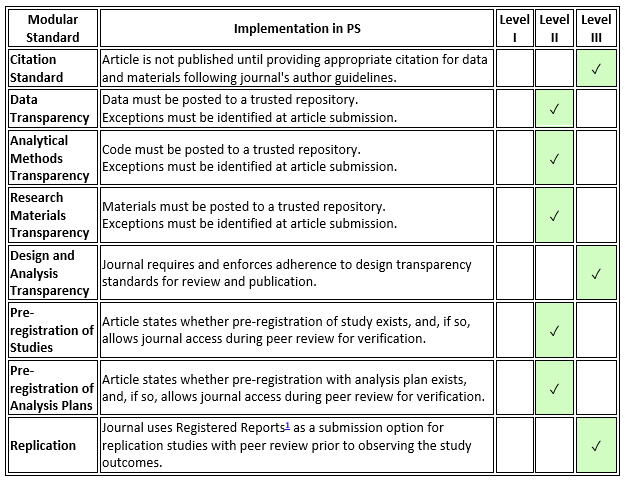
The guidelines summarized above concern any paper published in Personality Science that presents empirical data (whether quantitative or qualitative). Upon submission of a paper, authors will have to confirm that they have included appropriate statements (e.g., about the availability of data, code, materials, other documents, pre-registrations) within their papers. All papers will be checked regarding their adherence to the journal's adopted TOP standards outlined above. Papers that do not meet the standards cannot be published in Personality Science.
For papers reporting on data and empirical analyses, any supplements (materials, data, scripts, code, syntax, documents, etc.) need to be self-explanatory, useful, and well organized. Specifically, the journal requires all of those files to conform to the FAIR system – they should be findable, accessible, interoperable, and reusable. It is not just necessary or desirable to share information, but that information must also be understandable, helpful, and usable for others to also be able work with them (e.g., in reproducing the findings).
In empirical articles (i.e., articles presenting data), eight sets of statements need to be woven into the text. To facilitate the detection of these statements in the text, we ask that each of the statements appear in blue color in the manuscript. Although not a set rule, we advise to insert several of these statements directly into a dedicated sub-section on “Transparency, Openness, and Reproducibility” in the Method section. An overview of the necessary statements and potential sections to place them is given in the table below.


The policy of Personality Science is to publish papers only if the data are clearly and precisely documented and are maximally available to any researcher for purposes of reproducing the results or replicating the procedure.
- Authors reusing data available from public repositories must provide program code, scripts for statistical packages, and other documentation sufficient to allow an informed researcher to precisely reproduce all published results. This should be done even if the reused data itself may not be shared.
- Authors using their own, original data must:
- make the data available at a trusted digital repository
- include all variables, treatment conditions, and observations described in the manuscript
- provide a full account of the procedures used to collect, pre-process, clean, or generate the data
- In rare cases, despite authors’ best efforts, some or all data cannot be shared for legal or ethical reasons. In such cases, authors must inform the editors at the time of submission. This will be taken into account during the review process. Authors are encouraged to anticipate data sharing at the beginning of their projects to provide for these circumstances. It is understood that in some cases access will be provided under restrictions to protect confidential or proprietary information. Editors may grant exceptions to data and material access requirements provided authors:
- explain the restrictions on the data set and how they preclude public access.
- provide a public description of the steps others should follow to request access to the data.
- provide access to all data for which the constraints do not apply.
- Data should be made available through an open, permanent, and trusted repository that adheres to policies that make data discoverable, accessible, usable, and preserved for the long term. It should also assign unique and persistent identifiers. For example, such services are also offered by partners in the Data Preservation Alliance for the Social Sciences (Data-PASS) and most institutional repositories. Most author-maintained websites will not be compliant with this requirement.
4.4.2 Design Transparency
The policy of Personality Science is to publish papers where authors follow standards for disclosing key aspects of the research design and data analysis. Authors are required to review the standards available for many research applications (see the APA Reporting Standards) and use those that are relevant for the reported research applications. At manuscript submission, authors must confirm that they reviewed the standards, report whether any standards were relevant for the research application, and confirm that they followed those standards in the manuscript. The journal, or an entity acting on behalf of the journal, will verify that the appropriate standards were adopted and followed. Failure to follow the relevant standards may result in the paper not being published.
4.4.3 Publication Transparency
In the interest of transparency and openness, papers published in Personality Science will contain (among others) following information:
- author names and details (including contributorship roles according to the CRediT – Contributor Role Taxonomy)
- special information on the paper (i.e., category, invited, part of paper collection)
- abstract(s) and keywords
- key insights; relevance statement; plain-language summary (optional)
- URLs to supplements on OSF; Open Science badges
- handling editor name; total number of review rounds and reviewers; reviewer names (if opted in); available pre-publication peer-review history as supplements
- statements on funding, competing interests, other manuscript versions, ethics, acknowledgements, and other issues
- basic history (e.g., date of submission and acceptance)
- the entire peer review paper trail (see “transparent peer review” above)
In the submission portal, authors furthermore have to fill out a form that corresponds to the Transparency Checklist that was published by a consortium of authors (Aczel et al., 2019). This checklist specifies key aspects of pre-registration, details that should be reported in the methods and results sections, and the public availability of data, code and materials.
Aczel, B., Szaszi, B., Sarafoglou, A. Kekecs, Z., Kucharský, Š., Benjamin, D., ... & Wagenmakers, E.-J. (2019). A consensus-based transparency checklist. Nature Human Behaviour, 1--3. doi:10.1038/s41562-019-0772-6
4.4.4 Constraints on Generality (COG)
To promote cumulative and transparent science, Personality Science encourages authors to include a Constraints on Generality (COG) statement.
A COG statement identifies and justifies the target population(s), settings, and procedures for which the reported findings are expected to hold. Authors should specify:
- the characteristics of participants, materials, and contexts that are essential for observing the reported effects;
- any features that may limit the generalizability of the results; and
- considerations for researchers attempting direct or conceptual replications.
Explicitly defining these constraints enables other researchers to sample from comparable populations when replicating and to test boundary conditions of the original findings.
Simons, D. J., Shoda, Y., & Lindsay, D. S. (2017). Constraints on Generality (COG): A Proposed Addition to All Empirical Papers. Perspectives on Psychological Science, 12(6), 1123- 1128. https://doi.org/10.1177/1745691617708630 (Original work published 2017)
This Journal follows the APA requirement that authorship is merited by a substantial intellectual contribution to the manuscript, an approval of the manuscript’s final version, and the willingness to be held accountable for one’s work (https://www.apa.org/pubs/journals/resources/publishing-policies).
Principal authorship, authorship order, and other publication credits should be based on the relative scientific or professional contributions of the individuals involved, regardless of their status.
As part of our commitment to ensuring an ethical, transparent and fair peer review and publication process, Sage is trialling the adoption of CRediT (Contributor Roles Taxonomy) on several of our journals. CRediT is a high-level taxonomy, including 14 roles, which is used to describe each author’s individual contributions to the work.
You will be asked to list the contribution of each author as part of the submission process. Please include the Author Contributions heading within your manuscript. The information you give on submission will then show under the Author Contributions heading later at the proofing stage.
AI chatbots, for example ChatGPT, should not be listed as authors. For more information see the policy on Use of ChatGPT and generative AI tools.
All contributors who do not meet the criteria for authorship should be listed in an Acknowledgements section. It is good practice to obtain consent from non-author contributors whom you are acknowledging in your paper.
4.6.1 Third party submissions
Where an individual who is not listed as an author submits a manuscript on behalf of the author(s), a statement must be included in the Acknowledgements section of the manuscript and in the accompanying cover letter. The statements must:
- Disclose this type of editorial assistance – including the individual’s name, company and level of input
- Identify any entities that paid for this assistance
- Confirm that the listed authors have authorized the submission of their manuscript via third party and approved any statements or declarations, e.g. conflicting interests, funding, etc.
Where appropriate, Sage reserves the right to deny consideration to manuscripts submitted by a third party rather than by the authors themselves.
4.6.2 Writing assistance
Individuals who provided writing assistance (e.g. from a specialist communications company) do not qualify as authors and should be included in the Acknowledgements section. Authors must disclose any writing assistance – including the individual’s name, company and level of input – and identify the entity that paid for this assistance. It is not necessary to disclose use of language polishing services.
4.6.3 Funding
Personality Science requires all authors to acknowledge their funding in a consistent fashion under a separate heading. Please visit the Funding Acknowledgements page on the Sage Journal Author Gateway to confirm the format of the acknowledgment text in the event of funding.
4.6.4 Declaration of conflicting interests
Personality Science requires authors to include a declaration of any conflicting interests and recommends you review the good practice guidelines on the Sage Journal Author Gateway.
Sage is committed to upholding the integrity of the academic record. We encourage authors to refer to the Committee on Publication Ethics’ International Standards for Authors and view the Publication Ethics page on the Sage Author Gateway.
5.1.1 Plagiarism
Personality Science and Sage take issues of copyright infringement, plagiarism, or other breaches of best practice in publication very seriously. We seek to protect the rights of our authors and we always investigate claims of plagiarism or misuse of published articles. Equally, we seek to protect the reputation of the journal against malpractice. Submitted articles may be checked with duplication-checking software. Where an article, for example, is found to have plagiarized other work or included third-party copyright material without permission or with insufficient acknowledgement, or where the authorship of the article is contested, we reserve the right to take action including, but not limited to: publishing an erratum or corrigendum (correction); retracting the article; taking up the matter with the head of department or dean of the author's institution and/or relevant academic bodies or societies; or taking appropriate legal action.
5.1.2 Prior publication
If material has been previously published, it is not generally acceptable for publication in a Sage journal. However, there are certain circumstances where previously published material can be considered for publication. Please refer to the guidance on the Sage Author Gateway or if in doubt, contact the Editor at the address given below. Preprints are not considered prior publications.
5.2 Contributor’s publishing agreement
Before publication Sage requires the author as the rights holder to sign a Journal Contributor’s Publishing Agreement. Personality Science publishes manuscripts under Creative Commons licenses. The standard license for the journal is Creative Commons by Attribution 4.0 which means content may be copied, adapted, displayed, distributed, republished or otherwise reused for any purpose including for adaption and commercial use provided the content is attributed. For more information, you are advised to visit Sage's OA licenses page. Alternative license arrangements are available to meet particular funder mandates, made at the author’s request.
The preferred format for your manuscript is Word. LaTeX files are also accepted. Word and (La)Tex templates are available on the Manuscript Submission Guidelines page of our Author Gateway.
Personality Science strongly recommends that authors follow the journal reporting standards (JARS) set forth by the American Psychological Association (APA). The JARS fall into three categories that will likely cover most if not all empirical papers submitted to Personality Science: JARS-Quant for quantitative data, Qualitative research design (JARS–Qual) for qualitative data, and Mixed methods research design (JARS–Mixed) for mixed-methods combining quantitative and qualitative data.
6.3 Artwork, figures and other graphics
For guidance on the preparation of illustrations, pictures and graphs in electronic format, please visit Sage’s Manuscript Submission Guidelines.
Figures supplied in color will appear in color online.
This journal is able to host additional materials online (e.g. datasets, podcasts, videos, images etc) alongside the full-text of the article. For more information please refer to our guidelines on submitting supplemental files.
Personality Science adheres to the APA reference style. References to ensure your manuscript conforms to this reference style.
6.6 English language editing services
Authors seeking assistance with English language editing, translation, or figure and manuscript formatting to fit the journal’s specifications should consider using Sage Language Services. Visit Sage Language Services on our Journal Author Gateway for further information.
7.1 How to submit your manuscript
Personality Science is hosted on Sage Track, a web based online submission and peer review system powered by ScholarOne™ Manuscripts. Visit https://mc.manuscriptcentral.com/personalityscience to login and submit your article online.
IMPORTANT: Please check whether you already have an account in the system before trying to create a new one. If you have reviewed or authored for the journal in the past year it is likely that you will have had an account created. For further guidance on submitting your manuscript online please visit ScholarOne Online Help.
7.2 Title, Keywords, and Abstract
Please supply a title, short title, an abstract, and keywords to accompany your article. The title, abstract, and keywords are key to ensuring readers find your article online through online search engines such as Google. Please refer to the information and guidance on how best to title your article, write your abstract and select your keywords by visiting the Sage Journal Author Gateway for guidelines on How to Help Readers Find Your Article Online.
As part of our commitment to ensuring an ethical, transparent and fair peer review process Sage is a supporting member of ORCID, the Open Researcher and Contributor ID. ORCID provides a unique and persistent digital identifier that distinguishes researchers from every other researcher, even those who share the same name, and, through integration in key research workflows such as manuscript and grant submission, supports automated linkages between researchers and their professional activities, ensuring that their work is recognized.
The collection of ORCID IDs from corresponding authors is now part of the submission process of this journal. If you already have an ORCID iD you will be asked to associate that to your submission during the online submission process. We also strongly encourage all co-authors to link their ORCID ID to their accounts in our online peer review platforms. It takes seconds to do: click the link when prompted, sign into your ORCID account and our systems are automatically updated. Your ORCID iD will become part of your accepted publication’s metadata, making your work attributable to you and only you. Your ORCID iD is published with your article so that fellow researchers reading your work can link to your ORCID profile and from there link to your other publications.
If you do not already have an ORCID ID please follow this link to create one or visit our ORCID homepage to learn more.
7.4 Information required for completing your submission
You will be asked to provide contact details and academic affiliations for all co-authors via the submission system and identify who is to be the corresponding author. These details must match what appears on your manuscript. The affiliation listed on the manuscript should be the institution where the research was conducted. If an author has moved to a new institution since completing the research, the new affiliation can be included in a note. At this stage please ensure you have included all the required statements and declarations and uploaded any additional supplementary files (including reporting guidelines where relevant).
Please ensure that you have obtained any necessary permission from copyright holders for reproducing any illustrations, tables, figures or lengthy quotations previously published elsewhere. For further information including guidance on fair dealing for criticism and review, please see the Copyright and Permissions page on the Sage Journal Author Gateway.
8. Appealing the publication decision
Editors have very broad discretion in determining whether an article is an appropriate fit for their journal. Decisions are eligible for formal appeal if the author believes the decision to reject the manuscript was based on an error in the review of the article, in which case the author may appeal the decision by providing the Editor with a written description of the error they believe occurred.
If an author believes the decision regarding their manuscript was affected by a publication ethics breach, the author may contact the publisher with a detailed written description of their concern, and information supporting the concern, at publication_ethics@sagepub.compublication_ethics@sagepub.com
9. Further Resources
The Sage Journal Author Gateway has some general advice on how to get published, plus links to further resources. Sage Author Services also offers authors a variety of ways to improve and enhance your article including English language editing, plagiarism detection, and video abstract and infographic preparation.
If you have any questions about publishing with Sage, please visit the Sage Journals Solutions Portal.
You can view our complaints and appeals procedure.
Contact us
You can direct any questions to Personality Science’s Editorial Office:
Anne van der Vlist: annevlist@hotmail.com
Professor Jaap Denissen
Editor-in-Chief, Personality Science
Email: jjadenissen@gmail.com