






Abstract
Background
Beneficial correlations are suggested between food preparation and home food preparation of healthy choices. Therefore, there is an emergence of culinary medicine (CM) programs directed at both patients and medical professionals which deliver education emphasizing skills such as shopping, food storage, and meal preparation.
Objective
The goal of this article is to provide a description of emerging CM programs and to imagine how this field can mature.
Methods
During April 2015, 10 CM programs were identified by surveying CM and lifestyle medicine leaders. Program directors completed a narrative describing their program's structure, curricula, educational design, modes of delivery, funding, and cost. Interviews were conducted in an effort to optimize data collection.
Results
All 10 culinary programs deliver medical education curricula educating 2654 health professionals per year. Educational goals vary within the domains of (1) provider's self-behavior, (2) nutritional knowledge and (3) prescribing nutrition. Six programs deliver patients’ curricula, educating 4225 individuals per year. These programs’ content varies and focuses on either specific diets or various culinary behaviors. All the programs’ directors are health professionals who are also either credentialed chefs or have a strong culinary background. Nine of these programs offer culinary training in either a hands-on or visual demonstration within a teaching kitchen setting, while one delivers remote culinary tele-education. Seven programs track outcomes using various questionnaires and biometric data.
Conclusions
There is currently no consensus about learning objectives, curricular domains, staffing, and facility requirements associated with CM, and there has been little research to explore its impact. A shared strategy is needed to collectively overcome these challenges.
Introduction
Healthy nutrition is recommended for all. 1 Beneficial correlations are suggested between healthy food preparation skills and consumption of healthy choices.2,3 However, a survey from 2007 to 2008 evaluating trends in US home food preparation found a decrease in cooking activities. 4 Thus, experts are suggesting that nutritional education should augment a primary focus on nutrients with food-oriented education, 5 emphasizing skills such as shopping, food storage, and meal planning and preparation.2,6
In response, patients’ educational interventions that aim to improve culinary behaviors have recently emerged. 7 These interventions were found to improve short-term attitudes regarding healthy cooking, 8 confidence in cooking, 9 healthy food consumption, 9 and health outcomes. 10
Culinary education is emerging in medical education as well. The majority of the nutritional content currently taught in medical education is related to biochemistry, not practical, food-related knowledge and skills that may positively impact eating behaviors. 11 This gap manifests in the attitudes of residents, fellows, and other practicing clinicians who lack the confidence and knowledge to effectively prescribe nutrition.12,13 To bridge this gap, culinary education programs are emerging to address food-based knowledge and skills. Preliminary results from 2 such programs have documented improvement in both the providers’ personal and professional nutrition-related behaviors, 14 including the providers’ perceived ability to advise patients with metabolic risk factors. 15
Proponents of health-related culinary education are suggesting different labels for this area such as “culinary nutrition” or “culinary medicine” (CM). A recent manuscript suggested a definition of CM as “a new evidence-based field in medicine that blends the art of food and cooking with the science of medicine.” 16 However, there is still no consensus with regard to terminology, and useful definitions still need to be established by the larger medical and culinary communities.
The goal of this article is to provide a preliminary description of 10 emerging CM programs and to envision how the field of CM might mature in such a way that it impacts health behaviors and outcomes of both medical professionals and the patients and communities in which they serve.
Methods
During April 2015, a series of CM programs that deliver either medical or patient education were identified by surveying both worldwide CM leaders (eg, a complete list of physicians who are also chefs as identified by the authors) and lifestyle medicine leaders (eg, representatives from worldwide lifestyle medicine societies). This was intended to be a representative but not necessarily exhaustive list of relevant thought leaders in this area. The program's entry criteria consisted of the following: (1) delivery of health-related culinary courses that are scheduled on a regular basis (2) operation through a health-related organization (eg, hospital, clinic, medical school, school of public health), and (3) with or without a teaching kitchen. Programs that merely license another program's curricula were excluded.
Each of the identified program directors was invited to complete a narrative (Appendix, available at www.gahmj.com) describing his or her program's (1) structure (culinary facilities, organizational structure); (2) curriculum (structure, learning objectives, content, outcomes); (3) educational design (trainees, modes of delivery, culinary providers, other providers) (4) cost; and (5) funding. Directors were also invited to add themes or topics relevant to this descriptive summary.
The first and last authors (RP, DME) summarized the data and identified agreements and disagreements to discuss. The first author (RP) conducted interviews with each of the 10 directors in an effort to optimize data collection. This summary does not involve human subjects and thus was not sent for Institutional Review Board approval.
Results
Eleven CM programs were identified, and their respective directors were invited to participate in the compilation of information for this article. Ten programs’ directors (91%) completed the survey, and the CM programs that they direct are presented in Table 1. Nine of them were founded in the United States, and one was founded in Israel. Nine of the CM programs were founded in host institutions including teaching hospitals, clinics, medical schools, and a school of public health, and one (Chef Clinic-ChefMD) was founded as a private clinic.
Culinary Medicine Programs Contributing to This Article

One program (Chef Coaching) provides CM education without the use of a kitchen, 3 use in-house kitchens (Healthy Cooking and Lifestyle Center, Food Pantry and Demonstration Kitchen, and The Goldring Center for Culinary Medicine), 3 collaborate with professional culinary institutes (FareWellness, Healthy Kitchen Healthy Lives, MedCHEFS), 2 use home kitchens (Chef Clinic-ChefMD, Culinary Medicine Specialists), and 1 (CHEF program) uses a culinary institute–designed teaching kitchen within the hospital's cafeteria. Four programs have additional facilities such as a pantry (Food Pantry and Demonstration Kitchen) or gardens (Chef Clinic-ChefMD, CHEF program, FareWellness). Although the infrastructure varies from program to program, all of the programs’ directors are health professionals, mostly physicians, who also are either credentialed chefs or have a strong culinary background.
Educational Features
The educational features of the CM programs are described in Table 2. Each has a medical education curriculum, whereas 6 also offer education to patients (ChefMD, Chef Coaching, CHEF program, Healthy Cooking and Lifestyle Center, Food Pantry and Demonstration Kitchen, and The Goldring Center for Culinary Medicine). Most of the CM curricula feature group culinary education in a teaching kitchen (either a visual demonstration or a hands-on teaching kitchen). However one, the Chef Coaching program, is focused on remote one-on-one culinary education using other modalities such as video-clips and telephone sessions.
Educational Features of Representative Culinary Medicine Programs

Physicians (MDs) and other healthcare professionals (registered dieticians [RDs], registered nurses [RNs], physical therapists [PTs], doctors of chiropractic [DCs], exercise physiologists, psychologists, licensed master social workers, etc).
Organizations licensed the Goldring Center for Culinary Medicine curriculum: University of Texas: Southwestern: Moncrief Cancer Institute; Texas College of Osteopathic Medicine; UCLA Clinical and Translational Science Institute; Arnot Health Graduate Medical Education; University of Illinois Chicago; Western University of Health Sciences; Rutgers University School of Medicine – Robert Wood Johnson Campus; University of Colorado at Denver; Michigan State University College of Health Sciences; UT Health Science Center San Antonio; University of Chicago: Pritzker School of Medicine; Mercer University School of Medicine; Penn State University School of Medicine; Children's Hospital – San Antonio.
The culinary providers are usually culinary experts who might be employees either of the program or at the collaborating institutions, such as the Culinary Institute of America. In one instance, a chef was reported to be on faculty at the program's host institution (Tulane School of Medicine). Three program directors report that they use laypersons (Healthy Cooking and Lifestyle Center), medical trainees (MedCHEFS, The Goldring Center for Culinary Medicine), or culinary students (The Goldring Center for Culinary Medicine) as culinary providers to deliver community curricula. In addition to culinary providers, program directors report on other content providers: dietitians (Chef Clinic/ChefMD, FareWellness, Healthy Cooking and Lifestyle Center, Healthy Kitchens Healthy Lives); behavior change experts (Chef Coaching and Healthy Kitchens Healthy Lives); medical specialists (eg, endocrinologist, gastroenterologist) (Healthy Cooking and Lifestyle Center, The Goldring Center for Culinary Medicine); gardener (FareWellness); and public health faculty (Healthy Kitchens Healthy Lives).
Medical Education Curricula
The structure, content, and outcome measures of the CM medical education curricula are described in Table 3. These include 7 undergraduate medical education (UME), 5 graduate medical education (GME), and 5 continuing medical education (CME) curricula that educate a total of 2654 health professions per year. Two of the GME curricula include elective (FareWellness, The Goldring Center for Culinary Medicine), and 3 include required courses (Chef Coaching, CHEF program, Healthy Cooking and Lifestyle Center); one of the UME curricula includes a required course (MedCHEFS), 2 include combination of required and elective courses (Healthy Cooking and Lifestyle Center, The Goldring Center for Culinary Medicine), 3 include elective courses (Chef Clinic, Culinary Medicine Specialists, FareWellness), and 1 is an interest group (Food Pantry and Demonstration Kitchen). Furthermore, Tulane Medical School's CM curriculum has been licensed by an additional 12 US medical schools that incorporated CM curriculum by collaborating with culinary institutions in their communities.
Medical Education Curricular Components: Examples of Structure, Content, and Outcomes

Medical education curriculum foundation, average yearly participants.
Two programs reported on interprofessional CME curricula (Chef Coaching, Healthy Kitchens Healthy Lives), and one (Healthy Cooking and Lifestyle Center) reported on both dietitians’ and nurses’ curricula. Two programs offered professional CM training programs: Certified Culinary Medicine Specialist for health providers and chefs (The Goldring Center for Culinary Medicine), and Certificate of Completion in Chef Coaching for health coaches and chefs (Chef Coaching).
All the learning objectives of the medical education curricula that have been reported include improving providers’ nutrition related self-behavior. Other curricula's learning objectives are inconsistent and can be grouped to nutritional knowledge and prescribing nutrition domains. Learning objectives in the nutritional knowledge domain include (1) the ability to discuss culinary skills such as shopping, food storage, and meal preparation (usually when the curricula include other nutrition programs) or (2) the ability to discuss culinary skills but also traditional nutritional knowledge. Learning objectives in the domain of prescribing nutrition vary as well and include (1) the ability to counsel patients about nutrition and various culinary skills, (2) changing providers language from nutrient-based to food-based language, (3) improving providers’ attitudes about the importance of patients’ culinary behaviors, and (4) providing tools for increasing patients’ culinary behaviors such as recipes, video clips, and ideas for referral.
CM medical education curricula's content varies as well. Sessions are divided by either specific diets (eg, vegetarian and vegan diet, Paleo diet, Atkins diet); health conditions (eg, healthy individuals, diabetes, cancers); or culinary behaviors (eg, cooking legumes or vegetables, preparing breakfast). Two curricula address additional behaviors such as physical activity and mindfulness (Healthy Kitchens Healthy Lives, and Healthy Cooking and Lifestyle Center).
Six programs which educate a total of 2311 health professions per year evaluate their curriculum impact. These include Chef Coaching, FareWellness, Healthy Cooking and Lifestyle Center, Healthy Kitchens Healthy Lives, Food Pantry and Demonstration Kitchen, and The Goldring Center for Culinary Medicine. Outcome measures include (1) provider's perceived personal habits such as culinary skills and confidence 14 and healthy food consumption14,15,17; (2) professional outcomes such as perceived attitude14,15,17 and knowledge 15 regarding nutrition and cooking as well as confidence to14,15 and extent of nutritional and culinary counseling 14 ; and (3) patients’ perceived nutritional habits. 17
Patient Education Curricula
Six CM programs provide patients’ curricula and educate a total of 4225 individuals per year. The structure, content, and outcome measures of these curricula are described in Table 4. One program (Chef Coaching) delivers a remote hands-off course while others offer either hands-on cooking or cooking demonstrations. While all the programs that provide experiential education (eg, hands-on cooking or visual demonstrations) deliver community courses using basic kitchen tools such as a cutting board, knife, or a food processor, 3 also deliver courses in their teaching kitchens (CHEF program, Healthy Cooking and Lifestyle Center, Food Pantry and Demonstration Kitchen).
Culinary Curricula Customized for Patients: Structure, Content, and Outcomes
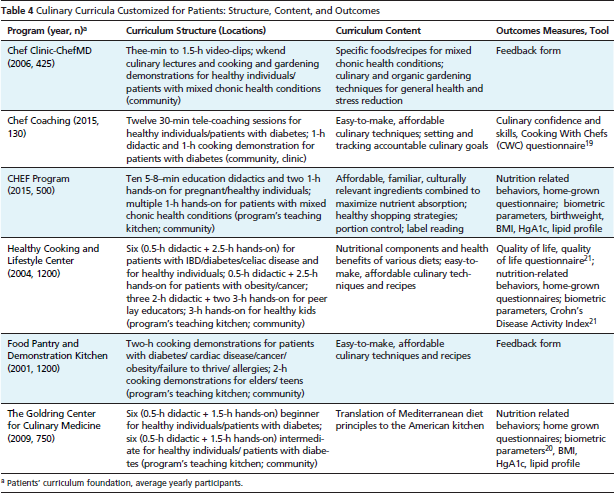
Patients’ curriculum foundation, average yearly participants.
All patients’ curricula include courses for both healthy individuals and patients with variety of chronic diseases, primary obesity and diabetes. One program (Chef Coaching) addresses only culinary behavior and is aimed to augment any nutritional program the patients follow, while others provide culinary knowledge together with nutrition guidance. The educational content areas of these courses vary and focus on either specific diets (eg, the Mediterranean diet) or culinary behaviors (eg, cooking lentils, preparing breakfast).
Four programs are delivered for free, funded by grants (Healthy Cooking and Lifestyle Center, Food Pantry and Demonstration Kitchen) or insurers (Healthy Cooking and Lifestyle Center) or are taught by students as part their training (The Goldring Center for Culinary Medicine). Four programs that educate a total of 2580 participants per year measure the impact of their patient's curriculum. Outcome measures include (1) patient-perceived personal habits such as culinary skills and confidence and healthy food consumption, 15 (2) patient-perceived overall wellbeing such as self-care and quality of life, 18 and (3) biometric outcomes.15,18,19
Discussion
This article summarizes the organizational structure, educational design, curricular components, cost, and funding of 10 emerging programs that provide CM education to medical and patient audiences. CM leaders report a high acceptance of CM curricula by providers and patients. The skill set and knowledge base of chefs has widespread popular appeal, in contrast to traditional nutritional education that may suggest compromising good-tasting food for better health. 20 However, several challenges have been identified.
First, there are currently no mutually agreed upon learning objectives for medical education, so a new program might either adopt another program's curriculum or develop its own learning objectives. We suggest that these objectives should be discussed and agreed upon by thought leaders in CM. Long-term goals might include mapping of an agreed culinary curriculum to both published nutritional curricula 21 and physicians’ and other providers’ training competencies. 22
Second, educational content areas of patient curricula vary and focus on either specific diets (eg, the Mediterranean diet) or culinary behaviors (eg, cooking lentils, preparing vegetables, using whole grains). Lifestyle medicine was defined as “evidence-based practice of assisting individuals and their families to adopt and sustain behaviors that can improve health and quality of life.” 23 With this definition in mind, we recommend that culinary curricula should focus on healthy culinary behaviors which apply to various healthy diets and nutritional recommendations.
Third, 7 of the programs include chefs as culinary providers; however, none of them reported that their chef had any training in education or behavioral change. Some culinary schools’ curricula include training in healthy cooking and basic nutrition; however, behavioral change and education skills are typically not taught to future chefs. Currently, the chefs who work in CM programs are a small self-selected group with a passion for education. Moving forward, training chefs whose education is focused on food production to be educators who are experts in behavioral change techniques such as coaching may be essential. 24 One can imagine that the coaching skills set, when combined with the credentialed chef's culinary skills, might be a useful 2-pronged approach for promoting healthy eating. 24
CM might provide compelling opportunities for medical education. First, one of the focus areas of culinary education is providers’ personal behavior, which is a strong predictor of their advisory practices.25,26 Second, because self-care is important in all professions, CM curricula might be used in variety of interprofessional educational programs (such as in Chef Coaching and Healthy Kitchens, Healthy Lives). Third, like other lifestyle medicine topics, CM presents a unique educational opportunity to address a challenge faced by providers and patients alike: improving health habits. Indeed, while most of the institutions’ services address patient needs, all of the reported CM programs that provide patient education serve a dual purpose by educating providers as well. Furthermore, in The Goldring Center for Culinary Medicine, medical trainees (students and residents) practice as community culinary providers while learning a CM curriculum.
The reported programs may be categorized by programs that (1) utilize a teaching kitchen and employ culinary providers, (2) collaborate with culinary schools that have teaching kitchens and employ the culinary providers, and (3) offer distance based culinary curricula (eg, programs like Chef Coaching). Although there is a consensus among CM leaders about the advantage of hands-on culinary education, there is still disagreement about the need to operate an independent teaching kitchen. While access to a teaching kitchen that serves as a laboratory and practice space may be ideal, the high cost of building and maintaining a facility is difficult to overcome.
Indeed, every program that offers hands-on education to both patients and medical professionals has a teaching kitchen. In contrast, the programs that offer hands-on medical education alone do not have a teaching kitchen. This may be due in part to the high volume of activities that are required to justify the cost of a teaching kitchen. Moreover, organizations that have a teaching kitchen reported on generating revenues through repurposing the facility for additional activities such as hospitality (The Goldring Center for Culinary Medicine) and healthy food production (Chef Clinic-ChefMD, Hadassah's Healthy Cooking and Lifestyle Center). Future opportunities might include the incorporation of modules that individuals can complete from their homes, such as the Chef Coaching program, which might increase teaching kitchens’ capacity and decrease program costs. A long-term goal might include dedicated funding, such as from a health insurance companies. Experiments need to be done to explore whether and how these CM models can become financially self-sustaining.
Thus far, there has been very little research to explore whether, how, and to what extent any of these CM curricula affect behaviors and health outcomes of medical professionals or their patients/communities. Although all of the authors agreed on the importance of evaluating CM curricula, only 7 programs are collecting data about the impact of their curricula. Objective outcomes, such as HgA1c and lipid profile, are collected by 3 programs,18,19 while other outcomes are collected by various self-perceived questionnaires, of which only one was officially validated. 27 A recent systemic review that summarizes the updated CM research has already identified the use of various unvalidated outcome measures. 7
In order to enhance the impact of CM, additional research is needed regarding the most effective methods of delivering and evaluating these curricula. Using standard, valid data-collection instruments to evaluate these programs’ impact on more than 6000 individuals annually might propel this movement forward in a significant and timely way. Evaluation from a healthcare cost perspective may be useful as well, as demonstrating a potential cost savings to insurers may lead them to financially support these programs, which could in turn help ensure their sustainability.
Conclusion
CM holds promise as a new educational intervention to help individuals improve their eating behaviors. This summary of culinary programs might benefit institutions that are in the process of developing CM programs. The current lack of a consensus in educational goals, facility requirements, and sustainability models warrants further discussion among field thought leaders. A true collaborative will be necessary to build a shared strategy and to address mutual challenges collectivity, to ensure continued growth and development of this emerging field.