






Abstract
A central assumption in lay and psychological theories is that people are attracted to potential mates who are similar to themselves in personality traits. However, the empirical findings on this idea have been inconclusive. Only a few studies have considered real-life dating contexts, and the statistical approaches they applied have sometimes spuriously identified similarity effects. In our study, 397 heterosexual singles (aged 18–28) participated in real speed-dates (N_dates = 940). Using dyadic response surface analysis, we investigated effects of actual similarity (similarity between self-reported personality trait levels) and perceptual similarity (similarity between an actor's personality and his/her perception of the partner's personality) concerning the Big Five traits. Neither type of similarity was related to initial romantic attraction. That is, the empirical evidence contradicted the idea that attraction occurs when people's personalities match. We conclude that understanding initial attraction requires a deeper understanding of interpersonal dynamics in first encounters.
Background
A central developmental task in many people's lives is the search for a romantic partner, a “good match.” A widespread assumption among laypersons and psychologists is that people are particularly attracted to individuals who are similar to them in personality traits (i.e., in stable behavioral tendencies; e.g., being similarly extraverted).
Why was this study done?
Surprisingly, the question of whether personality similarity fosters initial attraction is still empirically unresolved.
What did the researchers do and find?
In our study, individuals who were currently looking for a romantic partner participated in five speed-dates each. Our findings challenge the widely held assumption of the appeal of personality similarity: Whether individuals were attracted to their dating partner was independent of whether the two individuals were similar in personality—and even independent of perceiving the dating partner's personality as similar to one's own personality.
What do these findings mean?
Our evidence indicates that actual and perceptual personality similarity might not contribute to solving the task of finding a “good match.”
Relevance Statement
Does personality similarity matter when people search for a “good match” for them? We investigated this question with two perspectives on similarity (actual and perceptual similarity), naturalistic speed-dating data, and advanced statistical methods.
Key Insights
The role of personality similarity for initial attraction is unknown. Recent statistical developments allow a stringent test of similarity effects. Personality similarity does not seem to matter for initial attraction. Even perceptual personality similarity does not seem to matter. Actor and partner personality are related to attraction.
Keywords
The question of how people decide whether someone they meet is a “good match” for them has fascinated laypeople and scholars alike. A central but still unsettled assumption is that people prefer mates who are similar to themselves in personality traits. We refer to such a link between partners’ similarity and their attraction to one another as With the term personality similarity, we refer to the degree of congruence between two people's
Whereas effects of personality similarity on initial romantic attraction have been reported in studies involving hypothetical partners (for an overview, see Montoya et al., 2008), empirical work on whether similarity plays a role in more naturalistic, real-life interactions is sparse and has yielded inconsistent findings (Asendorpf et al., 2011; Luo & Zhang, 2009; Tidwell et al., 2013). Here, we provide a comprehensive investigation of personality similarity effects in real-life first encounters by using data from a large naturalistic speed-dating study. We differentiate between effects of We use the term “perceptual similarity” and not “perceived similarity” because the latter term has (also) been used to refer to a person's direct estimation of another person´s similarity to themselves (Decuyper et al., 2012).
Is (Actual and/or Perceptual) Similarity Appealing?
The attraction literature has long sought to establish similarity as a major attraction principle. In his seminal work on the Despite a relatively large body of empirical research on similarity effects in romantic relationships, there is yet no consensus about their existence. For example, some studies reported positive associations of partners’ personality similarity with relationship satisfaction (e.g., Gonzaga et al., 2007), others found similarity effects only for specific traits (e.g., Hudson & Fraley, 2014) and some concluded to find no substantial effects of similarity (e.g., Gattis et al., 2004; Park et al., 2023; Watson et al., 2004; Weidmann et al., 2017).
Empirical research on effects of actual similarity on initial romantic attraction is yet inconclusive. Positive effects of personality similarity have typically been found in studies involving hypothetical partners, akin to the bogus stranger paradigm (Byrne, 1961). When people are given explicit information about hypothetical romantic partners (e.g., in the form of written vignettes or bogus questionnaire results), they tend to prefer those who resemble their (self-concept about their) own personality (Klohnen & Luo, 2003; Montoya et al., 2008). By contrast, studies employing more naturalistic designs (e.g., speed-dating studies with real first-time encounters with potential romantic partners) have reported few and inconsistent effects of actual personality similarity on initial attraction (Asendorpf et al., 2011; Luo & Zhang, 2009; Tidwell et al., 2013).
Actual similarity refers to a comparison of two people's personality trait levels, which implies that it can influence the persons’ attraction to each other only through the indirect path of behavioral expression and perception processes (Back, 2021). By contrast, perceptual similarity—the similarity of one person's (self-concept about his/her) personality with his/her
Statistical Challenges in Investigating Similarity Effects
Similarity effects in initial encounters are usually tested by computing absolute (or squared) difference scores between the dyad members’ trait levels and using these scores to predict romantic attraction in a (dyadic) regression model (e.g., Asendorpf et al., 2011). The main effects of trait variables are often included as predictors in the model, which avoids the risk of confounding linear main effects of individuals’ trait levels with similarity effects (Luo & Zhang, 2009). For example, if there is a linear
Using the difference score approach while controlling for linear actor and partner effects, however, is still systematically biased toward false-positive conclusions about similarity effects. The reason is that this approach falsely indicates evidence of a similarity effect when there are actor or partner effects that are Note that other approaches that have been used to test for similarity effects for related research questions (e.g., interaction terms, profile correlations) cannot solve this problem (Edwards, 2001; Weidmann et al., 2017).
The Present Study
We aimed at a comprehensive investigation of whether personality similarity matters for initial romantic attraction. Our data stemmed from a real-life study in which 940 real speed-dates between 397 participants took place, capturing the initial screening stage of the partner selection process. We considered
Method
We used data from a real-life speed-dating study that took place between April 2015 and December 2015 in Münster, Germany (“Date me for Science” study, Wurst & Back, 2016).
Transparency, Openness, and Reproducibility
A full codebook of the “Date me for Science” study can be found at https://osf.io/n7dw9/. The codebook contains detailed descriptions of the procedures and all applied instruments, and thereby allows independent replication of the study. The processed data and the R code that can be used to reproduce our results are provided in the folder “data_and_code” in the Supplementary Materials. The “Date me for Science” data was used in other studies (enlisted at https://osf.io/hmr6j/). Whereas some variables used here were also used in those previous analyses, the research questions do not overlap; the present paper presents the first analysis of similarity effects with these data.
We preregistered the study background, our expectations, and the analytical procedures and interpretation rules, after the data was assessed but before it was analyzed (see Supplementary Materials). The test for similarity effects was exploratory. If similarity effects occurred, we expected perceptual similarity to have stronger effects than actual similarity. In analyses that showed no evidence of similarity effects, we explored linear actor and partner main effects. We expected rather weak and nonsignificant actor and partner main effects on romantic attraction; if anything, on the basis of previous research, we expected positive partner effects of males’ self-reported extraversion and openness on female attraction (Asendorpf et al., 2011; Back, Penke, et al., 2011). All analyses were conducted as described in the preregistration; we only corrected one mistake that concerned the equality constraints in additional analyses on gender differences (see the description in the Supplementary Materials for details), and we conducted one further robustness check that was not preregistered (see below).
Participants
We recruited participants who were between the ages of 18 and 28, heterosexual, single, and currently looking for a romantic partner. We obtained 400 participants within our time frame for data collection (April–December 2015). Three participants objected to the use of their data afterwards, so the final sample consisted of 397 participants (200 women;
Procedures
Participation in the study began with a pre-event online questionnaire on demographics and self-ratings. Participants were then invited to one of 42 evening speed-dating events in the laboratory. For each event, we invited five women and five men. Most speed-dating events involved 10 participants (26 events with 10 people, 11 with nine, 3 with eight, 2 with seven). The female and male participants were kept separate during the welcoming, instructional, and waiting periods so that no interaction with opposite-sex participants was possible before the speed-dates. Each participant dated each opposite-sex participant who was present at the event. One speed-date took place at a time. The respective female and male participants were led separately (the woman first) into the speed-dating room, where they were seated on a couch at a 90° angle. The speed-date took 3 min, during which the daters were alone in the room and free to choose what to say or do. The dates were videotaped. After the speed-date, the daters were separated and answered a post-date questionnaire. The “Date me for Science” study was approved by the local ethical committee.
Measures
Table 1 shows the applied instruments. Descriptive statistics, item-, and scale-intercorrelations for the measures can be found in the Supplement 3 (see Supplementary Materials).
Items Used in the Present Study

Attraction
Romantic Attraction
After each date, participants rated their speed-dating partner concerning appeal, fit, likeability, interest, and sexual attraction (see Table 1). Romantic attraction was operationalized as the mean of these five items.
Date Quality
Participants also rated the date concerning being in tune, comfortableness, enjoyment, unpleasantness (reverse coded before aggregation), and whether it went well. The mean of these five items was used as a measure of perceived date quality in the robustness analyses.
Personality
Self-Reported Personality (BFI-S)
The Big Five personality traits were assessed with the Big Five Inventory-SOEP (BFI-S; Schupp & Gerlitz, 2008) and two additional agreeableness items (Rammstedt & John, 2007; see Table 1).
5
Internal consistencies of the BFI-S were .71 (neuroticism), .84 (extraversion), .55 (openness), .62 (agreeableness), .61 (conscientiousness). Note that these numbers should be interpreted with caution due to the short scales (3 items). While retest-reliabilities of short personality measures tend to be satisfactory, internal consistencies are necessarily low when the few items cover different aspects of the respective Big Five dimension to allow a valid assessment of the trait (see also Gosling et al., 2003).
Self-Reported Personality (Adjective List)
Big Five self-reports were also assessed with an adjective list. For 29 personality-related adjectives, participants indicated how pronounced the respective characteristic was in themselves. From these items, we constructed a two-item scale for each of the Big Five traits (see Supplement 2 in the Supplementary Materials for details on scale construction and all item- and scale-intercorrelations). The adjectives that constituted the final scales are shown in Table 1.
6
Internal consistencies of the self-report adjective list scales were .61 (neuroticism), .72 (extraversion), .69 (openness), .64 (agreeableness), .54 (conscientiousness). These numbers should be interpreted with caution (see Footnote 5).
Perceived Personality (Adjective List)
After each date, participants rated the same adjectives as for self-reported personality about their previous dating partner. We computed the same two-item scales as for the self-reports to obtain commensurable measurements.
7
Internal consistencies of the perceived personality adjective list scales were .75 (neuroticism), .86 (extraversion), .80 (openness), .61 (agreeableness), .54 (conscientiousness). These numbers should be interpreted with caution (see Footnote 5).
Analytical Strategy
We investigated similarity effects in 2 (actual vs. perceptual similarity) x 5 (Big Five traits) = 10 separate analyses, using DRSA for dyads that are distinguishable by gender (Schönbrodt et al., 2018; see also Nestler et al. 2015). In analyses referring to actual similarity, we used the BFI-S measures of the respective trait. In analyses referring to perceptual similarity, we used the adjective-list assessments of the actor's self-reported personality and the actor's perception of the partner's personality to achieve commensurability of the predictor variables as required for DRSA (Schönbrodt et al., 2018).
Analytical Procedure for Investigating Similarity Effects
Each of the 10 analyses comprised several steps; this strategy was inspired by the analytical procedure in Weidmann et al. (2017) but adapted to more recent recommendations on (dyadic) RSA (Humberg et al., 2019; Schönbrodt et al., 2018). As the first step, for each speed-date, the female participants’ rating Z



Here,

Prototypical Similarity Effect
Second, we estimated a corresponding


The APIM model is nested in the DRSA model but includes only linear terms, so that it represents only linear, no curvilinear, actor effects (
Third, we compared the fit of the DRSA model with the fit of the APIM with a chi-square likelihood ratio test. If the DRSA model did
Fourth, if the DRSA model had a significantly better fit than the APIM, we used the coefficient estimates from the DRSA model to calculate auxiliary parameters
Figure 1 shows the graph (the
Implementation and Analytical Details
Before each analysis, we centered the respective pair of predictor variables that occurred within the same line of Equation 1 at their grand mean and scaled them at their grand standard deviation (Schönbrodt et al., 2018), and we standardized the attraction variable. As a pre-analysis, we inspected the numbers of discrepant predictor combinations for both directions of incongruence (Edwards, 2002), and we considered the distributions sufficient for investigating similarity effects (see Supplement 4). The only potential exception was that only 6% of women's perceptions of men's agreeableness exceeded the respective woman's self-reported agreeableness by more than half a grand standard deviation. However, given that only linear effects were detected for these variables, it is unlikely that this restriction masked a similarity effect, which required a curvilinear association for the whole range of the predictor variable.
All model estimations and comparisons were conducted with the
Additional Analyses
We preregistered several exploratory and robustness analyses (see Supplementary Materials). First, in analyses in which the similarity-attracts hypothesis was not supported, we explored the results to reveal whether attraction was associated with personality in another way. To this aim, if the DRSA model did not fit significantly better than the APIM, we interpreted the estimated coefficients of the APIM. This allowed us to detect linear actor and partner effects. If the DRSA model had a significantly better fit, we interpreted it by using response surface methodology (e.g., Edwards, 2002). Second, we tested the robustness of our results with further sets of analyses: To evaluate the effect that the measurement instrument (BFI vs. adjective list scales) had on the results, we (a) repeated the analyses involving only self-reported personality with the adjective list self-report measure, (b) repeated the analyses involving personality perceptions with BFI self-reports instead of the adjective list self-reports (
Results
Tables showing detailed results of all main and additional analyses are provided in the Supplementary Materials (see Supplement 5 for a schematic summary and a comparison with the preregistration).
Effects of Similarity on Attraction
Table 2 shows the results of the model comparison in the first analytical step. In the analyses on effects of
Results of Model Comparisons DRSA Versus APIM
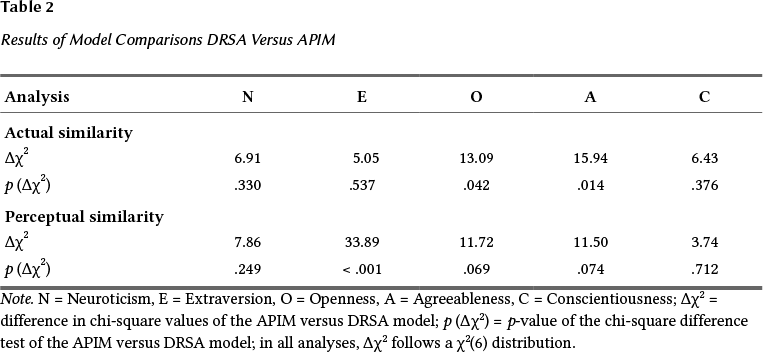
Concerning the analyses for
In sum, none of the 10 analyses supported the idea that actual or perceptual personality similarity between a male and female dating partner was related to their attraction to each other. We further inspected the results in an exploratory way and revealed a nuanced pattern of actor and partner effects.
Exploratory Inspection of Main Effects of Self-Reported Personality
Concerning actor and partner effects of
For
Coefficient Estimates of the APIM/DRSA Models That Were Selected on the Basis of the Model Comparison
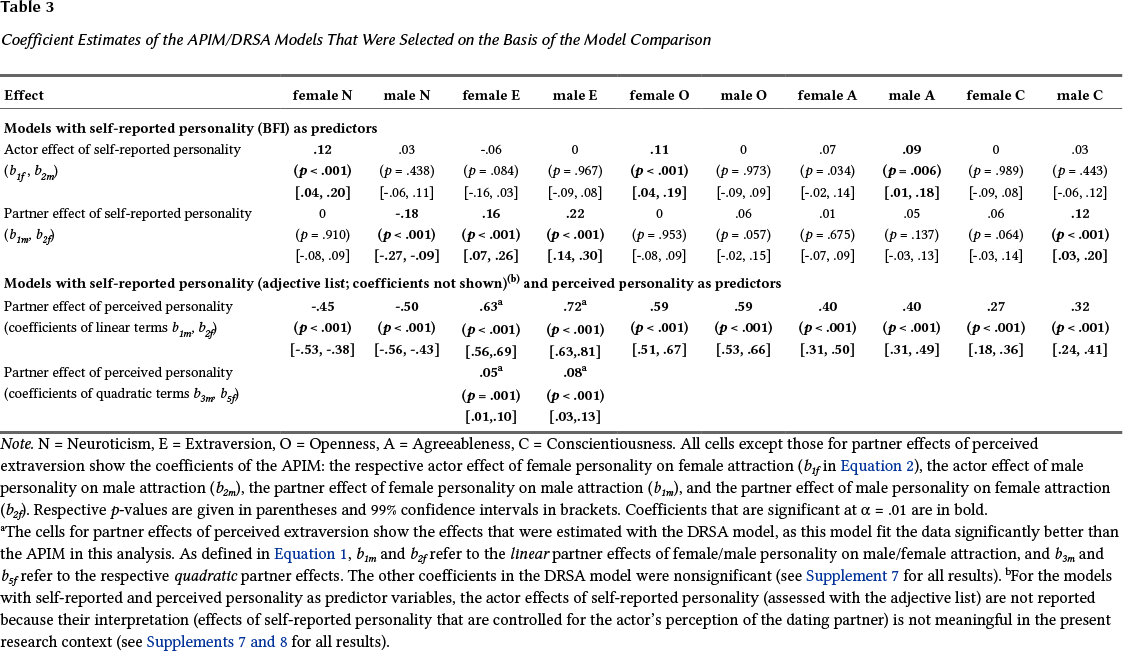
aThe cells for partner effects of perceived extraversion show the effects that were estimated with the DRSA model, as this model fit the data significantly better than the APIM in this analysis. As defined in Equation 1,
Exploratory Inspection of Main Effects of Perceived Personality
Concerning
For extraversion, the DRSA model had a significantly better fit than the APIM. For female attraction, the model coefficients revealed a monotonously positive but nonlinear partner effect of perceived male extraversion (indicated by
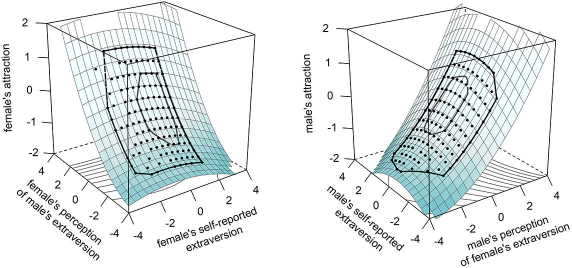
Response Surfaces of the DRSA Model for Self-Reported and Perceived Extraversion
Robustness Analyses
Consistent with the main analyses, the robustness analyses with different choices of the self-report measures (adjective list in the analyses on actual similarity; BFI-S in the analyses on perceptual similarity), of the adjective list scales, and/or date quality as the outcome variable yielded no evidence of similarity effects (see Supplements 6 to 8 and Supplement 10 for all results). In addition, the patterns of actor and partner effects reported above were largely replicated (see Supplement 5 for a summary of results and more information). The only substantial exceptions implied that (a) the positive actor effect of women's self-reported neuroticism should be considered tentative (as it was replicated in only one analysis) and (b) the two-item openness scale seemed to yield systematically different effects than the established BFI scale (see Supplement 5 for details). The latter observation concerns only the partner effects of perceived openness (the only result that was based on the two-item measure). When we repeated the analyses with an alternative scale for perceived openness, this partner effect replicated (see Supplement 10), but the effect nonetheless awaits replication with a more established instrument.
Gender Differences
Table 3 shows that the analyses involving only self-reported personality revealed a differentiated pattern of actor and partner effects, where some effects seemed to differ between genders and others did not. A formal test of gender differences (see Supplement 9 for all results) supported the respective pattern for
Discussion
We investigated whether people feel more attracted to potential romantic partners who resemble themselves in personality traits. We used data from a naturalistic speed-dating setting, applied DRSA, and differentiated between two perspectives on similarity. Neither actual nor perceptual similarity was related to initial romantic attraction. Instead, there was a differentiated and partly gender-specific pattern of actor and partner effects.
No Evidence of Similarity Effects on Initial Romantic Attraction
The lack of evidence of similarity effects was consistent across all Big Five traits, both perspectives on similarity (actual vs. perceptual), and all robustness analyses. Along with the observation that earlier studies found only a little and inconsistent evidence of similarity effects (though the applied statistical approaches were even biased toward false-positive results), we consider it increasingly unlikely that the similarity-attracts hypothesis is empirically supported in the personality domain. Our findings could also help to explain why—with regard to existing relationships—romantic partners do not seem to be more similar in their personalities, whereas they notably resemble each other on a number of other characteristics, such as attitudes, religiosity, and physical attractiveness (Luo, 2017). Moreover, our findings are consistent with recent evidence that, although the largest share of variance in romantic attraction is unique to the specific dyad in question, it is difficult to predict this unique attraction from distal person variables, such as personality traits (Joel et al., 2017). Consequently, understanding how people decide who is a “good match” for them, and understanding the role that similarity plays in this context, may require higher resolution investigations (Joel et al., 2017). Specifically, researchers might focus on (the degree of congruence between) dating partners’ expressed behaviors (e.g., how dominantly someone acts on a date) and actors’ affective preferences for respective behaviors (e.g., the extent to which dominant behavior evokes positive affect in the dating partner; see also Back, 2021; Back, Schmukle, et al., 2011).
Actor and Partner Effects of Actual and Perceived Personality
Considering
Personality
Limitations and Future Directions
The present study was the first to test for similarity effects in initial encounters using DRSA. Despite the relatively high power for detecting similarity effects, our results await direct replications in further large-scale and similarly naturalistic studies (e.g., via multilaboratory collaborations).
One limitation of our study concerns the Big Five scales for perceived personality that were constructed from the adjective list items. While it is standard to collect personality perceptions with adjective lists in speed dating (or round robin) designs to achieve a rapid and broad coverage of interpersonal judgments, the items cannot represent the Big Five as comprehensively as specialized Big Five instruments. The robustness analyses with different construction strategies and accordingly different scales indicate that the relative narrowness of the scales and their partial overlap did not essentially influence the results (see Supplement 10). Nevertheless, future studies should aim at assessments of personality perceptions and respective self-reports that, besides the necessary briefness, capture the Big Five more broadly.
The participants of our study were young adults (18–28) who were mostly students and who were heterosexual. Whereas we expect our results to generalize to other age groups and people without an academic background, we do not necessarily expect generalization to homosexual individuals. Furthermore, the present research question and study procedure referred to the initial screening phase of two unacquainted individuals; a direct replication of our study would therefore use a similarly short time frame (e.g., 3 minutes) that the two dating partners have to get an impression of the other person and form an initial attraction evaluation. Future research might explore whether the present results generalize across design variants, for example, across speed-dating designs with and without videotaping of the dates. However, we expect our findings to not be specific to an “organized” encounter in a speed-dating event, but to generalize to real-life initial encounters (e.g., in a pub). We have no reason to believe that the results depend on other characteristics of the participants, materials, or context.
Finally, future studies could extend our perspective by (a) zooming in on the dynamic processes (e.g., the interplay of expressed behaviors, perceptions, cognitions) involved in real-life first encounters and (b) taking a closer look at alternative forms of the initial screening phase (e.g., online dating; e.g., Bruch & Newman, 2018) and subsequent steps of the dating phase (e.g., relationship formation and development; Campbell & Stanton, 2014). We are convinced that these avenues will lead to a deeper understanding of how people make one of the most relevant decisions in their lives—who is a “good match” for them.
Footnotes
Mitja Back is a senior consultant member to the journal.
Acknowledgments
We thank all research assistants, student assistants and PhD students who were involved in the conduction and documentation of the “Date me for Science” study.
Ethics Statement
The “Date me for Science” study was approved by the ethical committee of the Department of Psychology, University of Münster.
Other Manuscript Versions
The manuscript is based on the master thesis of Theresa Franke-Prasse (not available online).
Data Availability
For this article, data is freely available (see Humberg et al., 2023).
Supplementary Materials
For this article, the following Supplementary Materials are available (for access see Index of Supplementary Materials below):
The authors have no funding to report.