






Abstract
Personality and social relationships influence each other in multiple and consequential ways. To understand how people differ from each other in their personality and social behavior, how these differences develop, and how this affects further life outcomes, we need to better understand the interplay of personality and social relationships. Here, we provide an integrative overview on personality-relationship research across relationship types (everyday encounters, friendships, romantic, and family relationships), and personality characteristics. We summarize the state of research on (a) how much relationship aspects vary across actors, partners, and actor-partner relations, (b) which personality characteristics predict these variance components (i.e. actor, partner, and relationship effects), and (c) how social relationships work as contexts for personality development. Following an integrative process framework, key open questions are discussed concerning the processes that underlie personality-relationship and relationship-personality effects. We conclude with a call for conceptual integration, methodological expansion, and collaborative action.
Relevance Statement
Personality and relationships influence each other in manifold ways; they cannot be understood in isolation. This paper summarizes the state of the art, provides a common framework for the future of science of personality and social relationships.
Key Insights
Emotional Stability, Communion, and Self-Control relate to getting along. Agency and Sociability predict getting ahead. Relationship variance is the largest but least understood variance component. Evidence for effects of relationships on personality development is mixed. More comprehensive and integrative research on underlying processes needed.
Keywords
The rich diversity in which individuals differ from each other cannot be understood without a detailed consideration of how people interact and bond with others. The science of personality, thus, requires a close consideration of social relationships. This regards all three key tasks personality science faces (see Mõttus et al., 2020): Description, explanation and prediction. To
Here, we build upon earlier reviews of personality outcomes (Soto, 2019) and development (Bleidorn et al., 2020), and the personality-relationship interplay more specifically (Back, 2021; Back, Baumert, et al., 2011; Mund et al., 2018). We provide an updated summary of the state of research, key open questions, and an agenda for the future of personality and social relationship science. We aim at a succinct presentation, but, at the same time, a broad coverage of relevant themes and approaches. Therefore, instead of giving a comprehensive overview of specific findings, we will focus on key insights and broad issues for future research illustrated by selective research examples.
What Do We Know About the Interplay of Personality and Social Relationships?
Personality and social relationships both concern somewhat stable differences in people's experiences and behaviors, albeit on different levels. Personality is situated on the individual level and can be defined as the typical way an individual acts, thinks, wants and feels and the self-concepts that emerge in this individual. Social relationships are situated on a dyadic level and can be defined by the typical way a dyad acts, thinks, wants and feels and the relationship-concepts (e.g., relationship satisfaction) that emerge in both members of a dyad (see Back, Baumert, et al., 2011). Social relationships are shaped by the personality of both partners and their unique mixture. How much a romantic couple trusts each other, for example, is driven by how much each partner tends to trust others (an actor effect), evokes trust in others (a partner effect) and their unique tendency to trust each other that is more than the sum of their parts (a relationship effect). Social relationships, however, also provide social interaction contexts in which personality can develop. The fact that one has secured a romantic partner or has repeated interactions with friends that are characterized by aggressiveness can influence an individual's typical experiences and behaviors across time and interaction partners, and, thus, their personality. In describing the current state of research on the interplay of personality and social relationships, we will first give an overview regarding key aspects of personality and social relationships that can be distinguished across research traditions. Afterwards, we will consider how much relationship outcomes vary across actors, partners, and specific actor-partner relations and then summarize personality effects on these variance components, that is, actor, partner, and relationship effects. Finally, we will summarize research on personality development in social relationship contexts.
Key Aspects of Personality and Social Relationships
Personality characteristics of interaction partners influence and are influenced by their social relationships. This arguably holds for all types of social relationships, although research has mostly investigated romantic (e.g., Dyrenforth et al., 2010), peer (e.g., Asendorpf & Wilpers, 1998), and family (e.g., Branje et al., 2004) relationships. Relationship functions in all of these types can be sorted according to the fundamental motives of “getting along” (attention, approval, acceptance), “getting ahead” (status, power, control of resources), and “finding meaning” (predictability, order in one's everyday life) (e.g., Hogan & Blickle, 2018).
Relationship research has considered a large range of personality characteristics, ranging from the Big Five or HEXACO traits, temperament (particularly in childhood), attachment (particularly in parent-child and romantic relationships), and more specific characteristics such as narcissism, self-esteem, shyness, and empathy. For the sake of parsimoniousness, we will sort personality into six domains that cut across research traditions and are central in social relationships: Agentic, Communal, Sociability, Emotional Stability, Self-Control and World-View traits.
Figure 1 provides a graphical illustration of these trait domains and their potential social relevance for actors and partners in terms of the three fundamental motives of getting along, getting ahead and finding meaning. Each trait domain (e.g., Emotional Stability) is illustrated together with the typical mind-set with which social actors high in that trait domain enter the social arena (e.g., “Everything will be fine.”) and the typical mind-set that such individuals evoke in others (e.g., “won't freak out”) via trait-typical behaviors. Please note that we have applied a male-female dyad in the figure for the ease of presentation but the logic can be applied to same-sex dyads as well. The illustration also indicates into what sorts of relationship functions these mind-sets translate over time (e.g. getting ahead: social status; getting along: lack of conflict). In the next two sections, we will examine how much these relationship outcomes vary across actors, partners and specific actor-partner relations and then summarize existing findings on how much and which personality characteristics predict these components.

Socially Important Domains of Personality Differences, Respective Typical Actor and Partner Mind-Sets, and Their Link to Domains of Relationship Outcomes
Social Relationship Components: The Amount of Actor-, Partner- and Relationship Variance
An important prerequisite to understand personality effects on social relationships is to analyze the sources that contribute to differences in relationship outcomes, such as initial romantic attraction, relationship satisfaction, liking in friendships or evaluations of family members. Variance partitioning studies using the Social Relations Model (Back & Kenny, 2010) carve up the outcome measure (e.g., attraction) into three conceptually and statistically distinct components. First, to what extent is the outcome due to the attributes of the
Figure 2 depicts the current best estimates of these variance components across evaluative measures in romantic relationships (left), nonromantic peer relations (middle) and family relationship (right). Actor variance is moderate across romantic and nonromantic peer contexts, and more pronounced in family relations: That is, people differ in how they evaluate others at first encounter as well as in established relationships. Partner variance emerges, too, but it tends to be quite small in established romantic relationships: That is, people differ in how they are evaluated by others, particularly in initial romantic, peer non-romantic and family relationships. Relationship variance tends to be quite large—at least as large as actor and partner variance combined (with the exception of family relations where actor variance is as large as relationship variance)—indicating that compatibility is critically important in relationship evaluations. Interestingly, while a number of personality predictors could be identified for actor- and partner variance (blue and grey bars), relationship variance—the largest share of the variance—is, thus far, very seldomly predictable (white bars). We will have a closer look at these personality effects in the next section.
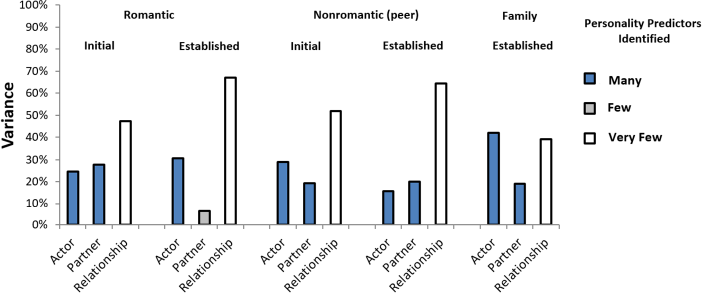
Percentage of Variance in Romantic, Non-Romantic Peer and Family Relationship Evaluations due to Actor, Partner and Relationship Differences
Personality Effects in Social Relationships
In the following, we give a brief overview on the findings about effects of personality on social relationships that we regard as relatively robust. We will consider personality effects on all three social relationship components.
Actor Effects: Predicting Differences in how People Perceive Their Social Relationships
Emotional Stability, Communion, Sociability, and Self-Control have the most consistent positive effects on overall evaluations and expectations regarding one's potential and existing relationships (e.g., Anglim et al., 2020). These links are particularly strong for getting along outcomes, such as self-reported satisfaction in romantic relationships (Dyrenforth et al., 2010), friendship, and peer relationships (Asendorpf & Wilpers, 1998) as well as self-reported positive family relations (e.g., Branje et al., 2004) and adaptive parenting (e.g., McCabe, 2014). Communion, open World Views, and Self-Control were also found to predict early positive evaluations across potential relationship partners (Thielmann et al., 2020). Agency relates to self-reported getting ahead outcomes such as self-perceived peer status and dating variety.
Partner Effects: Predicting Differences in how People Are Perceived by Their Social Relationship Partners
Emotional Stability is the prime predictor of partner-perceived getting along outcomes in close romantic relationships. Indeed, low Emotional Stability can be seen as “the relationship killer” because of its consistent ability to reduce not only one's own but also partners’ relationship satisfaction (Dyrenforth et al., 2010). Communion and Self-Control are additional predictors of partner relationship satisfaction. Partner effects also play a role in family relationships: Children's degree of Communion, Emotional Stability and Self-Control can, for example, contribute to parental warmth and stress (Ayoub et al., 2019).
Across age groups and acquaintance levels, Agency is the best predictor of social status achievement, which is necessarily defined by one's social partners (e.g., receiving social resources, being selected as a leader; Grosz et al., 2020). These getting ahead outcomes are additionally predicted by (low) Emotional Stability, particularly for men (Anderson et al., 2001). Children and adolescents with low levels of Emotional Stability are less popular and more rejected and victimized than their peers (Salmivalli & Peets, 2018). Children with higher Self-Control are less victimized by their peers (Robson et al., 2020). Sociability−a blend of Agency and Communion−is a robust predictor of getting along with peers across age groups, both at early acquaintance (Back, Schmukle, et al., 2011) and in long-term relationships (Cillessen et al., 2011).
The Personality of the Relationship: Predicting Differences in how Specific Partners Uniquely Perceive Each Other in Their Relationship
Relationship effects pertain to effects of some sort of personality combinations of actors and partners that predict relationship outcomes above and beyond what can be predicted by actor and partner differences alone. Although such personality matching or mismatching effects are among the most typically assumed both in laypersons and researchers, empirical evidence is limited. Most research on relationship effects focuses on (dis-)similarity in personality, although similarity is only one of many possible relations between the personality characteristics of both partners (picking just one personality variable and the same one for both partners). Personality similarity has negligible and mostly inconsistent effects on initial attraction to romantic partners (e.g., Luo & Zhang, 2009) as well as romantic relationship satisfaction (e.g., Dyrenforth et al., 2010). Furthermore, the machine-learning studies of Joel and colleagues (2017, 2020) found that neither initial attraction nor established relationship satisfaction was predictable by any actor-partner combination of self-reported personality characteristics. These results indicate that, in the domain of romantic relationships, relationship variance, the biggest share of variance, must come from “something else.” For peers there is some evidence for similarity effects in the domains of Sociability and World views. For example, similarity in students’ extraversion (van Zalk et al., 2020) and adolescents’ music preferences (Selfhout, Branje, et al., 2009) predicted a higher likelihood of becoming friends and belonging to the same subgroups. It is important to note that while actual similarity is seldom found to have robust effects on relationship outcomes, perceived similarity clearly has such effects (e.g., Montoya et al., 2008).
Few studies examined more specific actor-partner personality combinations beyond simple (dis-)similarity effects. Cuperman and Ickes (2009) investigated getting acquainted interactions and showed that the effects of personality similarity may depend on the trait level on which interaction partners are similar or differ from each other. Similarity was, for example, specifically detrimental to social evaluations when two disagreeable people met. Research on romantic partners in the transition to parenthood (Marshall et al., 2015) indicated that those low in Emotional Stability react more distressed to behaviors shown by low communal partners, which might stress out the latter more and lead to more disagreeable behaviors, provoking a downward spiral that might be uniquely strong for low Emotional Stability-low Communion pairings. Table 1 provides a summary of personality effects on social relationships.
Personality Effects on Social Relationships

Personality Development in Social Relationship Contexts
There is wide agreement that relationship experiences do have an effect on personality development across the life span, particularly in certain life stages such as young adulthood (Wrzus & Neyer, 2016). A first potential social source of personality development are life transitions that come along with new social tasks and roles (Bleidorn et al., 2020). According to the social investment principle, investment into new social roles that people face (e.g., as a lover, parent, co-worker) leads them to adopt behaviors and mind-sets that fit these roles, thereby changing the typical ways they act, think, want, and feel (i.e., their personality). On the one hand, such changes can affect a whole population similarly since many roles are age-graded, providing a potential explanation for mean-level changes in traits. Empirical evidence regarding main effects of social life events on personality change are, however, mixed. The most conclusive evidence concerns increases in Emotional Stability, Sociability, and Agency during the transition to the first romantic relationship, and increases in Self-Control, Communion, and Emotional Stability during the transition from school to college or work. On the other hand, role-driven changes can be a catalyst for individual differences in change since people differ in whether, when, and how they adopt certain roles and experience associated social events, a research domain that still needs to be better explored.
A second source are parenting effects on children. Indeed, empirical evidence exists for such effects, including prospective associations between dominant parenting and lower Communion (Kochanska & Kim, 2020). Importantly, associations between parenting and child behavior can not only be due to parents’ effects on their kids (e.g., parents’ cold parenting style causing low Self-Control in kids) but also the other way round (i.e., children's low levels of Self-Control causing a cold parenting style; e.g., Kochanska & Kim, 2020).
A third source are dyadic relationships. According to identity negotiation theory (Swann & Bosson, 2008), social interactions with others provide individuals with critical knowledge about themselves, especially if these interactions repeat over time. Social interaction partners strive for congruence in self-views, yet partners’ expectations may differ from actor's self-views. This initiates a process of identity negotiation, whereby actors and partners continuously affect each other's perceptions. One recent study among university freshmen found that friends’ extraversion levels influenced each other so that they became more similar over time (van Zalk et al., 2020).
A fourth source are peer networks in which these dyadic relations are embedded. Following group socialization theory (Harris, 1995) individuals both contribute to existing behavioral and attitudinal group norms and adjust their own mind-set and behavior to these norms. A range of studies, particularly in childhood, adolescence and early adulthood, shows that entering and belonging to certain peer groups indeed affects behavioral regularities that are closely connected to the personality domains of World views (e.g., attitudes and prejudice) and low Communion (e.g. antisocial behavioral style; e.g., Wrzus & Neyer, 2016). For example, stronger and more persistent identifications with nonconventional peer crowds were generally associated with more problematic behaviors throughout adolescence (Doornwaard et al., 2012).
In sum, across research traditions, theories emphasize the role of social relationships for personality development. At the moment, the empirical evidence for effects of social relationships on personality development is, however, mixed, and scattered across research fields. Also, relationship effects on personality development tend to be smaller than effects of personality on social relationships. A better understanding of what drives social relationship effects on personality (at different ages) is one of the key open questions.
Key Open Questions: Processes Underlying the Personality-Social Relationship Interplay
As summarized above, research on the interplay of personality and social relationships has provided robust insights into personality effects on social relationships across a wide range of relationship types as well as strong conceptual and initial empirical evidence for relationship effects on personality development. The next challenge for both research domains is to understand how exactly—that is, by means of which processes—one can explain these effects as well as when and for whom they occur.
An Integrative Framework of Personality-Relationship Processes
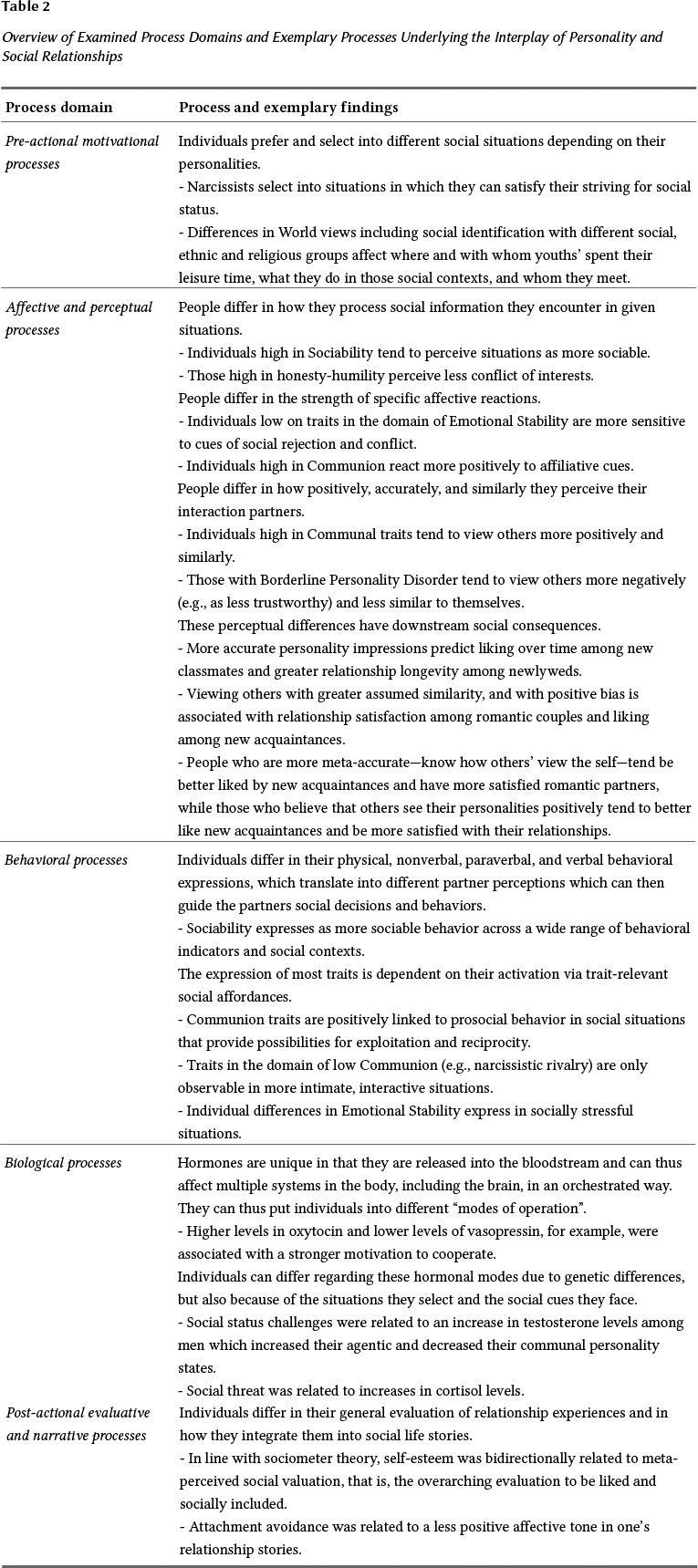
Figure 3 shows an integrative framework of processes that jointly underly the interplay of personality and social relationships. The proposed model builds on and combines previous models that describe social interaction processes underlying the personality-social relationship interplay (e.g., Back, 2021; Back, Baumert, et al., 2011), and models that describe motivational, interactional, and evaluative processes underlying personality development (Geukes et al., 2018; Wrzus & Roberts, 2017). It also more explicitly includes biological processes as well as the role of social context and situational affordances. Following the PERSOC framework (Back, Baumert, et al., 2011; also see Back, 2021), individual dispositions (i.e., stable mental representations of oneself as well as biological structures that predispose to certain ways of thinking, feeling, and wanting) and relationship dispositions (i.e., stable mental representations of specific others) are thought to influence each other over time via social interaction units that are made up of behaviors and experiential states of all interaction partners. Experiential states such as situation-, other- and meta-perceptions, social cognition and affect, and biological states such as hormonal reactions of interaction partners influence each other via observable interaction behaviors, that is, by means of behavioral expression and interpersonal perception processes. The framework also includes motivational processes that take place before people enter a social interaction, such as social expectations, preferences, goals and strategies, and processes that take place after people left an interaction, such as evaluations of interaction outcomes and narration about oneself and others. It also includes the influence of social context on nested macro-((sub)culture, ingroup-outgroup-composition, social network), meso- (social role, relationship type, relationship phase), and micro-levels (social events, social situations). These social contexts imply downstream situational affordances in circumscribed social interaction units, that is contexts “for the expression of motives, goals, values, and preferences” (Reis, 2008, p. 316). Finally, it illustrates that personality and relationship characteristics do not only influence each other by means of dyadic social exchanges but also more indirectly via relations to and effects on other partners (see Partner 2 in Figure 3; Hinde, 1997). Table 2 summarizes the range of relevant processes that are typically investigated in separate research streams (see Supplementary Materials for a version with exemplary references). We think that a joint consideration of these necessarily related processes is needed. The integrative framework provides such a joint consideration and might help to advance both theoretical development and empirical insights. First, it can work as a guideline for a closer investigation of a set of key open, process-related questions that we summarize in the following. These questions are currently unresolved and our framework helps to show how they might be tackled. In doing so, it aims at a detailed description of process chains instead of more metaphorical theoretical language. Second, instead of providing just a list of interesting processes, the model elaborates how different sorts of processes interlock, allowing to more firmly integrate process insights and work towards more holistic process explanations. Third, the framework can serve as a generic model against which existing theories can be evaluated, compared and refined. For example, this regards their causal logic and completeness, parsimoniousness, and specificity as well as their overlap with other existing theories. Fourth, the framework allows to develop new, domain-specific theories that focus on defined trait domains and relationship contexts, and specify relevant variables and processes respectively.

An Integrative Framework of Personality-Relationship Processes
Overview of Examined Process Domains and Exemplary Processes Underlying the Interplay of Personality and Social Relationships
Understanding Actor and Partner Effects of Personality on Social Relationships
Analyzing domains of processes jointly will help to get a better understanding of why and which personality aspects affect the actor's and partner's relationship outcomes. Importantly, this will have to consider actor and partner effects simultaneously. Also one needs to include the whole range of relevant process domains and, thus, assess not only people's experiences but also their actual interaction behaviors, and the characteristics of the situation they are in. Figure 4a summarizes a simplified version of the integrative framework depicted in Figure 3 for how actor's personality translates into actor and partner evaluated relationship outcomes considering the successive flow of a subset of relevant processes. Please note that we only included arrows representing processes that are needed to explain personality effects on actor and partner relationship outcomes and did not include reciprocal feedback effects on personality hat will likely emerge over time (see Figure 3, and section on “Understanding Social Relationship Effects on Personality Development” below).

Processes Underlying Actor, Partner and Relationship Effects of Personality in Social Interactions: Actor and Partner Effects

Processes Underlying Actor, Partner and Relationship Effects of Personality in Social Interactions: Relationship Effects
Partner effects of personality on social relationships (e.g., those high in Agency receive more social status) can emerge when dispositional differences actualize as what people want and how much they want it (Path 1 in Figure 4a:
Actor effects of personality on social relationships tend to be stronger than partner effects and this is partly a consequence of the fact that they can emerge more directly via mere intrapersonal processes: Personality (e.g., low Emotional Stability) relates to certain social motivations (Path 1; e.g., avoidance of and hypersensitivity to rejection) that are intrinsically connected to default perceptions of one's interaction partners (Path 11:
Understanding Effects of Personality Relations and the Relationship Component
Relationship variance is the biggest component of social relationship outcomes both in early relationship stages and in established relationships. Moreover, relational perception phenomena such as the unique (meta)positivity, (meta)accuracy, and assumed similarity with which individuals perceive each other predict more distal relationship outcomes. However, we are not yet able to predict where these unique relational perceptions come from: We don't know who will be a good match for each other based on knowledge on individuals’ personality. Two key problems in the search for relationship effects are that previous research almost exclusively focused on (1) very distal characteristics (i.e. each individual's self-reported traits) and (2) only one very specific kind of combination of two individuals’ personalities (i.e., their similarity). When considering the actual processes that produce relationship effects, it becomes clear that more proximate, social interaction characteristics need to be investigated (e.g., Hughes et al., 2021; van Zalk et al., 2020) and variable combinations other than (dis-)similarities are needed (Back, 2021).
Figure 4b depicts a generic process model of relationship effects (also see Back, 2021; Back, Schmukle, et al., 2011). We focus on processes needed to explain the emergence of relationship effects and did not include feedback processes by which the personality of actors and partners change and influence each other (again see section on “Understanding Social Relationship Effects on Personality Development” below). Following this model, to understand who matches with whom, one needs to understand the unique ways in which individuals perceive certain expressions of their social partner. In order for relationship effects to emerge, expressions of one partner's (A) typical behavior (or appearance) need to be perceived in unique ways by the other partner (B) according to this partner's motivational mind-set (Path 1 in Figure 4b; e.g., nervous behaviors are perceived as weak, particularly by those with a low motivation for intimacy) and/or the perceptions one partner (A) typically evokes need to be evaluated in unique ways by the other partner (B) according to this partner's motivational mind-set (Path 2; e.g., weakness perceptions are evaluated as annoying, particularly by those with a low motivation for intimacy). Moreover, this relationship effect can be strengthened if the resulting unique evaluation of B activates unique behaviors towards A (Path 3) which then affects the social interaction situation (Path 4) and, thus, functions as a situational affordance for further expressions of A's behavior (Path 5). If such processes hold for many dyads of a population, a relationship effect should emerge (e.g., the relation between nervousness behavior and intimacy motivation should predict a perception and thus a relational evaluation)
1
Please note, that the relation can be of many kinds including interactive moderation effects, absolute, or directed discrepancy effects. The relations of interest need to be defined in order to apply appropriate statistical tests.
Interestingly, there is some evidence that actual similarity in core personality traits may enhance perceptions of similarity, but that the effect is lagged, and needs time to unfold: For instance, among just-acquainted freshmen, actual and peer-rated similarity in personality traits longitudinally predicted more perceived similarity in these traits, which, in turn, predicted a higher likelihood of friendship formation (Selfhout, Denissen, et al., 2009). Such dynamic, longitudinal perspectives may shed more light on the processes that underlie emerging relationship effects.
Research on relationship effects might also include a broader set of variables and approaches. First, at least during acquaintanceship and conditions of uncertainty, personality reputations (i.e., what others think of a potential relationship partner) rather than self-perceptions may guide relationship choices (Selfhout, Denissen, et al., 2009). Second, one might apply narrative approaches to capture how couples make meaning out of the way that the story of their relationship fits into the story of their life (Bühler & Dunlop, 2019; Dunlop et al., 2021). Third, researchers who study established relationships should consider taking inspiration from the paradigms of person-perception scholars and incorporate additional targets into their designs (e.g., assess the focal participant's impression of their romantic partner
Understanding the Joint and Interactive Role of Biological and Social Processes
Biological processes are not yet sufficiently integrated into research on personality and social relationships. A first major problem is that the actual state of knowledge is unclear: Many published studies in social endocrinology are characterized by small samples and thus likely underpowered. In the case of testosterone and cortisol, for example, large-scale replications and well-powered preregistered studies are still exceptions (e.g., Kordsmeyer & Penke, 2019; Sundin et al., 2021). Another hormonal candidate for the regulation of personality processes in social contexts, oxytocin, faces severe methodological problems regarding measurement and application (Quintana et al., 2021).
A second major problem is that biological processes are often studied in isolation. In the case of hormones, James Roney called for “theoretical frameworks” of the overall regulatory effects that a hormone has in humans. Hormones can have endogenous effects on social motives (e.g. effects of estradiol and progesterone across the female ovulatory cycle on sexual desire, mating motives, and attraction). They can also react to social stimuli (e.g. effects of the presence of social status challenges on testosterone, physical proximity of significant others in case of oxytocin, or of social threat on cortisol), which in turn can affect personality-relevant experiential and behavioral states (e.g. competitiveness vs. nurturance in the case of testosterone, stress reduction and social affiliation in the case of oxytocin, stress experience in the case of cortisol) (Roney, 2016).
Such more integrative research on biological and social processes will have to account for the fact that individuals can differ in the degree to which such processes play a role. Also, further biological processes, such as cardiac vagal flexibility, which might be an indicator of social sensitivity, reflecting one's attunement to the social environment (Muhtadie et al., 2015) can be integrated. For any of these approaches, large preregistered replications are needed.
Understanding Between-Person Differences in Within-Person Social Variability
In the last two decades, research has integrated between-person differences in within-person state variability as an important aspect of personality that arise from cognitive-affective-motivational processes activated in specific situations (e.g., Fleeson, 2001). These differences in the variability of behavioral and experiential states can also be produced within relationship contexts (see Back, 2021, for an extended discussion): Varying social interactions and partner behaviors therein are key social triggers for varying actor experiences and behaviors. Moreover, research findings suggest that individual differences in within-person variability are related to interpersonal outcomes, above and beyond mean-level in behavior. For example, variability in behavior was related to less accurate perceptions by new acquaintances (Human et al., 2019), and lower relationship satisfaction (Sadikaj et al., 2015). Importantly, however, effects of variability might vary on the time-scale, the developmental context, and the specific behaviors in which variability is assessed.
Although between-person differences in within-person variability is one of the hot topics in personality-relationship research and in personality science more generally, this concept—how it is defined and measured as well as its determinants and consequences—is to date only loosely understood. We do not know what causes large within-person variability. Is large variability caused by factors within the actor, the partner, or by the interaction of actor and partner factors? Similarly, we do not know the processes via which within-person variability affects relationship outcomes.
A first key problem of this stream of research is that individual differences in variability are often considered a unitary concept where, in fact, they can be split up into a number of different sorts of variability differences. Most basically, one needs to differentiate between individual differences in how much people differ within similar social situations versus how much people differ across different social situations (Geukes et al., 2017). These two basic kinds of variability differences can be expected to have distinct determinants and social consequences: While higher values in the former can be seen as a kind of randomness or inner fragility, higher values in the latter can be seen as a sign of flexibility; adaptive responses to changing situational affordances (see Within and Across Context Variability model by Geukes et al., 2017 for details). Besides examining variability differences in the expressed level of a specific behavior, perception or affect states (flux), one can additionally examine variability differences in the extremity of expressed states (pulse) and in the kind of expressed interpersonal behaviors or perceptions (spin) (Moskowitz & Zuroff, 2004). Finally, one can simultaneously consider the variability versus coherence of people's level of trait expression and of peoples expressed personality profiles (Sherman et al., 2012).
A second key problem in this research area is that variability differences are considered as to represent psychological entities that can, in itself, have causal effects on relationship outcomes. Variabilities might be better dealt with as dynamic proxy measures, by-products of underlying social processes, specifically of the degree to which people react psychologically to more or less varying social affordances. Individual differences in within-context variability, can, for example, be seen as the result of differences in the
Understanding Social Relationship Effects on Personality Development
Research on the specific social mechanisms that drive relationship effects on personality development is still in its infancy. Most of the previous research addressed relationship processes theoretically but measured relationships in a generalized way and retrospectively over several years (Wrzus & Neyer, 2016).
One kind of process that seems to relate to both short-term variations and long-term changes in personality, particularly in the domain of Agency, are effects of meta-perceptions. Repeatedly feeling socially included, accepted and/or valued by one's peers, for example, related to increases in self-esteem (i.e., sociometer processes; e.g. Hutteman et al., 2015). Stress reactivity, or reactivity to daily hassles (including social conflicts), seems to be one process that particularly drives changes in Emotional (In)Stability (Borghuis et al., 2020; Wrzus et al., 2021). Behavioral mimicry, the tendency to adopt typical behaviors of one's social partners, might be particularly relevant when it comes to extraversion development within peer groups (van Zalk et al., 2020).
Such behavioral processes, particularly the way people communicate with and perceive each other (or abstain from communication), are also crucial to better understand the development of World view traits, for example attitudes and prejudice. The positivity and negativity of intergroup contact (i.e., encounters with members of other groups) relates to the development of intergroup attitudes and ethnic identities (Schäfer et al., 2021). However, what actually happens during social encounters with outgroup members that are perceived as “positive” or “negative” in retrospect is currently unclear.
Social relationships can also influence personality via their effect on biological processes. For example, committed romantic relationships and parenthood are associated with reduced testosterone levels though this effect seems to be moderated by orientation towards offspring investment and pair-bonding (Edelstein et al., 2011). Presence of potential romantic partners, on the other hand, increases male testosterone (Kordsmeyer & Penke, 2019; Roney, 2016). Moreover, adverse childhood experiences can have lasting effects on the stress system (Shonkoff et al., 2012). How far and under which conditions such effects translate into lasting personality changes is unclear. More integrative research on concrete social and biological mechanisms that underlie long-term trait development is needed (also see Back, 2021; Bleidorn et al., 2020; Geukes et al., 2018; Wrzus & Roberts, 2017).
Understanding the Role of Social Context
Most research focuses on the relations of personality in one specific type of relationship. Following the working model depicted in Figure 3, a closer consideration of social context is needed. This regards the embedding of relationships in social networks, the transition across phases within relationships, and the specific situations relationships are made of and provide.
On a macro level, individuals tend to have multiple, interconnected relationships, which form larger social networks (Wrzus et al., 2013). Relationships influence and are influenced by other individuals in a social network and by how the network is structured. A good illustration of this is provided by adolescence, a developmental period when youths’ social worlds become increasingly complex. The friends of adolescents’ friends may know each other, interact, and become friends as well and such indirect friendships can contribute to personality development. In the domain of World Views, for example, indirect friendships predicted the development of intergroup attitudes (Wölfer et al., 2019). Simply put, the answer to the question “who am I?” is likely to not only depend on one's self-perceptions and relationship with another person, but also on how this other person's relationships with yet other people develop and the social network in which these relationships are embedded. To better understand such network effects, one needs a stronger incorporation of the role of communication processes. This includes, for example, communication among different relationship partners about an actor (aka “gossip”; Costello & Srivastava, 2021).
On a meso level, personality research currently lacks a more integrative analysis of different phases of relationship formation including relationship selection, stabilization, maintenance, and dissolution. For all sorts of relationship types, research mostly focused on either relationship initiation or relationship maintenance. Research indicates that personality-relationship associations differ between short- and long-term relationship contexts. Communal personality aspects, for example, seem to exert a stronger influence in later as compared to earlier relationship phases (e.g., see Leckelt et al., 2015 in the case of antagonistic narcissism). There is longitudinal research on the first few months of an initial acquaintanceship and on established relationships, but there is a gap in between. The key challenge is, thus, to more fully track relationships from the very beginning to the development of a long-term meaningful relationship. Even more challenging will be to truly capture relationship transitions, that is to follow people (a) before they meet until they form a relationship and (b) from one relationship to another relationship. Analyzing such transitions is important to being able to disentangle (a) what attributes people “brought with them” into the relationship vs. the attributes that changed as a consequence of that relationship, and (b) what aspects of experiences and behaviors in a relationship are due to this specific relationship, this type of relationship more generally, and this individual. Examining relationship transitions is challenging because the number of initial interactions that turn into a meaningful relationship, as well as the numbers of individuals in existing relationships that enter a new relationship are quite low in typical research designs.
On a micro-level, relationships are lived within circumscribed situations that have specific affordances for certain interaction behaviors. These affordances and how they are perceived and thereby influence individuals’ behaviors need to be more fully considered. Affordances may vary across relationship types, and across cultures. They determine how and how much personality is expressed and observable and they may also moderate how expressed individual differences are evaluated (see Figure 4). Different relationships may likewise provide different affordances for behavior. If someone has a very good relationship with their employer, for example, an interaction may be much less constrained and also provide an affordance for Sociability, not only Self-Control. Affordances may thus be key to explain why certain traits only unfold in certain types of relationships, but not in others—affordances may also change over the course of a relationship and across interaction partners.
Conclusion: A Call for Conceptual Integration, Methodological Expansion, and Collaborative Action
Research on personality and social relationships has exploded in the past 10–20 years. Across diverse subdisciplines, it has contributed to a much better understanding of how the interplay between who we are—our personality—and how we are with others−our relationships. Understanding this interplay is key to understanding personality itself, that is, as regularities in how people strive for and select into social situations, and act towards and perceive others in these situations. It is also important in understanding its social outcomes and further life outcomes that are influenced by relationships, as well as changes and stabilization of personality in the context of relationships. Despite extensive progress and increasingly ambitious work that has been done, research on personality and social relationships is still scattered across fields and there are many unknowns and pressing unresolved questions.
First, there is need for conceptual integration across many independent lines of research that deal with very similar topics but engage in comparatively little cross-talk. The challenge here is to enable a broad and diverse consideration of personality, social relationship, and process aspects across literatures but at the same time to foster a stronger integration. That is, as we have showcased in this article, relationship research in personality psychology needs to more strongly include social, developmental, and network perspectives. In doing so, research will have to bridge the gaps between different aspects of personality, between different relationship types and phases, as well as between different process domains. This comes along with the need for parsimoniousness: The myriad of concepts and labels need to be condensed into key concepts and processes to reduce redundancy and jingle-jangle fallacies. This is not meant in a prescriptive way that limits available or new approaches. Quite in contrast, we want to highlight that conceptual and methodological diversity is incredibly important and particularly characteristic of personality research as a hub science. This diversity does, however, not preclude a better conceptual integration and a common language. That is, while “one should certainly ‘let all flowers bloom’ […] this does not mean that one should not try to better understand the similarities and distinct features of these flowers; to come closer to a systematic understanding of their overarching structures, appearances, and developmental principles; and to talk about these flowers in systemized scientific ways (e.g. using different names for different flowers and the same names for the same flowers and having verbal systems to sort flowers according to their (dis)similarities).” (Back, 2020, p. 4).
Second, in order to sufficiently capture and analyze personality and social relationships as well as the processes underlying this interplay, there is a need for methodological expansion. Regarding both the assessment of personality and social relationship characteristics, research needs to move beyond self-reports and include other data sources such as informant-reports, implicit tests, and behavioral tasks. To capture relevant processes, one has to assess experiential, behavioral, and biological states in the moment (e.g., Geukes et al., 2019; Wrzus & Mehl, 2015). Importantly each assessment tool should match the phenomenon that is to be assessed. People's self-concept and their overarching relationship concepts are, for example, best assessed with global decontextualized self-report questionnaires. Indirect assessment tools might be needed to capture motives or relationship representations that are less explicitly accessible. Experience-sampled self-reports might capture people's affect, cognition, and perceptions in the moment, while direct observations are needed to capture their behavior, and experienced-sampled other-reports might be applied to capture how people come across during social interactions. It's not just different methods capturing the same thing but different aspects that are best captured by different methods. Time-wise, one needs to capture relevant short-term (within day, daily, monthly) and long term (e.g. yearly) processes. One option is, thus, to set up large longitudinal studies that combine the repeated assessment of personality and relationship aspects (e.g., self- and informant-report surveys) with measurement bursts in which more detailed social processes are assessed (e.g., via experience sampling, social sensing, laboratory experiments, virtual reality) (e.g., Geukes et al., 2019; Wrzus et al., 2021). Importantly, to obtain robust and generalizable results, the investigation of intensive process data has to be combined with much larger sample sizes than usually done. To analyze the longitudinal interplay of personality and social relationships with such resulting complex data structures, sophisticated tools for data analysis are needed (e.g., Nestler et al., 2015).
The outlined challenges can most likely not be solved by individual research teams alone. Thus, there is, third, a need for collaborative action. Researchers across relevant (sub)disciplines should engage in coordinated theoretical, empirical, and methodological work. This might, for example, include conceptual integration efforts across different subdisciplines, coordinated intensive data collections, and mega-analyses across large existing data sets. Such collaborative action will move the field forward towards a detailed understanding of the exciting interplay of personality and social relationships.
Footnotes
Isabel Thielmann and Cornelia Wrzus are members of the journal's editorial board, Lauren Human is an associate editor of the journal, and Mitja Back is a senior consultant member to the journal.
Acknowledgments
We thank Leonie Hater for her help with the preparation of Figures 1 and  .
.
Supplementary Materials
For this article, an overview of the process domains and exemplary processes including references is available as a supplement (for access see Index of Supplementary Materials below).
The authors have no funding to report.