




Abstract
In view of the importance of managing assets and the lack of research in managing assets in the infrastructure sector, we develop an asset management model in this study. This model is developed in line with the unique characteristics of the infrastructure assets and asset management principles and criteria. In the proposed model, we consider activities at three levels, namely the strategical, tactical and operational levels. The interviews with experts in asset management and officials in several Dutch organizations have proven the potential of our asset management model.
1. Introduction
Assets, such as goods, buildings and employees, are essential to any organization. Hence, their management, termed as asset management, plays an important role for the success of organization. Asset management entails a systematic process of coordinated activities, such as planning, scheduling, maintaining and controlling, to manage the assets that an organisation owns. By managing its assets, an organization expects to deliver a certain level of service in a cost-effective manner and with low risks. In spite of the importance of asset management, in the literature, asset management is limited to the financial sector. In this sector, the assets refer to different types of investment options; and these investment options are compared with each other to achieve the optimal mix of investment options.
The civil infrastructure sector is concerned with the mobility issues. In general, its assets refer to a collection of durable, location-bounded investment commodities and the related non-location-bounded facilities for controlling transport means and cargo transfer (De Wit & Van Gent, 2001). In line with the different types of subsectors, such as road traffic, air traffic, railway and shipping, different types of infrastructure assets exist (De Wit & Van Gent, 2001). Moreover, the mobility issues in the infrastructure sector are addressed by having a certain degree of the relevant location-bounded and non-location-bounded assets (Nota Mobiliteit, 2004). In this regard, it raises the importance in managing these assets in order to sustain a certain degree of quality without incurring unnecessary expenses. In view of the lack of research in asset management in the infrastructure sector and its significance, in this study, we address how to manage asset in the infrastructure sector by developing an asset management model.
In the rest of the paper, in Section 2, we provide an overview of the civil infrastructure assets, e.g., its major characteristics. In Section 3, we discuss the asset management framework, which provides a foundation for the proposed asset management model. The proposed asset management model is subsequently discussed in detail in Section 4. Discussions and conclusions end this paper in Section 5.
2. Overview of civil infrastructure assets
Different from the assets in private sectors, such as the electrical power companies and the telephone companies, the assets in the infrastructure sector have several unique characteristics (Vickerman, 2005). First, civil infrastructure assets consist of large, lumpy investments characterized by a high degree of specificity. Another characteristic of civil infrastructure assets is that they are mostly fixed in location and use; therefore, they have no residual value when becoming redundant. Furthermore, when the assets are provided, the capacity can only be changed in discrete steps. For example, the construction of half lanes will be useless.
These asset characteristics have an impact on the characteristics of the civil infrastructure sector. The nature of being large, lumpy and specific leads to the fact that the owner must be the government (in most cases). This stems from the monopoly that is likely to emerge in large investments with high specificity. Further, since the infrastructure assets are public goods, the government cannot refuse admittance to the civil infrastructure; and everyone in the society is allowed to use it. In addition, the civil infrastructure is indirectly paid for by the society. This is because the government levies taxes, which are, in turn, used to construct and maintain the civil infrastructure. Due to these aspects, it is difficult for a non-governmental organization to manage the civil infrastructure assets.
Due to changes in the transportation environments and in public expectations, the successful application of asset management principles in other sectors, the application of asset management is considered in the civil infrastructure sector (US Department of Transportation, 2006). Similarly, the safety aspects and the increased congestions associated with the transportation necessitate the application of asset management to achieve the desired performance at low costs (Health & Safety laboratory, 2005). The changed public expectations on the transparency of the infrastructure-related decision making also underscore the importance for the government to apply the systematic approach provided by asset management to make decisions. At last, due to its advantage in making traceable decisions, asset management is also expected to improve the decision making process in the infrastructure sector. In summary, it is necessary to perform asset management in the civil infrastructure sector to accommodate the changes and to enhance decision making.
Due to the special characteristics of the infrastructure assets and the owner (i.e., the government), some political aspects must be taken into account when applying asset management (De Wit & Van Gent, 2001). They include additional types of risks (e.g., the risks of asset failures), the amount of political and public support, and the influence of social welfare on the decision-making process.
3. Asset management in general
3.1 Asset management principles
Several principles are essential to the process of asset management. They are summarized as policy driven, performance based, option and trade-off analysis based, decision making based on quality information, and accountability and feedback related (US Department of Transportation, 2006). We, thus, develop the asset management model to be applied in the civil infrastructure sector taking into account these principles.
The policy driven principle requires the decision-making process of resource allocation to be based on a well-defined set of policy objectives. In other words, achieving the policy objectives is the goal of the process. The performance based principle refers to the fact that the process is arranged to achieve the policy goals. Therefore the performance measures to be developed should be in line with policy objectives. By following the principle of option and trade-offs analysis, the decision on budget allocation are made by means of analysis of the impacts of the different investment alternatives. The decision based on quality information principle refers to the fact that all decision-making is based on credible and current data. The last principle demands a feedback mechanism to be included to create a transparent process and to ensure that performance is properly measured (Mitchell, 2002).
3.2 Asset management as a control process
Asset management entails a process. It has certain inputs, a transformation phase working on inputs and outputs resulting from the transformation. Furthermore it has a feedback loop for monitoring performance. In this regard, Vanier (2001) points out three planning horizons in asset management process, including strategic (more than five years), tactical (two to five years) and operational (under two years). Van den Boomen (2006) also divides the roles of management in accordance with the associated activities in each horizon. The control process of asset management has some similarities with the Deming cycle, which is a method to aid management in the pursuit of continuous process improvement (Gitlow, 1992). This is also consistent with the statements made by Nieuwenhuis (2008): For every control process, a Deming cycle can be recognized. Thus, in this study, we apply the Deming cycle to develop the asset management model.
3.3 Asset management decision criteria
In general, decisions in the asset management process are made based on three types of criteria: performance, expenditures and risk.
The assets are expected to deliver certain degree of performance. Performance measures, thus, provide decision makers with fundamental information that integrates the asset management elements by translating management and network priorities into specific actions and investments (PIARC, 2005). On a strategic level the performance is measured on the basis of the contribution to achieving the policy objectives. At a tactical level, the strategic goals are translated into the tactical goals taking into account the critical success factors and key performance indicators. The performance at the tactical level is then measured with respect to performance contracts, which describe the agreement between service providers or between service providers and customers. At an operational level, the service level agreements constitute certain degree of maintenance. This can be measured by means of inspection.
The expenditure-related criteria are concerned with the costs of an asset. Five categories of expenditures have been identified, including operations, maintenance, renewal, new work and disposal (IPWEA, 2006). When managing assets, cost analysis must be performed to estimate these categories of expenditures. In the literature, LCCA (life cycle cost analysis) is often employed to carry out cost analysis. As stated previously, the political aspects must be considered when managing assets in the civil infrastructure sector. Hence, the social costs and benefits must be taken into account when performing cost analysis for the expenditures of assets in the civil infrastructure sector. Accordingly, SBCA (social benefit-cost analysis) is also adopted.
The last criteria relates to risks that are associated with the assets. An organisation must understand its risk exposure and critical assets. Moreover, it must be able to manage those risks towards an acceptable level.
4. Managing assets in the civil infrastructure sector
4.1 Overview of asset management process
According to the characteristics of the civil infrastructure sector and the principles and criteria of asset management, we propose an asset management model applicable in the infrastructure sector.
As shown in Figure 1, the proposed model include activities at three levels: strategic, tactical and operational. Activities at each level form a Deming cycle including plan, do, check and act. The plan-related activities at a lower level are based on the act-related activities at the immediate higher level.

Asset management process at three levels
At the strategic level, the policy objectives and available funds are the starting point of the asset management process. These policy objectives are compared with the present situation concerning the assets to check whether or not the policy objectives are achieved. In case a policy objective is not achieved, a problem situation is created. For solving this problem situation, several solutions are developed. These solutions are subsequently evaluated against a set of selection criteria. The optimal possible solution is then selected. If several policy objectives are not achieved, multiple problem situations will be created. For all the problem situations, the process of formulating several solutions and selecting the optimal solutions will be executed. The selected solutions are encapsulated in a plan of action. From the plan of action, the solutions are developed into projects, which are prioritized based on criteria. The performance of the strategic level is measured to check whether or not the policy objectives are achieved.
These projects function as the input to the tactical level. Similarly, they are expected to achieve certain performance, which is recorded in performance contracts. At the tactical level, both project planning and budgeting are developed. More specifically, at the tactical level, the activities involved in the projects and the associated costs for these activities are planned. From this planning, budgets will be composed; subsequently, a decision will be made to execute the suggested measure on the basis of a set of decision criteria. Furthermore, schedule of these activities is established.
The schedule from the tactical level becomes the input to the optional level. The activities in the schedule must be properly executed, resulting in certain performance. This performance is recorded in performance contracts as well. The operational activities can be classified as maintenance, construction or management. These activities have a direct impact on the condition of the asset, which is measured to check whether the performance contract is complied with. While we summarize the activities at the three levels in Figure 2, we elaborate these activities in the following sections.
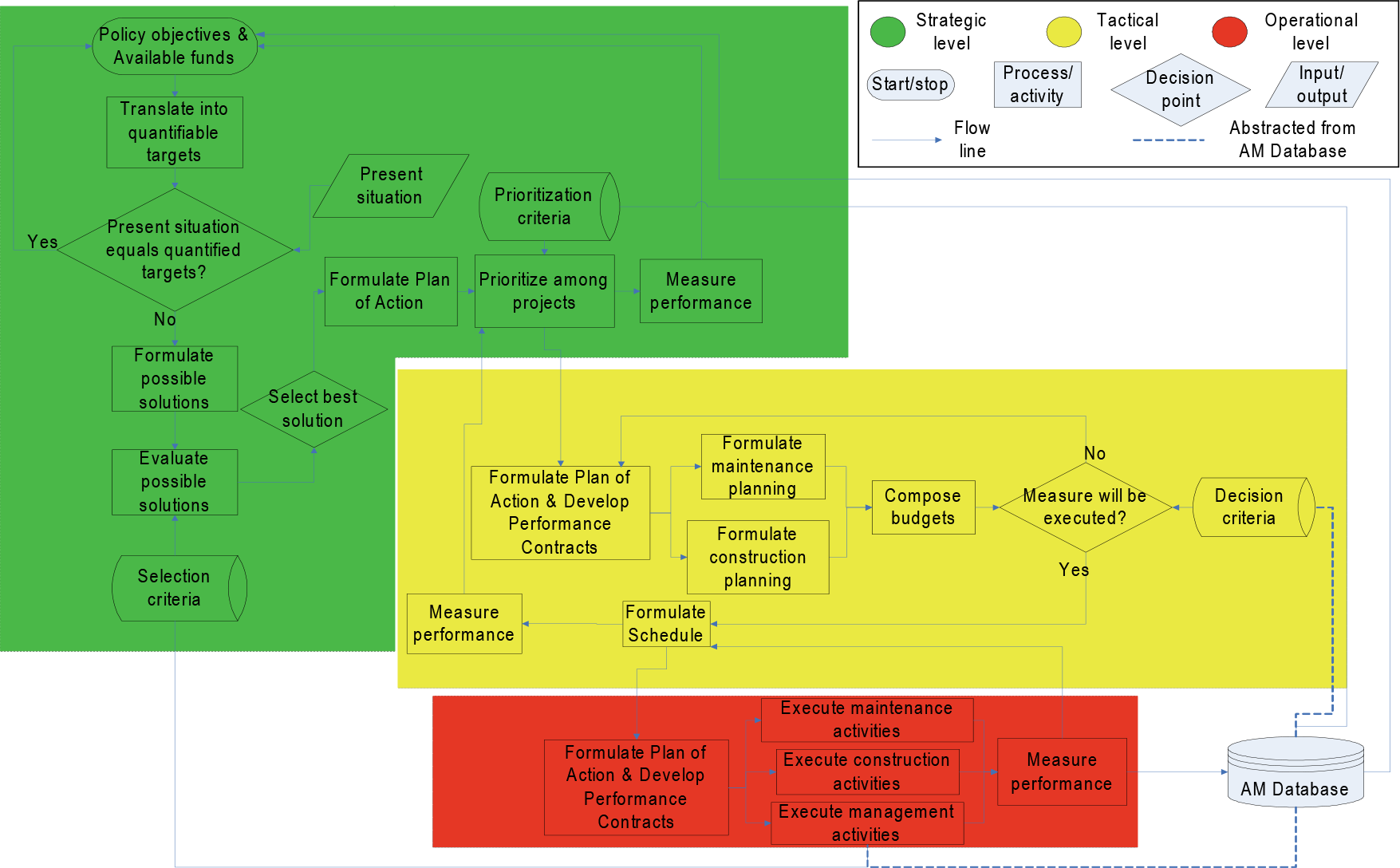
Overview of asset management activities in the civil infrastructure sector
4.2 Asset management at the strategic level
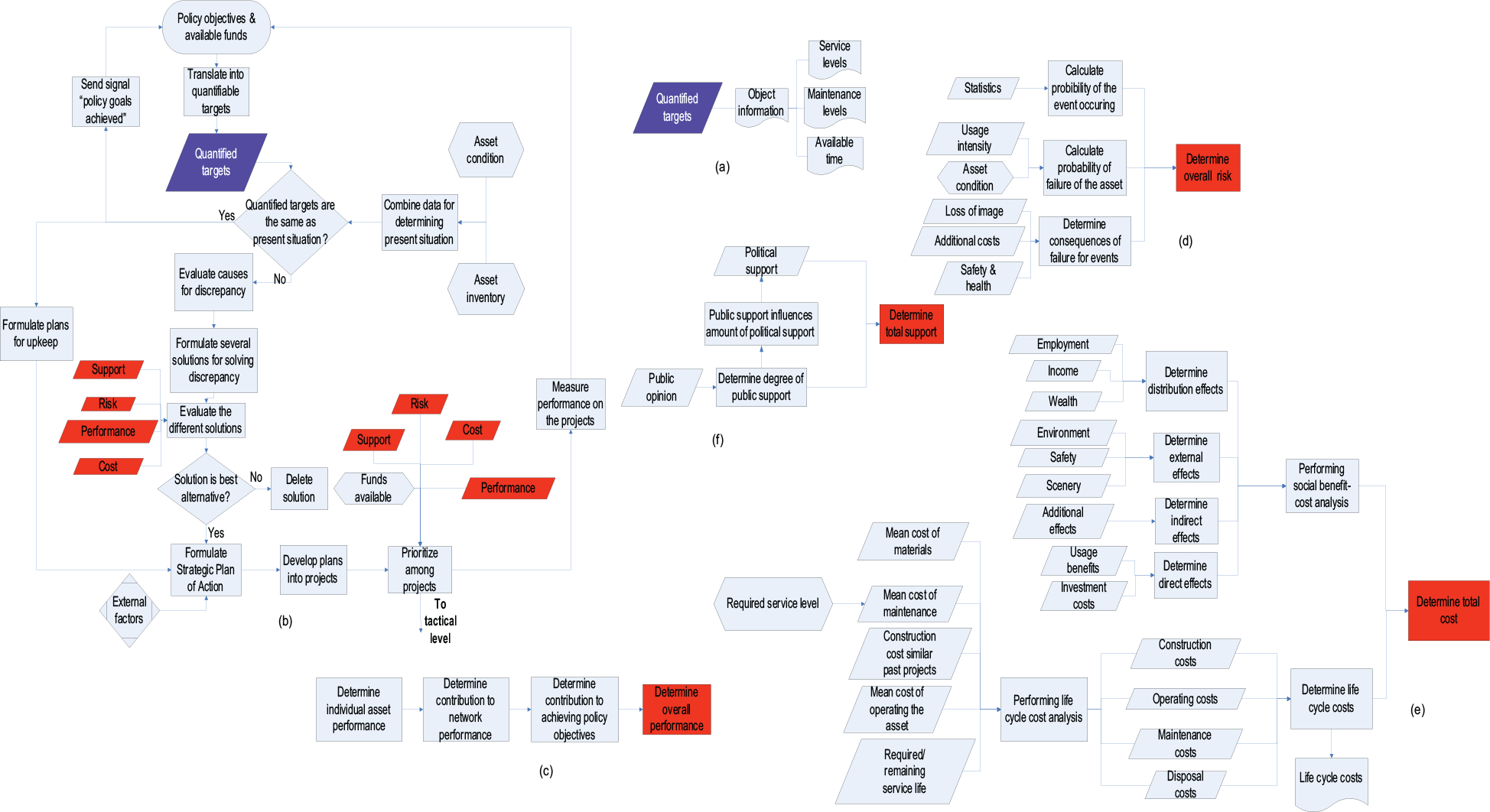
Figure 3 shows the detailed activities for managing assets at the strategic level. As the owner, the government sets policy objectives (e.g., reduce 30% traffic-jams), which are then translated into quantifiable targets (e.g., a national trunk road, R1, must be 6 lanes wide to reduce 30% traffic jams). The quantified targets should contain object information about the assets. This object information is divided into service levels (e.g., R1 must be able to process 20000 vehicles every hour between location A and location B), maintenance levels (e.g., R1 must have a minimum roughness of 6 mm) and time available (e.g., the policy objectives must be achieved by 2015). The development of the quantified targets is shown in Figure 3(a).
Asset management activities at the strategic level
These quantified targets are then compared with the present situation of the assets, as shown in Figure 3(b). Such a present situation is constructed from the asset inventory and the asset condition. In general, the asset inventory defines the collection of assets and its associated value; the asset condition describes the current condition of the asset. When the present situation does not comply with the quantified targets, a problem situation arises. In case the present situation equals to the quantified targets, a positive signal will be sent to the policy objectives. Furthermore, a set of plans for upkeep of the situation is to be formulated. In case of the problem situation, the causes for the discrepancy between the present situation and the specified targets must be evaluated. This will lead to several solution alternatives for solving the problem situation. These solutions are then evaluated against a set of selection criteria: performance, risk, expenditures and support. Based on the evaluation result, the optimal solution will be chosen. This solution is then recorded in the strategic plan of action.
The performance of the solution to be determined depends on the individual asset performance. The individual asset performance determines the network performance of the assets, which ultimately determine the performance towards achieving the policy objectives shown in Figure 3(c). The risk associated with the solution is identified by performing risk analysis to determine the consequences of event failures, to calculate the probability of asset failures and to calculate the probability of event occurrences. The consequences of event failures can be, e.g., loss of image, additional costs on safety and health. The probability of asset failures depends on asset conditions and the usage intensity. The probability of event occurrences depends on statistics about event history, as shown in Figure 3(d).
The solution expenditures include the associated lifecycle costs and the social benefits and costs. Hence, LCCA is to be conducted to determine the costs of a solution for the entire lifecycle of an asset; SBCA is to determine the benefits and costs for the entire society. The lifecycle costs drivers include construction, operating, maintenance and disposal (Rahman and Vanier, 2004). Based on these drivers, the lifecycle costs are calculated. They include the mean cost of materials, the mean cost of maintenance, the construction costs of similar past projects, the mean cost of operating an asset, and the required/remaining service life, as shown in lower part of Figure 3(e). In a similar way, the SBCA is to be performed, as shown in the upper part of Figure 3(e). The SBCA concerns the investment costs and the benefits of using the investment (i.e., the direct effects), the additional effects (i.e., the indirect effects resulting from the direct effects), the effects on environment, safety and nature (i.e., external effects) and effects on employment, income and wealth (i.e., distribution effects).
To evaluate the solution alternatives, their support needs to be determined. The total support for a solution includes political support and public support, as shown in Figure 3(f). The public support can be determined based on the public opinion on the solution in consideration. To certain degree, the public support will influence the amount of political support.
Upon the determination of support, risk and performance, the solutions are evaluated against these criteria. Based on the evaluation, the optimal solutions achieving the policy objectives will be selected, as shown in Figure 3(b). The solutions that are not selected will be terminated as possible solutions. Based on the selected solutions, a strategic plan of action will be formulated, including strategic goals and the possible ways that these goals can be attained. With the strategic plan, projects will be developed and further prioritized. Project prioritization can be done based on the same decision criteria used in the solution selection together with available funds. Project prioritization functions as input to the tactical level in that the activities at the tactical level need to be performed based on the ordering of projects to be executed. At last, the performance of the strategic level is measured based on the project execution.
4.3 Asset management at the tactical level
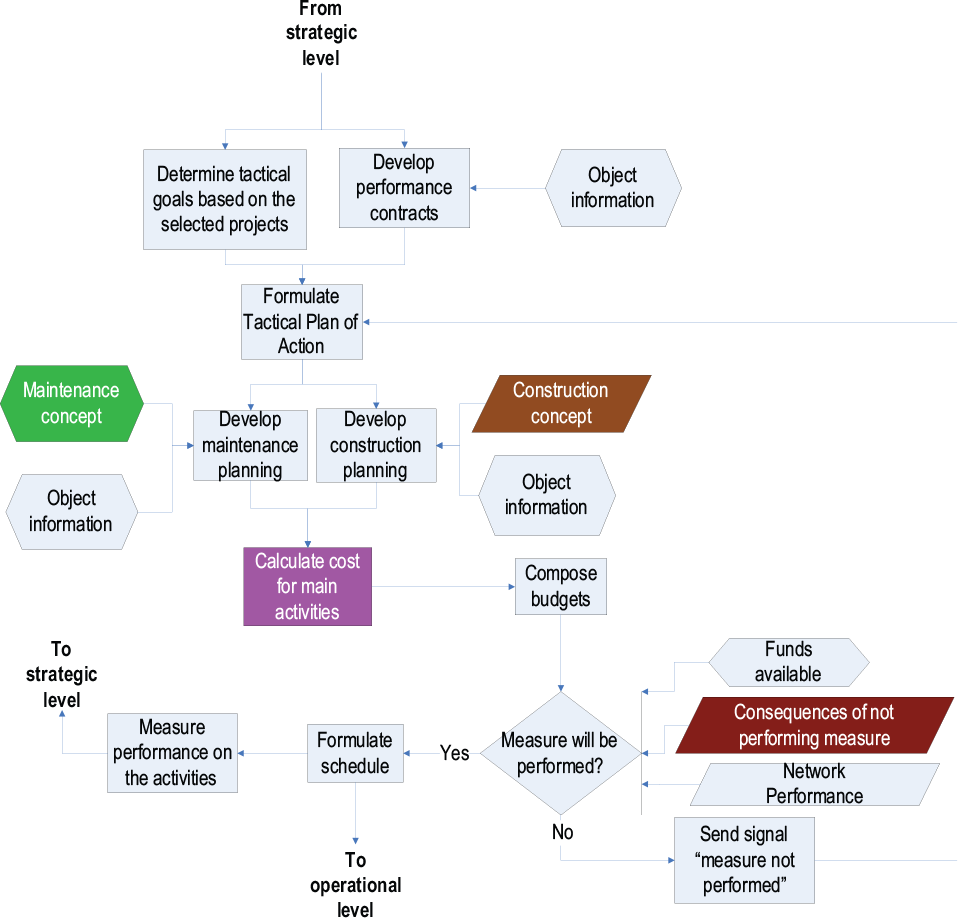
Based on the projects developed at the strategic level, tactical goals are to be determined. These tactical goals must be in line with the strategic goals so that achieving the tactical goals would lead to the fulfilment of the strategic goals. Furthermore, performance contracts determining required asset performance need to be formulated based on object information. In addition, the asset managers may define the conditions under which the performance is achievable. These tactical goals and performance contracts will be used to formulate the tactical plan of actions, as shown in the upper part of Figure 4. The tactical plan of action should contain the tactical goals and a number of measures, which are in the form of construction activities and maintenance activities. In this regard, planning must be developed for these two types of measures.
Asset management activities at the tactical level
Maintenance planning can be developed based on maintenance concept and the available time describing object information. The maintenance concept consists of risk analysis, maintenance strategy, definition of the maintenance tasks (Traduco, 2007). Construction planning can be developed based on a construction concept and the available time describing object information. The construction concept determines the activities that are necessary to construct the asset. The construction activities can be preparation, building and other additional activities.
Upon the completion of construction measure planning and maintenance measure planning, the associated costs are to be determined for each activity. Based on such cost calculation, budgets can be obtained to describe the activities necessary for the project and the associated costs. These budgets will be the input to determine whether or not the measures will be executed, as shown in Figure 4. Other decision criteria include the available funds, the consequences of not performing the project and the network performance. The available funds can be determined based on the quantified targets set at the strategic level. The consequences of not performing the measure can be obtained by performing a risk analysis determining the risk of asset failures and the risk of not achieving the tactical goals.
If a measure will be executed, a more specified plan of activities will be formulated. This specified plan is termed as schedule, listing all the actions associated with the measures. (This schedule becomes the input to the operational level.) If a measure will not be executed, the information will be sent back to the performance contracts because it is in the performance contracts, the asset performance to be achieved is recorded.
4.4 Asset management at the operational level
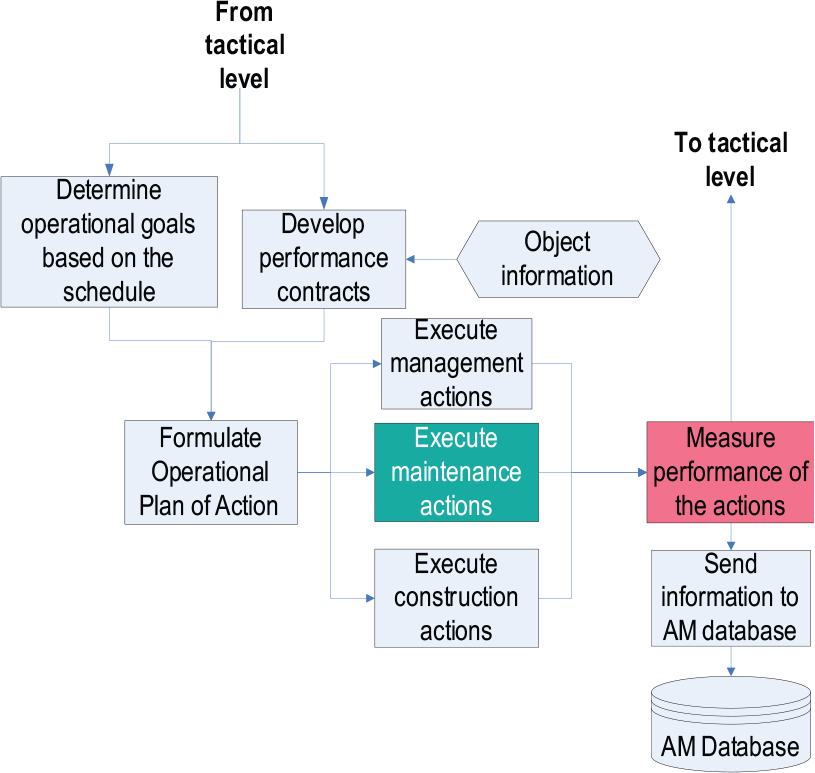
Based on the schedule developed at the tactical level, the operational goals are defined first. Similarly, the achievement of the operational goals should contribute to the achievement of tactical goals and ultimately the strategical goals. In addition to these operational goals, performance contracts defining the expected service quality are to be determined. Subsequently, these performance contracts and operational goals will be used to formulate an operational plan of actions, as shown in Figure 5. This plan of action contains all actions that must be executed in order to achieve the operational goals.
Asset management activities at the operational level
The operational plan of action should contain three categories of activities: maintenance, construction and management. Management activities are indirect (or overhead) activities that are necessary for performing maintenance and construction activities. They are either planned maintenance or inspection. Planned maintenance activities must be carried out regularly to keep the assets in good conditions. Inspection activities assess the asset conditions; their frequency is defined by the maintenance concept. Construction activities start with preparation, including, e.g., cleaning the terrain, flattering the terrain. Subsequently, building actions will be carried out. Such building actions can be, e.g., laying foundations, laying piping and building the actual asset.
The performance of the three categories of activities - management, construction and maintenance - is measured in terms of performance and cost efficiency. The actual costs that are incurred when executing the actions are compared with the calculated costs; the asset condition that is measured by inspection is compared with the expected maintenance level. The measurement results are sent to the asset management (AM) database and the schedule at the tactical level as well, in attempting to check whether or not the operational goals are achieved.
5. Discussions and Conclusion
In this study, we developed an asset management model to be applied in the civil infrastructure sector. We considered activities at three levels – strategical, tactical and operational – in this model to manage assets. In addition, the activities at all levels are developed based on the principle of the Deming cycle. This model was confirmed by a number of experts in several Dutch organizations, where we did the interviews. These experts are active in the fields of the Dutch civil infrastructure sector; municipality, district water board, Department of Public Works & Water management, and Schiphol airport.
While we developed the model based on field studies and a number of interviews with the experts in asset management and officials in the relevant Dutch organizations, the proposed model can be fine tuned based on small-scaled applications, which might pave a potential avenue for future research. In addition, we developed the model by considering the characteristics of the infrastructure sector in the Netherlands. Consequently, this model might not be applicable to other countries due to the different characteristics of the infrastructure asset. In this regard, future research efforts might be devoted to develop a generic asset management model, which can be adjusted based on the unique characteristics of the infrastructure sector of the country in consideration.