




Abstract
We have tried to present the most matched approaches with which the vision dose through numerous studying the segment fields and recognizing the picture. Here we define external pictures features as the prevailed picture features and then extract the locust point of minus decline and among these points. Of minus decline and among these points we have defined the points which match with the human vision specifications according to the defined factors in this research such as clarification sharpness roundness and adjacency and used them as copied systems. We have reviewed our proposed patterns for truth, correctness and validity through performing two empirical tests.
Introduction
We have the most contact with our surrounding through vision and %40 of works the vision [17]. With respect to the scientific improvement recognition and describing very complicated system, gradually, the artificial vision system have been copied from human vision system with respect to the numerous approaches parallel to the scientific developments in processing the picture the experience of one century working on processing the picture prows that the best and the most accurate approaches are those which match with the human vision. So we have tried to present a capable approach matched with the human vision process. As we follow the human vision approach we propose an approach with maximum resolution present the most sensitive factors in identifying the image parts by human eye. Then we have tried to develop it for automated processes through computer. Generally in processing the image (picture) two goals are followed:
(a) Developing pictorial data by human being, (b) The process of data for automatic understanding by the machine. Because our goal here is to process the picture matched with the human's vision process, so, both of these goals should be followed. Generally, we should choose the image show approach in order partition the image. There are two ways to show an image area: (a) Showing the area according to its outer/external specification (e.g. area border), (b) Showing the area according to the internal specification (e.g. comparing the area pixels).
We know that the system of a picture are our construction Clemens of understanding the image [1, 4, 8, 9, 14] so we should look for an approach to show the system with the maximum show for human vision. Eric Candle [17] proves that the most sensitivity of the human's vision to a view comes from the image edges and the image edge pattern that the most prevail and influenced factor for recognizing View. So to show the System, our attention is focused on the image edges. Now that were used the image over from the commuter in order to describe the contour, we should look for the patter like length for direct lines which connects the exetremun points, number of curves in the borders and so on. We have to just be accurate that having access to the description of the area it should be possible to do it in deviation such as size, transport and turning changes. According to the theory presented by Christ Johnson from Harvard and tese from maxplank venire city, Germany issued in 2001[2], the human vision system shows the most sensitivity to the non-coherences accordingly and as loft man and Singh say from Californian university[5], shapes heights are the most important specifications in identifying the image. We have done some experiments empirically to review the froth of the story and through introducing the pattern called the least minus decline specification [1, 4, 8, 9, 14] and the most important description approach and we have proven the results of applying and its prevail on other approaches.
Reviewing the upheaval theory in the shapes and the minimum rule
Most of the objects have been formed from some pieces and these pieces often have some vision upheaval differences. The piece upheaval theories have been based on the minimum rule for the segments limit definition direction. According to this rule, the Hunan's vision defines the border between segments in the least minus inclination on the siluets and parallel to the least minces fundamental curves on a surface. Infect, each subset of a shape cam be considered as a segment but in order to cognize, any segment can't be considered and the segments should be chosen with a series of principles. As We said, the researches and the results of the performed developments regarding there review of the understanding of the objects by human shows that the humans vision of the object is based on the formed segments and the space valuations among the segments [6, 9], Hoffman and Richards [5] proved that the humans vision uses the general calculation rule for object segments. They set the minimum rule for the first time. As we said, according to this rule, the human vision refines the border between segments in the least minus curve an silliest and a long the least minus fundamental curves on a surface. To describe this rule, first we have to explain the meanings such as normal vectors and curves and fundamental curves for flat curves. (Figure 1).

Normal vectors and curves and fundamental curves for flat curves
Normal vectors are vectors with the same length which are vertical on the curve. we have to pay attention that the normal victors cum be divided into two groups, the ones which point the left and the ones which point to the right. Also, there is two separate style for the selection of form and the context on the curve point at, we consider it the figure. So, it points at left in figure (1), and the context is in the right part. The other mining is curve. Infect the size of the curve in every point shows how the changing speed is for the normal around that point and the size of the curve in each point is the inverse length of the circle radius which has the best situation whit this point and the adjacent points. The curve sing in some parts of the curve which are curve comparing to the selected figure are positive and I some parts which are curve are negative curve and in fact it has the negative curve minimum (NCM) now if the image (1) with changing the direction of the normal vector and change the picture with the context the point “a” would be a positive maximum curve (PMC) revealing the NCM points can be done according to the directions change calculation on the contour. Now the rule of minimum is stated with respect to the following meanings: “All the negative fundamental curve define the between the segments”. As we said earlier the piece upheaval theory according to the minimum Rule, has been formed to define the border between the segments. Generally, a segment upheaval depends on at lest three factors:
(a) The size of the segment to the total image, (b) the degree and the level of the segment upheaval, (c) the amount of the borders of that segment. These factors have influence on d) vision process to define and recognize the form of the context in the image. In order to review the fund anointed factors in recognizing the image by human's vision, we did the test 1 and 2.
Test subject: the human eye shows the maximum sensitivity to the non-consistency in the contour curve. The testes: we considered 10studints from Tehran Elm and Santa University. They were from various courses and they didn't know about the target of the test. Approach: in order to review the mentioned theory, we have used two sets of non-heterogenic shapes. One set is like a mass of oval (Fig.2E) which we clarify them with “E” letter and the other one is a mixture of a semi circle and a semi oval so, they look upheaval (Fig.2B), and we introduce them with “B” letter. We prepared two different groups of them to do the test. The first group contained some oval shops, which were arranged beside each other and we just put one heterogeneous oval beside them (Fig.3B).

Masses related to Test No.1: Mass of oval (Right) and a mixture of a semi circle and a semi oval (Left)
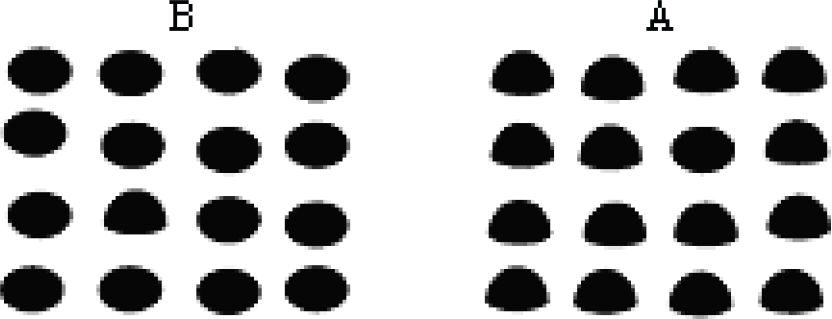
Two shape sets related to test No.1: Regular oval between heterogeneous ones (A) and a heterogeneous oval between regular ones (B)
Through changing the sets, we overheated the test for these two sets in 4,8,12 and 16 numbers. Presentation approach: to present the images, we used a computer. Each person were in front of a computer when showing the image on the monitor, they announced their answer through key board in they were announced that if they witnessed any irrelevant image comparing whit the other images, press “P” other wise, press “A”. And if they couldn't recognize it, there is no need to press any key. We have presented the tests for different show times and we have brought there salts in Table 1.
Results from Test No.1

Test1 result: As you saw the Table.1, recognizing the letter “B” located among E letter has been tone by so many and with a high percentage. But, recognizing the letter “E” among the “B” letter has been done with a small percentage and this is admittance to the sensitivity human's vision to the changes in the images contour curves. Also, we see, when the size of the set increases, the increases; the sensitivity decreases.
We have used the patterns in figure (4). Each pattern of figure (4) present unclear patterns that cum be considered as continuous images from the breasts borders in monogram or like fish shells which are fallen on together in the left or right (to facilitate the description, we consider them as fish shells). So, here may be two different understandings from the patterns and those, which point toward left. According to the theory of the prominent (upheaval) shapes, more upheaval (prominent) shapes, move prevailed patterns. In figure (4-a), we have considered both upheavals may be common in this pattern. In figure (4-b), we have considered the right side pointing pleases whit a bigger upheaval. Our estimation is, whit respect to the maintained cases the comment on pointing to the right by this pattern cam be done easily. Through looking at the figure (4), we can search this case.

Shapes Used in Test No.2.
We should pay attention that this point is near a curve and this curve is the border of a fish shell. Now, we search that this point seems prevailed in side the shell or out side the shell.
Test case: Reviewing the NCM point
The subject (testes)
We chose 10 students from Elm and Santa university from different courses just the previous test (they where exactly the pervious students). All of them were healthy people and they didn't know about the test at all.
The test approach: in order to give them motivation, we used the pattern (4). We present the patterns through the computer. Each one was sitting in front of monitor and was away from the monitor about 50 centimeters and the mentioned patterns were presented simultaneously each pattern was shown through the key board.
Test tow-part one
In the first period, they were announced that they would see fish shells and they lied to recognize the direction of them. They were also said that for the right direction press “R” and for the left deviation, press “L” and if they shouldn't recognize the direction, there is no need to press any key. (for a quick respond the location or “R” and “L” were high lighted already and they could find it easily). We acquired the Table 2.
Results from Test No.2-Part 1

Results from Test No.2-Part 2

Test 2–part one results
Expected the recognition of B toward right is more strongly that left. With respect to increasing the number of shells the decision making decreases but the prevailed direction is still right. Decision making regarding “A” pattern as we estimated goes on hardly and the reason can be the soreness of the upheaval in two comments.
Test2-part two
In the second part of this test, they were told they would encounter fish shell with a black spot on them. And if they could recognize the black spot, they should press “I” and if the black spot looked out of shell they should press “O”. Final, if they couldn't recognize any thing, they shouldn't press any key. The test situation was just like the previous one and you may see the results in chart (3). The results of test2-part two in the figure (4), the comment of the spot on the shell (I) says that one recognizes the minus minimum of the more upheaval part, as a criterion to evaluate the borders. so, the comment is, to be more prominent and upheaval is the key, if the one recognize the spot of the shell, it means less upheaval and prominent. As we expected in B pattern, the percentage of recognizing the spot on the shell is more and the percentage is decreased be cause of the number of the sell but it is still the dominant. Regarding the pattern “A” because the upheaval parts were the same, the recognition has been done weakly.
As we mentioned, among those issued approaches for using NCM points to segments the image the short-cut rule match on the humans vision more than anything. But this approach suffers from limitation. Because choosing the shortest lines in segmentation is not always right and may cause errors in the system and lock of the image that they have smaller dimensions comparing the total image dimensions. In order to ratify these limitation, theory shortening the lines, we choose, a series of coefficient that we can consider the smallest distance and use the threshold degree, define the part lines and theory the various lines that verbal the NCM points, we can choose our Intentioned segment lines. In order to develop the issued approach, we manipulated new parameters such as resolution segment curve globe coefficient sharpness coefficient and the adjacency coefficient. The resolution recognition is one of the most promoted of the human's vision. Where the control areas are seen as a signal part object in clear shows we see them as two clear and a monotonous (plane) reflection but when we see them as two part of on abject we see them two part, which have different reflections. So we can that the segment borders can deviate the solution understanding.
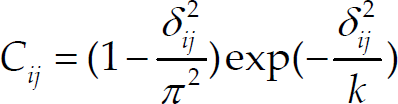
In figure (5) we have used Euler's spiral as a segment curve to describe the applied segment. Using a flat curve in segmenting Not only leads to a natural segmenting but also it gives a better choose when we acquire a segment overlap. Globalizing causes the segment circularity as much as possible the globalizing definition in a way we used to introduce the globalizing coefficient; it is mentioned in an article by parent and zucker. First we define the cooperation coefficient as δ
ij
=|Λ
i
+ Λ
j
− π| in which Λ
i
is an angle mode by NCM with a line which concede two points of NCM. Then globalizing coefficient is
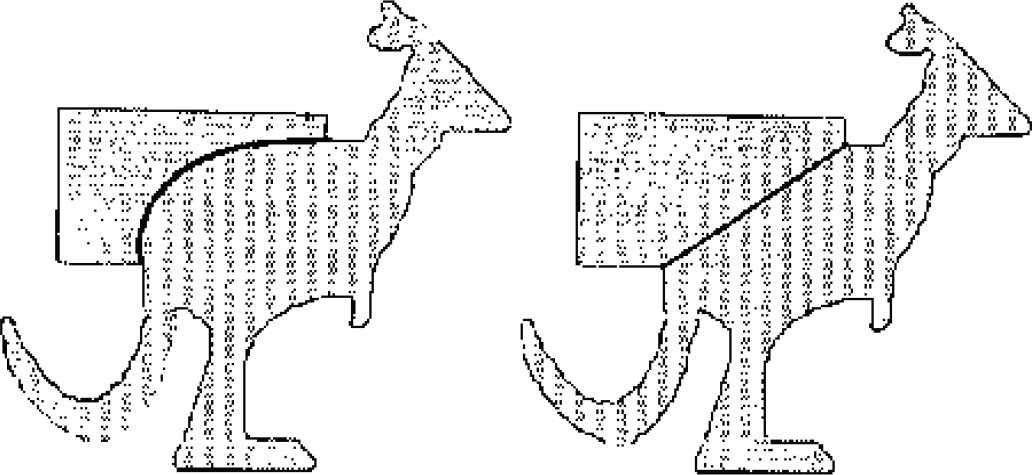
Segment Completion: Euler spine(left) in compare to straight line(right)
in which the k parameter is chosen in away that the globalizing coefficients have less influence on the sharpness coefficient is defined is below:

and the adjacency coefficient is defined as below:

in which dig shows the Oklidoss distance between two points NCM and shows the standard derivation and all are the distance of NCM from each other. Bezier and B-saline multi sentences both use the parametric equations to describe the surface with a curve. We use cubic B-saline to describe the contour out of the image segment to describe the contour and the curve. We do this according to the issued article by Anzai and surrender. Of it as follows:
Step(1), showing the image, step(2), revealing the NCM point, step(4) calculation of the correct coefficient, step(5)segment curve selection.
The human's vision understands the object shape according to the formed segment and the space relation between them. According to the results, humans vision systems show the maximum sensitivity to the segment outer patterns and the outer patterns of on image pervades the inner patterns. Among these patterns the image edges are the most important factors for image recognition parts. The humans vision system show the maximum sensitivity to the non-coherence and side by side image. Image upheavals are the most important specification in recognizing the image. The lost minus curve pattern as a fundamental image specification and the most important approach for image description. It is not always right to choose the shortest line in segmentation be curve it would cause an error in system and non-recognition of the segments which have a smaller dimension comparing to the total image. Using the segment curve instead of segment line will cause an accurate recognition. Using parameters such as adjacency coefficient sharpness globalization coefficient and the resolution can help the segment exploitation. The border of the segment can change the resolution understanding so it should be considered in segment exploitation.