




Abstract
In this paper, a multi-agent model is proposed for considering the human resources factor in decision making in relation to the six sigma project. The proposed multi-agent system is expected to increase the acccuracy of project prioritization and to stabilize the human resources service level. A simulation of the proposed multi-agent model is conducted. The results show that a multi-agent model which takes into consideration human resources when making decisions about project selection and project team formation is important in enabling efficient and effective project management. The multi-agent modeling approach provides an alternative approach for improving communication and the autonomy of six sigma projects in business organizations.
1. Introduction
Six sigma is a powerful philosophy that aims at improving the quality of an organization's performance, and focusses on identifying and quantifying errors in business processes. The Six sigma initiative is a famous quality control philosophy. Its aim is to reduce defects in an organization's operations using a project-by-project approach. Six sigma is one of the most popular quality control approaches in many industries and has gained huge success (Eckes, G., 2001). It has been suggested that a key success factor for six sigma project implementation is the project selection process (Meredith, R. & Mantel, S., 2006). Project selection is the process of evaluating individual projects or groups of projects, selecting and scheduling some the most suitable candidates to implement the project so that the objectives of the organization can achieve (Adams, C., et al., 2002; Kumar, U., et al., 2008). In most of the studies in the literature, the decision making in relation to the project selection considers mainly the project time scale, return on investment, total cost of ownership, etc. This paper is an attempt to further improve the project selection and project team formation processes, in the six sigma projects, by considering human resources factors. This will increase the success of project management.
A six sigma project team generally consists of two types of team players, i.e. a black belt as the team leader, and a green belt as a team player. People are important to the six sigma project selection process. This is because in most of the cases, each black belt has individual expertise in a specific domain, and it is impossible for them to participate in a six sigma project that is not within their domain. As a result, there will be a limited number of black belts available for most projects. On the other hand, due to the resource constraints in practical situations, a company usually has a limited number of available green belts. Therefore, the factors of team formation and human resources should be considered when decisions are being made with regard to project selection. We therefore propose a multi-agent model for considering human resources factors in the six sigma project selection process. Agent-based computation is a new domain paradigm of information and communication technology (Horling, B., & Lesser V. R., 2004; Weiss, G., 1999), and agents address autonomy and complexity that is able to adapt to changes and disruptions, exhibit intelligence and are distributed in nature (Bussmann, S. & Schild, K., 2000; Cerrada, M., et al., 2007; Ferber, J., 1999). With the multi-agent model, human resources are involved in the decision making in connection with the six sigma project selection process. The model has the authority to prioritize projects while utilizing human resources information. This multi-agent system is expected to increase project prioritization accuracy and stabilize the human resources service level. The structure of this paper is as follows: In section 2, the proposed multi-agent model for the six sigma project selection with its four agents, i.e. project agent, human resources agent, green belt/ black belt agent is defined and modeled. In section 3, a simulation of the proposed multi-agent model is described, and an analysis of the results is presented. Finally, a conclusion with with suggestions for further development is given in section 4.
2. Development of the Multi-Agent Model
In the proposed multi-agent model for the selection of six sigma project, four types of agent are developed, i.e. project agent, human resources agent, green belt agent, and black belt agent. The structure of the proposed multi-agent model and the interaction flows of its agents are illustrated in Fig. 1.
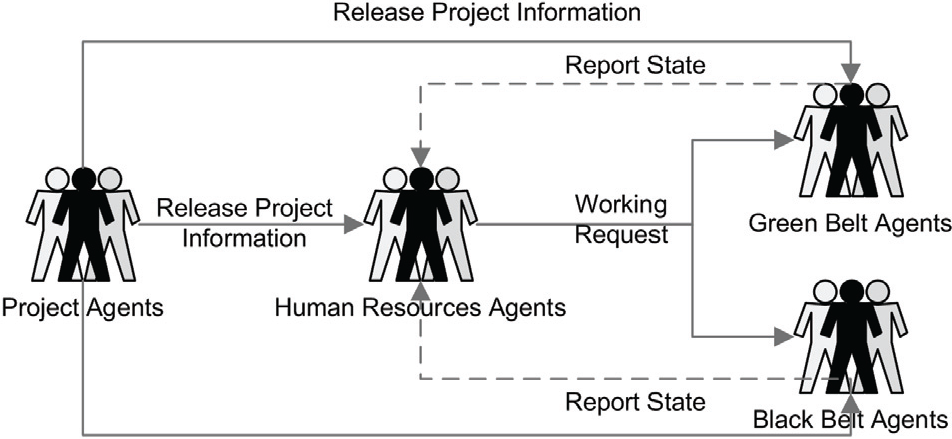
Structure of the proposed multi-agent model and the interaction flows of its agents
2.1. Project Agent
The project (PJ) agent acts as a project architect that controls the process flow of a six sigma project. The project agent is responsible for initiating the project requirements and for providing the relevant project information. Each project agent is responsible for one six sigma project only, so that the number of project agents is equals to the number of six sigma projects in the system. After the project agent has finished preparing all the required project information, such as the project scale, the estimated return on investment, the number of green belt/ black belt agents required, etc. the project agent then communicates with the human resources agents in order to prioritize the six sigma project and to recruit the green belt/ black belt agents for the project. The project agent cannot start a project until commitments are received from the green belt/ black belt agents. Therefore, if the project is in a state of progress, it uses a certain number of green belt/ black belt agents that cannot work for other projects. However, when the project is finished, the project agent will release all the green belt/ black belt agents, and the project agent will terminate itself as a signal of project completion. In the multi-agent environment, the project information is generated by project agents and sent to human resources agents in an array form. The project information includes:
The number of green belts required
The number of black belts required
Six sigma – Define the stages
Six sigma – Measure the defined stages
Six sigma – Analyze the defined stages
Six sigma – Improve the defined stages
Six sigma – Control the defined stages
Allocate an index number to the agent responsible for the project
Allocate the suggested priority of this project
Allocate the required skill code for the Black Belt
2.2. Human Resources Agent
A human resources (HR) agent acts as a system manager in the proposed multi-agent model for the six sigma project selection. HR is also a communication hub for project agents and green belt/ black belt agents to exchange information. As a system manager, a human resources agent has two job responsibilities, i.e. project scheduling and the recruiting of green belt/ black belt agents. The human resources agent schedules the project according to the priority rules, he/she decides the earliest due date, first come first served, etc. When a new project request is initiated and is received from project agents, human resources agents will compare it with the projects that are already scheduled, and then prioritize it by putting it in an appropriate position in the project schedule. The human resources agent will also recruit the necessary green belt/ black belt agents needed for the project to start. Human resources agents will then be able to make a decision regarding resources between the resources needed by the project and the number of green belt/ black belt agents available.
2.3. Green Belt and Black Belt Agents
A Green belt (GB) agent is a basic team member in a six sigma project. Green belt agents do not have specific skills and thus are suitable for taking part in any six sigma project. All green belt agents are identical, and can serve in only one project at a time. A Black belt (BB) agent is similar to a green belt agent, however, a black belt agent has its own specific skills, and these skills are from a skill pool that contains all skill fields related to the operation of the six sigma project. Skills of different black belt agents may overlap, but for any particular six sigma project, there are a limited number of suitable black belt agents available. Both green belt/ black belt agents are in either a “working” state or in an “idle” state. They never terminate themselves. In the recruiting process, human resources agents send a working signal to “idle” green belt/ suitable black belt agents, and those green belt/ black belt agents who are available will respond to it. However, the recruitment of black belt agents is more difficult than the recruitment of green belt agents as most of the six sigma projects require agents who possess specific knowledge and skills.
2.4. Communication between Agents
Communication takes place between agents, and all communication is achieved by sending messages through broadcasting or one-to-one communication. With broadcast communication, all agents can receive the messages and the target agents can respond to it; while for the one-to-one communication, only targeted agents are able to receive and respond to the message. A communication matrix between the agents in the proposed multi-agent model for six sigma project selection, is presented in Table 1.
2.5. Dynamic Execution States of Agents
All agents are listed by default as “idle” at the beginning of the six sigma project selection process. All agents have their own built-in intelligence and logic that motivate them to act and respond in the agent environment so as to achieve system level automation.
A matrix showing communication between agents

A project agent can operate in several execution states. These are dynamic linear execution states that include the state of project initiation, project information sharing, responds receiving, project running, agents releasing, and project termination. The graphic illustration of the project agent execution states is shown in Fig. 2.

Project agent execution states
The human resources agent has two job responsibilities, namely, project scheduling and the recruiting of green belt/ black belt agents. The job responsibility of project scheduling operates with a simple dynamic linear execution state while the recruiting of agents uses a more complicated dynamic logical execution state. The dynamic execution states for the two job responsibilities of human resources agents are shown in Fig. 3 and Fig. 4 respectively.

Human resources agent execution states for project scheduling

Human resources agent execution states for agent recruitment
The green belt agents and the black belt agents have similar dynamic execution states that include the state of work request receiving, working, and work releasing. The graphic illustration of the green belt/ black belt agent execution states is shown in Fig. 5.

Green belt/ black belt agent execution states
The four types of agents act according to their respective execution states; project agents have a one-to-one relationship with the project that they have initiated. Project agents terminate themselves after a project is completed. The human resources agent is designed to work continuously so as to schedule projects and recruit green belt/ black belt agents. Green belt and black belt agents have simple states as either “working” or “idle”. The human resources agent, the green belt/ black belt agent do not terminate themselves as long as the system is in existence.
2.6. Modeling the Multi-Agent Environment
The proposed multi-agent model is a decentralized and individual-centric approach for the selection of six sigma projects. The multi-agent defines the universal properties and provides a platform for all the agents to execute their tasks. The multi-agent environment is considered as a place where an organization's structure, rules, and plans are integrated.
The organization's structure in the multi-agent environment is defined as the organization's identity and goals, together with the agents involved and their roles. Therefore, the organization's structure in the multi-agent environment is generally defined as:

where ORG_ID is the identification of the organization; ORG_GOAL + is the group of organizational goals; AGENT+ is the group of the agents involved, i.e. project agent, human resources agent, green belt/ black belt agent; AGENT_ROLES is the role of each agent in the multi-agent environment.
For the group of organizational goals, a binary function R is used to represent the sequence of organization goals so as to achieve the organization's goal in a predefined sequence in the multi-agent environment, i.e.

where “SERIAL” means the organization's goals should be achieved one by one in a linear sequence; “BEFORE” means a specific organizational goal should be achieved before other organization goals; “PAR” means the goals should be achieved simultaneously with each other. Another function Q is then used to represent the commitment of the organizational goal in the multi-agent environment, i.e.

where g i is the i-th goal in the group of organizational goals. Apart from the organizational goals, organizational rules also apply in the multi-agent environment. These rules refer to how the organization is formed, and one of the major rules in the multi-agent environment is that the organizational goal should run simultaneously so that the same goal cannot be executed twice in the multi-agent environment. The relationships between the organizational goal and the rules are formulated as:


In addition, different agents have their own roles, and a one-to-many relationship exits between agents and roles, therefore, the parameters in the multi-agent environment can be further defined as:
ORG-Stru def <ORG_ID, ORG_GOAL + , AGENT + AGENT_ROLES>
ORG_ID = SSPS; (Six Sigma Project Selection)
ORG_GOAL = PSSP; (Prioritize Six Sigma Project)
AGENT = HumanResourcesAgent;
AGENT_ROLE = SYS_MAG; (System Manager)
AGENT = ProjectAgent;
AGENT_ROLE = PRJ_INT; (Project Initiator and Manager)
AGENT = BlackBeltAgent;
AGENT_ROLE = SSP_MAG; (Project Leader)
AGENT = GreenBeltAgent;
AGENT_ROLE = TEAM_PLY; (Team Player)
3. Modeling and Simulation of the Multi-Agent Model
The proposed multi-agent model for six sigma project selection and its four agents are modeled in a JAVA platform of a software package AnyLogic, in which, the agents manage their logic and activities according to their state chart with different dynamic execution states, such that all agents autonomously and individually interact with each other in the agent environment. The hierarchy of the proposed multi-agent model for six sigma project selection is illustrated in Fig. 6.

The hierarchy of the proposed multi-agent model for six sigma project selection
3.1. Simulation Package – Anylogic
AnyLogic (XJTek, 1992) is a software package design for simulation tasks. It supports various types of simulation systems, such as System Dynamics, Process-centric, Agent Based approaches, etc. All these types of simulation are achieved using one modeling language and within one model development environment. AnyLogic use Java as its development language, which is flexible enough for users to present the complexity and heterogeneity of business, economic and social systems. The level of details is also adjustable to meet different simulation requirements. AnyLogic supports the Object-oriented model design paradigm, which makes possible the modular and incremental construction of large models. In Anylogic, the developed agents manage their logic and activities according to their individual built-in state chart. Each state chart is a JAVA based platform that directly supports agent-based modeling.
3.2. Simulation Results and Analysis
In the proposed multi-agent model, the states of all agents as well as their corresponding relationships are simulated. In order to illustrate the effect of the proposed model, the following criteria are the most important ones:
Can the proposed model start recruiting process when projects are in queue?
Can the proposed model be suspended if green belt/ black belt agents are not available?
Can the proposed model arrange all projects and able to complete the recruitment tasks for all projects?
In the simulation, four major types of statistical data sets are captured in the proposed multi-agent model for the analysis, i.e.:
Dataset: <Number_of_Working_GreenBeltAgent>
This dataset captures the statistical value of the number of green belt agents that are recruited by human resources agent and in “working” state.
Dataset: <Number_of_Working_BlackBeltAgent>
This dataset captures the statistical value of the number of black belt agents that are recruited by human resources agent and in “working” state.
Dataset : <Number_of_Projects_Initiated_by_ProjectAgent>
This dataset captures the statistical value of the number of project that initiated by project agent.
Dataset : <Number_of_Projects_In_HumanResourcesAgent>
This dataset captures the statistical value of the number of projects in human resources agent, i.e. the number of projects that actually can start with the required number of green belt agents and suitable black belt agent.
The four types of dataset that captured in the simulation are used to develop the time plots of the simulation results as shown in Fig. 7. Fig. 7(a), 7(b), and 7(c) show the simulation results for the dataset of number of working green belt agents, number of working black belt agents, number of projects initiated by project agent, and the number of projects in the human resources agent. At the beginning of the six sigma project selection simulation, all agents are by default listed as “idle”, and all agents have their own built-in intelligence and logic.
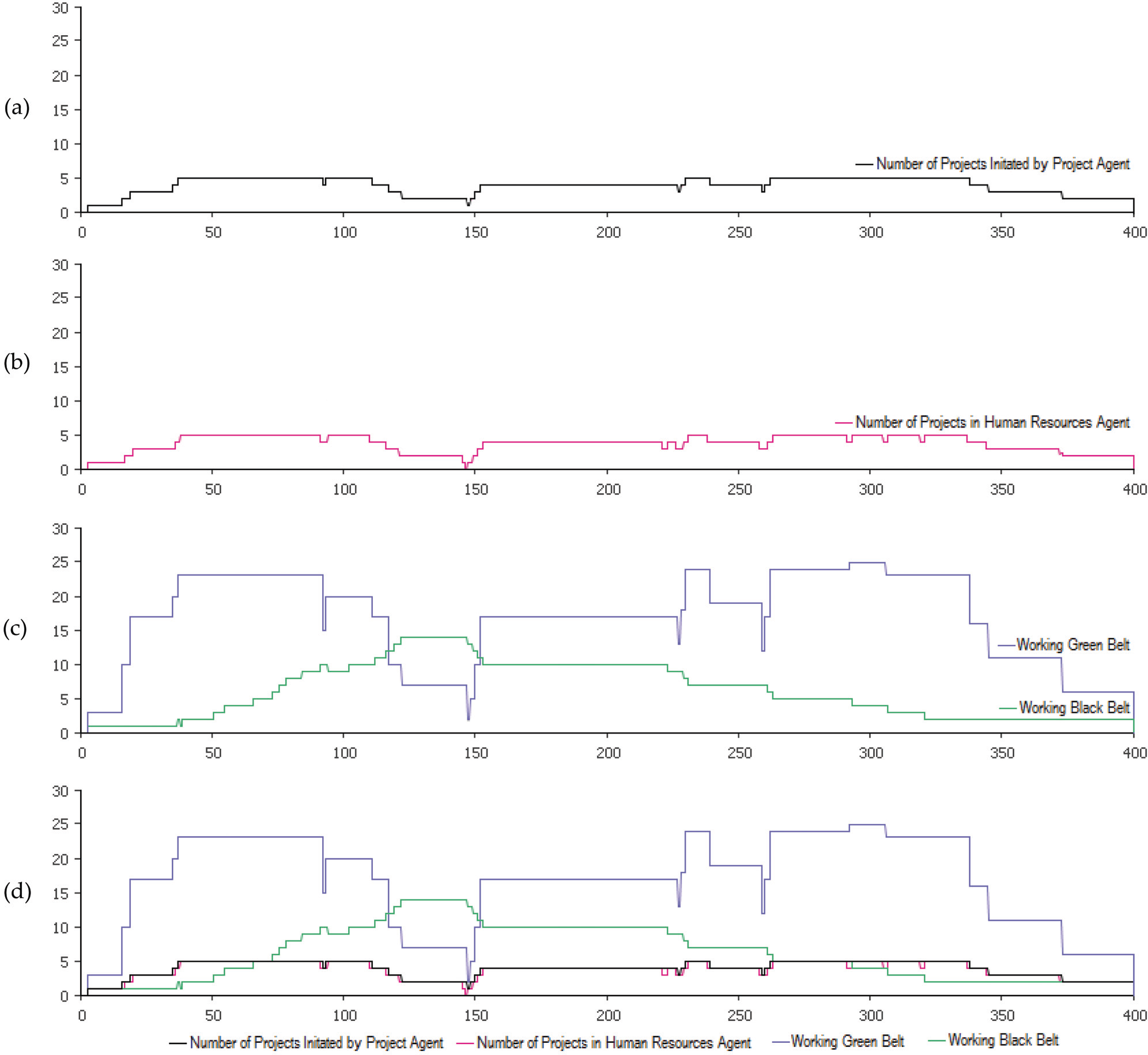
Simulation results for the multi-agent model for six sigma project selection
At time period 4, a six sigma project is initiated by project agent, thus human resources agent starts the green belt/ black belt recruiting processes simultaneously, and as some of the agents are being recruited for the project, then as shown in Fig. 7(c), the number of working green belt/ black belt agents increases. This phenomenon shows that the proposed model is able to respond quickly to the newly initiated project as well as start the recruiting process. The maximum available number of green belt and black belt agents are 15 and 30 respectively.
In the multi-agent environment, since the number of green belt/ black belt agents are limited, so there will be a certain period of time when the model is suspended, as the human resources agent cannot start the green belt/ black belt recruiting processes even though some projects have been initiated by project agents, and the projects are then waiting in a queue until some green belt and suitable black belt agents are available. Therefore the number of projects initiated by project agents is not equal to the number of projects in the human resources agent, i.e. the time period 14, 17, 33, 36, 86, 89, 103, 108, 114, 136, etc. as can be seen by comparing Fig. 7(a) and Fig, 7(b). And at time period 325, the recruitment process declines as most of the projects are finished, and the green belt/ black belt agents are released. Therefore, it can be inferred that the proposed model can run in an efficient way to balance the requirements of the project with the available green belt/ black belt agents for the six sigma project selection.
Fig. 7(c) shows a complete model simulation result of all the agents' interactions. It shows that all agents can effectively interact with each other in the multi-agent environment. Although some projects are delayed (i.e. the number of projects initiated by the project agents and the number of projects in the human resources agents are different), the initiated projects can still all be carried out and completed at the end of the model simulation as shown in Fig. 7(c), and the human resources agents are able to complete the recruitment tasks for all six sigma project selection processes. Therefore, the human resources agent can effectively participate and become successfully involved in the six sigma project selection process.
4. Conclusion
In this paper, a multi-agent model is proposed for the selection of six sigma projects, In this, human resources agents are involved in the selection process, and thus enable an efficient and effective six sigma project selection process. The satisfactory simulation results in this paper show that the multi-agent modeling approach provides an alternative way for selecting six sigma project. The proposed multi-agent model can be further improved in several ways, such as by enhancing the functions of prediction, auto-scheduling, and some mathematical models from the literature can also be adopted in this model so as to make the model more practical for managing six sigma projects.