




Abstract
Two national demonstrator projects have been developed using global RFID standards to explore the suitability of this pervasive technology to the fast moving consumer goods supply chain. The projects show that RFID technology is still not reliable enough to produce advantages over traditional tracking technologies. This paper reviews the processes and gaps in these experiences, and assesses future research opportunities in this area. A system modelling approach is used to understand the relationships between different sub-systems in the enterprises of the supply chain and examine the enterprise processes that drive the activities in the national projects. Based on these analyses, an enterprise system model is proposed for designing future development of RFID based supply chains.
Keywords
1. Introduction
At present, passive radio frequency identification (RFID) technology has several limitations: signal interference, speed of tag reading and memory size (Piramuthu, 2007). Therefore in order to access more information about the product that the tag represents, we store that information externally and use the RFID tag as a key to access from a server (Kelepouris et al, 2007).
The potential of passive RFID technology for improving business efficiency has been investigated in several large scale projects. The BRIDGE project (Lehtonen et al, 2007) was a project in the European sixth framework programme investigating the barriers to the implementation of the EPCglobal Network in Europe (http://www.bridge-project.eu/index.php/mainpage/en/). The National EPC Network Demonstrator Project (NDP) tracked pallets and cartons through the supply chain (GS1 Australia, 2006). EPC (Electronic Product Code) is an identification standard administered by EPCglobal using a specific type of passive RFID (EPCglobal, 2005). Upon successful completion of the NDP, the NDP Extension project was formed to explore issues related to the application of EPC data to support paperless deliveries (Mo et al, 2007). The problem was that significant changes in the companies were still required before complete roll-out of the technology to the supply chain. EPC network standardization helped the initial IT infrastructure. However most issues in these projects were dealing with restructuring business processes and synchronising transaction activities in the supply chain.
This paper consolidates experience in two Australian projects using a scientific approach that can assist future EPC system integrators to implement EPC enabled supply chains. The approach includes the use of enterprise reference architecture to develop an enterprise model for identifying future functional requirements of EPC enabled supply chains. This paper is structured as follows. We discuss the need for a robust modelling process and compare several well known enterprise architectures to identify the most appropriate enterprise architecture for this study (Section 2). Section 3 provides a brief summary of the two national projects. Based on the experience, we propose an enterprise model for the two national projects (Section 4). By benchmarking against a future scenario, we explore the enterprise functional requirements for future RFID enabled supply chains (Section 5).
2. Enterprise Reference Architectures
Enterprise engineering methodology can be used to explore why differences occur and how they can be dealt with in an enterprise system. A supply chain is a specific form of networked enterprises that has the goal of sustaining continuous supplies for its members. This type of networked enterprises is referred as virtual enterprise, which has a common mission but does not have full contractual arrangement to bind everyone working together (Vesterager et al, 2000). To understand a virtual enterprise, the methodology specified by IFIP–IFAC Task Force (1999) is used to examine the suitability of different enterprise architectures for this modelling work. PERA (Williams, 1994) describes how to design an enterprise through its lifecycle. As such, PERA is best used for large scale one off development projects. CIMOSA (Didic et al, 1995) lays out a generic enterprise architecture from which particular industry sector models can be developed and hence is useful for industries with stable system design such as automotive. GIM (Chen et al, 1997) describes how the components of an enterprise are linked. It identifies the importance of decision support in the enterprise reference architecture, and describes a two stage process to design decision roles in the enterprise system. Zachman's framework (Zachman, 2008) is designed to identify system elements in organisations but does not address the design of system processes, particularly inter-company processes. Since the primary focus of the EPC enabled supply chain is the flow of information and the future exposition of the decisions made by different operators and systems when the EPC items move across the supply chain, GIM's structure has the best alignment and is therefore selected as the reference architecture for this study.
3. The National EPC Network Demonstrator Projects
The Australian national projects were developed to accummulate operating performance data of an RFID enabled supply chain in a real business environment so that the industry partners can use the data to justify their own business case. Two projects were conducted between 2005 and 2007.
3.1. The National EPC Network Demonstrator Project
The NDP used full stack of EPCglobal network protocol enabling inter-organisational transactions and supply chain management. When a given tag is detected, instead of having each company storing this information and communicating to the next partner, the EPCglobal model defined a unique global EPC that could be queried to access detail information from local servers.
In order to share information securely among the partners, partners can access the NDP portal on the global server with password control. Product information, containment (content), history (track and trace) data can be accessed using the EPC as the search key (Figure 1). This data sharing capability demonstrated the importance of data transparency about the traded items such as location and time about a shipment. The timely information improved efficiency of the supply chain.
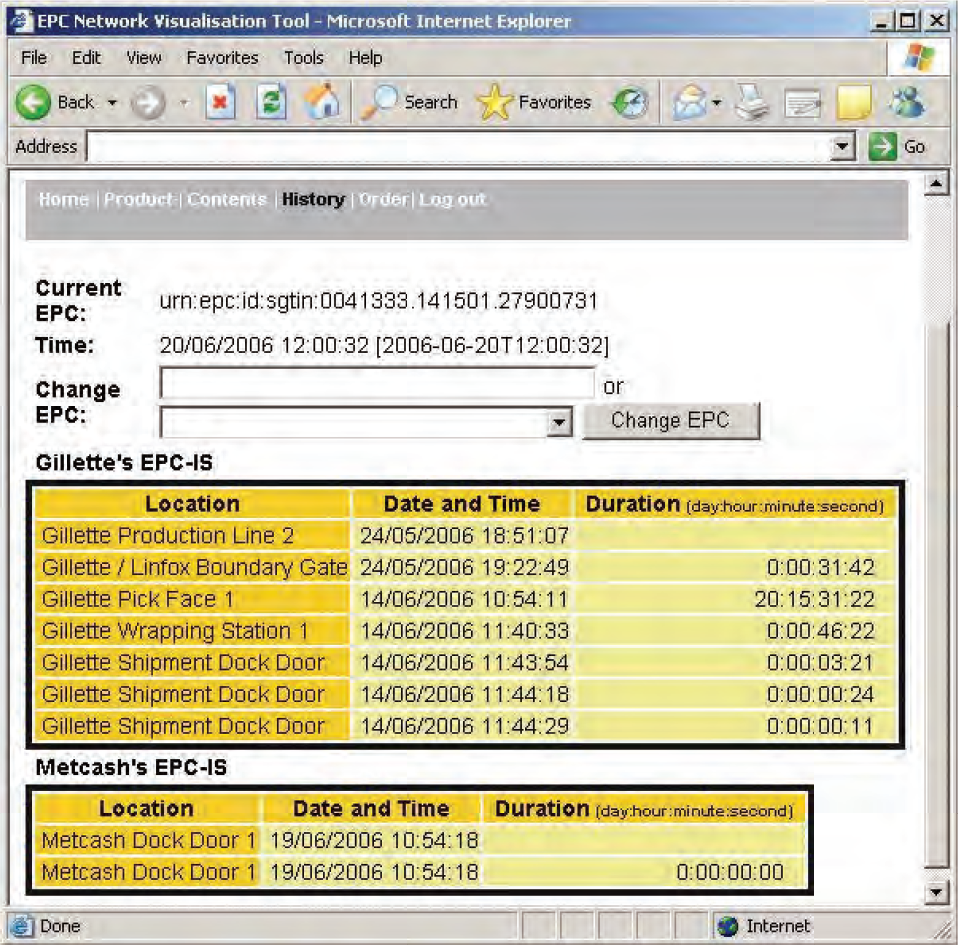
Track and trace for EPC
3.2. The NDP Extension
The NDP Extension was a follow on project investigating how EPC processes could be integrated with real business processes to achieve paperless (electronic) proof of delivery. It concentrated on assets, in this case pallets. Returnable asset management was one of the potential benefit areas identified in the NDP and BRIDGE projects. In the NDP Extension, six sites in two states in Australia: New South Wales and Victoria, were installed with the EPC hardware and network infrastructure. The project proved that business information integration for supporting paperless delivery of pallets could be practised provided that a 100% read rate was achieved in the transaction. Process models were developed for each of the transaction routes (Gajzer, 2007). An average process efficiency gain of 18.1% was recorded. The efficiency gain and hence cost reduction were achieved by eliminating of data entry, verification and reconciliation processes. Furthermore, improvements in inventory accuracy as well as quality were significant.
4. Modelling Differences of the Two National Projects
The two national projects were designed at a time when the industry was still trying to understand the implications of EPC technology to their business. To provide a framework for analysis, an enterprise model was developed to compare the differences between existing technology and future business expectation.
4.1. An adapted virtual enterprise model
According to GIM, three systems are working in an enterprise, viz, physical, decision and information systems. The decision system describes a structure of decision centres, which can be office bearers or autonomous units at different levels in the organisation. The physical system describes the machines, components and resources that the enterprise has at its disposal for generating profits and wealth. The enterprise does business through its physical system. Hence, the activities of the physical system are affected by the decisions made in the decision centres, e.g. for a supply chain, decisions drive goods movement. The information system is critical to the propagation of decisions to the lower levels of the decision system and the physical system. If the right information about the decision is transmitted to the right decision centre at the right time, the physical system will act correctly. Otherwise, it will not take any action or worse still, perform a wrong action. In the virtual enterprise, propagation of information is particularly difficult because of cross-company boundary characteristics. Timeliness of information and its accuracy during propagation among partners is critical to the success of the whole virtual enterprise's operations. We model the EPC enabled supply chain as shown in Figure 2.
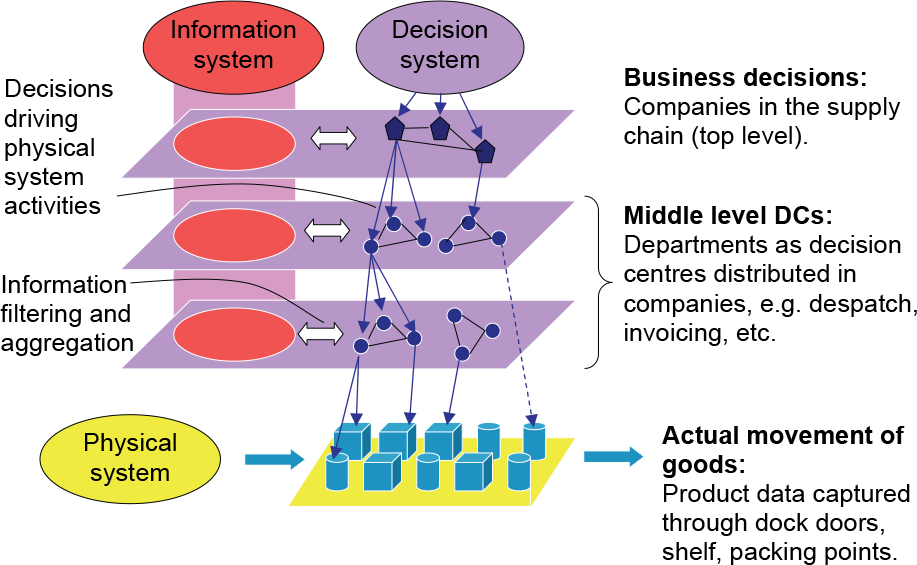
Enterprise model for EPC enabled supply chain
At the top level, the decision centres are partner companies in the supply chain, each of which has its own set of rules and protocols. The companies' departments then represent the lower level decision centres where decisions are made according to the protocols and agreed guidelines in the virtual enterprise. Communication between companies need to occur at any level while goods are moved in the physical system driven by the decisions in different decision centres. Obviously, decisions and supporting information solicited among the companies are filtered and aggregated at company boundaries. These information are transferred to other levels via the information system, which can be a paper based system. Therefore, operational decisions are made based on company hierarchy rather than flow of information.
4.2. EPC Network – information system
In the national projects, the EPC Networks formed the backbone of the information system. Figure 3 shows the EPC Network structure of the NDP as described by Mo (2008). The layered functional demarcation helped the consortium members to divide their work, for example, the EPC Information System (EPC-IS) of the industry partners were implemented on different platforms administered by the IT Department of the partners. Integration of the complete system was achieved through higher level layers of the EPC Network structure.

Infrastructure elements of EPC Network in NDP
On the other hand, the IT infrastructure of NDP Extension was implemented with a different set of hardware. Figure 4 shows a layered view of the IT infrastructure. On each site, the RFID readers were managed by an AON router. This served partially as middleware as well as the local EPC-IS and local Object Naming Service (ONS) layers. The EPC Discovery Services and Root ONS were implemented on a global server on the Internet. In addition to EPC Network elements, the NDP Extension information system had a separate server, known as Asset Manager. This retrieves EPC data from the global server and communicated with the personal digitial assistant (PDA) of the trucks.

EPC Network design in NDP Extension
The two national projects test the ability of the EPCglobal compliant network to facilitate the sharing of RFID and related meta data for the supply chain. This fundamental requirement drove a number of similarities in IT infrastructure. The most significant of which was the insistence by IT infrastructure providers in both cases to use fixed IP addresses for the servers. This requirement was based on a rigid server structure, which assumed a non-interrupted network. This similarity was also reflected in the design of web portals. However, this proved to be a difficult issue, in gaining acceptance both among the partners' IT and management teams.
By comparing Figures 3 and 4, it is clear that the NDP Extension has introduced an extra layer of functionality to the virtual enterprise system. We label this the “business” layer.
4.3. RFID system configurations – physical system
Since capturing RFID physical data is a critical activity in the physical system, hardware configuration was a major development. RFID applications are dependant on the environment in which it is required to perform.
To ensure that the RFID readers could capture any tag passing through the dock door of the distribution centres, the antenna configuration was a portal configuration with two antennas mounted on steel posts at both sides of the door (Figure 5).

Portal configurations with 4 antennas
For the NDP Extension, because the pallets could be stacked, the consortium decided to concentrate all available antennae on the readers to a one-sided configuration to improve system readability (Figure 6). Thus, all four antennae were located on a stand and the pallets were arranged such that all tags were on one side of the pallets. It can be seen from these projects that there are no fixed rules specifying how the hardware configuration should be designed for a scenario. The physical setup design process was time consuming.

Antennae mounted as one-sided configuration
4.4. Processes – decision system
The decision system is characterised by the processes and tasks. To minimise the risk of disrupting normal business, the NDP consortium decided to keept to a limit of 9 store keeping units (SKUs). The system design to trade these SKUs incorporated 15 EPC processes developed to resolve data integrity issues. Figure 7 shows a story board developed for the manufacturer's process of pallet receipt. First, someone decided the process that particular business transaction made, in this case, the receiving process of pallets. Second, to relate the pallets to a business activity, the goods in the delivery were associated with a purchase order. Third, the EPC data of the pallets were captured in a scanning process in which the EPC-IS returned transaction results for operator's acceptance. Decisions in the process were entirely operator dependent.

Receiving pallet story board
On the other hand, the NDP Extension aimed at electronic proof of delivery and hence the process model did not include any manual confirmation (Figure 8). A standing order is set up between the pallet supplier and the customer. To enable the new EPC pallet receiving process, the system was modified with a specially designed business transaction system and displayed the results of RFID reads on truck PDAs. Under the new process, when a forklift load of pallets was driven past the fixed readers at the pallet service centre, the tag information was delivered to the Asset Manager for tag processing. As the Asset Manager (in Figure 4) had no reference information for the order and could not tell if the correct number of pallets was read, the tag data and counts were sent to the Business Information Server via a web services message. The business transaction system paired the tag reads to the original order information and synchronized the tag count to the truck driver's PDA. Hence, a traffic light display indicated whether the order had been completed loaded.

EPC enabled pallet receiving process
5. System Gaps
Today, companies use Enterprise Resources Planning (ERP) systems extensively for managing the manufacturing and delivery processes. Typically, an overseas manufacturer despatches a purchase order from information in the ERP. Once the products are packed, the information is sent to a central RFID repository where the information such as location or status of a particular tag is updated in realtime. An international forwarding agent is then notified and makes necessary arrangements to ship the freight order to its correct destination. Tag information from the central RFID repository can also be accessed by customs broker for clearance purposes. Once the goods arrive, they are unpacked. Since each package is already assigned a specified distribution center or retailer outlet, we simply cross-dock the product rather than receive it into inventory.
The scenario throws some ideas into consideration. First, since companies from several countries are involved. Future RFID enabled virtual enterprises should possess easy entries and exits as much as possible. In essence, he issue is that of flexibility. Enterprise systems should adopt generic standards that are compatiable with non-complying organisations, for example, customs and retailers.
Second, the routes for physical goods movement are predominately one way, that is, from manufacturer to the retail outlet. However, it has been observed that RFID tags are not 100% reliable. The virtual enterprise system should have a contingency plan to deal with non-performing tags and goods return.
Thus, to enable business activities of the future business scenario, the decision system should expand and a corresponding development of the information system is also expected. These new functions are:
Rules: explicitly govern the operations of a supply chain, e.g. acknowledgement procedure, case level bundling, non-perfect reads, pick face, re-read alert, wrapping
Inventory management: keeps track of how goods are encountered and registered, e.g. smart shelf, stock replenishment levels, storage and retrieval procedures
Operations: required to prepare the enterprises for managing activities, e.g. delivery schedule, layout planning, transportation timetable, human resources planning
We can now refine our enterprise model to incorporate additional layers of functions as decision centres. Since the EPC Network forms the basic backbone of the EPC enterprise information system, and we have already identified a “business” layer while analysing NDP Extension, we modify the enterprise model with increased business and enterprise layers as shown in Figure 9.

System architecture for the RFID enabled virtual enterprise system
The model shows that significant enhancement must be developed in the decision system to handle issues in supply chain management and operations. This can be done by further refining the dotted objects to finer levels with responsibilities of the stated tasks assigned to individual departments and work groups. The model also shows extension of the information system beyond the EPC Network structure to cater for the need of the decision system. By reference to the national projects, the lower parts of the decision system are currently available (solid boxes). For more generalised use, this part of the architecture has to be standardized so that it can be made plug and play in any business environment.
For physical layer processes, equipment for interacting with actual goods movement is normally vendor specific and can be upgraded readily. The movement of goods are drawn below the physical layer function but are controlled by decision centres.
In the physical system, there are configuration problems that need to be resolved. The design principle is detect-and-read but the physical system design is largely experimental. With strict standardization compliance, most existing hardware vendors are able to provide devices with this capability.
6. Conclusion
The proposed RFID enabled virtual enterprise system architecture illustrates how the technologies and system design can be integrated to provide a viable solution in supply chain problems. It is clear from the two demonstrator projects that the physical and information systems show substantial commercial ability that, while not ideal, can be tailored to suit specific needs of a virtual enterprise. All implementations must be fully committed. The information is transparent and visible to the parties involved, hence, more productivity between transits. The fundamental principle of applying RFID tagging process is that the more parties involved using the same piece of data, the more efficient the supply chain is. Hence, the future research model should concentrate on development of a decision system that drives RFID applications to be adopted by as many enterprises as possible. For example, the possibility of EPC system interacting with banking systems to validate and process payment between importer and manufacturer can be easily fulfilled to achieve virtual enterprise functions.
Footnotes
7. Acknowledgement
The NDP and NDP Extension projects were supported by the Australian Government through two research grants from the Information Technology Online (ITOL) Program managed by the Department of Communications, Information Technology, and the Arts.