




Abstract
This paper aims to explore structural, optical and wettability aspects of zinc oxide (ZnO) nano thin films prepared by radio frequency (RF) magnetron sputtering. The deposition time is varied from 10 to 50 minutes and sputtering pressure from 0.5 to 8.0 Pa. The increase of deposition time from 10 to 50 minutes leads to formation of a single (002) peak for ZnO films; (100), (101) and (110) peaks are not observed under these conditions. The intensity for (100), (002), (101) and (110) peaks decreases with a sputtering pressure value of 3.5 Pa and above. The optical transmission and band gaps are measured by a UV-Vis-NIR spectrophotometer. The wettability and contact-angle hysteresis (CAH) for deposited ZnO nano thin films are investigated for water, ethylene glycol, sunflower oil and formamide using a contact-angle goniometer.
1. Introduction
Zinc oxide (ZnO) nano thin film has been comprehensively investigated over the last few decades for its use in various industries and technologies such as laser diodes, surface-acoustic-wave devices, light-emitting diodes, and transparent electrodes for solar cells and displays [1,2,3]. ZnO has emerged as one of the most promising materials in these areas due to its optical properties associated with high chemical and mechanical stability [4]. By monitoring the size, shape and crystallinity of ZnO nano thin film, we can optimize its various properties.
The wettability of solid surfaces is a very important property, and is determined by the geometric structures as well as the chemical composition of surfaces [5]. Knowledge of the wetting behaviour and surface energy of nano thin films is important for various industrial processes and applications such as cleaning, coating, printing, paints, and textiles [6]. ZnO is an auspicious alternative for hydrophobic applications in optofluidic devices due to its photo-induced surface wettability conversion [7]. ZnO has been considered for various applications as a low-friction/-wear coating for wide temperature range and sliding applications due to its optoelectronic, piezoelectric properties and wide band gap [8-12]. The technique of RF sputtering has attracted considerable attention for ZnO nano thin film manufacturing, as it allows the resulting film properties to be measured under varying sputtering conditions, such as substrate temperature, deposition time, pressure and RF power. However, the effect on wettability and optical properties of changing time and pressure on the ZnO nano thin film has not been much reported in the literature.
The objective of the study presented here was to improve hydrophobicity with lower CAH and transparency of ZnO nano thin films synthesized by reactive RF magnetron sputtering. ZnO nano thin films were deposited on corning glass substrate at different deposition times and deposition pressures; their effect on structural, optical and wetting behaviour of deposited films was investigated.
2. Experimental Details
ZnO nano thin films were deposited by RF magnetron sputtering in a custom-designed 16″ diameter × 14″ cylindrical chamber (Excel Instruments, India). A ZnO (99.99% purity) target of 50.8 mm diameter was kept at a distance of 50 mm from the substrate, and argon was used as an inert gas to deposit ZnO nano thin films. Corning glass was used as substrate. The flow of argon was kept constant at 10 sccm, measured and controlled using a mass flow controller (Alicat, USA). During the deposition process, RF power and temperature inside the chamber were kept constant at 150 W and 300°C, respectively. The deposition was carried out over 60 minutes. ZnO nano thin films were deposited at deposition times of 10, 20, 30, 40 and 50 minutes at deposition pressure of 2.0 Pa; the sample names for these coatings are 10m, 20m, 30m, 40m and 50m respectively. In the other case, deposition was carried out at pressures of 0.5, 3.5, 5.0, 6.5 and 8.0 Pa at a constant deposition time period of 60 minutes; the sample names for these coatings are 0.5P, 3.5P, 5.0P, 6.5P and 8.0P, respectively.
The structural properties of ZnO nanostructured thin films were characterized by X-ray diffractometer (Bruker, Model D2 Phaser). The surface topography was studied by atomic force microscopy (Nanosurf easyscan2). The wettability properties were measured by a contact-angle measuring system (Ramehart, Model 290). The optical properties were recorded by a UV-vis-NIR spectrophotometer (Shimadzu, Model UV-3600 plus).
3. Results and Discussion
The XRD graph of the ZnO nano thin films at various diffusion times is shown in Figure 1a. The ZnO nano films display a weakly oriented (002) peak at the deposition time of 10 minutes. When the deposition time increases from 10 minutes to 50 minutes, the intensity of the (002) peak increases. The oriented grain growth may be freely prompted along (002) orientation as there will be adequate time available for ZnO to grow along this preferred orientation.

XRD patterns of the ZnO films deposited at different (a) deposition times and (b) deposition pressures
ZnO nano films were deposited at deposition pressures of 0.5, 3.5, 5.0, 6.5 and 8.0 Pa for the second set of experiments. Figure 1b shows XRD graphs of the ZnO nano thin films at different sputtering pressures. At deposition pressure of 0.5 Pa, weakly crystalline ZnO nano thin films with (002) and (110) peaks are observed. The maximum intensity of the (100) peak is at 0.5 Pa, whereas the maximum intensity of the (002) peak is at 3.5 Pa. Consequently, a decline in the intensity of the (002) peak is observed from 5.0 Pa to 8.0 Pa. When the sputtering pressure has the higher values of 5.0 Pa and 8.0 Pa, the intensity of various ZnO textures diminishes gradually.
Ma [13] prepared ZnO thin films on glass substrates by RF co-reactive magnetron sputtering at different deposition times of 20, 40, 60 and 80 minutes in argon and oxygen atmospheres. As the deposition time was increased, surface morphologies of films became smooth and their distribution was uniformly orientated along the (002) plane. The crystallinity was improved as deposition time was increased. Tang et al. [14] reported evolution of only the (002) peak of ZnO at different deposition pressures of 1.0, 1.5, 2.0 and 3.0 Pa at constant RF power of 200 W. They observed that the intensity of the (002) peak for ZnO increased up to a pressure of 2.0 Pa. After a pressure of 3.0 Pa was reached, the intensity of the (002) peak decreased. We have also observed in our experiment that the intensity of various peaks of ZnO decreases when pressure is increased beyond 3.5 Pa. This is in good agreement with the cited studies.
In our first experiment, when the deposition time was varied from 10 to 50 minutes, crystalline ZnO nano thin films with favoured (002) orientation could be easily obtained. In our second set of experiments, when the sputtering pressure was varied from 0.5 to 8.0 Pa, we were able to successfully obtain (100)-, (002)-, (101)- and (110)-orientated peaks of ZnO. Even at a higher sputtering pressure range from 5.0 to 8.0 Pa, we achieved a (002) peak of ZnO. Scherrer's formula [15] was used to calculate the average crystallite size of ZnO nano thin films. The average crystallite size of ZnO increases from 9 nm to 20 nm when deposition time is increased from 10 to 50 minutes, and from 11 to 21 nm when the deposition pressure is raised from 0.5 Pa to 8.0 Pa.
A UV-vis-NIR spectrophotometer was used to measure transmittance and absorbance spectra for ZnO nano thin films coated on corning glass substrate. Figures 2(a) and 2(b) show the optical transmittance spectrum of ZnO nano thin films deposited at different deposition times and deposition pressures. ZnO nano thin films are highly transparent in the visible range of the electromagnetic spectrum, with an average transmittance reaching values up to 80%. It is clearly observed from Figures 2(a) and 2(b) that with an increase in deposition time from 10 minutes to 50 minutes, and in deposition pressure from 0.5 Pa to 8.0 Pa, the value of transmission decreases from around 80% to 65%. The reason may be that the thickness of the ZnO nano thin films increases with increase in deposition time and decreases with increase in deposition pressure.

Optical transmission curves of ZnO films deposited at different (a) deposition time and (b) deposition pressure
The refractive indices of ZnO nano thin films calculated from the transmission data are given in Table 1. It is clear that the refractive index ‘n’ is around 1.5 to 1.51 for variation of deposition time and deposition pressure [16]. To measure the optical band gap of ZnO nano thin films, absorption spectra of films were noted as a function of wavelength. Figures 3(a) and 3(b) show the plot of (αhυ)2 on the y-axis versus photon energy ‘hυ’ on the x-axis for ZnO nano thin films. An extrapolation of the linear region of a plot indicates approximation of optical band gap ‘Eg‘, since Eg=hυ when (αhυ)2 = 0 as per Tauc relation [17]. The calculated Eg value for zinc nano thin films varies from 3.28 eV to 3.20 eV for deposition time variation from 10 to 50 minutes, and from 3.21 eV to 3.25 eV for deposition pressure variation from 0.5 Pa to 8.0 Pa.
Calculated parameters of zinc oxide nano thin films

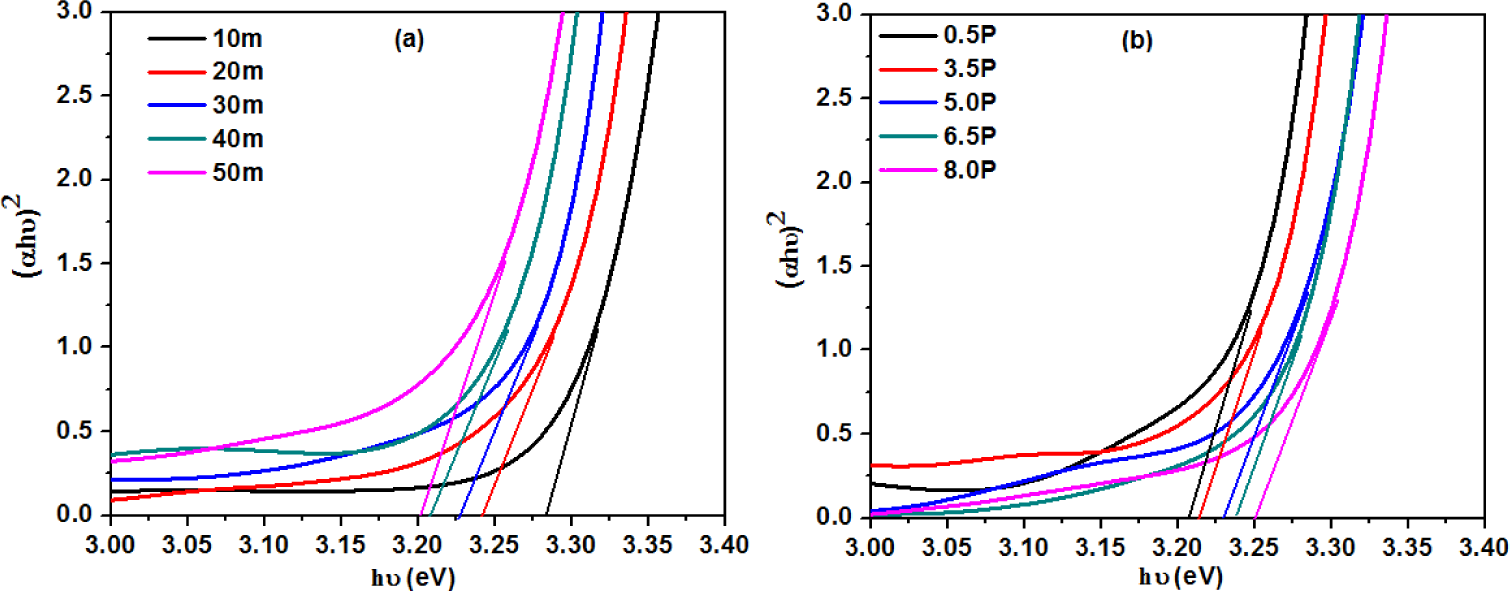
Optical absorption curves of ZnO films deposited at different (a) deposition times and (b) deposition pressures

AFM images of ZnO nano thin films deposited at different (a) deposition times and (b) deposition pressures
The AFM images of ZnO nano thin films deposited at different times and pressures are shown in Figures 4(a) and 4(b), respectively. The thickness of ZnO nano thin films increases with deposition time and decreases with increase in sputtering pressure due to greater deposition rate with a gradual rise in surface roughness. At 10 minutes and 8.0 Pa, ZnO nano thin films are almost amorphous, with very low surface roughness value. When the deposition time is increased to 50 minutes and deposition pressure is 0.5 Pa, ZnO nano thin films are thicker, with greater surface roughness values compared to previously.
The crucial parameter that illustrates wettability is static contact angle, which is defined as the measurable angle that a liquid makes with a solid. The contact angle depends mainly on the roughness of the thin film. The Wenzel equation [18] gives the relation between surface roughness and water contact angle. The wettability properties of water, ethylene glycol, sunflower oil and formamide on deposited ZnO nano thin films were measured by contact-angle goniometer. The values of the static contact angle of water, ethylene glycol, sunflower oil and formamide are shown in Figures 5(a) and 5(b).

Contact angle of ZnO nano thin films at different (a) deposition times and (b) deposition pressures
A single liquid–solid system has a spectrum of equilibrium contact angles. Variation in contact angle is referred to as contact-angle hysteresis (CAH) in chemical sciences. The maximum and minimum contact angles are called the advancing contact angle (θA) and the receding contact angle (θR), respectively [19]. The advancing and receding contact angles can be generated by the tilting plate method. The values of the advancing contact angle (θA), receding contact angle (θR) and CAH on deposited ZnO nano thin films for water, ethylene glycol, sunflower oil and formamide are shown in Table 2. When the deposition time of ZnO nano thin films is increased from 10 to 50 minutes, the CAH of water decreases from 8.7° to 3.1°; for ethylene glycol it decreases from 18.1° to 12.2°; for sunflower oil it decreases from 23.3° to 12.3°; and for formamide it decreases from 21.2° to 9.3°. When deposition pressure is increased from 0.5 Pa to 8.0 Pa, the CAH of ZnO nano thin films for water decreases by 9.6° to 4.3°; for ethylene glycol it decreases from 17.6° to 10.6°; for sunflower oil it decreases from 23.6° to 14.4°; and for formamide it decreases from 22.3° to 10.6°. The relation between surface roughness and CAH on deposited ZnO nano thin films is shown in Figures 6 (a) and 6 (b).
Wettability properties of zinc oxide nano thin films


CAH and surface roughness of ZnO nano thin films at different (a) deposition times and (b) deposition pressures
The lowest obtained CAH values were 3.1° for water, 12.3° for sunflower oil and 9.3° for formamide at deposition time 50 minutes and roughness value 34 nm, and 10.4° for ethylene glycol at surface roughness value 27 nm and deposition pressure 8.0 Pa for deposited ZnO nano thin films. Based on these minimum CAH values, liquid is easily removed from ZnO nano thin films surface when it is just tilted from horizontal level. This behaviour is very useful for self-cleaning processes in vehicles and industries. We observed that when deposition time and sputtering increased, the CAH value decreased. This may be due to a decrease in the interaction between droplets of water, ethylene glycol and the other two liquids with the surfaces of ZnO nano thin films.
Varying the surface chemical composition and surface morphology for surface energy of a film are challenging processes. The highest contact angle of water, ethylene glycol, sunflower oil and formamide for ZnO nanostructured thin films is obtained up to 114.6°, 94.5°, 58.7° and 99.7° for sample 50m deposited at deposition time 50 minutes, respectively. The films deposited under these conditions are hydrophobic for water. Repellency of films for ethylene glycol, sunflower oil and formamide increases from its initial respective values of 26°, 20.2° and 37.2° for uncoated substrate. This study therefore demonstrates that the development of repellent ZnO nano thin films can be tailored to the requirements of specific applications involving water, ethylene glycol, sunflower oil and formamide. These films can have possible uses as wear- and erosion-resistant defensive coatings in non-stick home appliances, or, especially relating to formamide, in the paper and fibre industries.
4. Conclusion
ZnO nano thin films were deposited at various deposition times and working pressures. The (002) peak of ZnO thin films increases and grain size becomes larger with increase in deposition time and deposition pressure. When deposition pressure is 3.5 Pa, (100), (002) and (101) textures of ZnO are observed. The optical energy band gap decreases with increase in deposition time and decrease in deposition pressure for deposited ZnO nano thin films. The maximum surface roughness values of 34 nm and 27 nm are observed for ZnO nano thin films deposited at 50 minutes and 8.0 Pa, respectively. For deposition time of 50 minutes, the contact angle values of water, ethylene glycol, sunflower oil and formamide are 114.6°, 94.5°, 58.7° and 99.7°, respectively. When deposition pressure is kept at 8.0 Pa, the contact angle values are 106.7°, 84.6°, 53.6° and 92.3°, respectively. The CAH value decreases with increase in deposition time and working pressure for deposited ZnO nano thin films. These films may have potential use as liquid-repellent protective coatings.
Footnotes
5. Acknowledgements
This work has been supported by AICTE grant number 20/AICTE/RIFD/RPS (POLICY-III) 24/2012-13 sanctioned under Research Promotion Scheme (RPS). We are thankful to the President and Provost of CHARUSAT for supporting this research work. We are also grateful to Dr T. K. Chaudhuri, Professor and Head, Dr K. C. Patel Research and Development Centre (KRADLE), affiliated to Charotar University of Science and Technology (CHARUSAT), India, for granting permission to use various equipment available in the Centre's characterization laboratory.