




Abstract
This paper focuses on studying the effect of cable tensions and stiffness on the stability of cable-based parallel camera robots. For this purpose, the tension factor and the stiffness factor are defined, and the expression of stability is deduced. A new approach is proposed to calculate the hybrid-stability index with the minimum cable tension and the minimum singular value. Firstly, the kinematic model of a cable-based parallel camera robot is established. Based on the model, the tensions are solved and a tension factor is defined. In order to obtain the tension factor, an optimization of the cable tensions is carried out. Then, an expression of the system's stiffness is deduced and a stiffness factor is defined. Furthermore, an approach to evaluate the stability of the cable-based camera robots with hybrid tension-stiffness properties is presented. Finally, a typical three-degree-of-freedom cable-based parallel camera robot with four cables is studied as a numerical example. The simulation results show that the approach is both reasonable and effective.
1. Introduction
With the development of television broadcasting technology, the requirements for aerial panoramic photographing are increasing rapidly. In general, helicopters, rocker cameras and crank-arm lift trucks are often adopted for aerial panoramic photographing. However, helicopters have several disadvantages, such as noise, trembling, instability of footage, and the facts that they ignore the details of motion and are easily affected by weather. Rocker cameras and crank-arm lift trucks only work within a small range because they are limited by freedom and lift height. They interrupt the audience's view of the scene. Therefore, it is necessary to create a photographing mode that can achieve full-range framing, real-time footage, continuity, efficient effort, flexible screens and stability. It is perfectly feasible to achieve the above-mentioned requirements by means of a cable-based parallel camera robot, as is shown in Figure 1 [1].

General model of a cable-based parallel camera robot
The cable-based parallel robot is a kind of parallel robotic manipulator that uses actuated cables in order to operate objects. It confers several outstanding advantages over its rigid-link counterpart, including a simple structure, a high payload, high speed, a stable gantry configuration, a small degree of inertia, flexibility, precise manoeuvrability, removable reorganization and a large workspace. Cable-based parallel robots satisfy different functional and performance requirements in a variety of practical applications. They are studied in different fields, such as statics [2], dynamics [3], kinematics [4], institutional performance analysis [5] and control theory [6], etc. They are also defined by a range of different performance evaluation indexes from distinct perspectives, such as workspace [7], singularity [8], stiffness extreme value [9], driving force optimization [10], accuracy error [11] and so on. It is proposed that theoretical analysis and calculation methods guide the development research and applications of the cable-based parallel robots. Regrettably, the stiffness of the cable-based parallel robot is far lower than that of the rigid-link parallel robot, and stiffness plays an important role in the stability of the system. Stability is particularly important for the cable-based parallel robots because it directly affects operations under the conditions of high speed and high precision. Sometimes, a system is destroyed not because of weak intensity but because of a loss in stability. Therefore, it is necessary to analyse the stability of cable-based parallel robots.
Several studies have been performed to establish the stability of the cable-based parallel robots. Carricato et al. [12] proposed an optimization algorithm to analyse the stability of unconstrained cable-based parallel robots. However, this study only considers the unconstrained cable-based parallel robots in static balance. Jiang et al. [13] developed an approach for stability analysis that is based on the Hessian matrix. If the Hessian matrix was positive, the corresponding equilibrium configuration can be considered as stable. However, the study failed to quantify the impact. Bosscher et al. [14] put forward a method to measure such stability; their study was based on the slope and had physical significance. The measure was developed in order to explain how the mechanism was severely affected by the influence of an unknown external force. However, this measure was only applicable to unconstrained parallel robots. Liu et al. [15] discussed the minimum cable-tension distributions for the completely restrained cable-based parallel robots. It showed the minimum cable-tension distributions in the workspace in terms of three performance factors. It also illustrated the relationship between the three performance factors and stability. However, the study ignored the stiffness factor. Korayem et al. [16] established the stiffness model in considering a cable's sagging and flexibility. It analysed stability based on a characterization of the stiffness matrix. Regrettably, it only discussed the relationship between the stability and stiffness matrices, failing to quantify the impact. Behzadipour et al. [17] established a stiffness model in which a cable was equal to four combination springs that were not under a state of pre-tension. The study discussed the stability relationship between the stiffness matrix and mechanisms. It also proved the necessary and sufficient conditions for the matrix being in a state of positive and system stability. However, a stiffness model in which a cable was equal to four combination springs under no pre-tension was imprecise, because the springs differed in the form of stiffness matrix that they took. Thus, discussion of the degree of approximation was necessary. Svinin et al. [18, 19] explained the stiffness matrix and the stability analysis in terms of the Gough-Stewart Platform. It indicated that the stiffness matrix was positive definite, and therefore stable, if all the joint-stiffness factors were positive. Unfortunately, no examples illustrated the theory of rationality and effectiveness. More importantly, it was only applicable to the rigid, rod-driven parallel robot.
The main focus of this article is to study the effects of minimum cable tension and stiffness on the stability of cable-based parallel robots. First, a classical approach is used to establish the mechanical equilibrium equations of Newton-Euler. Second, the concept of the cable-tension factor of cable-based parallel robots is introduced. Then, a set of formula derivations for obtaining the stability factor of these robots is derived. In the following section, a formula is derived for obtaining the stiffness factor. Then, a stability approach that is based on a characterization of the cable tension factor and the stiffness factor is presented. Finally, based on the above modelling, a simulation study for a three-degree-of-freedom cable-based camera robot is shown to prove the rationality and effectiveness of the method proposed.
2. A Static Equilibrium Equation for Cable-Based Parallel Camera Robots
When the cable-based parallel camera robots are small in size, the cable sag under the action of gravity is negligible. Therefore, the shape of the cable can be approximated as a straight line.
In order to simplify the theoretical model, this paper makes the following assumptions:
The connections between the cables, frame and end-effector are ideal;
The cables meet ideal conditions; that is, the cables can pull but not push.
The deformation of the cables complies with Hooke's Law.
A kinematic model of the cable-based parallel camera robot with a coordinate system and parameters is established. Its end-effector is connected to the base via four cables, as shown in Figure 2. It is assumed that the robot is tensional; that is to say, the cable tensions can be generated in all cables at the same time. A global fixed-reference frame, as noted by O - XYZ, is attached to the base of the cable-based robot and is referred to as the base frame, where O is the origin point. A moving reference frame, as noted by P - xyz, is attached to the moving platform, where P is the reference point at which the camera robot is positioned. Point Ai, at which the cable i = (1,2,3,4) is tangential to the pulley, is assumed to be fixed to the global fixed-reference frame. Furthermore, the i th cable is attached to the moving platform at point Bi, and this attachment point is assumed to be fixed relative to the moving platform. Vectors °ui =[°

Kinematic model of a cable-based parallel camera robot
According to Newton-Euler, the static-balance equation of this cable-based parallel camera robots is [9]


Where W is the generalized external force acting on the end-effector centre point in the environment; T = [T1,T2,T3,T4]T is the vector of the cable tensions, assuming the tensile forces to be positive; Tmax is the upper bound of the cable tension and Tmin is the lower bound of the cable tension. The parallel camera robot Jacobian J is found to be

Where
3. Definition of the Tension Factor of Cable-Based Parallel Camera Robots
Due to the fact that only the cables are under tension, the camera robot must be driven redundantly in order to make the end-effector be completely controllable. If the motion trajectory of the end-effector is known, then there is more than one solution for the kinematic equation. However, it is necessary to count each cable tension in real-time in the actual motion control. Therefore, it is necessary to optimize the cable tensions in order to obtain a unique solution [10].
Based on the static balance equation, the expression of cable tensions is defined as:

Where J+ is the Moore-Penrose generalized inverse of the Jacobian matrix J; Null(J)λ is the homogeneous solution for the cable tensions, only changing the internal tension distribution; Null(J) =[J1,J2,J3,J4]T is a zero-dimensional base space of the Jacobian matrix and λ is an arbitrary scalar. Upon substituting Eq.(4) into Eq.(2), it can be found that

Therefore, the optimization of cable tensions can be considered as a single-objective programming problem for λ. Its model is as follows:

Where F (λ) is the objective function, which is the polynomial with respect to λ, and it is selected for different needs.
In this paper, the minimum variance of cable tensions is the optimization goal, which uniquely determines the cable tensions' solutions. The objective function F (λ) is described as:

Where
The minimum variance is selected as the optimization goal because it makes cable tensions' values identical.
The minimum cable tension at any position in the workspace can be expressed as:

The largest minimum cable tension in the whole workspace can be written as:

This paper deals with the stability of the cable-based parallel camera robot by using the cable tension factor, for the case of establishing the minimum cable tension TSmin at any position in the workspace and solving the maximum cable tension Tmaxmin in the whole workspace. The cable tension factor of the stability is defined as:

4. Stiffness-Factor Analysis of Cable-Based Parallel Camera Robots
The stiffness matrix refers to the linear relationship between a small change in the generalized external force and the displacements of the end-effector. When a camera robot is in a stable equilibrium state in a certain pose X0, assuming that the robot is slightly distorted from the generalized external force dW, the original pose X0 produces a small displacement d X to that required to reach a new pose X1. Therefore, the theoretical model of the stiffness matrix is developed as follows [12]:
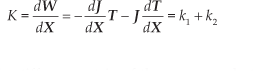
The static stiffness matrix of the camera robot consists of two parts: k1 is the end-effector stiffness matrix generated by the changed pose, which depends on the cable tensions, and k2 is the cable elastic stiffness matrix, which depends on the cable's physical properties. X is the pose of the end-effector.
The first term in Eq.(11) is the end-effector stiffness matrix, which can be rewritten as [20]:
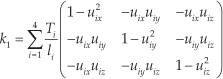
Where uix, uiy, uiz and i = 1,2,3,4 are the components of the i th unit vector of the cable length and li is the cable's straight lengths.
The second term in Eq.(11) is a mapping of the joint stiffness, which can be rewritten as [20]:

Where E is the elastic modulus of the cable and A is the cross-sectional area of the cable.
On rearranging Eq.(11), Eq.(12) and Eq.(13), we get the following expression:

In order to analyse the stability of the camera robot, this paper uses the Rayleigh quotient of the static stiffness matrix K in order to characterize the robot's stiffness, which is based on the eigenvalues of the matrix theory and the principle of the symmetrical matrix polarity. The Rayleigh quotient is defined as:

According to Eq.(11), the R (d X) is rewritten as:

Eq.(16) shows that the Rayleigh quotient is the ratio of the small variation for the generalized external force d W and the small variation pose d X.
For the purpose of analysing the Rayleigh quotient, the following expression is set according to the relationship between the inner product and norm:

Due to Eq.(11) and Eq.(17), if the small variation d W of the generalized external force remains unchanged, then the small variation pose d X of the end-effector platform is directly associated with the static stiffness matrix. Assuming that the module of the small variation d W of the generalized external force is a constant 1, the larger
The static stiffness matrix K can be identified for any position of the workspace for a camera robot. In order to evaluate the pros and cons of the stiffness in the workspace, the singular value σ(K) of the static stiffness matrix is given as follows:

Based on the principle of the real symmetrical matrix's eigenvalue, the inequality relationship of

Where d X ≠0.
The position that possesses the biggest minimum singular value is the most stable position for the whole workspace. Therefore, this paper presents the stability study of the cable-based parallel camera robots in terms of the stiffness factor η in the workspace. The stiffness factor of the stability is defined as:

Where σ(K)Smin is the smallest minimum singular value of the current position in the workspace, and σ(K)maxmin is the largest minimum singular value in the whole workspace.
5. A Stability Analysis of Cable-based Parallel Camera Robots
Definition of stability: A cable-based parallel camera robot is stable if it can maintain a desired working position when it is disturbed by generalized external forces. In other words, when an end-effector can stay at a desired position X in the workspace under a generalized external force, the camera robot can be considered as stable.
A definition of the stable workspace: Each position in the workspace corresponds to a set of specific minimum cable tensions and stiffnesses. That is to say, it corresponds to certain stability. The positions that satisfy certain stabilities are gathered together to form a stable workspace.
The larger the minimum cable tension TSmin, the more stable the camera robot will be, because the cable will be tighter and it will be difficult for the end-effector to deviate from the desired working position when it is disturbed. Thus, the camera robot is considered stable if all of its positions meet the minimum cable tension, which is not less than a certain value. According to the definition of the cable tension factor, it is worth noting that the denominator is constant and the numerator is the minimum tension of the current position in the workspace; therefore, the distribution trend for the minimum tension and the cable-tension factor is consistent. Therefore, the larger the cable tension factor φ, the more stable the camera robot will be.
One can evaluate the stability of a camera robot by using the minimum singular value of the static stiffness matrix. That is because the position that holds the biggest minimum singular value is the most stable position for the whole workspace. The larger the minimum singular value, the stronger the stability for the camera robot. On the basis of the definition of the stiffness factor, one knows that the larger the stiffness factor, the more stable the camera robot.
In conclusion, these properties indicate that a cable-based parallel camera robot can become more stable by increasing the cable-tension factor and the stiffness factor.
The stability of the cable-based parallel robots that resists external disturbances not only relates to the cable tensions, but also to the stiffness. Therefore, it is more comprehensive and objective to evaluate the stability of the end-effector by using both tension and stiffness, which are weighted equally. Therefore, this paper deals with the cable-tension factor and the stiffness factor of the camera robot in the workspace in order to study stability. The hybrid tension-stiffness index Ω is proposed in order to evaluate stability based on Eq.(10) and Eq.(20). The value of Ω is called the hybrid-stability index, which is defined as:

Where b1 and b2 are the weighted coefficients and b1 + b2 = 1. The values of b1 and b2 are positive numbers less than 1.
The weighted coefficients reflect the contributions of the cable-tension factor and the stiffness factor on the system's stability. Hence, they are usually determined by the camera robot's configuration and the optimization of the cable tensions. Once the configuration and the optimization of the cable tensions of the camera robot are determined, two unique weight coefficients can be determined. For this paper, the research object is a redundant actuation and a fully constrained cable-based parallel robot, whose optimization objective is the minimum variance of the cable tension. Therefore, the two weight coefficients are b1= 0.6 and b2 = 0.4.
The range of the hybrid-stability index is Ω ɛ[0,1]. When Ω = 0, the positions lie outside of the workspace. When Ω = 1, the position possesses the best stability possible for the workspace, the distribution of the four cable tensions is the most uniform and the stiffness value is the biggest. The other important factors are obviously Ω ɛ (0,1).
The algorithm for the stable workspace can be summarized as follows:
Input the real-time position Xi of the end-effector in the workspace (i = 1,2,…,N is the total number of positions) and a threshold limit Ω* min of the hybrid-stability index. Input the generalized external force on the end-effector W (Xi),i = 1.
Calculate the Jacobian matrix J and the zero-dimensional base-space matrix Null(J) = [J1,J2,J3,J4]T of the Jacobian matrix.
Obtain the optimized cable tensions via Eq.(1) and calculate the minimum cable tension of the current position using Eq.(8). Calculate the largest minimum cable tension of the whole workspace using Eq.(9).
Get the stiffness matrix and the minimum singular value of the current position via Eq.(11) and Eq.(18).
Obtain the tension factor using Eq.(10).
Obtain the stiffness factor using Eq.(20).
Calculate the stability of the current position using Eq. (21).
Judge whether Ω(Xi) is larger than Ω* min . If it is, record and output Xi; if not, go to the next position, i = i + 1.
Judge whether Xi is the final position. If it is, record and output the current position and stop the calculation; if not, go to (1) and solve Ω(Xi+1) for the next position Xi+1.
6. Numerical Example
6.1 Description of the Camera Robot
In order to prove the rationality and effectiveness of the hybrid-stability index, a simulation study was carried out. One particular type of a three-degree-of-freedom cable-based parallel camera robot was used for simulation and analysis. It uses four cables in manoeuvring the work platform.
The actual model in 3D space is of three translational degrees-of-freedom and three rotational degrees-of-freedom. The camera robot, however consists of a translational mechanism and a second-stage rotating mechanism. The translation is implemented via four-cable traction, a composite-hinge structure, and stable horizontal and vertical gyroscopes. The composite-hinge structure decouples the rotation from the translation, making this paper capable of studying the translation problems independent of other factors. The second-stage rotating mechanism is used to adjust the attitude of the camera. Hence, the rotational degree-of-freedom for the second-stage rotating mechanism can be uncoupled completely. Therefore, the camera platform in the workspace can be considered with three translational degrees-of-freedom, and it can be assumed to be a point mass.
The geometric and mechanical properties of the camera robot used in the simulation are listed as follows. The mass of the camera platform is m = 20kg. The upper bounds of the cable tensions are Tmax=[3000,3000,3000,3000]T N. The lower bounds of the cable tensions are Tmin = [10,10,10,10]T N. The positions of the pulleys are A1 = [0,0,25]T m, A2 = [39,0,25]T m, A3 = [39,42,25]T m, A4 = [0,42,25]T m. The elastic modulus of the cable is E = 1.5 × 10⁵MPa. The cross-sectional area of the cable is A = 2.3mm2.
6.2 Results and Discussions
As shown in Figure 3, one may observe that the cable-tension factor φ is distributed symmetrically around the centre position in both the horizontal and vertical planes. It is worth noting that a position closer to the centre and upper positions leads to larger cable-tension factors. That is to say, the centre and upper positions possess larger φ than the ones around them. Moreover, one feature is that the same φ are distributed along the same curves. It is evident that the inside surfaces hold larger φ than the ones outside. Meanwhile, the contour-line trend indicates that the upper positions hold larger φ than the lower positions.

The cable-tension factor on the sections of the workspace
The cable-tension factors on two different sections are shown in Figure 3(a) and 3(b). It can be noted that φ is symmetrical about the X and Y planes. The points closest to the centre positions pose the biggest cable-tension factor. Meanwhile, it is noteworthy that the contour lines for the cable-tension factor comprise a group in themselves, and that they spread from the centre to the surrounding area. This occurs because the biggest φ occupies the centre position. The further away the positions are, the smaller φ they possess.
The stiffness factors of the different sections are shown in Figure 4. As can be observed, the stiffness factors are symmetrically distributed about the centre position on the same horizontal plane. Of course, it is important to note that the larger η is distributed on both sides of the central axis because of its remarkable stiffness. This phenomenon is different from the cable-tension factor shown in Figure 3(a) and 3(b). Even more important is the fact that the shapes of the surfaces show in detail the change of η along the central axis. Meanwhile, the positions holding the same η are situated on the same contour lines because they occupy the same position of the stable workspace. It is clear that the curves of the stiffness factor vary with X, Y and Z, because the stiffness for each position is different. In other words, the stability is not the same.

The stiffness factor in the workspace
As is shown in Figure 4(a), it is noteworthy that the shape of the surface is a saddle-shape. By observing Eq.(11), Eq. (12) and Eq.(13) we know that the values of stiffness mainly depend on the Jacobian J and the elastic properties. Namely, the saddle-shaped is related to the Jacobian J and the elastic modulus E, the cross-sectional area A and the cable straight lengths li of the parallel camera robot. However, the elastic modulus and the cross-sectional area are constants. The cable straight lengths li are equal to two norms of the cable length vector when we take out the numerical simulation. According to Eq.(3), we know that the saddle-shape is caused by the unit vectors of the cable lengths. In other words, the saddle-shape is due to the speed of the stiffness variation; therefore, it showed a saddle-shape on the surface.
Furthermore, one may find that the distribution of the stiffness factor is different to that of the cable-tension factor along the Z-direction. The cable-tension factor increases with the increasing Z coordinate values, but the stiffness factor first increases and then decreases. The larger stiffness factors are distributed in the lower portion of the Z coordinates, while the larger cable-tension factors are distributed in the upper portion. However, the cable-tension factor and the stiffness factor cannot be ignored in creating the stability of the cable-based parallel robot. The minimum tensions avoid the virtual pull, and the stiffness represents the robot's ability to resist the generalized disturbances. Therefore, it is comprehensively and objectively better to weight both of them in order to analyse the stability. The best stability requires them to be distributed in the upper portion of the workspace in engineering applications. Therefore, the weighted coefficients b1 and b2 are necessary for stability analysis.
The distribution of the hybrid-stability indexes in the workspace is shown in Figure 5. Here, b1 = 0.6,b2 =0.4. Figure 5(a) is the hybrid-stability index on the Z = 9m plane. Figure 5(b) is the hybrid-stability index on the Y = 9m plane. Figure 5(c) is the hybrid-stability index on the X = 9m plane. Figure 5(d) is the distribution surface of Ω = 0.5 in the workspace.

The hybrid-stability index in the workspace
From Figure 5(a), it is worth noting that the hybrid-stability index is a symmetrical distribution about the X-direction and the Y-direction because the horizontal sections are rectangles. Moreover, the hybrid-stability index is larger at the central positions than at the other positions, because both the minimum cable tension and the minimum singular value are larger there.
As expected, the hybrid-stability index increases with the increasing Z along the midline shown in Figure 5(b) and 5(c). More importantly, the greater the value along the Z-direction, the greater the stability that will be obtained. It should be noted that the positions inside the surface satisfy the stability requirement. It is evident that for the surface that is in the upper part of the workspace, the distribution of the hybrid-stability index gradually diverges to that of the surrounding workspace with the increasing Z, because the cable tensions and the stiffness tend to decrease.
Considering Figure 5(a), 5(b) and 5(c) together, it is clear that the biggest hybrid-stability index is at the centre-top position; that is because the weighted coefficient between the cable-tension factor and the stiffness factor is reasonable.
As shown in Figure 5(d), the colours represent the height of the Z-coordinate. It is important to note that the hybrid-stability index within the curved surface is larger than 0.5. Therefore, the surface can be used as the boundary condition in order to judge that a stable workspace possesses a certain degree of stability. As long as the end-effector runs inside the curved surface, it is thought to satisfy the desired working condition. Meanwhile, the hybrid-stability index is a symmetrical distribution in the workspace.
With Figure 5(e) and 5(f) together, one may find that the stable workspace is distributed in the upper-middle portion of the workspace. In conclusion, the end-effector operates in this region as much as possible.
The hybrid-stability indexes on two different vertical planes are shown in Figure 6. Together with Figure 5(c), it is evident that stability varies with different X. It can be seen that stability is a symmetrical distribution, and that it is larger at the central positions than at the other positions. The internal surfaces possess more stability than the external surfaces. That is to say, we should make the camera robot operate in the internal surfaces as much as possible. It can be noted that the positions with the same degrees of stability constitute a family of symmetrical contour lines, and the shapes of the contour lines are different. The contour-line density represents the gradient of the variable stability. The larger the density, the quicker the variable gradient will be.

Ω on the different parallel vertical planes
The relationship between the hybrid-stability index and the stability of a workspace is shown in Figure 7. It is worth noting that the stability of a workspace varies with the hybrid-stability index. It increases at first, and then decreases. The stable workspace is largest when the hybrid-stability index is 0.4. That is to say, the stable workspace is not proportional to the hybrid-stability index, making it necessary to achieve a balance between them.

The relationship between hybrid-stability indexes and stable workspaces
It is important that the stability of the cable-based parallel camera robot is defined in general terms, such as “The structure can be maintained at a desired location and status when the robot is disturbed by generalized forces” [2]. Thus, all running stable positions of the camera robot comprise the stable workspace.
The stable workspace being subjected to different types of generalized disturbance is shown in Figure 8. Here, FX,FY,FZ are equal and they lie on the positive direction of the coordinate axis. From Figure 8, it is evident that the volume of the anti-interference stable workspace decreases with an increase to the generalized disturbance. That is because the greater the generalized disturbances, the greater the chance of damage. As stated above, generalized disturbance plays an important role in establishing the stability of the cable-based parallel camera robot. When the generalized disturbances are different, so is the volume of the anti-interference stable workspace.

The stable workspace under the influence of different disturbances
It was found that the anti-interference stable workspace is at its largest when only +FX has an effect on the end-effector. This can be readily explained by the fact that the system has a sufficient capacity to resist the single-direction generalized disturbance. The anti-interference stable workspace is smallest when it is disturbed by two-direction generalized disturbances. That is to say, the stability of the system is at its worst under that condition. That is because the resultant force of a pair of mutually perpendicular forces is at its largest.
In a word, the proposed indexes are significant for the cable-based parallel camera robot in order to analyse the disturbance rejection. Even though it does not directly describe the disturbances, it can indirectly reflect the size of the disturbances. The stability of the camera robot depends on the system itself, which is the natural property of the structure. However, the existing disturbances will cause the system to be unstable. The instability of the camera robot directly causes variations to the cables' tensions and stiffnesses. According to Eq.(10) and Eq.(20), the largest minimum cable tension Tmaxmin and the largest minimum singular value σ(K)maxmin become large, while the minimum cable tension TSmin and the minimum singular value σ(K)Smin at the current position in the workspace are constants. Therefore, the cable-tension factor and the stiffness factor get smaller. In addition, the more frequent the disturbances, the greater the variations in the cables' tensions and stiffnesses, and the smaller the proposed indexes will be. That is to say, the proposed indexes reflect indirectly the size of the disturbances. Hence, different proposed indexes reflect different disturbances in the workspace. Therefore, the proposed indexes offer some guidelines for selecting the appropriate workspace for the end-effector.
The stabilities under different weighted coefficients are depicted in Figure 9. b1 is the weighted coefficient of the tension factor, and b2 is the weighted coefficient of the stiffness factor. From this figure, it can be noted that the stabilities are different when the values of the weighted coefficients are different. That is because the contributions of the minimum tension and the minimum singular value are different. As expected, the positions in the middle plane, which is the vertical planes Y =9m and =9m, hold bigger Ω than the ones around them under different weighted coefficients.

The stability under different weighted coefficients on the horizontal plane
Considering Figure 9(a) and 9(b) together, it is noteworthy that the stabilities are different along the Z-direction. It is also evident that the stability spreads to the surrounding area. With Figure 9(c),9(d) and 9(e), it can be seen that the red region reduced gradually with the increasing b1, which illustrates that the stability is falling.
As shown in Figure 9(f), the stability area varies with the weighted coefficients. Namely, it increases first and then decreases with the increasing b1. That is to say, the tension factor plays a leading role in the beginning period. It implies that the weighted coefficients will be used as a guide for choosing the control strategy and designing the control system. From Figure 9(f), it is noteworthy that the size of the stable workspace Ω 0.3 is the largest when b1 = 0.4,b2 = 0.6. The distribution for stability that is consistent with our expectations, however, is shown in Figure 9(b) when b1 = 0.6,b2 = 0.4. That is to say, we have to achieve a balance between stability and size of the stable workspace when designing a controller. It is worth noting that when b1 = 0.5,b2 = 0.5, stability is not at its largest because the effects for the minimum cable tensions and the stiffness are not equal. Therefore, it is fairly important for us to select the appropriate weighted coefficients based on the configuration of the cable-based parallel camera robot and the optimization goal of the cable tensions. Moreover, it can be seen that the smaller the proportion of stiffness, the worse stability will be. In a word, stiffness cannot be ignored in favour of the stability analysis.
The significance of the simulation results for stability is to provide a reference value for the workspace of the camera robot. According to the simulation results, we can prevent the camera from working in the unstable region, and, based on the analysis above, it can be concluded that the end-effector of the camera robot in the workspace can operate stably and reliably at the desired positions. Those holding a higher performance index can be attributed to the larger minimum cable tensions and the larger stiffness. Accordingly, it is reasonable and effective to determine the system's stability based on the hybrid tension-stiffness evaluation index.
7. Conclusions
In this paper, a new approach for evaluating the stability of the cable-based parallel camera robots is introduced. This approach shows that the stability of cable-based parallel camera robots is the weighted summation of two factors. The first one represents the cable-tension factor and represents the influence of the minimum cable tensions on the system's stability. The second one is the stiffness factor and is caused by internal forces. It represents the influence of stiffness on the system's stability.
The stability of a cable-based parallel camera robot is defined as the capacity of a robot to be stable under the influence of generalized external forces. It was indicated that the positions at the centre of the workspace possess larger minimum cable tensions and stiffnesses than those of the other positions, leading to stronger stabilities.
An example of a three-degree-of-freedom cable-based parallel camera robot with four cables is provided, in order to elaborate the meaning of stability and its geometrical implications. It also confirms the rationality and effectiveness of the evaluation index.
The focus of this paper is on analysing structural stability, without considering the operating status of the camera robots. Hence, motion stability will be one of the focuses of our future work. When long-span cables and high manoeuvrability are involved, the effects of cable inertia on the robot's dynamics must be dealt with carefully. For this purpose, we shall study the motion stability of the highspeed cable-based parallel camera robots when considering the cables' inertia effects.
Footnotes
The authors declare that there is no conflict of interests regarding the publication of this paper.
9. Acknowledgements
The authors gratefully acknowledge the financial support of the National Natural Science Foundation of China under Grant Nos. 51175397 and 51105290.