




Abstract
In this paper, we present an application of a method for solving the multi-objective programming problem (the MP method), which was introduced in [1]. This method is used to solve the problem of distribution (te problem of cost/profit allocation). The method is based on the principles of cooperative games and linear programming. In the paper, we consider the standard case (proportional distribution) and the generalized case in which the basic ideas of coalitions have been incorporated. The presented theory is applied and explained on an investment model for economic recovery.
1. Introduction
The problem of distribution (allocation or division) is a common, everyday problem. It consists of dividing a certain amount among several (two or more) users. We experience this problem every day through the distribution of our salaries on life's necessities, family members, overhead expenses and other costs. The payment of wages to workers and the distribution of incentives from certain funds are also examples. The problem is not only connected with the distribution of the financial resources. It also covers the distribution of food, water, energy, oil and gas, goods and any other property at the global or local levels.
The problem of distribution (PD) is easy to solve if the available amount which has to be divided is large enough. In fact, in this case the problem does not exist because each user can get as much as he needs or requires. Usually, the available amount is limited and such distribution is impossible. In these cases, objective possibilities and the aspirations of the users have to be respected, which implies some kind of cooperation among the users.
The PD has been extensively studied in the literature and it is usually considered as a cost and profit allocation problem. Usually, researchers use cooperative games as the framework in determining the algorithms for solving this problem. The following text presents some papers in which such ideas have been used.
In [2], the allocation of operating costs among the lines of an insurance company as an accounting problem is presented. It is proved that the cost allocation problem is identical to the determination of the value of a cooperative game with transferable utilities. A new method, called ‘proportional nucleus' is proposed as a solution to the problem.
In [3], the authors solve the cost and profit allocation problem among connected companies, as well as the determination of production and transportation plans, by applying a solution concept from game theory.
In [4], the cost allocation problem within the generalized linear programming class of games is investigated. It is assumed that a group of agents participate in a common project and that each agent defines his requirements for his expected benefit resulting from the project. The joint cost or profit of the project must be allocated among the agents in order to satisfy a set of required properties. The authors present a general and efficient algorithmic framework for computing exact cost allocations in generalized linear programming games. The literature surveys of cost allocation by linear programming and generalized linear programming games are given in [5] and [6].
The game theoretic models of cost allocation used to solve the cooperative advertising problems are studied in [7]. For this purpose, different models are proposed. Some models are focused on advertising spending by manufacturers and retailers, and manufacturers' support programmes for local advertising.
The cost allocation problem also occurs in public utilities [8], [9], the joint production of goods [7] and electricity [10], [11], [12], [13], [14], the use of networks [15], accounting [16], management [17] and other situations.
In this paper, we present a new approach to solve the cost (profit) allocation (distribution) problem. The paper is an application of a new method for solving a general multi-objective linear programming problem (MOLPP) from [1]. The reasons for using it are its properties: (1) it is an iterative method (if the obtained solution is not satisfactory, then it can be improved by the next iteration(s)); (2) it is based on the principles of game theory (cooperation among decision-makers); (3) each iteration consists of a linear programming problem which yields a unique solution; (4) the solution is obtained by respecting the aspirations of decision-makers within the frame of given possibilities; (5) in each iteration, we can compute objective indicators which show the reality of aspirations and which may be used to define the strategy for the next iteration. These properties are very important in the solving procedure for the considered distribution problem (which is a specific case of MOLPP). The proposed method allows different criteria to be involved in the solution process. For a better understanding of how these possibilities become prominent according to the specific nature of the problem, we provide several examples. The main contribution of the paper is an application to an investment model (see Section 4) which suggests one means for economic recovery. The benefits of such a model are confirmed by explicit mathematical results (with general and particular parameter values).
2. Statement of the problem
Let b be the available amount (budget) which has to be divided among n users (players) P
i
, i=1, 2, …, n, and let x = (x1, x2,…,xn)εRn. We define a general constraint set
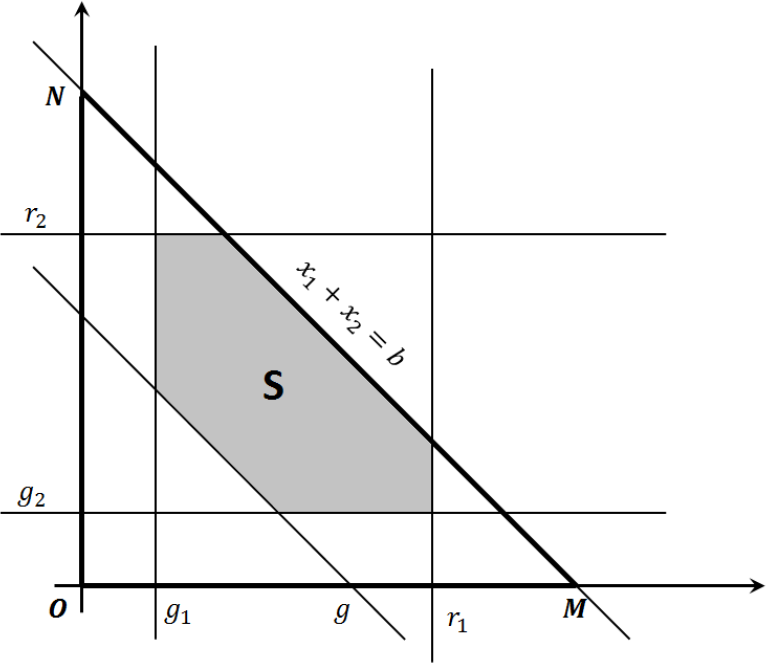
The constraint set (general and available)
For example, if we divide the entire budget b, then we have x1 + x2 + … + xn = b, which defines S (the line MN in Figure 1). We can also have restrictions for the lower bounds (xi≥gi and/or x1 + x2 + … + xn≥g) or for the upper bounds (xi≤ri), which will reduce B to S (see Figure 1). If we do not intend to spend the whole budget b, then a constraint such as x1 + x2 + … + xn≤r <b can appear as well. Various kinds of other restrictions are also possible. Thus, the PD can be stated in the following general form,
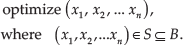
Here, the word “optimize” does not have a strictly defined meaning. The meaning may vary in different practical situations, although generally it means the maximization of some kind of utility which is not necessarily the amount xi for each player P i . Below we consider such alternative optimization possibilities in the PD (1).
3. The new method for solving the problem
To solve the PD (1), we will use the technique from [1]. We consider the standard case of proportional distribution and the generalized case separately.
3.1 The standard case
First, we consider the well-known standard PD where each of the players wants to maximize his part of the budget. In this case, the PD (1) has the following form,

Since (2) is MOLPP, we will use the new method, which was established in [1], for such problems. Suppose that some of the players Pi (or all of them) have the aspiration level di. This means that Pi wants to get xi≥di. Generally, di may be any non-negative number. In practical situations, di is an amount which P i needs or expects. It can also be the lower bound, i.e., the smallest amount which ensures the normal functioning for P i or for the sector i which P i represents. Thus, using [1] Sec. 1.1, we define the desired budget,

and, for Λ≥0, shifted desired budget,

where, for each P i who did not define his level di, we assume that di = 0 (see the graphic illustration in Figure 2 for n = 2). Here, we also assume that di≠0 for at least one i ε {1, 2,…, n}.

The standard case
According to [1] Sec. 1.1, we can state the following linear programming problem (LPP) which is assigned to (2),
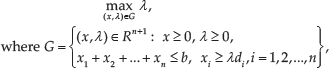
or more briefly,

The obtained solution is a standard proportional distribution, x*1:x*2: … :x*n = d1:d2: … :dn. Note that if Pi does not define his aspiration level (di = 0), then he gets nothing (xi* = 0). The optimal value Λ* indicates to what extent the desired aspirations may be realized.
Applying the same kind of analysis as in [1] Sec. 1.1, we can make the following observations and comments. If a player is not satisfied with the obtained solution (4), then the aspiration levels need to be redefined and the problem (3) has to be solved again. This determines the next step (iteration) of the method. Note that since all the constraints at the optimal point are active (equalities), any increase of a certain aspiration level will cause a decrease in the optimal values of the other players, and vice versa. Thus, the redefinition of the aspiration levels is a matter of agreement (cooperation) among the players. Note also that any player Pi can define his absolute level gi (if the others agree with that). In this case, the constraint xi≥gi – instead of xi>≥Λdi – participates in the definition of G. In other words, this player does not participate in the definition of DΛ but he causes the reduction of the general set B to S (see Section 1). Many other cooperative restrictions for the next step, such as xi + xj≥gij or xi + xj≤rij, etc., are also possible. In this way, after several subsequent iterations based on cooperation, the players can reach the solution which will satisfy all of them.
3.2 The generalized case
The generalization of the problem (2) is motivated and directed by practical considerations. For example, suppose that the state distributes incentives to different economic sectors. The prosperity of an individual sector does not depend only on the obtained incentive but also on the production of other sectors. Such prosperity can be measured by some kind of utility function for each sector and/or for the whole economy.
For these reasons we assume that, in the problem (1), we have k utility functions ui(x1, x2,…,xn), i = 1, 2,…,k. Here, k is generally independent of n (k may be greater than n, equal to n, less than n and even equal to 1). Note that ui is not necessarily the utility function for the player P i . It may be assigned to a regulatory subject (state, government, investor) or any other user. Now, the goal is to maximize the utility functions ui, i = 1, 2,…,k instead of the amounts xi, i = 1,2,…,n. We have

which is the MOLPP again and thus the detailed analysis from [1] can be applied. The assigned LPP which has to be solved is

and di is the aspiration level for ui. This problem is one step of the method. It can be iterated until the best possible solution is obtained.
Very often, on the economic and the political stage, we can see entities associated in coalitions. One expects to receive greater benefits as a member of a given coalition than by one's self. Some ideas regarding coalitions were studied in [18]. In light of our analysis, such ideas lead us to solve the MOLPP (5) by using our method (6). To clarify this point, we provide the following example.
Let us consider now the possibility of a coalition. Suppose that uij(x) is the utility function for coalition {P i , P j }, i,jε{1,2,3,4}, i≠j. We have another six problems with one two-member coalition,
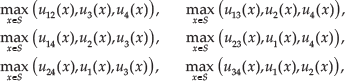
and three problems with two two-member coalitions,

Similarly, if uijl(x) is the utility function for coalition {P i , P P l }, i, j, lε{1, 2, 3, 4}, i≠j, i≠l, j≠l, then we also have four problems with one three-member coalition

Finally, if we consider the global coalition {P1, P2, P3, P4} and the utility function u1234(x), then we have one more problem
Thus, if we permit all possible coalitions then we have 15 MOLPP problems (5) which may be solved using the method (6). When all these solutions are known, the players – who have the option to choose – can choose the best means of coalition-building for themselves. After such a choice has been made, the accepted solution may be modified just because of the possibility of choosing (the player(s) who have made a choice may require an additional stimulation or reward). Here, in this example, we have permitted every possible coalition, which is not the case in practical situations. Some coalitions are useless or else impossible. This can be clearly seen in everyday economic situations and especially in political life.
To explain some of these possibilities, we provide the following example.

Suppose that we obtained Λ1=0.81, Λ2=0.75, Λ3=0.9. We see that C2 can realize exactly 75% (Λ2=Λ*), while the realizations for C1 and C3 can be better (81% and 90%). This means that d1 and d3 can be increased up to

without affecting the optimal solution Λ* =0.75. Why is it that this solution cannot be larger? Because d2 is set too high. If d2 is decreased, then the realizations become better. If we want to have Λ*≥μ in the next iteration, we have to require
4. Applications
In the last few years, the economic crisis has become a global problem. Many states are faced with reduced production, consumption and social standards. New progressive and useful investments are necessary to revitalize economic life. The following example is a small contribution in this direction.
We suppose that the government ensures the investment fund f for economic recovery. The criterion of distribution from the fund to the sectors A and B is based on the planned effects of this investment. The government will stimulate exports by ε per penny of exported goods, and buying on the domestic market by β per penny of purchased goods. At the same time, to increase production and employment, it will discourage imports (by using certain restrictive rules such as additional taxes, laws, etc.) by γ per penny of imported goods. The measure for the efficacy of any investment will be the total revenue of each sector. How can the distribution be realized according to the given criteria?
The PD here is the MOLPP (5) with two utility functions: the total revenue function u1 for sector A and u2 for sector B. The constraint set S is given by the available amount in the investment fund. We have the following four cases.

The fund distribution is: εr1 x 1 to A and εr2x2 to B.
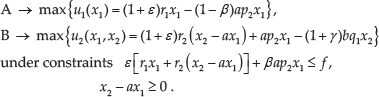
Note that the last constraint ensures that B produces enough to meet the needs of A. The fund distribution is: εr1 x 1+βap2x1 to A and εr2(x2-ax1) to B.

The fund distribution is: εr1(x 1-bx2) to A and εr2x2 + βbp 1x2 to B.

The fund distribution is: εr1(x1-bx2)+ βap2 x1 to A and εr2(x2-ax1)+βbp1x2 to B.
These problems could be solved by solving the assigned LPP (6). The desired budget D and the shifted budget DΛ are defined by using the fixed costs di, i = 1, 2 as the aspiration levels, which is a natural choice. When the optimal solution (x1*, x2*) is known, the profit of each sector is given by

Now, we will illustrate the given investment model for the following values of the parameters

For each of Cases I-IV, we state the MOLPP (5) and th assigned LPP (6).

and the solution is
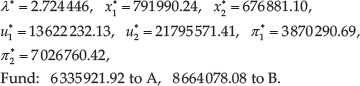
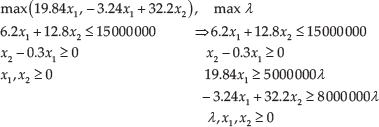
and the solution is
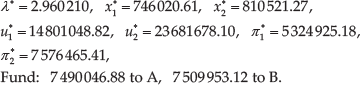

and the solution is

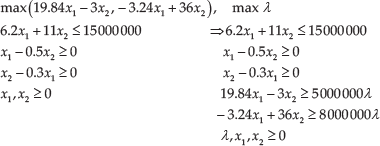
and the solution is
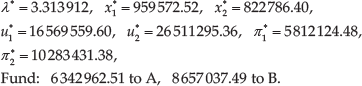
The obtained results do not require much comment – the benefits of such an investment for economic recovery are obvious. The mutual cooperation between the sectors and the export orientation (the fourth case) significantly increases their production volume, total revenue and profit. Note that in this case the total profit of the sectors exceeds the investment fund., Thus the sectors alone have sufficient funds for further investments.
5. Conclusions
In the paper, we apply the new, efficient method which was established in [1] for solving the cost (profit) allocation (distribution) problem. We consider both the standard and the generalized case.
In the standard case of proportional distribution, the players maximize the amount which they would obtain according to their aspirations. The optimal value of the indicator Λ shows to what extent the aspirations can be realized. If a player is not satisfied with the realization, then the next step (iteration) can be performed.
The generalized case is more interesting. The players can form coalitions to increase profit. In this case, the allocation is determined by the maximization of certain utility functions. There is an indicator with the same meaning and also the possibility of iteration. We apply the method in order to analyse an investment model for economic recovery. Financial incentives for exports and for buying on the domestic market would revitalize the economy of a state. The production volume, total revenue and profit of various economic sectors would be significantly increased. The explicit mathematical results clearly confirm this conclusion.