




Abstract
This article deals with the importance of environmental factors for business strategy. It discusses the potential benefits to companies which show concern for the environment beyond their legal obligations.
The main contribution of this article is in presentation of the results of a questionnaire survey concerning customer views on products certified as ‘environmentally friendly’. The knowledge of the respondents concerning individual instruments was not great. Most of the respondents were unwilling to pay more than 20% more for environmentally friendly products in comparison with conventional products. Only 38% of the respondents bought environmentally friendly products repeatedly.
Keywords
1. Introduction
The importance of taking an environmentally friendly approach is often emphasized with regard to business strategies. Declaring a company to be ‘environmentally friendly’ seems to have become an important competitive tool. The aim of this article is to discuss the potential benefits as well as limitations of an environmentally friendly business strategy, and also to evaluate – on the basis of empirical research – the potential opportunities in incorporating ecolabelling into business strategy in the Czech Republic.
2. Literature Review
When a company tries to implement such a strategy, it is crucial that customers should not lose trust in the company. Even though the business strategy of acting in an environmentally friendly way has great potential, in order to be successful it is necessary to thoroughly assess the feasibility, suitability and prerequisites for its successful implementation. It is crucial to thoroughly assess whether there is a market for such products, and at the same time to evaluate the company's ability to successfully manufacture and introduce products to the market. It is essential to consider the size of any investment expenditure as well as the company's resources. When implementing a green strategy, companies must use these resources efficiently and also take advantage of the weaknesses of the competition [1–3]. The importance of considering environmental factors is affirmed by the fact that it is perceived to be a global trend [4].
This creates new opportunities for companies, because customers are more interested in companies which adopt a friendly approach to the environment. Simultaneously, this factor is taken into account by potential investors [5], thereby creating value for customers. This represent the current trend in the strategic orientation of firms [6].
The growing interest in the area of environmental protection and sustainable development strategies has contributed to an increased interest in the trade in environmental goods and services [7]. It is vital to emphasize that, just because a product is environmentally friendly, it does not automatically follow that the product will be in higher demand. As some surveys show, consumers consider a number of other factors when shopping [8].
In the past, companies were often of the opinion that being environmentally friendly means higher costs and lower efficiency. However, if a company is innovative, it can come up with a solution that will, for instance, allow for the better use of inputs and minimize waste. There are two potential benefits of this approach – the better use of materials and an eventually lower expenditure on fees relating to pollution [9]. Companies can implement sustainable growth while respecting both factors, i.e., economic growth and sustainability in environmental terms [10].
For instance, Du Pont is an example of a global company that sympathizes with the concept of sustainable development as an opportunity for growth and the development of social justice [11].
Taking an environmentally friendly approach is part of a company's social responsibility. The concept of social responsibility conveys the effort of companies to include within the decision-making process all those interest groups that are in some way involved in the activities of the company. Integrating the concept of social responsibility into business activities can have an impact on the financial performance of companies [12, 13]. Corporate social responsibility is a part of corporate strategy, and one sometimes encounters the term “period of corporate social responsibility” [14]. This concept is linked to the fact that managers have to take into account corporate stakeholders. Stakeholders comprise all those persons who may be influenced by the actions of the company [15].
Companies can use many optional instruments when adopting an environmentally friendly approach. These instruments include the evaluation of a product's lifecycle, EMAS certification, ISO 14000 standards, and ecolabelling, etc. [16, 17, 18], as well as environmental management accounting [19, 20]. These optional tools can positively affect the performance of companies. By using these instruments, a company will follow a proactive strategy which contributes to the sustainable development mentioned above [21].
The concrete benefits of some of these instruments include improvements in market position, stakeholder relations and environmental performance. On the other hand, the potential difficulties include additional requirements on the organizational structure of the company and human resources, on environmental information and on the calculation of outcomes [22].
The positive impacts might be significant only on some aspects of environmental or competitive performance [23]. Some of the research continues to show than non-economic factors can drive the use of these voluntary instruments more strongly than economic incentives [24].
Research shows that companies which take a proactive approach to the environment and deal with environmental issues gain unique skills and capabilities, which consequently strengthen their competitiveness [25].
3. Experimental
To meet the objective formulated in the introduction, a questionnaire survey was carried out. The questionnaire used open and closed questions. The closed questions were either dichotomous (two-choice) or alternative (multiple***choice). In some closed questions, the opportunity to answer “in your own words” was given. Identification questions were placed at the beginning of the questionnaire. These questions referenced age, sex, education and size of residence. A filter question was used in the questionnaire. This filter question divided the respondents into two groups – buyers and non-buyers of environmentally friendly products. The questionnaire was tested. The questionnaire was sent through the Internet. Around 50,000 respondents were interviewed. The response rate was about 0.8%. Subsequently, the questionnaire was evaluated. Random selection was used.
The questionnaire survey determined brand awareness, the reasons for customers purchasing certified products, and also the reasons for not purchasing these certified products. Furthermore, the willingness of customers to pay a higher price for these products was analysed.
The questionnaire survey was carried out electronically. 380 filled-out questionnaires were obtained and processed further. 26% of respondents were aged under 26 years, 37% of respondents were aged 26–40 years, 33% were aged 41–60 years, and 5% of respondents were aged over 60 years. The size of residence was another surveyed factor. 22% of respondents lived in a place of residence with a population ranging from 0–3,000 inhabitants, 13% of respondents lived in a place of residence with a population ranging from 3,001–10,000 inhabitants, 19% of respondents lived in a place of residence with a population ranging from 10,001–50,000, and 46% of respondents lived in a place of residence with a population above 50,000 inhabitants. The level of education was another factor considered. 14% of respondents had acquired a primary education and had attended secondary school without a leaving certificate, 44% of respondents had attended secondary school with a leaving certificate, and 42% of respondents had acquired a university education.
The χ2 test of goodness of fit was used for the verification of dependence. The software Statgraphics Centurion XVI was used for the evaluation. A standard significance level of α = 5 was required.
4. Results and Discussion
4.1 Results
4.1.1 Customer Awareness of Environmentally Friendly Instruments
The first question asked about the types of optional company tools used as part of an environmentally friendly approach that customers are familiar with. The answers are listed in Figure 1. The respondents could choose more than one answer.

Customer awareness of environmentally friendly instruments
The most familiar environmentally friendly instrument was the label ‘environmentally friendly product’, which was known by 73% of respondents. The label “organic farming product” was also relatively well known among the respondents – 56% of them were familiar with this label. Certifications of environmental management systems were significantly less well-known. 32% of respondents were familiar with the ISO 14000 standards, and only 7% of them knew the EMAS certification.
The next question examined whether consumers take into account the fact that a product was produced in an environmentally friendly manner. 50% of respondents said that they take this factor into account. The other 50% of respondents stated that they do not take it into account.
4.1.2 Frequency of Purchase of Environmentally Friendly Products
Another question sought to determine how often consumers buy environmentally friendly products. The results are listed in Figure 2.
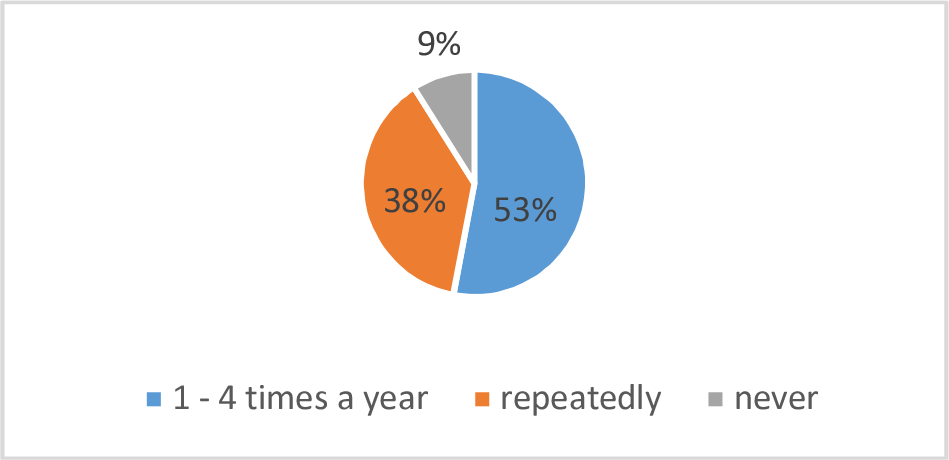
Frequency of purchase of environmentally friendly products
The results show that 38% of respondents repeatedly buy products labelled ‘environmentally friendly’. 53% of respondents purchase those products only exceptionally, and 9% of respondents never purchase these products.
4.1.3 Reason for Purchasing Environmentally Friendly Products
Figure 3 states the reasons why respondents purchase environmentally friendly products. The respondents could choose more than one answer.

Reasons for purchasing environmentally friendly products
58% of respondents buy environmentally friendly products because they want to contribute to environmental protection. Almost the same number of respondents (57%) stated that they expect these products to be of high quality. 6% of respondents stated other reasons for purchasing these products.
The respondents could give more reasons for buying environmentally friendly products. Other reasons included coincidence, protecting and strengthening their health, supporting local producers, feeling good, and the fact that another product is not available on the market.
4.1.4 Reasons for Not Purchasing Environmentally Friendly Products
The next question aimed to determine the reasons why some respondents never buy environmentally friendly products. The results are listed in Figure 4. The respondents were able to choose more than one answer as well as state their specific reasons.
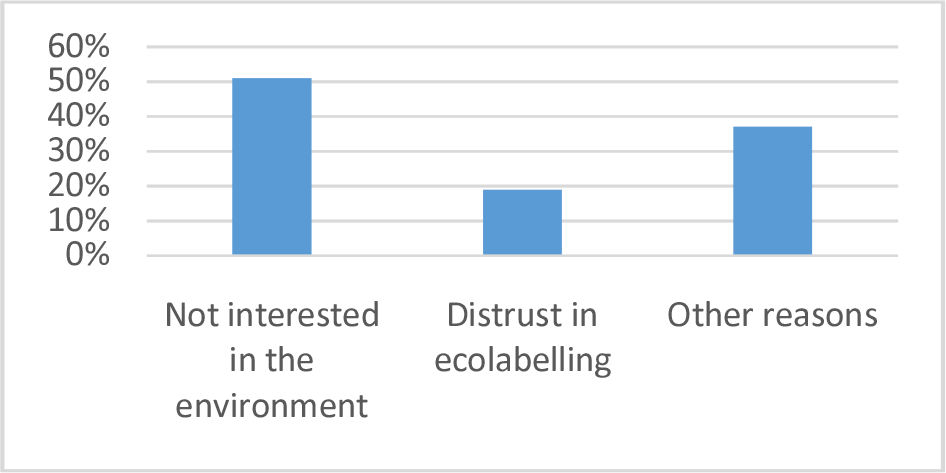
Reasons for not purchasing environmentally friendly products
The majority of respondents (51%) do not buy environmentally friendly products because they are not interested in environmental issues. 19% of respondents do not trust the Ecolabel. 37% of respondents stated other reasons, including lack of knowledge of the brand in question, higher prices and lack of monitoring of these factors.
4.1.5 Willingness to Pay a Higher price for Environmentally Friendly Products
The last question examined whether customers are willing to pay a higher for a Product that is certified as ‘environmentally friendly’. The results are listed in Figure 5.

Willingness to pay a higher price for environmentally friendly products
80% of respondents said that they are willing to pay 0–20% more for environmentally friendly products compered to products without certification. Less than one-fifth of respondents are willing to pay 21–50% more. Only 1% of respondents would pay 51–400% more. Given the small number of respondents in this group, this group will not lee considered for further evaluation.
4.1.6 Dependency Evaluation
Another step in the research is the evaluation of the dependencies of the chosen factors. Table 1 provides information about the evaluation of the dependencies of the chosen factors on education.
Chi-square and P-value values – dependence on education.
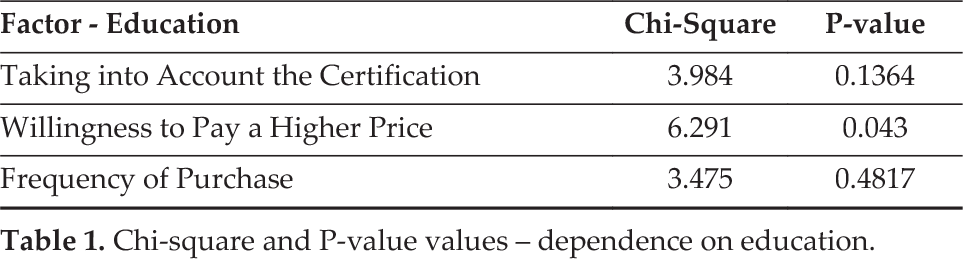
A dependency between education and a willingness to pay a higher price was demonstrated (P-value 0.043). People with a higher education level are willing to pay higher prices for environmentally friendly products. Other dependencies, between education and taking into account the certification, and between education and the frequency of purchase of environmentally friendly products, were not demonstrated.
Table 2 provides information about the evaluation of the dependencies of the chosen factors on population of residence.
Chi-square and P-value values – dependence on population of residence

No dependency between population of residence and the chosen factors was demonstrated. The P-values were distinctly higher than the required 0.05.
Table 3 provides information about the evaluation of the dependencies of the chosen factors on age.
Chi-square and P-value values – dependence on age

A dependency between age and taking into account the certification of environmentally friendly products was demonstrated (P-value 0.0257). According to the research, older respondents take this certification into account more than younger respondents. A dependency between age and the frequency of purchase of environmentally friendly products was also demonstrated (P-value 0.0013). The frequency of purchases was higher among older respondents. No dependency between age and a willingness to pay a higher price was demonstrated at the required level of significance (P-value 0.0822).
4.2 Discussion
It is possible to conclude that individual voluntary instruments are not widely known among consumers. The most famous of these instruments is the environmentally friendly product certification, which was known by almost three-quarters of respondents. Other voluntary instruments are significantly less well-known. A relatively significant factor in tracking dependencies is the age of the respondents. Elderly respondents take this certification into account more and buy more labelled products. This fact may be related to increased awareness and the perception of the sustainability challenge that confronts people as they get older. In connection with the age of the respondents, it might be expected that young people would be more interested in a friendly approach to the environment [26, 27]. This expectation was not confirmed, according to the research undertaken. Education was proven to be a factor associated with a greater willingness to pay more for environmentally friendly products. This fact can be explained by the expectation that people with a higher level education will usually have a higher income. Thus, higher prices will not be an obstacle to the purchasing of these products. One might presume that the population of residence would have an impact on the decision to buy environmentally friendly products. The reason for this is that people in larger cities generally have higher earnings. This expectation was not confirmed.
Almost all the respondents were unwilling to pay more than 50% more for environmentally sound products, and the vast majority were unwilling to pay more than 20% more. These results are consistent with the research, for example, in the US market, where most consumers are also unwilling to pay more than 20% more compared to conventional products [28]. A similar conclusion, namely that customers are unwilling to pay a much higher price (usually no more than 25% more) for these products, has also been drawn by other surveys [29, 30]. Other surveys have shown that the higher cost of products can be achieved by using special distribution channels [31, 32]. The degree of willingness to pay a higher price can also depend upon the price of the product. At relatively low prices, consumers are willing to pay 15–20% more. At higher prices, consumers are willing to pay only about 5% more for organic products than conventional products [33]. This will be linked to the issue of elasticity of demand in general [34, 35].
5. Conclusion
The questionnaire survey showed that 80% of consumers are willing to pay at most 20% more for such products. Simultaneously, almost three-quarters of respondents said that they are aware of this certification, and nearly 40% of consumers repeatedly buy products with this Ecolabel. The main reasons for buying these products are environmental protection and the expected higher quality of products certified in this way. At the same time, the questionnaire showed that one-fifth of respondents who do not buy certified products do not trust this Ecolabel. Therefore, it is possible to formulate recommendations for companies and public authorities in this area. Companies and public authorities should be more active in raising public awareness of these products. Furthermore, they should clearly highlight the benefits of products certified in this way. However, public authorities do currently support these certified products, especially in public procurement. The limitation of the study is its focus on the voluntary instruments known by consumers. Further research should focus on concrete benefits in the area of savings in operational costs, and the reduction of emissions, etc.
Footnotes
6. Acknowledgements
Supported by financial support from the Internal Grant Agency at the University of Economics, Prague (project F3/121/2014).