




Abstract
Wet ball milling was used to exfoliate MoS2. The aim of the study was to examine how the surface energy of all the individual materials affected the formation of the nanosheets. Two types of milling balls were selected: one made of steel and one made of Al2O3. The liquids used were water (H2O), isopropyl alcohol (C3H8O) and kerosene. The obtained nanosheets were identified and characterized using transmission/scanning electron microscopy and electron diffraction. Following sedimentation, scattered light intensity was measured. Our experiments showed that the material of the milling balls played a significant role in the experiment and had an influence on the number of the nanosheets obtained. Irrespective of the liquid employed, the number of nanosheets in the suspension obtained by milling with Al2O3 balls was greater by 100% than those obtained via milling with steel balls.
1. Introduction
Ever since the exceptional electron properties of graphene [1] were discovered, many studies have focused on the production of 2D nanoparticles with a thickness not exceeding a few atomic layers. Two-dimensional crystals can be produced using various physical and chemical methods, e.g., laser ablation, physical and chemical vapour deposition and liquid phase exfoliation [2]. Historically, the oldest method consists of mechanically separating the individual layers through adhesion to another material. This technique provides relatively good 2D nanocrystals but its efficiency is low and thus, its wider use is limited.
The potential possibility of realizing the large-scale production of 2D nanocrystals by the so-called ‘top-down’ method is offered by layered crystal exfoliation, assisted by the adhesion forces of a liquid (liquid exfoliation) and enhanced by the action of ultra sounds [3] or an electric field [4]. Exfoliation processes induced by mechanical energy are also available, in which the exfoliation happens due to the abrasion that occurs during a milling operation [5].
In studies focused on ultrasound-assisted liquid exfoliation performed to date, investigators have experimentally examined the effects of various liquids on the formation of nanosheets involving the most important layered crystals [3,6,7]. A formal description has been prepared for the effect of separation of the individual layers from a crystal under the action of surface forces, based on the solubility theory [8] and on the assumption that enthalpy mixing ΔHmx should be as low as possible.
The method of refining materials by abrasion to obtain particles smaller than 0.1μm has been recognized since 1966 [9]. One of the earliest studies devoted to the use of this technique for refining graphite [5] demonstrated the possibility of producing very thin crystals (20nm) with a specific surface area greater by more than 100 times that of the initial graphite powder. The researchers underline the specific role played by the liquids employed. Janot and Guerard [10] describe also how the various types of milling and the different sizes of milling balls affect the amorphization degree of graphite.
Antisari et al. [11] showed that thin graphite flakes (10nm) can also be obtained by milling in a mortar-type mill where the participation of the shearing forces is the greatest. The liquid used in this milling operation was water. Milling of graphite in the presence of a liquid was also reported by Zhao et al. [12]. Using a planetary mill, the authors obtained a suspension of graphene flakes with a thickness ≤3 layers. Similar results were obtained using various organic solvents [13]. According to the authors, to increase the proportion of the layered flakes in the suspension, it was necessary to precisely control the milling parameters such as the milling time, milling energy and the size of the milling balls.
Similarly with hBN(α-BN, hexagonal) crystals, Li et al. [14] obtained flakes several nanometres thick by milling in a planetary mill with the participation of a liquid. The authors emphasize that the process can be easily scaled and that the final product only contains a small number of defects and impurities. They compare the effects of water, ethanol, dodecane and benzyl benzoate on the peeling results of hBN ball milling and conclude that the best results can be obtained with benzyl benzoate, which they attributed to the good match between the surface tension of the liquid and hBN crystals, the high viscosity of the liquid and its low reactivity with the Fe balls.
Due to the nature of the process, the surface area of the crystals produced by milling is small (of the order of nm2 to µm2). The processes have reasonably good efficiency and produce a relatively high yield of the single-layer crystals (up to 40%). The yield and the average size of the flakes finally obtained can be controlled by appropriately selecting the parameters of centrifugation [15]. Experiments have also been conducted with hBN and MoS2 subjected to a combination of milling and sonication. The results indicate that each method has its own advantages [16].
The investigators concerned with milling exfoliation examined various liquids; however, systematic studies on the relation between the surface energy of the liquid and the solid are scarce. Moreover, unlike other methods, milling exfoliation involves two solids that take part in the process, i.e., the crystal and the mill balls. The role played by the material of the ball and its surface energy have not been systematically investigated.
The exfoliation of layered crystals is a synergic process [17] in which both the mechanical work (ball impacts) and the adhesion work participate. One might therefore expect systematic studies to be carried out on the role played by the surface phenomena that take place at the interfaces of the individual phases, i.e., between the material to be refined, the refining material and the liquid. To date, no such investigations have been reported in the literature.
The material chosen for the experiments was molybdenum disulphide (MoS2). In many applications, MoS2 has been found to function as an excellent solid lubricant [18]. Other interesting applications include photovoltaics and photo-catalysis, which involve the absorption of electromagnetic radiation within the visible range [19]. The layered structure of MoS2 permits producing, in a relatively easy way, 2D crystals that have exceptional properties, much better than those of the bulk material. As the thickness of the crystal is decreased to the unit cell value, the band structure of the electrons changes and the energy gap is increased from 1.29eV (indirect transitions) in the bulk material to 1.90eV (direct transitions), which entails changes in the electric and optical properties of the material [20]. In separate 2D MoS2 crystals, the luminescence quantum energy is increased by more than a factor of 104 [21]. The 2D crystals can be used for the manufacture of ultraviolet photo-detectors [22], field-effect transistors [23] and the electrodes used in lithium ion storage batteries [24]. Since there is no significant difference between the properties (such as, e.g., electric properties) of MoS2 flakes constructed from one and several layers, exceptional electric properties can be achieved even when the nanocrystal is composed of several layers [20].
During the exfoliation, new faces are formed which, in MoS2 with its atomic structure, have varied properties [25]. According to Zanin et al. [26] and Park and Jeon [27], the faces of the individual layers that are formed from the sulphur atoms do not exhibit polar behaviour, whereas at the edges of the flakes, polar effects predominate, which results from the Mo-S bonds being broken. The effects associated with the different properties of the faces and edges vary alongside the changing morphology of the crystal, since the ratio of the face-to-edge surface areas varies during exfoliation and the effects due to the increased surface area of the faces should become predominant.
The investigations performed in the present study confirmed the significance of the role played by the surface forces of all the participants in the exfoliation process, especially the role played by the surface of the grinding balls.
2. Materials and methods
In our experiments, the selection of liquids and solids was based on the Fowkes [28] theory, which states that interactions only occur between the surface energy components of bonds of the same type, i.e., dispersive with dispersive and polar with polar. These surface phenomena should facilitate the exfoliation provided that: Eadh ≥ Ecoh + interlayer interaction in a layered crystal, where Eadh is adhesion energy of two solids and Ecoh is cohesive energy into the solid body.
Two types of milling balls were selected: one made of steel, which had metallic bonds and dispersive surface effects, and one made of Al2O3, with covalent-ionic bonds and a preponderance of polar effects. The liquids were water (H2O), isopropyl alcohol (C3H8O) and kerosene. The properties of the materials are given in Table 1.

Mechanical exfoliation was conducted using MoS2 powder 325 mesh grade with a purity of 99% (delivered by Alfa Aesar Co). The morphology of this powder in its starting state is shown in Figure 1.
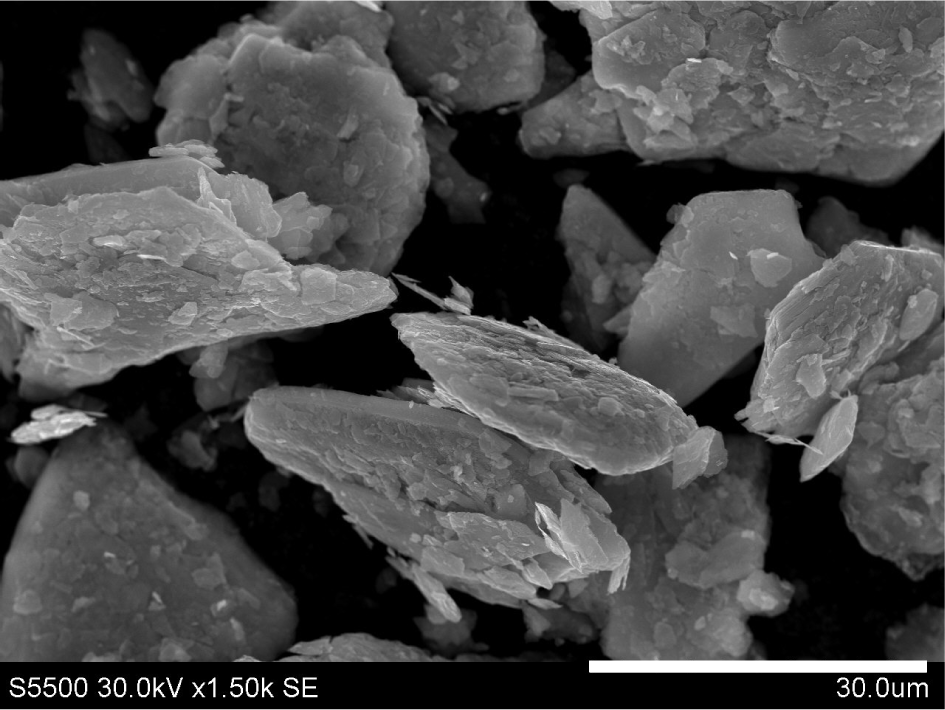
Morphology of the MoS2 powder in the starting state
The MoS2 layered crystals were exfoliated using two different milling techniques, differing in terms of the participation of the ball impact energy. In both cases, the mills were selected to ensure a predomination of shear stresses.
The first series of experiments was conducted with a homemade low-energy cannon-ball type mill with a rotational speed of 300 rev/min (Figure 2a). The powder was placed in a polyethylene container with a volume of 800ml (according to the amount of the powder) and the milling medium was in the form of balls 2mm in diameter, made of 316 steel, as well as Al2O3 balls (99.5% purity).

Schematic representation of milling techniques used for exfoliation of the MoS2 crystals: (a) cannon-ball type mill; (b) attritor mill
The aim of the next series of the experiments was to examine the effect of the milling energy. The mill used in this series of experiments was a home-made attritor mill with a rotational speed of 600 rev/min (Figure 2b). As in the first series, the process was conducted in polyethylene containers, but only with the Al2O3 balls.
In both experiments and with all the liquids employed, the milling process was conducted at room temperature for t=30h. The ball-to-powder mass ratio was 333:1 and the suspension concentration was 5g/1, the same in both series of the experiment. Time was chosen experimentally and the criterion was to obtain a Tyndall effect in the suspension. Other parameters, including the concentration, were selected on the basis of the presented literature. The temperature during the process was less than 30 degrees Celsius. The parameters of the exfoliation processes are shown in Table 2.
Milling process parameters used in the two exfoliation variants

After the milling process was completed, the suspensions were sieved, poured into beakers and stirred. The test samples, one part with a volume of 25ml and the other part with a volume of 5ml, were taken from each beaker using an automatic pipette. The 5ml sample was additionally diluted with 20ml of an appropriate liquid.
Then, all the samples were left for 24h to 100 days to permit sedimentation.
The nanoparticles and the powders were observed in STEM (scanning/transmission electron microscope, Hitachi S 5500) and TEM (transmission electron microscope JEOL JEM 3010). The SEM/TEM samples were prepared by instilling the suspension on holey carbon film coated grids (300 mesh).
For light scattering examinations, the suspensions were placed in glass phials and exposed to white LED light. The scattered light intensity was measured with a diode perpendicularly to the incident light.
3. Results and discussion
The milling process and subsequent sedimentation process yielded colloids and a deposit at the bottom of the beaker. Particles also adhered to the milling balls.
3.1 Milling in a cannon-ball type mill
3.1.1 Surface of the balls
In rotational milling with the participation of isopropyl alcohol, no adherence of molybdenum sulphide to the balls was observed, irrespective of the milling technique and the type of balls. Milling in water resulted in small amounts of impurities deposited on the surface of the balls, whereas in the presence of kerosene, the ceramic and steel balls were almost entirely covered with a thin layer of MoS2 flakes. Figure 3 shows the ball surfaces prior to and Figure 4 following the milling process conducted with the participation of kerosene.

Surface topography of the mill balls prior to the milling process: (a) clean surface of the Al2O3 ball; (b) clean surface of the steel ball

Surface topography of the mill balls after the milling process: (a) and (b) MoS2 particles deposited on the surfaces of the Al2O3 balls after milling in kerosene, (c) and (d) MoS2 particles deposited on the surfaces of the steel balls after milling in kerosene
Observations of the ball's surfaces showed that powder particles that adhered to steel balls could be characterized by the much larger surface area of plates the covered (Figure 4b and d). Stereological analysis indicated that the surface of these particles were on average three times larger. According to the Fowkes theory [28], the non-polar surfaces of the steel balls interact with the faces of the MoS2 flakes much more intensively, which may result in flakes with a surface area exceeding even 100µm2 being “cemented” to the relatively smooth surface of the steel balls. When, after milling in kerosene, the ceramic and steel balls were washed in isopropyl alcohol, we obtained a suspension of MoS2 flakes with an intensive blue colour similar to that observed in the suspension formed after milling and sedimentation in the presence of isopropyl alcohol. After washing the balls in isopropyl alcohol, the flakes that had adhered to their surfaces were washed out to be suspended in alcohol. Due to the dispersive-polar character of the interactions, isopropanol dispersed the particles well in the suspension, while at the same time “isolating” them from the surfaces of the balls, irrespective of their type (steel or ceramic).
Water wet the steel relatively weakly (γst≥90), as was also the case for 2D nanocrystals; therefore, it did not favour the dispersion of the MoS2 particles. As was the case with kerosene, the repelled flakes adhered to the surface of the steel balls, forming a thin film on their surface.
With Al2O3 balls, the preponderance of the polar interactions on the ball surface should decrease the tendency of the flakes to adhere. It is difficult to unequivocally estimate the influence of the adhesion forces, since during the collisions of the balls, their surfaces crack and chip. An analysis of the chemical composition of the sediment confirmed that it was contaminated with Al2O3 from the balls. The chipping of the ball surface may facilitate the removal of adhered flakes from it.
The flakes may also adhere to the ball surface through mechanical anchoring to its irregularities. As can be seen in Figure 3a, the surface of the corundum ceramic balls are much more developed, which facilitates the mechanical engagement of the powder particles with the balls' surfaces. This is confirmed by the photographs shown in Figures 4a and b, where we can see the finest particles anchored at the peaks and valleys of the ceramic ball's surface.
3.1.2 Particles produced by milling
An analysis of the particles present in the suspension and in the deposit following sedimentation showed that irrespective of the milling method and the liquid employed, the powder particles had been considerably refined (Figures 5, 6, 7) compared to the starting powder. After 48h sedimentation, the walls of the glass vessels that contained the samples milled in kerosene or water became dirtied and in those containing particles milled in water, the particle floatation effect was observed (deposit floated on the suspension surface).
The diluted samples changed colour during the sedimentation, acquiring in the case of isopropyl alcohol a weaker or stronger pale-blue colour. After 100 days of sedimentation, light scattering was observed in all the suspensions. Table 3 shows the results of the light scattering analysis.
Intensity of light scattered in the suspensions obtained by cannon-ball milling (Δ – approximation error)

It was found that in the suspensions of MoS2 particles obtained by milling with Al2O3 balls, the intensity of scattered light was about twice as high as in those milled with steel balls, meaning that the former contained greater amounts of light-scattering material. In view of the reproducibility of the process conditions, we can conclude that irrespective of the liquid employed, the participation of the Al2O3 balls favoured the refinement of the material and thereby, the formation of nanocrystals suspended in the colloid. This may be a direct result of the balls' material surface forces on the layered crystals.
The morphology of the flakes present in the isopropyl alcohol suspension is shown in Figures 5 and 6. The size range of the particles was very wide, with the average particle size being 250nm.

Morphology of the MoS2 flakes produced by cannon-ball milling with Al2O3 balls in an isopropyl alcohol suspension: (a) SEM image; (b) STEM image
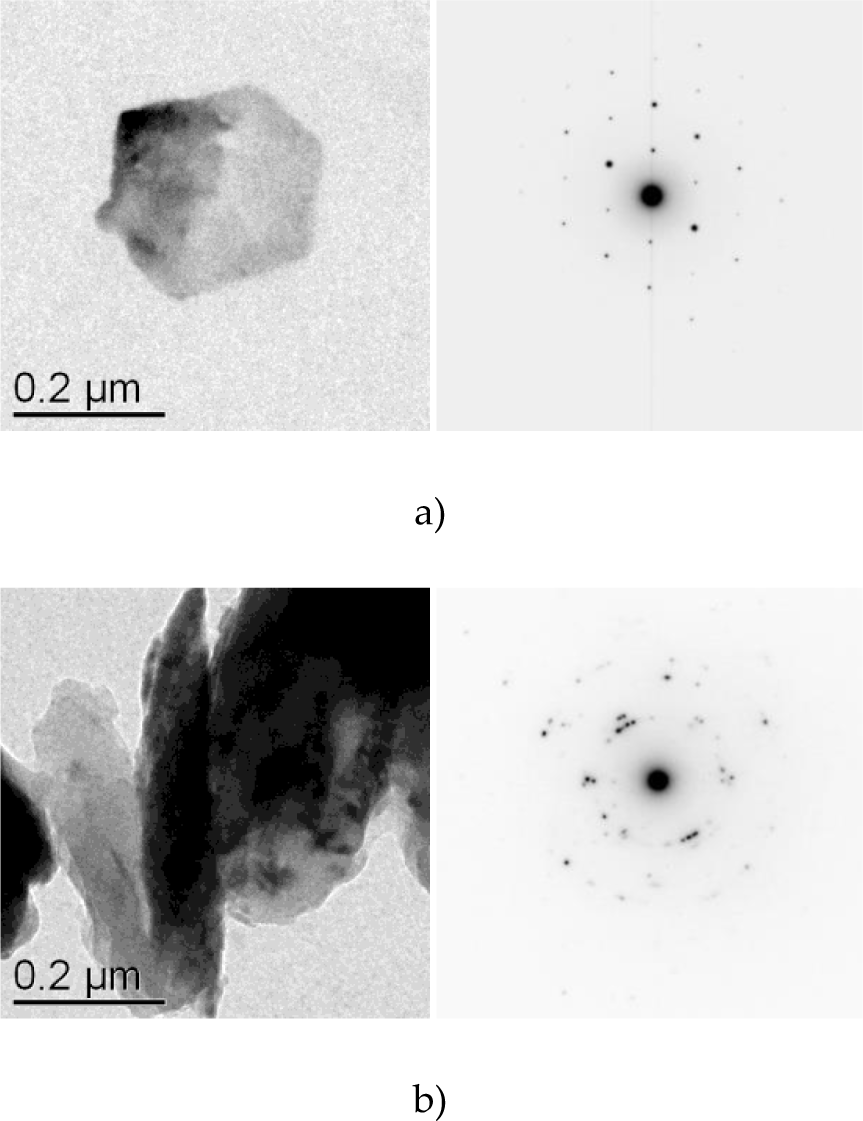
Shape and the electron diffraction pattern of the MoS2 particles obtained by cannon-ball milling: (a) single-crystal MoS2; (b) multi-layer MoS2 nanocrystal
A TEM electron diffraction analysis of the regions (shown in Figure 6) indicated that the nanoparticles visible in the image had a crystalline character. The analysis also revealed the presence of multi-layer MoS2 flakes. The results of the diffraction analysis are shown in Figure 6.
As to the morphology and size of the nanosheets suspended in isopropyl alcohol, no considerable differences were found between those obtained by milling with steel and by milling with Al2O3 balls.
The samples obtained by milling in liquids other than isopropyl alcohol also contained MoS2 nanocrystals made up of several (or more) layers. However, contrary to isopropyl alcohol, in water and kerosene, most of the crystals strongly agglomerated, so that separate nanosheets were only sporadically observed. Generally, agglomerates were observed, such as can be seen in Figure 7a and b.
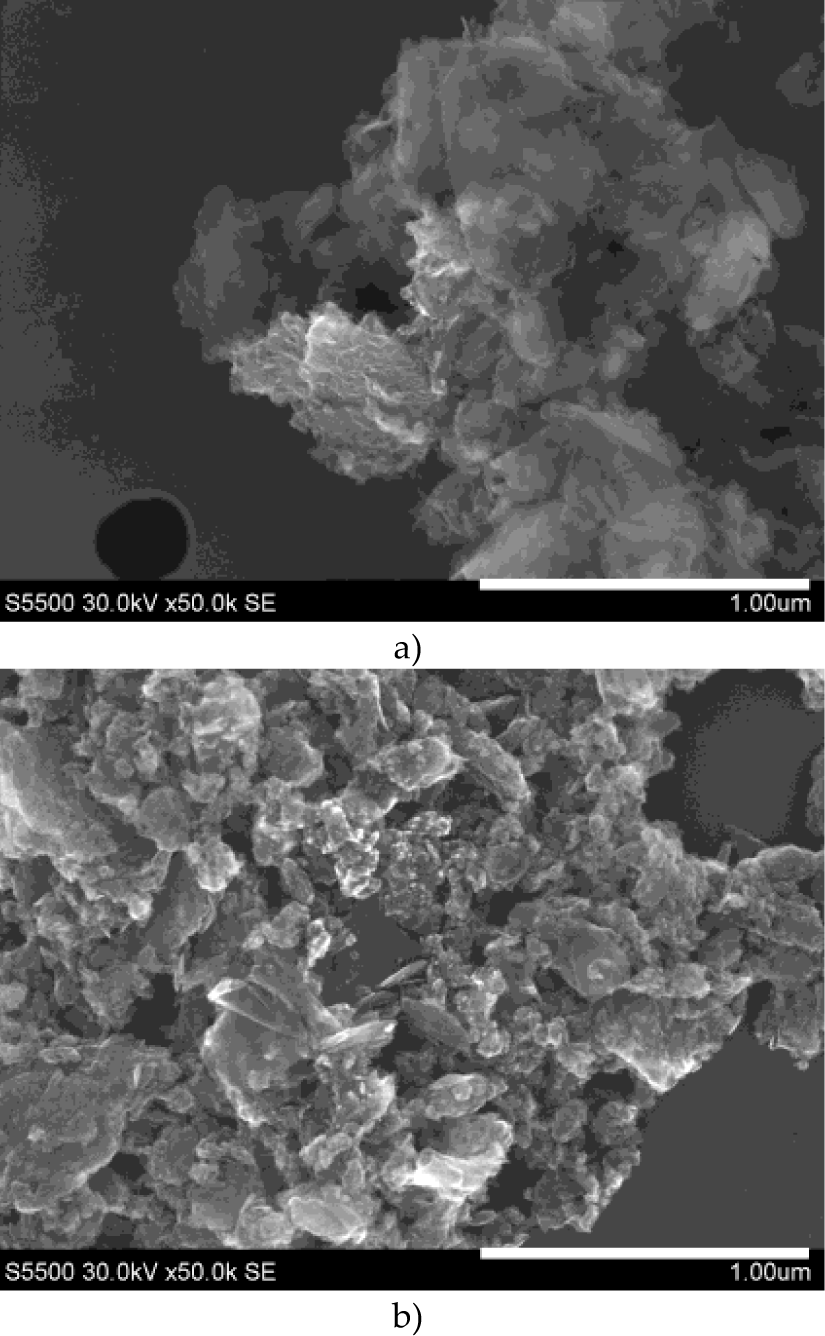
Morphology of the particles obtained by cannon-ball milling in a suspension of (a) water; (b) kerosene
The sediment mainly contained refined and strongly agglomerated crystals. No essential differences were found between the sediments obtained in different liquids. The amount of contamination was also minimal. In all the sediments examined milled with Al2O3 balls, an EDS chemical analysis confirmed that the amounts of Al in the sediment was vestigial (1–3%). No Fe was found in the sediment after milling with steel balls conducted in alcohol and kerosene. Small amounts of Fe were identified in the sediment obtained after milling in the presence of water.
3.2 Attrition milling
3.2.1 Effect of ball impacts
In attrition milling, the ball impact energy was higher than in the cannon-ball type mill, which was due to the high rotational speed of the ceramic blades in this instance. The results obtained by exfoliation in the attrition mill in the presence of isopropyl alcohol were very similar to those obtained after rotational milling. Here, too, single-layer and multi-layer MoS2 nanocrystals were identified.
The finest nanoparticles with good dispersion were obtained after attrition milling in the presence of isopropyl alcohol. The suspension contained particles with an average size of 150nm, with elongated shapes and sharp edges (Figure 8a), and regions of agglomerated particles/flakes, oval in shape, with an average size of 90nm, but much thinner (perfectly translucent in the microscope transmission mode – Figure 8b). A diffraction analysis indicated that the flakes had an amorphous character.

Morphology of the particles obtained by attrition milling in a suspension of isopropyl alcohol: (a) SEM image; (b) STEM image – light field
Essential differences were revealed in terms of sediment between the particles obtained by attrition milling and cannon-ball type milling using Al2O3 balls (Figure 9). After milling by the attrition method, significant amounts of contaminants such as aluminium oxide and zirconium oxide could be seen as dispersed light-colour particles, visible on the surface of a large MoS2 crystal (Figure 10a), whereas in the deposit of the powder that had been cannon-ball milled, there were large MoS2 crystal fractions with very small flakes adhering to them that predominated (Figure 9b).

Comparison between the morphologies of the powder particles present in the deposit after milling with ceramic balls by: (a) attrition milling; (b) cannon-ball milling
The presence of substantial amounts of contamination with the materials that participated in the attrition milling indicated that the exfoliation process was in this instance more violent (due to the higher kinetic energy involved) and may therefore have yielded particles with a smaller average size, or may even have led to their amorphization. Moreover, the contaminants in the form of sharp edge ceramic micro-particles adhered to the surface of the MoS2 crystals functioned as a micro-abrasive medium that broke the exfoliated nanosheets.
4. Conclusions
In exfoliation by milling, the material of the mill balls appeared to play a very significant role. Irrespective of the liquid employed, the number of nanosheets in the suspension obtained by milling with Al2O3 balls was greater by 100% than that present after milling with steel balls. Since no differences were observed between the morphology and size of the nanosheets obtained with the Al2O3 and steel balls, the difference in the efficiency between these two processes may be attributed to the surface effects associated with the ball material.
The character of the surface effects that occur when milling with Al2O3 can possibly be the effect of separation of the individual layers from the bulk MoS2 crystal due to the action of the surface forces of the balls, as can be observed in liquid assisted exfoliation. Adhesion interaction with Al2O3 appeared to be more advantageous than in case of using steel balls, which only acted by dispersion forces.
It should, however, by noted that the summarized effect of the ball surface also depends on its morphology. In milling with the use of corundum balls, there is the additional effect of crystals anchoring at the irregularities of the ball surface; however, in our experiment, it was impossible to assess which of these effects dominated over others.
Our experiments confirmed the advantageous role of isopropyl alcohol, which has been described in the literature reports, with regard to ultrasound-enhanced liquid exfoliation. No contamination of the surfaces of the balls with MoS2 nanocrystals and no suspended nanosheets agglomeration were observed in the presence of isopropyl alcohol.
As the milling energy increased, the collisions intensified. Consequently, the ball surfaces underwent chipping and were cleaned, resulting in the flakes obtained being smaller. Another adverse effect may be that the nanocrystals become amorphized, an effect that has been well-established in mechanical alloying processes.
Footnotes
5. Acknowledgements
The authors wish to thank Professor Aleksandra Sokołowska for inspiration, encouragement and many useful comments during the preparation of this manuscript. This work was supported by the Polish National Science Centre in frame of the project Nr 2011/01/B/ST8/02986.