




Abstract
This paper discusses good criteria for a supply chain performance measurement model and their level of importance. The criteria were obtained from results of previous research findings and recommendations from several researchers. The criteria are divided into two categories, namely efficient and effective. To examine which criteria can be used to assess a supply chain performance measurement model, a survey was conducted by distributing questionnaires to supply chain actors from different industry fields (both manufacturing and services) in Indonesia using random sampling techniques. Data analysis using pairwise comparisons with an analytical Hierarchy Process model showed that efficient criteria were more important than effective criteria. Efficient criteria consisted of three sub-criteria: the amount of data is not too much and low cost and output is presented in a simple form. Effective criteria consisted of the criteria in the order of importance as follows: clarity, validity, comprehensiveness, responsiveness and dynamics. Further research is needed for developing a model that meets these criteria
1. Introduction
Performance measurement plays an important role in the improvement of an organization. Performance measures can determine the level of progress of the organization and determine the necessary action needed for improving the organization. From a management perspective, performance measurement has the role of providing feedback information, which is very useful for managers to monitor the progress of the company's performance as an initial step in the development of the company, to increase motivation and communication and to diagnose problems [20,21]. Performance measurement can be used to assess the effectiveness of strategies in Supply Chain Management (SCM) and to identify success and opportunities for the future. It shares an important contribution in the decision making process in SCM, especially for the process of re-planning the company's objectives and strategies, as well as in the re-engineering process [3].
There are various approaches in SCM performance measurement and these can be grouped into three categories, i.e., based on context (supply chain conditions), content (what is measured) and process (how to measure), on the supply chain maturity phase and on the number of elements measured [5,12,19]. Good supply chain performance measurement should be specific with regard to its context, content and process. Based on the supply chain maturity phase, performance measurement can be divided into three stages. The first stage is referred to as the early stages of the supply chain and focuses on the company and its relationship with the direct consumer. The second phase is referred to as the intermediate supply chain and focuses on companies that cooperate with suppliers and distributors. The third stage is the advanced supply chain and focuses on supply chain actors and their relationship with the other parties in sending the product to the consumer, such as logistics providers, wholesalers and others. At each stage, the performance measurement model applies a different approach. Based on the number of elements being measured, performance measurement can be classified into three levels, namely individual level measurement, group level measurement and system level measurement. Individual level measurements measure the performance of a single activity such as cost, time, flexibility and quality. Group level measurements measure the performance of a group activity, that is, activity within a department or of a business unit. System level measurement measures the level of compliance strategies and corporate culture or organization with the environment.
Other approaches are based on general categories that divide supply chain performance measurement into two classes of systems, namely financial and non financial. Financial performance measurement systems can be grouped into two categories: activity based costing and economic value added. Non-financial performance measurement system approaches can be classified into nine different types groups according to their criteria of measurement (1).
Various models for supply chain performance measurement will result in different measurements being used. From a management point of view, the variation of measurement models will increase complexity to the selection of measurement. In this condition, management needs guidance for determining the criteria for a good model, so that performance measurements can be effectively applied. In order to assess which performance measurement model can be used properly, it is necessary to know the level of importance (weight) of the criteria mentioned above.
Based on our knowledge, until recently, there has been no research that focuses on determining the criteria of supply chain performance measurement models that considered the level of importance (weight) of each set of criteria. Therefore, it is necessary to survey the level of importance of each set of criteria. This paper discusses criteria that are used in designing and selecting SCM performance measurement models.
2. Literature Review
2.1. Identification of good criteria for SCM Performance Measurement
A performance measurement model can be applied to measure a company's performance and the performance of SCM. The criteria of performance measurement models for a company were obtained from the results of several case studies conducted by several researchers and from recommendations by some researcher/author. These criteria will be explained in the following paragraphs.
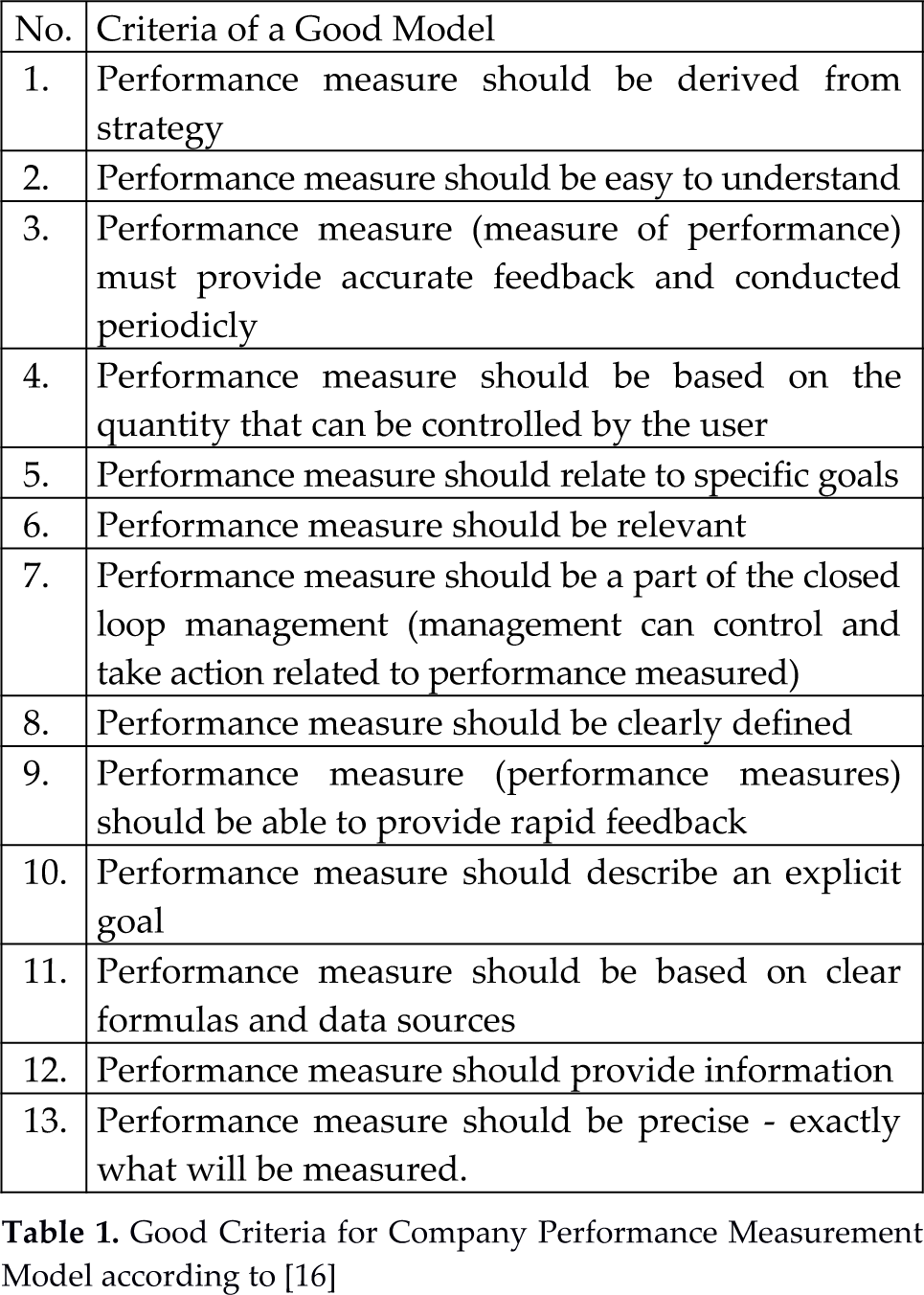
A case study in an aeroscope and automotive company was conducted by [16] and identified 13 criteria of performance measurement, as presented in Table 1.
Good Criteria for Company Performance Measurement Model according to [16]
Based on a case study conducted in the manufacturing company Just In Time (JIT), Crawford and Fox [4] proposed four types of criteria as follows:
Performance criteria are measured in an easy way to be understood by the people who are being measured.
Data is collected by the person being measured.
Performance measures should be presented in comprehensive graphs.
Performance data should be available for periodic review.
Criteria of performance measurement based on recommendations from other researchers, such as those proposed by [2,7,17] are described as follows. Fry and Cox [7] suggest that good measurement does not lead to conflict among members of the organization. Blekinsop and Davis [2] suggest several aspects to be considered when designing a performance measurement system:
Objectives among departments that will not generate conflicts.
In line with goals of the organization, both horizontal and vertical.
Corporate culture.
Short-term, medium and long-term goals, both financially and non-financially.
Total commitment of all involved.
Comprehensive understanding of the performance measurement.
Neely [17] recommends criteria for the design of performance measurement that are grouped into two categories, i.e., criteria that focuses on design process and criteria that focus on output of the design process. Criteria that focus on the design process are described as follows:
Performance measures should be derived from the company's strategy.
The purpose of each performance measure must be made explicit.
Data collection and methods of calculating the performance must be made clear.
Everyone (customers, employees and managers) should be involved in the selection of the measures.
The performance measures that are selected should consider the nature of the organization.
The measurement process should be flexible in terms of dynamic condition.
Desirable characteristics of the output process include:
Performance measures should enable/facilitate benchmarking.
Ratio-based performance measures are preferable to absolute numbers.
Performance criteria should be directly controlled by the evaluated organizational unit.
Objective performance criteria are preferable to subjective ones.
Non-financial measures should be adopted.
Performance measures should be simple and easy to use.
Performance measures should provide fast feedback.
Performance measures should stimulate continuous improvement rather than simply monitor.
Measurement criteria, as described above, are recommended for performance measurement within the scope of the company. In order to implement these criteria within the scope of the supply chain, additional criteria need to be considered, i.e,
Be Balanced: the needs of all stakeholders must be accommodated and balanced [6,9,18,19]. Balance criteria are measured by two aspects: to accommodate the needs of all stakeholders and stakeholder contribution measurements.
Be Integrated: the relationships among all measurements must be integrated [6,15,19]. This suggests that all the terms in the SCM element must be covered and integrated both vertically and horizontally.
Performance measures should focus on business processes that deliver value [12,16] and be specific to business units [9,12,16].
Include stakeholder contributions, thereby involving the stakeholders to contribute to the success and/or failure of a business [18].
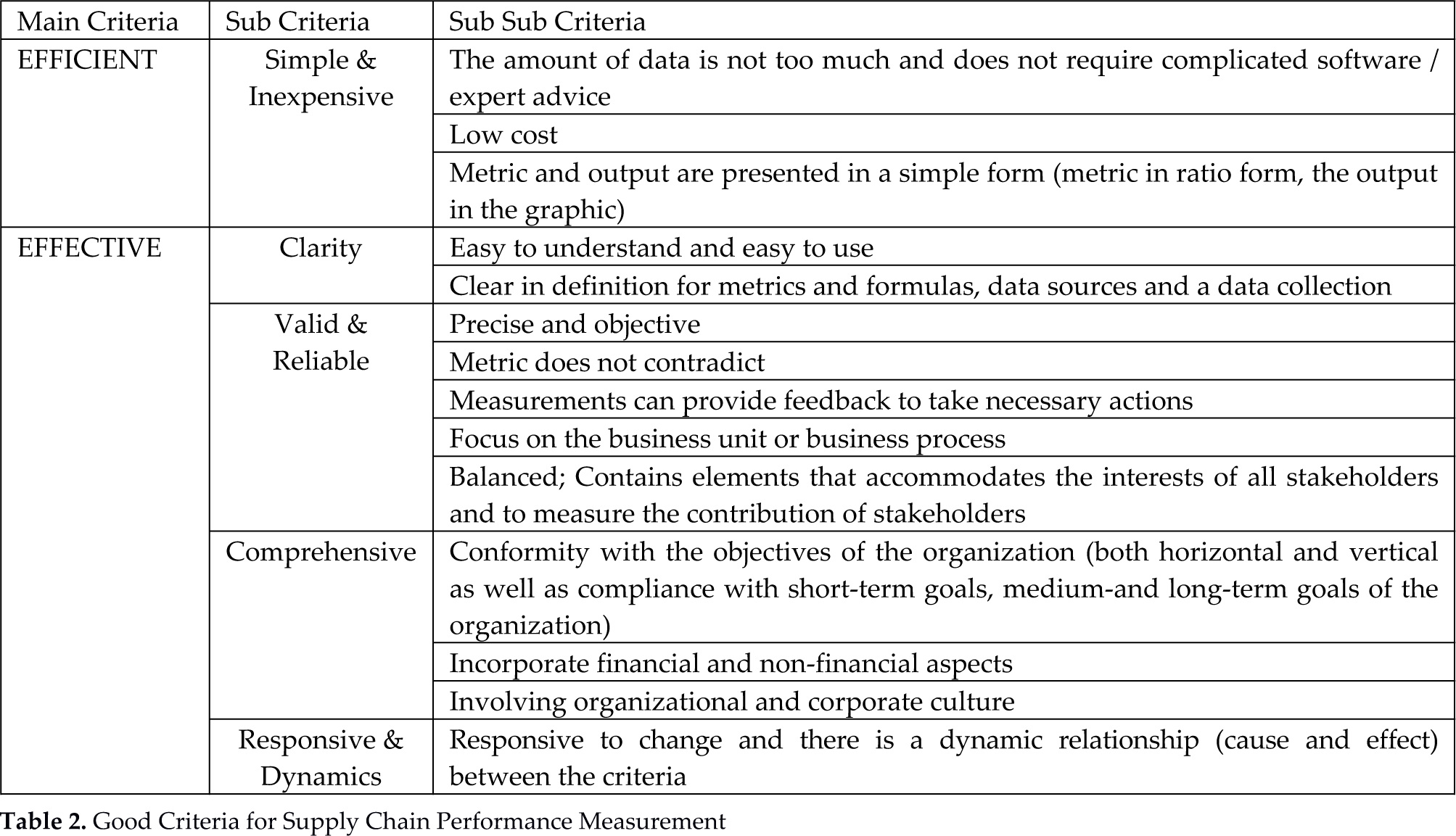
In general, it can be said that good criteria in measuring the performance of SCM is needed for efficient and effective measurements. Performance measurement is the process of quantifying the efficiency and effectiveness of an activity into measurable value [14]. From the results of the case study and the recommendations given by some researchers, the writer categorizes good criteria for measuring the performance of SCM into two categories, namely efficient and effective. Efficient is defined as the minimum use of resources (time, effort and money) for achieving optimum results. Effective is defined as successful or achieving goals appropriately. Criteria for an efficient and effective supply chain performance measurement model subsequently translated into several criteria and sub criteria, as given in Table 2.
Good Criteria for Supply Chain Performance Measurement
3. Research Methodology
A survey was conducted by distributing questionnaires to SCM actors using a random sampling technique. The questionnaire subjects were actors of SCM who were competent in assessing the level of efficient and effective criteria from several Indonesian companies, including manufacturing, services, electricity and mining. The questionnaire was sent to 144 respondents. The questionnaire addressed level of importance in terms of criteria with pairwise comparisons on a scale from 1–9 (see Appendix 1). Questionnaire results were analysed using Analytical Hierarchy Process techniques to obtain the weight of each set of criteria [22]. Analytical Hierarchy Process is a Multi Criteria Decision Making method that has been used by many other researchers for measuring the performance of activities in SCM [10,11].
4. Results and Discussion
Identification of criteria was based on the criteria proposed by some researchers who conducted a case study among several companies, as well as on the recommendations of a selection of researchers. Criteria can be categorized within the company scope and within the SCM scope. Because the scope of the supply chain involves several companies or organizations that are inter-organizational (cross-organizational), the criteria of the company's scope need to be extended. To determine the effectiveness of the model, the criteria have been divided into two main categories, i.e., efficient and effective. The survey was conducted by distributing questionnaires to SCM actors who were competent in assessing the level of efficient and effective SCM. Data collection was conducted using a random sampling method. Minimum sample size was 49 respondents, based on the formula of minimum sample size, with a 95% confidence level or a level of significant (σ) of 5% and an error research (sample error) average of 15% of the mean value. To determine the number of samples that can represent the population, the data distribution was tested using the Kolmogorov Smirnov normality test. The normality test showed that all the data in each variable had been normally distributed.
The study was conducted by sending questionnaires to 144 respondents. The questionnaire contained questions about the importance of efficient and effective criteria in the measurement of an SCM model. As many as 134 questionnaires were returned with a response rate of 93.05%. Of the 134 respondents who returned the questionnaire, 64 respondents who were main actors in SCM were selected to fill out a follow-up questionnaire that contained details concerning criteria and sub criteria. A sample number of 64 was considered as representative of the population, because the sample was greater than the minimum requirement of 49 respondents. Respondents consisted of personnel from various industries including manufacturing, services, electrical and the mining industry, as presented in Table 3. The composition of the respondents is given in Figure 1.
Data Respondents by Industry Sector
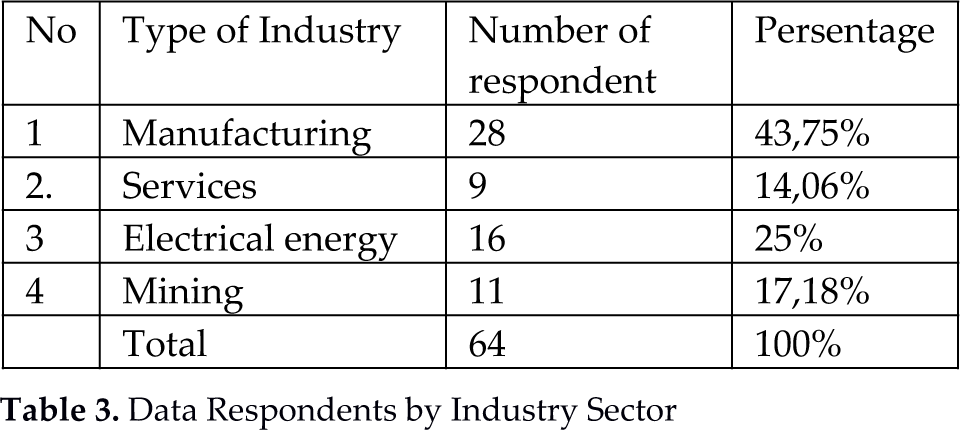

The composition of the respondents
Pairwise comparisons were used to determine priority among criteria weights. The results showed that the consistency ratio was less than 0.1 mean and that all assessments were consistent. The results and consistency ratio criteria weights are given in Table 4, while the hierarchical structure is shown in Figure 2 (Appendix 2).
Weighting Criteria for Supply Chain Performance Measurement Model


The Hierarchical Structure of Criteria for Supply Chain Performance Measurement Model
The results showed that the good criteria should focus on efficient criteria (62.5%) rather than effective criteria (37.5%). This indicates that the measurement model of good design should be simple and inexpensive. To obtain a simple model at a low cost, it is necessary to perform data distillation, so that the variables involved are not too many and the metric is kept in a simple form. In the effective category, the most important aspect is clear (0,355), followed by valid and reliable (0.271), comprehensive (0.196), responsive and dynamic (0.179). Clarity of measurement can be achieved by designing a performance measurement that is easy to understand and easy to use, both in the form of metrics, how to measure and the interpretation of results. Similarly, valid and reliable criteria require a design that focuses on determining the precise variables that can describe the performance of SCM.
A Good measurement should provide feedback to decision makers and the various elements in the measurement should be balanced. A Good measurement must also be comprehensive by considering the following aspects: organizational goals (vertical or horizontal, short-term goals, intermediate goals and long term goals), financial and non-financial aspects, corporate culture and corporate organizations. Responsive criteria in a good measurement model indicates that there is a mechanism for controlling the causal relationships among the criteria. The criteria, as described previously, can be used as guidance for choosing the best model or for designing a measurement model.
5. Conclusion
In order to meet the expectations of stakeholders, SCM performance measurement models must meet various criteria. Therefore, it is necessary to survey the level of importance of each criterion. A survey was conducted to identify the criteria and the weight of criteria. Data analysis using pairwise comparisons and the Analytical Hierarchy Process model showed that efficient criteria (weight 62.5%) was more important than effective criteria (37.5%). Efficient criteria consisted of three sub-criteria, that is, the amount of data is not too much (40.,8%), low cost (30.5%) and outputs are presented in a simple form (28.7%). Effective criteria consisted of specific criteria in the order of importance as follows: clarity (35.5%), validity (27.1%), comprehensiveness (19.6%), responsiveness and dynamics (17.9%).
The limitations of this research are that the respondents were sourced only from four types of industries; therefore, the resulting criteria may not be generalizable to the needs of all types of industries. Data was only collected using questionnaires without interviews; thus, deeper information about detailed operational criteria has not yet been obtained. Further research opportunities should look to establishing detailed operational criteria and how to integrate these criteria into the measurement model.