




Abstract
The Australian Defence Force and industry are undergoing significant changes in the way they work together in capability enhancement programs. There are capability gaps in maintaining and supporting current obligations during major asset acquisition, which has migrated into the front line of Royal Air Force Fighter Groups as a new capability. This paper examines a steady state support solution and argues that in order to interchange from one support solution to a new architecture there must be a period for transition, which may need its own interim business model and operational service. A preliminary study of several existing support solutions reveals the generic elements that need to be parameterized and traced through the support system architecture trajectory.
Keywords
1. Introduction
The Royal Australian Air Force (RAAF) is in the process of a major reworking of its organizational structure (Davis, 2010). Its entire air combat fleet has embarked on a decade long process of renewal and augmentation. The F-111 long-range strike aircraft has been retired and the replacement Super Hornets have begun to arrive. The F-35 Lightning II Joint Strike Fighter is scheduled to be delivered progressively from 2014 to 2020 and the ‘classic’ Hornets will be phased out over the same period.
These assets are complex engineering systems that require significant support infrastructure. Traditionally, these support infrastructures are the responsibility of the asset owner, in this case, the RAAF. However, increasing the complexity of the system and changing the operating conditions requires service personnel to have a higher level of analysis and judgment capability. The concept of designing support services for these assets as a system is not new. Rathwell and Williams (1996) studied the use of enterprise engineering methodology for supporting whole-of-life petroleum plant designs for Fluor Daniel and concluded that companies providing services for complex engineering products could minimize the apparent complexity of these systems.
A major challenge in designing support systems is the uniqueness of service requirements. Every complex engineering product is different and hence it is fair to say that each support system is customized (Tukker, 2004). Spohrer et al. (2007) associated a service system comprising people and technologies with a system's changing value of knowledge. Johannson and Olhager (2006) examined the linkage between goods manufacturing and service operations and developed a framework for process choices that enabled joint manufacturing and after-sale service operations. The consequence is that the system owners need to prepare for significant financial implications beyond acquisition (Neely, 2009).
However, unlike a product, a support system needs to adapt to the changing environment (Ng et al., 2010). Current acquisition processes focus on attaining the new capabilities only. There is very little, if any, effort considering the impact of retiring old equipment during the change over period. Major capability acquisition programs, such as those run by the RAAF, need to transition from the existing support systems designed for specific aircraft types to new air capability and operational systems. The challenge in this transition is to maintain a viable working support system while meeting the requirements of the integrated holistic capacity. This paper studies several existing support systems and the changes they have gone through to identify key elements of the model that can be used to characterize changes over time.
2. Transition management
Transition is different from change and very often it is the transition that people resist – not the change itself (Bridges, 2003). Staff at different stages of a changing system will have emotional responses that need to be recognized. Alcorn and Jarrand (2013) witnessed the need for potential partnership and culture to be integral parts of an operational plan for a health care system being constructed. Rollenhagen et al. (2013) measured plant cultures vs. professional subcultures in three Swedish nuclear power plants using six factors including change management, knowledge and participation. They showed that organizations of the same nature going through the same process and hence exhibiting similarity in patterns but potentially different transitioning processes. Everard and McInnes (2013) recognised that systemic solutions were not a panacea if applied merely as ‘downstream’ fixes, but could motivate broader cultural change towards more sustainable practices. Hutchinson et al. (in press) studied four commercial organizations as they adopted a model driven engineering approach to their software development practices. Instead of technical factors, they identified complex organizational, managerial and social factors that influenced the success or failure of the change project. This research shows that the transition of capability has far-reaching implications for organizational culture and therefore needs to be understood and managed, especially where the change is radical.
According to Nonaka et al. (2000), organizations transitioning to attain a sustainable competitive advantage need the capacity to generate, renew and use knowledge. In technologically complex industries, the tacit knowledge residing within staff is an intangible asset that is difficult to capture (Foguem et al., 2008). In the new economy, it has become the top priority for leadership to manage the knowledge in a workforce if the organization is undergoing a transition. Nicholls et al. (2013) evaluated the environmental management process that has been used successfully for managing flood and erosion risks on changing coasts. The competitiveness and performance of engineering companies depended on the availability, reliability and productivity of their systems. Wnuk et al. (2013) studied the environment of rapid changes in requirements in the software business. They reported results from an empirical investigation with 219 respondents and concluded that obsolete software requirements constitute a significant challenge for companies developing software intensive products to handle obsolete software requirements. Van Horenbeek and Pintelon (2014) developed a maintenance performance measurement framework that aligned the maintenance objectives on all management levels (i.e., strategic, tactical and operational) with the relevant maintenance performance indicators. The framework enabled the decision maker to better understand the complex relationships and make more reliable decisions. These pieces of research show that effective management of knowledge in the transition process is critical to success.
In addition, transition management cannot be effective without good planning. Ng et al. (2011) described the planning and implementation of a new service transformation of an organization, including both the current operating state of the product-based service and the required future operating state for effective service capability. Chattopadhyay et al. (2010) studied a global engineering company and showed that organizational capability should first become adaptive by establishing internal structures and processes to aid the creation of competence and hence the ability to transform to a service provider. Cete and Yomralioglu (2013) analysed the efficiency of the Land Administration System (LAS) in Turkey and showed the need for re-engineering the Turkish LAS. Tien and Berg (2003) promulgated that due to the size and importance of the service sector, there were opportunities for systems engineering to be exploited in the design and delivery of services. Mo and Nemes (2010) discussed the effect of disruptive transitions, such as mergers and acquisitions, on enterprises and proposed a flexible enterprise modelling methodology for improving the effectiveness of the planning process, which was structured around the transformation requirements. This literature reveals that a holistic enterprise methodology approach is required to develop a transition plan of service systems.
3. Enterprise Modelling
An enterprise architecture defines the methods and tools, which are needed to identify and carry out changes (Bernus & Nemes, 1996). Enterprises need lifecycle architecture that describes the progression of an enterprise from the point of realizing where change is necessary, through setting up a project for implementation of the change process. Denton et al. (2007) specified an information technology route map that enabled rapid designs for IT solutions to automate some business processes for service supply chains.
A service system often involves active interaction from several independent, collaborating enterprises. Several research attempts have been made to understand how enterprise architecture methodology should be applied in engineering services. Chattopadhyay and Mo (2010) modelled a global engineering services company as a three-column progression process that was centred on human engineering effort. Ivanovic et al. (2013) investigated system architecture investments aligned with (current and future) business goals. They modelled customer value using management tools such as strategy maps and balanced scorecards. They found that a systematic design methodology should be used to develop well-defined policy and processes across the organizational boundaries and the changes should be implemented in all enterprises concerned with the process.
There are many risks in collaboration: confidentiality, intellectual property, transfer of goods, conflicts, opportunity loss, product liability etc. (Shen et al., 2005). To minimize the risks, service enterprise architecture provides a framework that has clearly established phased activities (Doucet et al., 2008). Chattopadhyay et al. (2012) developed a business enterprise model with particular emphasis on an intense collaborative network for a variable-variety, variable-volume and customized situations with provisions for recycling and reverse logistics. These attempts incorporating human participation in modern global enterprises highlight the effect of new information and communication technologies in bringing a human dimension to enterprise architecture for service oriented businesses.
A support system is a dynamic system. The rationale to use enterprise engineering methodologies to guide service system transitions is to minimize enterprise design modifications and the associated rework of the system governing information and material flows (Veneziano et al., 1999). Any unplanned change to the enterprise will create uncertainty in enterprise performances. The support system architecture serves as a framework for consolidating existing knowledge of the service system as well as an instrument for examining future requirements in such a system in a simulated environment and developing plans for achieving the expected future state. Fizzanty et al. (2013) identified issues in supply chain sustainability and developed a framework for guiding implementation that established commitment among stakeholders and lowered the resistance of the system environment. In doing this, it is important to also be able to assess and prioritize the risks of making changes using well-structured decision support methodology (Sharma and Bhat, 2012).
This paper uses a holistic enterprise architectural approach to map out the components of the enterprise under which the product and related services are changed. According to Mo (2012), an enterprise system for service and support systems has three interacting components operating within a business environment (Figure 1).
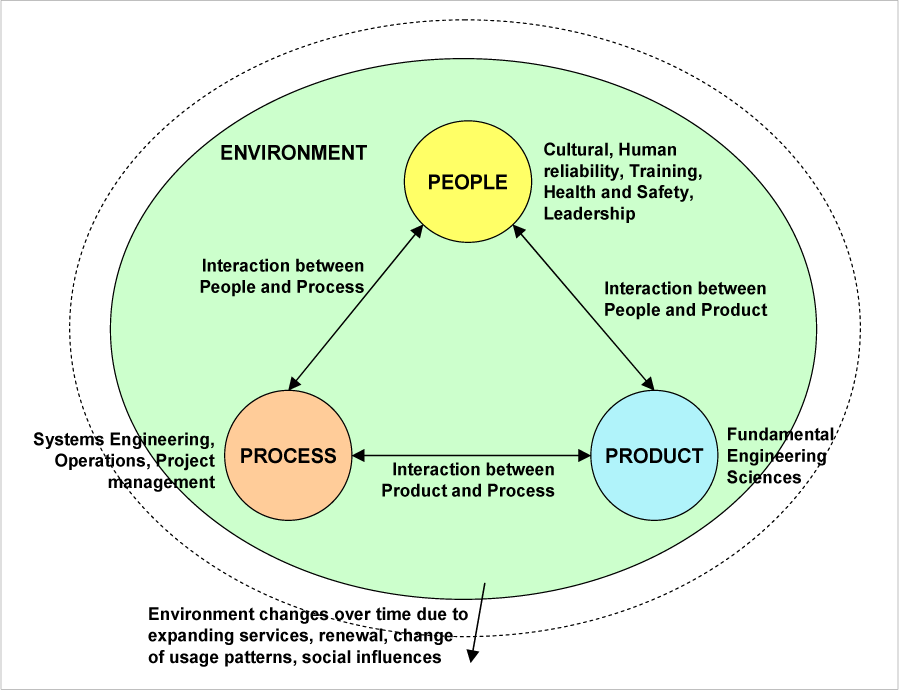
Product Process People Environment (3PE) model
An enterprise model can describe a baseline support system at time t0 (Figure 2). The baseline description is a “snapshot” record of the enterprise. The enterprise model enables interpolation between “snapshots” that leads to the identification of trends and changes in the enterprise architecture. By carefully analysing the evolution and links between different functions, data and processes, a development continuum can be mapped out to form a trajectory, as shown in Figure 2. The new (future) architecture covers the additional “changing” aspect of a service system by integrating the concepts of product, process and people to changes in the environment over time.

Enterprise models in a transition trajectory
The selection of performance indicators depends on the application context (Beasley et al., 2005; Liu and Barrar, 2009). Berrah et al. (2000) reviewed a number of performance indicators with the aim to evaluate approaches to improvement. An architectural trajectory model should help the understanding of possible future states of the support system and ensure continuity of capabilities (Karkach, 2006). Based on these concepts, this paper identifies the key capability elements of a support system from several existing support systems that can be used to characterize the changes over time. Capabilities are affected by the environment, which changes over time. Mapping the trajectory is an iterative process; by monitoring or estimating the changes in capabilities over time, the trajectory can be visualized by the overall indicator value and used as a management tool for the transition.
4. Existing Support Systems
A system that requires changes from its current enterprise model takes a paradigm shift in culture, behaviour and relationships to meet the desired value proposition of the new system. Some of the solutions may not be palatable to the customer for political, geographical or historical reasons. However, they are explored to identify the key capability elements of a service support enterprise.
4.1 Hawk 127
The Hawk 127 project is a complex service contract that draws on the experience of the international Hawk user group. The business model looks at the needs of the Commonwealth to provide trained fast jet pilots for the operational Australian Air Force. The contract requires a level of aircraft availability from BAE Systems. Failure to meet this metric may incur severe financial penalties. In the earlier phases of the contract this drove the culture of the business model to one largely focused on delivering a product as opposed to a service.
Under the Strategic Reform Program the Defence Materiel Organization (DMO) (2011) is seeking greater accountability and transparency in the way Defence manages its budget. The new contracting paradigm has forced projects to look at initiatives such as Lean, Kaizan and other efficiency drives in an effort to remain competitive and continue to remain the customer's supplier of choice. Under this environment, there are four key processes in the support system:
Fleet Management
Logistics Management
Engineering support
Deeper Level Maintenance
The challenge of such a complex engineering system service is to evolve and change with the life cycle of the product. What was of high importance at the start of the product lifecycle, such as defect reporting and management reporting, have now become secondary to the needs of in-service, long-term planning, scheduled maintenance and policy reviews.
As opposed to the traditional architecture where the Systems Program Office (SPO) determined maintenance and support requirements, areas that were part of the SPO environment are now under the direct control of the prime contractor. BAE Systems took over the management of several key aspects of the service, including fleet management, deeper maintenance, publication management, spares provisioning and engineering support. As part of the work offset a purpose built facility was located at Williamtown next to the RAAF base.
This new system architecture, shown in Figure 3, not only demands collaboration at the highest level, but also at the very lowest levels, within the integrated project team. The aim is for the entire individual IPT's to actively share not only data, but also knowledge and information in order to derive the optimized solution, through improved discussion and understanding, for the overall benefit of the project support system. In Figure 3, establishment of the Capability System Management Committee and its related subcommittees highlights the output focus of the architecture meeting customer's expectations.
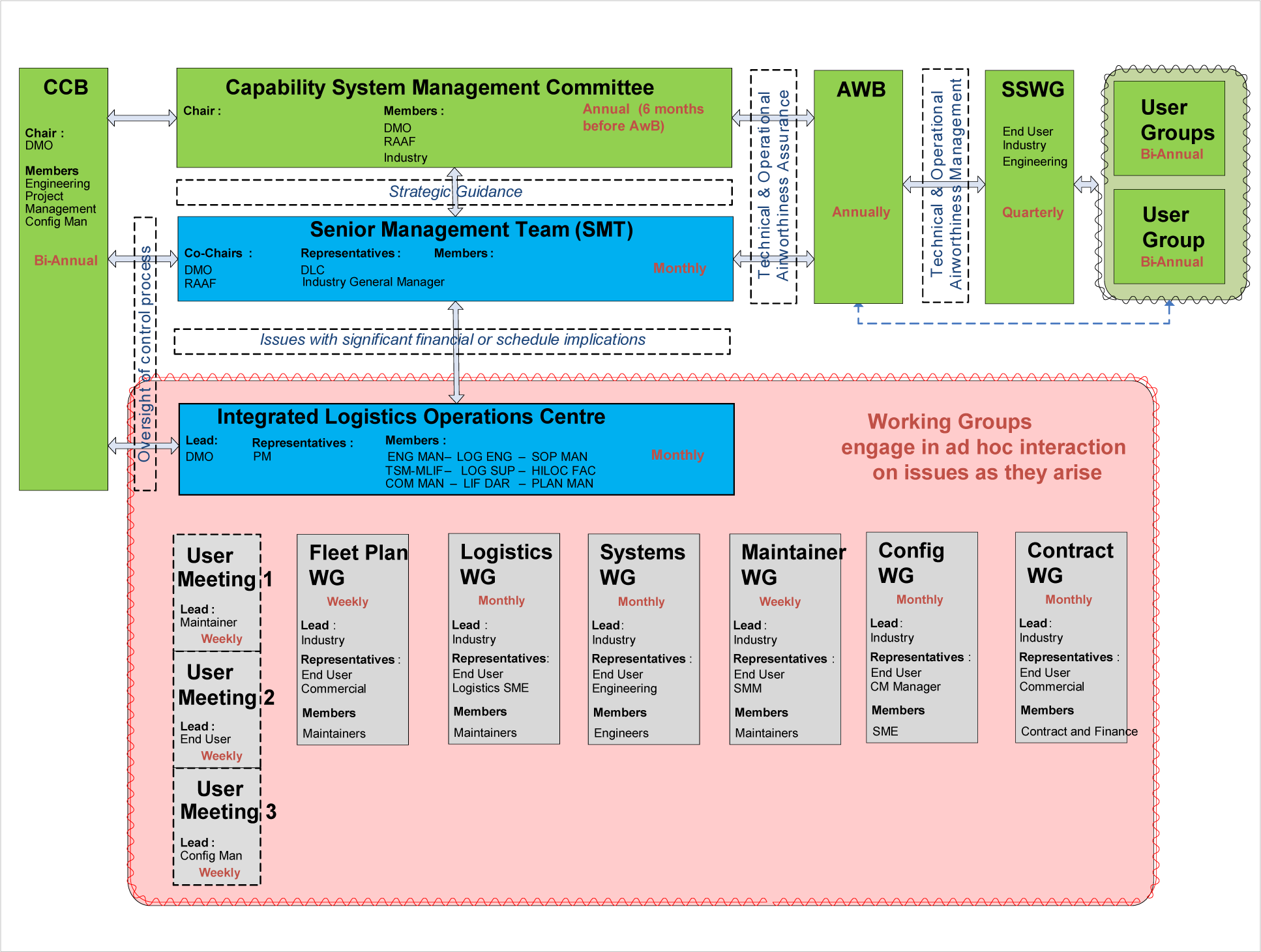
Hawk 127 support architecture.
The two most influential factors are that the customer's value proposition has changed over the length of the contract and the constraint placed on the Commonwealth to limit funding in line with the Strategic Reform Program. This has forced the customer to seriously consider step changes in its own performance rather than allowing the service provider to manage and implement change. The introduction of the service model is a clear intent of the customer to try and optimize performance and reduce cost. While this may not be beneficial to the value delivery system, it is a key enabler for the customer to be able to maintain and drive its changing value proposition.
The support solution framework and documentation focuses on the support contract through the eyes of the customer or end user. These interactions between internal stakeholders vary greatly depending on the level of criticality. The maintenance and supply areas have a strong robust procedural relationship, which is needed to ensure that supply meets demand as required and in most cases, the supply can be predicted to support scheduled maintenance activities.
The need to improve the internal management of the support system has only recently been identified. The measure of the contract is via regular reporting on an agreed set of measures, such as aircraft availability, flying rate of effort, spares demand satisfaction times and technical response times. There is no similar reporting or measurements for internal customers. The emerging need for internal management initiates a more radical enterprise model focused on the needs of SRP, which would drive out duplication and provide a lean fully integrated solution. The paradigm shift would have to come from the customer and allow a greater deal of dependency on the service provider (Table 1).
Paradigm shift to promote value proposition
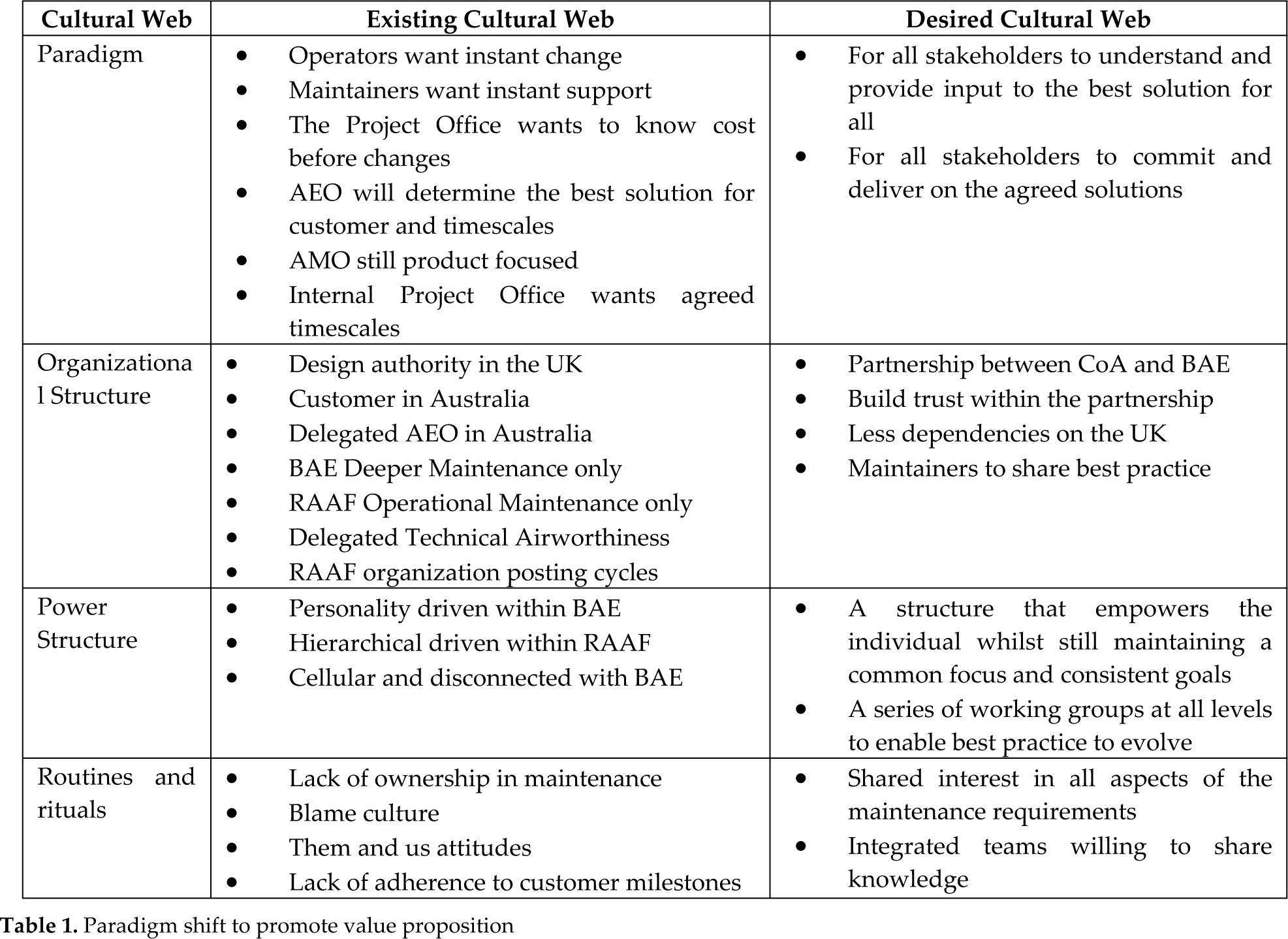
In moving away from the current paradigm, an effective and optimized service capability is essential to understand the current environment or enterprise and that of the desired transition state. To identify when the new environment has sufficiently matured, the service solution must be constantly measured against a preagreed set of KPI's or reporting metrics. This measurement is key to ensuring that the focus of the transformation remains on the service capability and the customer value.
4.2 Hornet F18
The acquisition of the Hornet fleet between 1984 and 1990 occurred prior to the introduction of the current ADF Airworthiness Management System in 1993. DMO has an overarching responsibility for providing the Air Force with project management of Hornet fleet engineering, logistic support and acquisition. Since 1993, Defence has made significant progress towards increasing efficiencies and maximizing combat capability over a decade of continuous air combat upgrades and acquisitions. This experience will ease the burden during what will be a carefully balanced transition to the F-35A. The introduction of new capability is subject to two different organizational processes. DGTA will oversee the technical design solution and design acceptance, while the process of Service Release ensures that the support elements are in place. This second process is that of the Airworthiness Agency (ACPA). This creates the potential for a disjointed and different focus on the priority and needs of the end user.
The decision in 2007 to acquire 24 F/A-18F Super Hornets and their delivery in 2010–11 was intended to bridge the capability gap between the early retirement of the F-111 fleet (advanced from 2015–20 to 2010) and the eventual acquisition of the F-35 Lightning II Joint Strike Fighter. In a defence context, the period of four years between the decision to acquire the Super Hornet fleet and its arrival in Australia constituted a very short time frame for the establishment of such a significant and complex capability. To ensure that the Super Hornet fleet's on-going support and capability development occur cost effectively, Defence is seeking to maintain close commonality with the US Navy in terms of Super Hornet operation, maintenance and support. This is being achieved through a combination of commercial contracting and the acquisition of maintenance items and technical support via US Foreign Military sales agreements.
The focus of the design and optimization depends on the phase of the lifecycle that the service is in. The F18 it is a fully operational combat aircraft that has a support solution ready to meet its varied and rapid deployments. As the Super Hornet solution is seen as a short term measure until the JSF program becomes operational, it has required both significant contractor and customer involvement, necessitating a consistent optimization and data management approach to ensure that there are no missing or conflicting assumptions.
In-service support of individual F/A-18A/B aircraft is provided at two levels:
Operational Maintenance undertaken by several Air Combat Group's Operational Conversion Units. This includes aircraft flight-line servicing and fault diagnosis, and aircraft condition inspections and repairs at the line replaceable unit level
Deeper Maintenance undertaken both by contractors and by the ACG personnel employed in the Wing F/A-18 Deeper Maintenance Combined Workshop at Williamtown.
During this short term in-service support, continuing trade-offs are expected between supply chain performance and cost and maintenance performance throughout the contract. The project is however still dependent on the US Navy and the support contracts to ensure that the Super Hornet meets its capability. With the majority of the support solution coming from the US Navy, the RAAF needs continued capability of not only the front line but also of people and experience. With this support solution this loss of knowledge will continue to erode the RAAF position.
4.3 Tornado Aircraft
The Availability Transformation: Tornado Aircraft Contract (ATTAC) provides guaranteed availability of Tornado aircraft for the RAF. BAE Systems is the subcontractor supporting the RAF Tornado fleet to boost aircraft's availability for frontline operations while considerably reducing cost to the taxpayer. The contract (ATTAC) is expected to save the MoD an estimated £510 million over the initial ten years of the program. The company works in a partnered approach with the MoD and the RAF and includes on-aircraft maintenance of the Tornado fleet, spares support, technical support and training. The approach builds on availability improvements and cost reductions achieved through earlier pilot programs, e.g., combined maintenance and upgrades has reduced traditional maintenance man hours by 50% and support of the secondary power system has been undertaken at 23% less than the historical costs.
Three Key Performance Indicators (KPIs) came into effect:
Available Flying Hours KPI
Spares availability to Forward KPI
Technical Support to Forward KPI.
These are reported daily, weekly or monthly. By way of example, the sub-measures for KPI 1 include: aircraft availability, readiness, aircraft on ground (AOG), attrition, readiness, sortie value, technical arisings, ground aborts, capability faults, system faults, role equipment, late from maintenance, ground support equipment, airworthiness and safety and many others.
Under ATTAC contract, the government pays a fixed price for a specified number of assets to be available for operations. If an aircraft is grounded for repairs or maintenance, the aircraft supplier covers those repairs at no extra cost to the government. Through these contracting terms, the Defence Industrial Strategy has turned the industry's existing business models on their heads. The contractor is being paid for availability and given full management responsibility that is tied to clear metrics and financial penalties as well as rewards.
A system engineering approach was applied to the ATTAC solution to reduce overall risk by ensuring appropriate rigour and depth. The System Engineering Management Plan (SEMP) encompassed the ATTAC service in terms of its processes, organizations, location, data, applications and technology (POLDAT). It also addressed non-recurring activities over the ATTAC lifecycle to provide evidence of control over the design and development of the ATTAC service and their associated maturity criteria. Modelling of the asset management service was divided into manageable portions first by type, then by supplier.
5. Key capabilities in existing support system
The study of these support systems reveals common elements of a typical support system for aircraft. In this analysis, the 3PE service enterprise model is used to consolidate the concepts. Tracking changes made to these elements in a quantified hierarchical structure will provide a transitional picture of the support system.
5.1 Product
5.1.1 Maintenance Engineering Analysis
All three support systems described in Section 4 show strong elements of Maintenance Engineering Analysis (MEA). MEA is a tool developed by the logistic community to integrate logistic support requirements into the mainstream of an asset acquisition cycle. This integration is essential to ensure that the development and implementation of logistic support planning is consistent with the design and development of hardware and that it is responsive to fleet operational requirements.
The purpose of the MEA is to provide objective maintenance data analysis for the maintenance team including Failure Mode and Effects Analysis (FMEA) or Failure Mode, Effects and Criticality Analysis (FMECA). These analyses are proactive maintenance engineering methods used to identify potential failure modes, determine their effect on the maintenance costs and identify actions to mitigate the failures. These analyses are performed by maintenance engineers on a regular basis and with the functionality provided by the maintenance management system, allowing the maintenance team to effectively compile their maintenance data reporting, as well as gain the benefit of benchmarking results against comparable systems.
5.1.2 Configuration Management
In all support systems, the focus of the service is a fleet of aircrafts. In order to ensure that the service system has successfully applied all service elements to more than one aircraft, there needs to be strong and consistent Configuration Management both of the product and of the support service itself. The role of configuration and ensuring that all the changed requirements have been fully implemented needs careful planning and is at the very centre of the transitional process.
5.2 Process
5.2.1 Standard Compliance
The aircraft service system works in a highly regulated environment. The major constraint on the aircraft support system is airworthiness regulation. The role of the airworthiness regulator is a critical defining factor in the shape and nature of the support solution. It sets the engineering and maintenance regulations via the Technical Airworthiness Manual (Australian Defence Force, 2011). Spare parts must be maintained properly for aircraft support and no unauthorized components can be used on aircraft. Compliance to its regulations is required. The use of the Authorized Engineering Organization (AEO) and the Authorized Maintenance Organization (AMO) is essential in any aircraft support system.
5.2.2 Logistics Management
While most of the above elements have a transitional short term life, the management of logistics during this phase is more related to long-term planning. The phasing out of one solution and the introduction of a new service may not need to be so integrated as the other elements. KPIs related to the phase out or phase in of a solution are different to those in the steady state support solution.
5.3 People
5.3.1 Training
Each type of aircraft has different design, maintenance and supplies requirements. AMOs are required to keep the skills of the personnel working on the aircraft at a satisfactory level at all times. Any technical team that shows competency by a formal assessment process is made up of authorized personnel, allowing them to work on certified tasks on the specified aircraft. Specific training that allows the product service to transition from the current state to the future state needs to be identified at early stages of the support system development and should be pro-actively managed.
5.3.1 Enterprise Management
Enterprise management is the capability to apply systems engineering principles and practices to develop and monitor changes. It is fundamental to the systems engineering approach that efficiency of the interface requires systematic development of the functions and the respective relationships. The ideal support system is one that has a clearly defined responsibility and accountability for each function so each can operate in a complementary manner with suitable information exchange and synchronization of activities.
5.4 People/Process Interactions
5.4.1 Transition Planning
Traditional enterprise architectures are based on a top down approach. They emphasize uniformity throughout the organization. As such, the structure is inflexible. Changing the structure in order to respond to fast changing dynamic issues for in-service engineering systems will take too long to fix any problem. The transitional enterprise will by its very nature need to be flexible but also provide a strong framework that allows the other elements' transition. Such flexibility can only be achieved by innovation in the interaction between people (from all stakeholders) and the affected enterprise processes.
5.4.1 Risk Management
The fundamental change within a transitional architecture is the ability to react to customer operational needs in a more responsive manner. Risk management and its offset must be highly mitigated in this set up, with lifecycle costing and reliability data providing a large input into the model. The risk management issues pertinent to support operations should have been assessed earlier in the project lifecycle during the development phase. However this is not always the case, therefore support solutions will fall into two broad groups: the first is a support contract where the residual risk associated with the product is fully understood and the second is a support contract for a product where the residual risk is not fully understood.
5.4.2 Operational Safety, Suitability and Effectiveness
For all temporary and permanent modifications, the system Operational Safety, Suitability and Effectiveness (OSS&E) must be preserved. OSS&E is integral to the modification management process and as such must be preserved throughout modification planning and execution to ensure operational safety, design integrity and suitability for all modified systems and end items. Therefore, all proposed temporary and permanent modifications must be reviewed by the responsible Configuration Control Board (CCB) and be approved by the support manager prior to implementation.
5.5 Product/Process Interactions
5.5.1 Maintenance Management
The foundation of managing maintenance activities on aircraft is to ensure relevant records are kept. Every piece of apparatus and equipment should have its own maintenance record. This includes vehicles, generators, rescue tools, hoses and even ground ladders. If something needs to be inspected, maintained, tested or repaired, it needs a separate record. The records should show what work was performed, when it was done and who did the work. The person doing the work should be properly identified, rather than having the shop foreman or supervisor sign off on everything. This last point is critical. If an apparatus or piece of equipment is involved in an accident where someone is injured or killed, investigators will want to know if the inspection, maintenance or testing was performed by a qualified person. To defend themselves adequately, companies need to record the name of the person who actually performed every task.
5.5.2 Certification
Maintenance certification is essentially the quality control of the maintenance services and unlike engineering must be done on the completion of the task (engineering artefacts, in the form of abstract data, can be assessed long before their completion). Maintenance task certification can only be done by the authorized person who performed the task. In the case of an apprentice (who is a trainee and by definition not an authorized maintainer), the trainer of the apprentice is the authorized person and must certify for the apprentice. The principle is that certification is traceable to authorized individuals. Task certification is provided by the authorized person (a Licensed Aircraft Maintenance Engineer, or LAME). Independent verification is provided by a Licensed Aircraft Maintenance Engineer.
5.6 People/Product Interactions
5.6.1 System Safety Management
System safety aims to prevent incidents. The main means of prevention is non-conformance reporting that enables a broad base within the maintenance service organization and involves customers in detecting, documenting and taking action on non-compliance matters. In fact, complaints are the major source of such information. Non-conformances include errors, incidents, suspected adverse events, complaints and product deviations from approved engineering specifications. A non-conformance reporting procedure addresses the requirement that quality related problems, including regulatory non-compliances, ideas for improvement and internal audit outcomes, are documented, actioned and reviewed appropriately.
Non-compliance of any party in supporting a maintenance task is especially serious when maintenance fails to bring capacity back on-line as promised. Examples are delays in schedules, late delivery of key repair parts, unavailability of appropriate skills, etc. Non-compliance of this nature diminishes future cooperative schedule coordination. When maintenance crews encounter schedule compliance problems outside their control, the reasons should be captured and studied for trends, leading to constructive action.
5.6.2 Publication Management
As maintenance practitioners and/or professionals involved in logistics support, it is important to realize that knowledge changes in this live and changing support environment. There are operational changes, supply chain issues, system upgrade, re-configuration, obsolescence management, and many other factors. To keep up-to-date on these changes in the support environment, reviewing and publishing technical publications are the main actions. The technical publications can include (but not limited to):
Technical Data Management
Maintenance Documentation
Certification Basis
Recording and Closeout of Maintenance
Inspection Registers
Inspection and Test Plans
Material Certification
In addition to standard maintenance (often understood to be routine), deviations and non-standard repairs are also common. While the maintenance team takes appropriate actions fulfilling their duty and keeping their records, logistics and the larger maintenance organizations should be informed by reports.
6. Discussion
The foregoing analysis focuses on the identification of elements in the 3PE model relevant to the development of a support system for defence aircrafts. It would be useful to explore how the adapted 3PE model fits the cases themselves (Table 2).
Brief comparison of relevant elements in the three transitional architectures

From Table 2, the transition requirements are obvious for F18 due to a product change. The other two cases are less obvious in transition. However, changes are required for processes and people in terms of the continuous improvement agreed between the contractor and the customer.
7. Conclusion
The research has established a framework for developing architecture for support systems during the transition stage. The framework is based on enterprise integration and modelling methodology. Three cases are examined carefully to determine the transition stages. The case studies show that the support system for aircraft can be represented by an enterprise model that contains three essential elements: product, process and people. These elements interact among themselves within the boundary of an environment. Using the 3PE model, the existing support systems are analysed and their changes over time due to changes in the operating environment are examined. The outcome of this research can be used as a reference structure for the development of the capability assessment hierarchical model.
There are still limitations in the current model as the analyses are largely qualitative. Changes that may be due to error correction rather than system necessity are not distinguishable from the cases. The application of the parameterized 3PE model in Figure 3 will transform some of the factors into measurable parameters. Analysing quantitative data integrated with the qualitative framework will be the focus of future research on transitional support architecture.