




Abstract
In recent years, the increased provision of bundled products and services has become an increasingly relevant economic trend for manufacturers in achieving competitive advantage. The project environment has not been left untouched by this economic trend, in particular throughout the delivery of integrated project-service solutions in all project life cycle stages. Innovative value offerings encompass a complex network of suppliers and subcontractors that is not stable and is arranged in a sporadic and unpredictable manner. Multiple case studies in the yacht industry were conducted to explore the configuration of project-service solutions. The research constitutes an original contribution to studies on servitization adoption in an industrial project context from an inter-organizational perspective. It emerged that SMEs reorganize themselves, in order to provide flexible on-demand solutions to customers, by including all the capabilities within their network. Newly arising professional roles are oriented to the implementation of smart networks and are focused on service infusion in order to provide increased customer value.
1. Introduction
During the last decade, the shift toward project-service integrated solutions has been recognized as a growing economic trend in the project environment [1, 2]. Previous research has also highlighted that the servitized strategies require the coordination of complex networks of product/service providers, especially when seeking a more efficient and effective flow of information between partners in the value chain [3].
In the project environment, customer-supplier implications of servitized strategies are particularly critical [4] for two reasons: firstly because the innovative value offerings encompass a complex network of suppliers and subcontractors [5] that is not stable and is arranged in a sporadic and unpredictable manner [6]; and secondly, because the different technologies and capabilities of the various actors involved require dynamism and mutual adaption in order to offer integrated project-service solutions to customers [7]. Hence, the majority of projects and the related pre- and post- delivery services extend the boundaries of the single firm.
Despite its criticality, the research topic concerning “project-service Value Chains” remains relatively unexplored in the project environment. Further contributions are required in order to investigate the configuration changes of the value chain over the product life-cycle [8] and the performance implications with the embedded project and service offerings [4]. The impact of specific project-service solutions on Supply Chain (SC) performance has not been analysed by previous literature and it represents a research area that requires further exploration in order to understand the different set of SC performances that are oriented at the creation of different value propositions.
This article, focusing on the yacht industry, aims to explore how industrial project-based organizations reorganize their value chains and customer-supplier relationships in order to deal with the new competitive context of integrated project-service solutions. The following research objectives are proposed:
Analyse the strategic orientation of an industrial project-oriented supply chain in order to investigate the role of integrated life-cycle solutions towards the provision of customer value. Investigate how project organizations change the structure of the value chain in order to propose valuable life-cycle solutions. Identify the impact of life cycle solutions on Supply Chain performance in order to detect common patterns that can be used to provide similar value propositions.
The present article is structured as follows: Section 2 describes the theoretical background of integrated project-service solutions; Section 3 defines the research methodology that consists of multiple case studies in the yacht industry; Section 4 depicts the results and the discussion; finally, Section 5 draws the conclusions and outlines future research developments.
2. Theoretical Background
Project-based organizations are currently placing more emphasis on service provision [4, 9] by enriching the modalities and the priorities of the value proposition to customers [10]. The “Servitization” paradigm, which was originally formulated and has, for a long time, been discussed as a solution for the manufacturing industry [11, 12], is here used to describe the tendency to provide not just a pure project but integrated project-service solutions with a leading role of service offerings [13, 14]. Such solutions include both a project and a service component. They are designed to link the completion of custom-based products with a set of offerings, that extend the traditional project delivery phase to the coverage of the whole project life cycle.
If the lack of integrated SC frameworks has been highlighted for the management of product-service solutions in the manufacturing context [15, 8], in the project context the research contributions are even more explorative. Furthermore, SC implications of integrated project-service solutions have an impact on a wider range of roles and functions than in the manufacturing sector [16]; this requires the development of a framework to investigate the value chain implications of life cycle solutions in the project environment.
Therefore, the structure of the framework is aimed at the investigation of the research objectives, by linking the following aspects in a logical sequence: the strategies of the servitization paradigm; the organizational implications of servitized strategies from a SC perspective; and the operative declension of servitized strategies through life cycle project-service solutions. Thus, the main elements underpinning the servitization paradigm in the project industry are organized on three different levels:
Servitized Strategy Supply Chain Relationships Integrated Life Cycle Solutions
Figure 1 depicts the theoretical framework that is based on the combination of Project Management and Supply Chain Management (SCM) research fields and will be used to frame the case studies.

Framework of project-based SCM Servitization
2.1 Servitized Strategy and Pro-active Co-creation of Value
Servitized strategy is oriented toward the delivery of increased value to the final customer [17], through increased support and availability of project-service solutions [16]. As customers are now demanding a major extension of service orientation, servitization strategies support the creation of competitive advantage in terms of increased quality, enhanced barriers to entry, and a differentiation of offerings from those of competitors [18]. In the yacht industry, the revenues that can be generated from a servitized strategy can be substantial as the installed base of products has a long life cycle [19] and a complexly engineered product is offered [20]. Finally, services are also used to acquire market knowledge about customers' expectations, which, in turn, improves specific solutions and creates new business opportunities.
Focusing on the manufacturing sector, Neely [10] has outlined five options for servitization, which have not yet been contextualized in the project environment:
Integration oriented. The ownership of the product is transferred to the customer and services are added by going downstream to achieve vertical integration. A typical example from the yacht industry is presented by the General Contractor, who aims to extend the offering of services to post-sales activities through the acquisition of refitting companies. Product oriented. The ownership of the product is transferred to the customer and additional services, which are directly related to the product, are provided. In the yacht industry, the intangible service components, such as engineering and conceptual design, are added to customize the product offering in accordance with the requirements of the Project Owner. Service oriented. The ownership of the product is transferred to the customer and valuable services, which represent an integral part of the offering, are provided. This option involves new business models with a shift of risk and responsibilities. In the yacht industry, on-demand and preventive maintenance services are provided with worldwide availability to Project Owners, who can then better plan the life cycle of their investment. Use oriented. The ownership of the product is retained by the provider, who shares, leases and pools the function of the product to the customer as a service. The yacht management and charter services represent a typical example of this option. Result oriented. The provider sells the capability that the user wants instead of the product itself. In the yacht industry, there is a high recourse to this option through the outsourcing of construction activities.
2.2 Supply Chain Relationships
The impact of servitization strategy potentially involves the whole network of organizations and requires a deep understanding of supply chain relationships among project participants. The provision of project-service solutions encompasses more supply chain participants over a longer period than in a traditional project delivery.
Johnson and Mena [8] have proposed the first valuable SCM model for servitized products. The authors have identified ten main processes involved in servitized SCM, among which information flow stands out as the key process. Information flow is necessary to interconnect other processes by overcoming spatial barriers and by reducing demand/supply uncertainty. Customer-supplier relationships are greatly affected by the management of the information flow, fostering the establishment of long-term agreements and increasing the responsiveness of the whole chain.
The effective provision of project-service solutions has been attributed to the development of collaborative relationships among project participants that can generate win-win situations between the different echelons of the supply chain [1, 21]. To achieve increased value creation, supply chain participants reconfigure their roles and responsibilities, generating the fit between the required capabilities and customer needs and thereby realizing synergies and spill-overs between the project and the service component of the solution [22]. Profit-sharing practices should be implemented among the servitized network, which becomes the bearer of the risk through contracts including penalties for non-compliance [8].
In the yacht industry, several actors participate with different perspectives to the establishment of customer-supplier relationships:
Owners. They aim to obtain customized value propositions that ensure a determined level of product conditions and performance during its life cycle [23], thus reducing post-delivery risks and the related cost unpredictability. General Contractors. They aim to increase their revenues through customer-centred value propositions that have being pushed downstream in the supply chain towards in-service support [24]. Sub-contractors. They operate almost the totality of project activities [25], but their weaker position in the business network requires the continuous scan of business opportunities and the establishment of new value constellations in order to enhance their offerings [26]. Suppliers. Through project-service solutions, they aim to obtain a larger share of customers' value stream by facilitating the adoption of new co-designed products and by building barriers to entry, with major impacts on project differentiation and project long-term success [7].
2.3 Integrated Life Cycle Solutions
Project companies are changing the characterization of their value offerings toward more sophisticated solutions. Kujala et al. [14] have proposed three types of project-service solutions, namely transactional project delivery, project led solution and life cycle solution. The latter is characterized by the offering of the Project and the Operations and Management (O&M) services as one integrated value proposition. Life cycle solutions represent the most advanced offerings that can effectively cover customer needs, even after the delivery of the project [27]. These solutions are used to bond with customers by creating additional value with a long-term perspective, they therefore represent an effective means to achieving customer lock-in [28]. Moreover, they can be used as an entry point toward contiguous market segments for the provision of additional solutions in the future, thus facilitating customer entry [4].
According to Helander's classification [29], life cycle solutions can be positioned at three different stages of an industrial project delivery:
Pre-project phase (e.g., financial services, conceptual design and brokerage). Project phase (e.g., co-development of customized systems, engineering and project management). Post-project phase (e.g., maintenance, refitting and chartering).
It is worth underlining the fact that the various project participants (General Contractor, Owner, Suppliers, Subcontractors) are involved in all three project stages, emphasizing the critical role of SC relationships in the creation of value [18]. Moreover, as the extent of the project-service solutions covers the entire product life cycle, servitized value chains have a deep influence on the performance of the Supply Chain [30, 31]. Drawing from extant manufacturing and project literature [4, 32], we indicate eleven different types of impact of project-service solutions on Supply Chain performance, namely:
Innovation Cash flow stability Customizability Cost Lead time Responsiveness Delivery efficiency Brand relevance Quality Service level Coordination
3. Methodology
In accordance with the exploratory nature of the research objectives, we considered case study methodology suitable to support in-depth results and gain new knowledge in an area that is characterized by limited empirical research [33, 34]. The selection of case companies was critical for the present research as the investigation involves the successful provision of project-service solutions from a supply chain perspective. A “purposive sampling strategy” was adopted [35]. Within the yachting industry, we selected four companies that provide project-service solutions with different business perspectives and remit the main roles in the SC: a Main Contractor, two Suppliers and one Sub-contractor. This choice was driven by the search for a high quality sample that was considered complex enough to describe the managerial behaviour of this industrial project context. Hence, the selected companies achieved great business performance in the last five years, providing high value-adding services for the customers in all the three different stages of project life cycle: pre-project, project and post-project delivery.
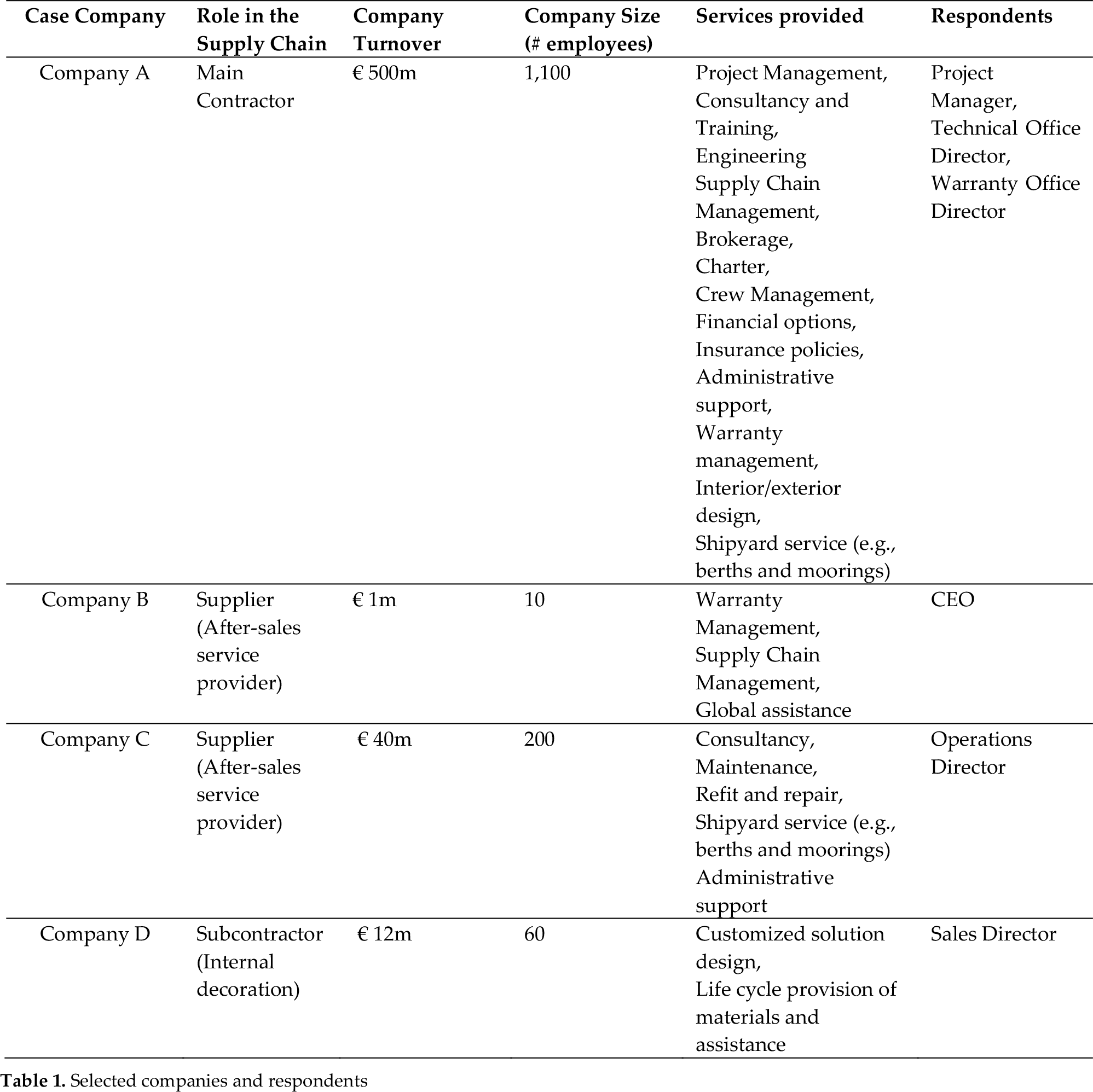
Primary data was collected through semi-structured interviews with managers. The duration of the interviews ranged from one to two hours. To ensure transparency and repeatability of research, all respondents were interviewed using the same research protocol. The interviewees sample included experienced and senior levels managers from various functional areas, such as CEOs, engineering directors and project managers. Secondary data sources were also consulted in order to triangulate data sources and increase findings reliability [36]; these included internal strategy documents, public industry statistics and websites. Table 1 provides the summary of case studies, highlighting the position of the company within the supply chain, its turnover, the number of employees, the services provided and the role of each person interviewed.
Selected companies and respondents
The transcripts of the interviews and the secondary data were collected in a case study database. The analysis of the data was performed both within and across cases in order to investigate differences and similarities between the cases [37]. The reliability of data was checked by sending back the transcript of the cases to the companies for confirmation.
4. Results and Discussion
4.1 Servitized Strategy
All selected companies stressed how the increased provision of value for the customer represented their main strategic objective. The source of customer value is created in a different manner for each project by adding customized service components according to the requirements of the Owner, in a similar fashion to the full customization of the final product. From the interviews it emerged that the yacht industry is facing a shift of strategic orientation. Until the last decade, the product was the sole focus of project participants and an intensive relationship with the Owner was limited to the project delivery phase. From the analysis of case studies, it emerged that yacht companies have shifted their focus to flexible and on-demand solutions. The provision of services in the long term allows for a reduction in the volatility of cash flows [38]. In a project context such as the yacht industry, which is characterized by trend and seasonality, a more stable financial flow is particularly critical.
In order to contextualize the servitization strategies in the yacht industry, the five strategic options proposed by Neely (2008) [20] were outlined for each case company:
Integration oriented. Within this option, two different cases have been identified. In both cases, the objective is to access a business segment that would allow the company to manage the products during the whole life cycle, exploiting economies of knowledge and scope. In the first case, the Suppliers of complex systems, such as the engine, the domotics and the décor, extend their business by providing the assembling of the supplied products on-board and the maintenance services after the project delivery. Hence, Suppliers own the know-how to best operate in complex systems and the Main Contractor can benefit from the better assembling that then reduces reworks during project executions and warranty costs after project delivery. In the second case, the Main Contractor aims to extend the offering of project-service solutions to the post-sales phase (typically maintenance and refitting). The access to this market does not require the Main Contractor to make any additional investments as he/she already owns the necessary facilities and the equipment. To increase its presence in this business, two different strategies have been implemented: an equity-based and a network-based control. In the first case, the Main Contractor acquires after-sales companies, assuming the governance of the supply chain and of the entire system of value creation. In the second case, the Main Contractor involves after-sales Sub-contractors to participate in the project delivery phase. Subcontractors extend their business opportunities by entering an upstream business segment. Product oriented. The objective of this option is to provide the highest level of customer value through the full customization of the product within the project delivery phase. The related provision of project-service solutions includes the engineering, the design of interior/exterior and the development of co-designed systems. Main Contractors, Subcontractors (e.g., designers) and Suppliers (e.g., audio-visual systems) cooperate to achieve the highest customer satisfaction that results in higher profitability. Within this strategic option intangible solutions provided by the Main Contractor are also included, such as SCM and project management, which are necessary to effectively deliver the product in accordance with the requirements of the Owner. In the yacht industry, Main Contractors can outsource the totality of production activities: their role is completely focused on the coordination of the complex networks of Sub-contractors and Suppliers. Service oriented. This option is mainly characterized by post-sales project-service solutions that are aimed at gaining the satisfaction of the Owner during the utilization of the product. Examples of these services include navigations assistance and itinerary planning. This option is also characterized by the highest dynamism of the market. Hence, new professional roles are entering the market with the objective of providing on-demand services with a global covering. Typical solutions comprise the provision of turnkey systems, specific/complex interventions and the management of out-of-warranty activities. These professional roles act as Supply Chain Coordinators; they pool the capabilities of Sub-contractors to obtain a responsive and fully-comprehensive assistance offering to the Owner. Within the supply chain, the Supply Chain Coordinator is positioned as the joining link between the Main Contractor and the network of Sub-contractors. Use oriented. This option has been extensively undertaken during the last decade by Main Contractors and specialized after-sale service providers. It is based on the temporary offering of facilities and luxury products to the Owner, who requires top-range products and services after their arrival in the shipyard. The charter service represents the traditional solution, but use-oriented solutions extend the provision of the yacht-as-a-service to embrace other marine concierge services, such as infrastructures (e.g., berths and moorings), other luxury products (e.g., catering and marine consumables) and human resources (e.g., crews and security staff). Result oriented. This option has existed within the yacht industry almost from the beginning and our case analysis did not reveal new patterns or trends in the market. In general, result-oriented strategies are extensively used by the Main Contractor, who outsources most of the fabrication activities to Sub-contractors, removing the total cost of ownership of equipment and focusing on core activities like project management and SCM.
4.2 Supply Chain Relationships
From the interviews, it emerged that the yacht industry is modifying its structure in order to cope with the increased orientation towards the offering of project-service solutions. In particular, product customization and post-sales processes, in which contact with the Owner is traditionally more frequent and intense, are setting the stage for the diffusion of the collaborative trend to the whole yacht value chain.
Company A is strengthening its relationships with many critical Suppliers and Subcontractors in order to unite the top marine sector companies into an exclusive partnership. The objective of the Main Contractor is to increase the coordination among the critical participants that are involved in multiple projects. As a consequence, the Main Contractor is able to retain the manufacturing imprint, by drawing on a highly specialized workforce, innovative construction techniques and a stable production process. On the other hand, Suppliers and Sub-contractors become closer to the final customer and are involved in all the project life cycle activities from the design to the after-sales activities. Company A shared information with other network participants through web-based communication. The information flow is managed through a star configuration, with a hub (the Main Contractor) that centrally coordinates all information with other peers (Suppliers and Subcontractors). The improved visibility and transparency of information resulted in faster engineering and design process, reduced information lead time and more responsive project execution.
Interesting insights also concern the relationships between groups of SMEs, such as Sub-contractors and Supply Chain Coordinators. The relationships within this network of SMEs are driven by the obtainment of the necessary capabilities to provide project-service solutions in the post-delivery project phase. A typical example includes the assistance and repair of the product with a global coverage. SMEs are interested in establishing network long-term supply chain agreements in order to provide responsive, on-demand and flexible project-service solutions in accordance with customer requirements. From an organizational perspective, they reorganize themselves in order to share risks and incentives on the network level. Moreover, the management of the information flow has peculiar characteristics: driven by the responsiveness of the service, IT is based on a web-based cloud configuration that allows the sharing of information on demand without significant up-front investments. Network participants developed shared procedures for the provision of services, ranging from security and operations to the behavioural conduct. Before any maintenance activity, a set of job-cards is completed in order to understand the typology of intervention and to identify the professional roles that are aggregated on demand to cope with it.
4.3 Integrated Life Cycle Solutions
This sub-section describes the operative declension of a servitized strategy through the provision of project-service solutions. We relate the various solutions to the creation of customer value, highlighting the impact on Supply Chain performance as a necessary intermediate step to achieve a comprehensive representation of servitization implications.
Figure 2 describes the various steps of the analysis: from the identification of project-service solutions, through their impact on supply chain performance, to the positioning within the project life cycle until the creation of value for the final customer.
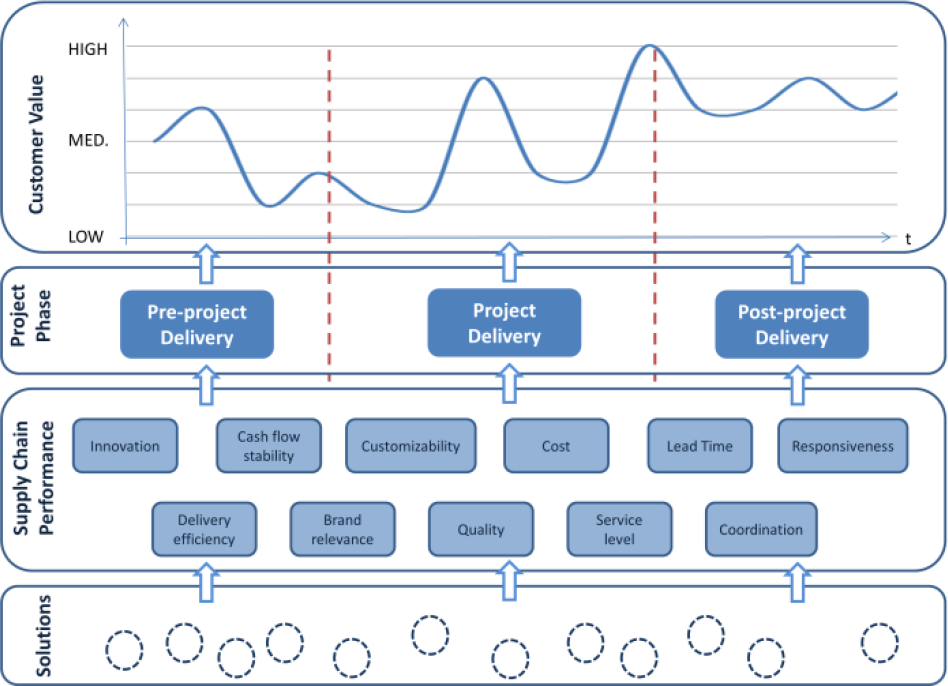
Impact of project-service solutions on customer value
Results from the case interviews showed that the provision of value-adding solutions involved all the phases of product life cycle (from the definition of product design, through the construction, to the continuous maintenance and after-sales activities). Moreover, the provision of solutions was polarized in correspondence to the peaks of perceived value for the Owner.
The first peak is observed during the conceptual design of the product in the pre-project delivery phase. The Main Contractor, supported by designers and major Suppliers, formalizes the requirements of the Owner with the mediation of Brokerage companies. The customizability, the brand relevance and the innovation level of the product are the main drivers of customer value. A deep understanding of Owner requirements in accordance with constructability principles is fundamental in order to deliver the final product without cost/schedule overruns. As the decisions taken during this phase will impact the entire life cycle of the product, consultancy and training sessions among project participants are required to align expectations and objectives. Delivery efficiency is the major SC performance impact for these project-service solutions.
The second peak of customer value arises during the preparation of interiors (e.g., the definition of décors or the assembly of audio-visual systems) and exteriors (e.g., the painting of the hull). During the project execution, the provision of project-service solutions is driven by an increased creation of value but is also interconnected to project performance; therefore the impact on lead time, cost and quality have to be considered. The definition of interiors is entirely customized and it is realized by the Main Contractor with a set of designers, usually selected by the Owner. Suppliers and Sub-contractors are also involved in this activity as they can propose innovative solutions and they are responsible for the effective assembly of the final products. Customizability and responsiveness emerged as having relevant impact on SC performance. Regarding exterior design, the value-adding solutions support the construction of the superstructure and the painting of the hull. These activities are particularly complex and a limited amount of players are available in the supply market. For these project-services solutions, customizability and lead time represent important impacts on SC performance. The whole network of participants is involved in order to adapt and integrate the profusion of different parts from different Suppliers and Subcontractors. As a consequence, coordination emerged as having the most critical impact on SC performance.
The third peak of customer value is related to project delivery. This phase represents the most valuable for the Owner as it is related to the launch of the yacht. After the delivery of the project, the perceived value of the Owner slightly decreases with time, together with the utilization of the product. In our study, it emerged that the provision of project-service solutions was no longer polarized next to the peak but was prolonged in the future. The effect of post-project delivery solutions can be summarized within two typologies: the first one is aimed at the minimization of value degeneration during product use; the second one is aimed at the maximization of the value during product use. The combined outcome of the two different typologies has been graphically described by the alternate peaks and valleys in the top-right corner of Figure 2. In the first case, typical examples of solutions include maintenance, warranty management and refit/repair solutions. Within this typology, cash-flow stability, quality and service level represent the major impacts on SC performance. In the second case, in which project-service solutions are oriented towards the maximization of value during the utilization of the final product, the supply of luxury goods and the provision of berths and moorings are relevant. The Owners' need for this second typology of solutions depends on the stationing location and on unpredictable patterns. Customer responsiveness and service level become the critical indicators of SC performance.
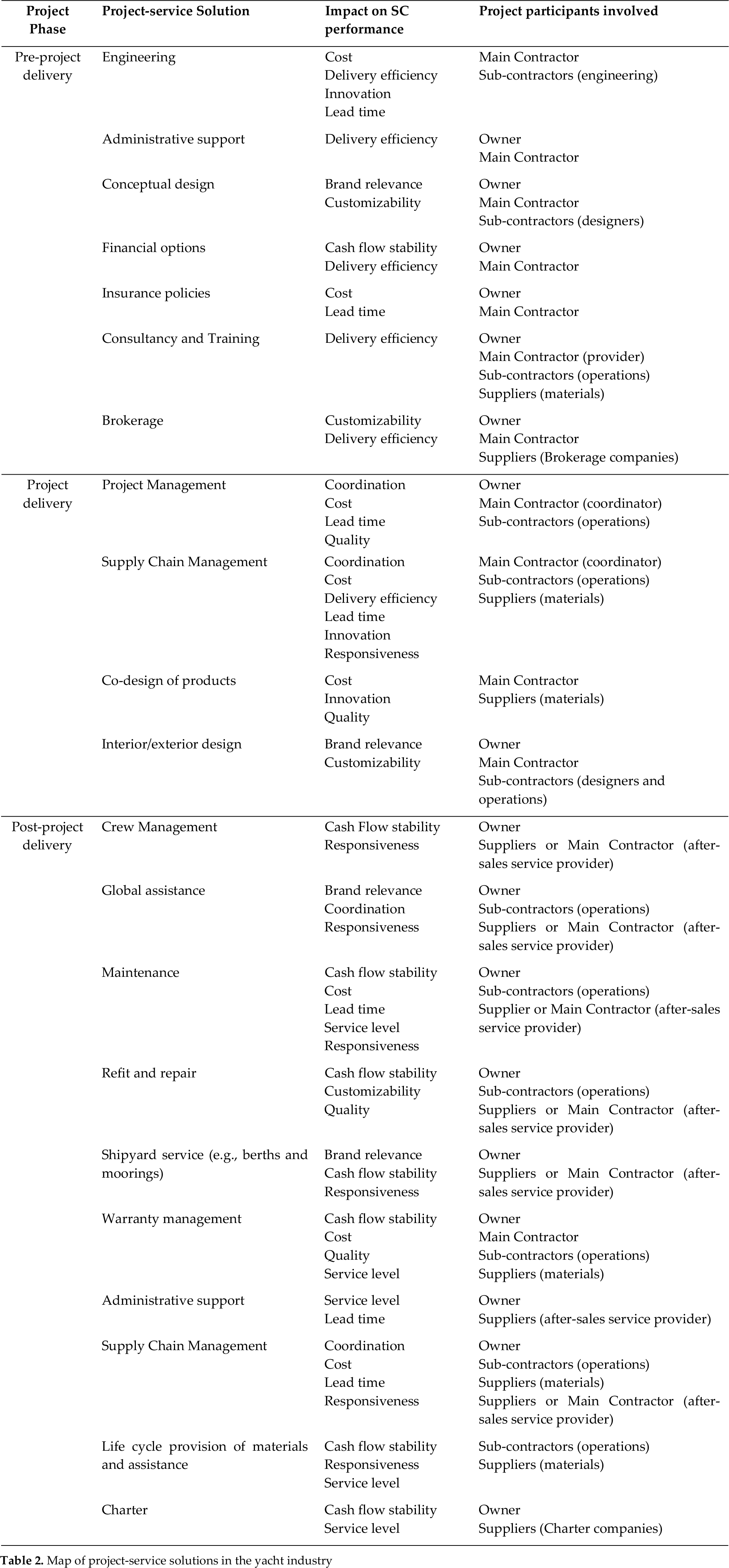
Table 2 provides a complete representation of life cycle solutions, framing them according to the project delivery phase, their impact on SC performance and the various project participants involved.
Map of project-service solutions in the yacht industry
5. Conclusions
5.1 Theoretical Contribution
The present study provides two main theoretical contributions. Firstly, the research synthetizes extant contributions in order to formulate a framework for the investigation of the servitization paradigm in a project-based environment. The literature review revealed a lack of SC frameworks for the management of project-service solutions. The combination of several frameworks from both manufacturing and project literature resulted in a three-level framework for servitized project SCs that was used to frame the case studies. Common sets of SC performance were identified for project-service solutions in accordance with the project phase in which solutions are provided: during pre-project delivery, supply chain performance is oriented towards brand reputation, customizability, innovation and delivery efficiency; during project delivery, major impacts are felt from coordination, lead time, innovation and responsiveness; during the post-project delivery, the supply chain is mainly affected by cash flow stability, responsiveness and service level.
Secondly, the present article extends the research on servitization adoption in an industrial project context from an inter-organizational perspective. A contextualization of previous strategic servitization frameworks that involved a manufacturing context is here proposed for a specific project environment. By describing the key value chains of the yacht industry, the tendency toward integrated project-service solutions is investigated and the related customer-supplier implications are outlined. This research analyses how the SC modifies its structure and configuration in order to foster the adoption of new servitized strategies, collaboration practices, and innovative revenue sharing schemas that are settled to properly satisfy Owner requirements. To the best of our knowledge, this represented an unexplored research area, as project-service solutions had been previously treated from the business model perspective.
5.2 Managerial Contribution
This research provides a value analysis for a project-based supply chain configuration over the evolution of product life cycle, from the design development to the after-sale activities. The value analysis provides a map of the impact of each solution on SC performance in all project phases. The pre-project delivery phase is characterized by the absorbed involvement of the Main Contractor, Owner and Suppliers in the design and development of a customized product. Financial/insurance options, consultancy, conceptual design activities and brokerage services are typically provided at this stage and already include a life cycle perspective that takes the requirements of the Owner into consideration (e.g., through the definition of warranties and maintenance contracts). The project delivery phase includes the coordination between the Main Contractor and Subcontractors. Project management, supply chain coordination, interior/exterior design and administrative support represent the main services that have been observed at this stage. The life cycle orientation arises during the integration of systems and the definition of responsibilities for the handling over and the assembly of components. Such decisions showed a deep impact on future maintenance and repair activities. The post-project phase is characterized by having the largest share of value for project-service solutions (e.g., yacht management, refit, maintenance, crew management, charter, berths and moorings). The tendency of the industry is oriented towards an increased exploitation of this project phase. Main Contractors attempt to vertically integrate downstream the Supply Chain through the acquisition of specialized companies. Subcontractors and Suppliers reposition and focus their value offerings in order to gain under-exploited business opportunities.
The present study can highlight strategic opportunities for both big Main Contractors and a vast array of SMEs involved during the project life cycle. The former seek to maximize the competitive advantage arising from the differentiation of the final product. The latter aim to capture customer value within their market niche and to spread supply risks among network participants [39]. To achieve their strategic objectives, companies should align the supply chain impact of project-service solutions with the various project delivery phases. Drawing on the evidence from the case studies, it emerged that SMEs reorganize themselves in order to provide flexible on-demand services to customers by including all the capabilities (knowledge plus skills) within their network. Newly arising professional roles are emerging in the industry. They are specifically oriented to the implementation of smart networks and are focused on service infusion. To overcome the fragmentation of the yacht industry, they strive to implement long-term relationships that, even with sporadic frequency, provide better resource allocation and inter-firm adaptability. Such professional roles gather together the required jobs on demand, so that customers are able to attenuate the lock-in position from a single Main Contractor.
5.3 Limitations and Future Developments
Our research findings are limited to the interviews and documents related to the servitization paradigm. Notwithstanding the fact that this approach is consistent with the research objectives; a major recourse to in-depth information would surely improve the understanding of supplier-customer value chains in the project environment. In some cases, interviews involved only one respondent per company. This is mainly related to the limited size of small organizations in the sample, where only a few top managers can provide compelling information about strategic topics. Therefore, a multiple case study strategy, that includes more companies as well as more respondents per company, represents the logical continuation of the present research. In particular, a theoretical replication [37] of findings would allow researchers to verify the supply chain implications of project-service solutions for similar project participants.
All our interviewees included organizational roles directly involved in the provision of project-service solutions. Future research could also benefit from the involvement of Project Owners in order to contrast/confirm the provider perspective with the user perspective on integrated solutions.
The theoretical implications highlight that the servitization paradigm impacts all the levels of the proposed framework (strategic, organizational, life cycle solution). The various levels of the framework could represent separate research development avenues. Managerial implications suggest that there is room for considerable improvements and refining of project-service solutions implementation, especially when they are delivered over the life cycle of the product. Such solutions affect the dynamics between project participants and more empirical work is necessary to gain an understanding of the changes and the contingencies affecting supply chain configuration.