




Abstract
In this paper, a literature review of the mathematical models for supply chain design is proposed. The research is based on the study and analysis of publications of the last twelve years from the most widespread international journal about operations management and logistics. The aim of the work lies in identifying tendencies in the literature and related open issues about the strategic decisions, economic parameters, constraints and model features considered in the strategic planning and design of supply chains. After a description of the review methodology, comparison parameters and paper exhaustiveness, some guidelines are given in order to support future works in this field.
1. Introduction
A supply chain is a complex network - going from suppliers to customers - that involves resources, people, technologies, activities and information in order to convert raw materials into finished goods and distribute them to final customers. Typically, a supply chain is composed of several echelons represented by suppliers, plants, warehouses, distribution centres (DCs), and customers. There are usually different supplier options for purchasing raw materials, different production options for the assembly of semi-finished and/or final products, and different distribution options to carry final products to market.
Generally, the design and management of a supply chain seek to obtain the best global performances so as to achieve the better performance of single link of the chain [1]. Managers who make decisions at different levels of the supply chain need to be supported by robust tools to evaluate the impact of alternative strategies on a firm's performance, prior to making them in the real environment. In this context, system modelling is used to forecast the behaviours of the supply chain as variations of network configurations. These models can be approached through mathematics or simulation [2]. The main purpose of supply chain modelling lies in minimizing or maximizing an objective function through the identification of decisions and trade-off solutions that satisfy conflicting objectives at the same time. Therefore, the use of optimization approaches, which are generally based on mathematical models, is highly recommended in order to design supply chains [3].
According to [3], there are no papers in the literature where all the decisions involved in the strategic planning and design of supply chains are considered. Moreover, a limit in segmenting production costs exists because this driver is usually considered in an aggregate manner.
The present work proposes a classification of mathematical models for the strategic planning and design of supply chains in terms of exhaustiveness about strategic decisions, economic parameters, constraints and model features. The aim of the work is to identify the tendencies in the literature in order to make readers aware about absences and open issues, as well as to provide some guidelines for future models about the strategic planning and design of supply chains.
This paper cannot - and does not - attempt to be an examination of the full range of the literature, but is rather a sampling of important papers published from 2000 to 2012.
The remainder of this paper is organized as follows. In Section 2, a literature review is given. In Section 3, the review methodology is explained, listing keywords used for the paper search, the sources used for paper selection, and approach to comparison. In Section 4, the comparison parameters are described in detail and papers are classified in relation to the parameters themselves. The discussion is given in Section 5. Section 6 provides concluding remarks and future work directions.
2. Literature Review
In the literature, several review papers regarding the supply chain problem were found. The aim of this section is to report some of the most relevant papers regarding the supply chain literature review.
A literature review on green supply chain management is given in [4], classified on the basis of the problem context in a supply chains' major influential areas and on the basis of the methodology and approach adopted.
In [5], a supply chain literature review is given to contribute to a critical theory debate through the presentation and use of a framework for the categorization of literature linked to supply chain management. The literature is classified according to two criteria: a content- and a methodology-oriented criterion.
An extensive review of strategic production-distribution models is presented in [6], with special emphasis on models for global logistics systems.
A review of facility location models in the context of supply chain management is given in [7], focusing in particular on the integration of location decisions along with other decisions relevant to the design of a supply chain network.
In [8], a review of inventory models with multiple supply options is given and their contribution to supply chain management in discussed.
A build-to-order supply chain management (BOSC) strategy review is given in [9], based on the following four major areas of decision-making: organizational competitiveness, the development and implementation of BOSC, the operations of BOSC, and information technology in BOSC.
A literature review relating to the integration and implementation of supply chain management practices from a strategic viewpoint is given in [10].
In [11], a review of system dynamics modelling in supply chain management focused on inventory decision and policy development, time compression, demand amplification, supply chain design and integration, and international supply chain management, is proposed.
In [12], a supply chain network design problem under uncertainty is discussed and a critical review of the optimization models proposed in the literature is presented.
A review of the main contributions in the field of production and distribution planning for agri-foods based on agricultural crops is given in [13]. The models are classified according to their relevant features, such as the optimization approaches used, the type of crops modelled and the scope of the plans, among many others.
The aim of this paper, in comparison with the above studies, is to identify the tendencies in the literature and related open issues about strategic decisions, economic parameters, constraints and model features considered in the strategic planning and design of supply chains.
3. Review Methodology
This review is based on papers published from 2000 to 2012 on the strategic planning and design of supply chains. A total of 50 references were collected from the most widespread journals about operations research and management science (Table 1).
Paper distribution on source journals.

In order to find papers related to mathematical models for supply chains, the following keywords were used on bibliographical databases and search engines, such as Sciencedirect: ‘supply chain strategic design’, ‘supply chain planning’, ‘supply chain optimization’, ‘supply chain network design’, ‘supply chain production planning’, ‘supply chain delocalization’, ‘logistic network design’, ‘facility location’, ‘distribution network design’, ‘production-distribution systems’, ‘location-allocation problem’, ‘supply chain linear programming’ and ‘supply chain mixed-integer programming’. Furthermore, the bibliographical references of papers have served as a continuous search reference.
Once papers have been selected, related models were studied in order to identify the most studied issues in the literature. On the basis of this analysis, a list of thirty comparison parameters was implemented in order to assess paper completeness (Table 2). The parameters selected for the comparison were defined on the base of the authors' knowledge.
Parameters selected for paper comparison.

Finally, the weight of each parameter was evaluated and an analysis of the literature was performed in identifying consolidated practices and areas of improvement.
4. Taxonomy
Since, in the literature, model objectives change as a function of the planning horizon length, we consider it opportune to define the features of each horizon in order to contextualize the parameters chosen for the models' comparison. According to [14], the planning horizons of the supply chain can be clustered as follows:
Strategic planning: this level refers to a long-term horizon (3-5 years) and has the objective of identifying strategic decisions for a production network and defining the optimal configuration of a supply chain. The decisions involved in this kind of planning include vertical integration policies, capacity sizing, technology selection, sourcing, facility location, production allocation and transfer pricing policies. Tactical planning: this level refers to a mid-term horizon (1-2 years) and has the objective of fulfilling demand and managing material flows, with a strong focus on the trade-off between the service level and cost reduction. The main aspects considered in tactical planning include production allocation, supply chain coordination, transportation policies, inventory policies, safety stock sizing and supply chain lead time reduction. Operational planning: this level refers to a short-term period (1 day to 1 year) and has the objective of determining material/logistic requirement planning. The decisions involved in programming include the allocation of customer demands, vehicle routing, and plant and warehouse scheduling.
Due to the goal of the paper, we focused our attention only on those issues connected with strategic planning, eventually considering those concepts which overlapped with strategic and tactical planning.
4.1 Strategic Decisions
According to [15], an operations strategy has the objective of defining long-period targets as to products, customer satisfaction and supply chain integration. Moreover, in [15] the authors demonstrated a framework that identifies the main decisions, targets and performance indicators involved in the operations strategy field, as well as the way in which all these elements act together in response to a firm's business strategy.
Capacity sizing (CS) addresses the problem of identifying the overall productive capacity for the whole supply chain in order to fulfil market demand on the planning horizon. Decisions about capacity are typically based on a trade-off between the cost of resources and a product's availability. Lead, lag or stay-even strategies can be adopted as a function of a way to compete. Usually, if a competitive advantage is offered by cost, it is preferable to anticipating the installation of capacity whereas, conversely, it is preferable postponing.
Technology selection (TS) seeks to choose an optimal technology for each production process in order to meet market needs in terms of product quality and availability. In a multinational context, this choice can be split into two main areas: (i) decisions about a global production strategy where it is necessary to evaluate a plant's layout and focus, and (ii) a grade of the automation and flexibility of the technology. On the other hand, decisions about single countries address the problem of using local customized technology or global standard technology.
Sourcing (S) has the objective of choosing a typology and a number of suppliers for a production network in order to meet cost, quality and availability requirements. Typical decisions in this field concern the location of suppliers, the total number of suppliers, and the number of item purchased by each supplier. The sourcing issue becomes hard to address in global contexts, where cost saving in raw materials (which can be exploited in developing countries) could be hurt by low quality or else by the low reliability of suppliers.
The facility location is aimed at identifying the optimal supply chain configuration in order to obtain a good trade-off between costs, quality and the availability of products. In order to address this theme, two problems should be considered: (i) where to place the facilities (plants, warehouses, regional DCs, local DCs, etc.), and (ii) in which a facility allocates the production/logistics activities. In order to better identify the typology of such decisions, we divided the comparison parameters in facility location in relation to the upstream supply chain (FLU) - which is principally connected with production network configuration - and the facility location related to downstream supply chain (FLD) – which is principally connected with the distribution network configuration. Table 3 shows the classification of selected papers in terms of the strategic decisions described above.
Strategic decisions considered in selected papers.

4.2 Economic Parameters
Due to their nature, economic parameters are easy to model through mathematics. Indeed, all the analysed works are built on an objective function of profit maximization or else cost minimization. In this context, the classification of papers can be made in consideration of the drivers that compose the net profit of a firm: i.e., its costs, revenues and taxes.
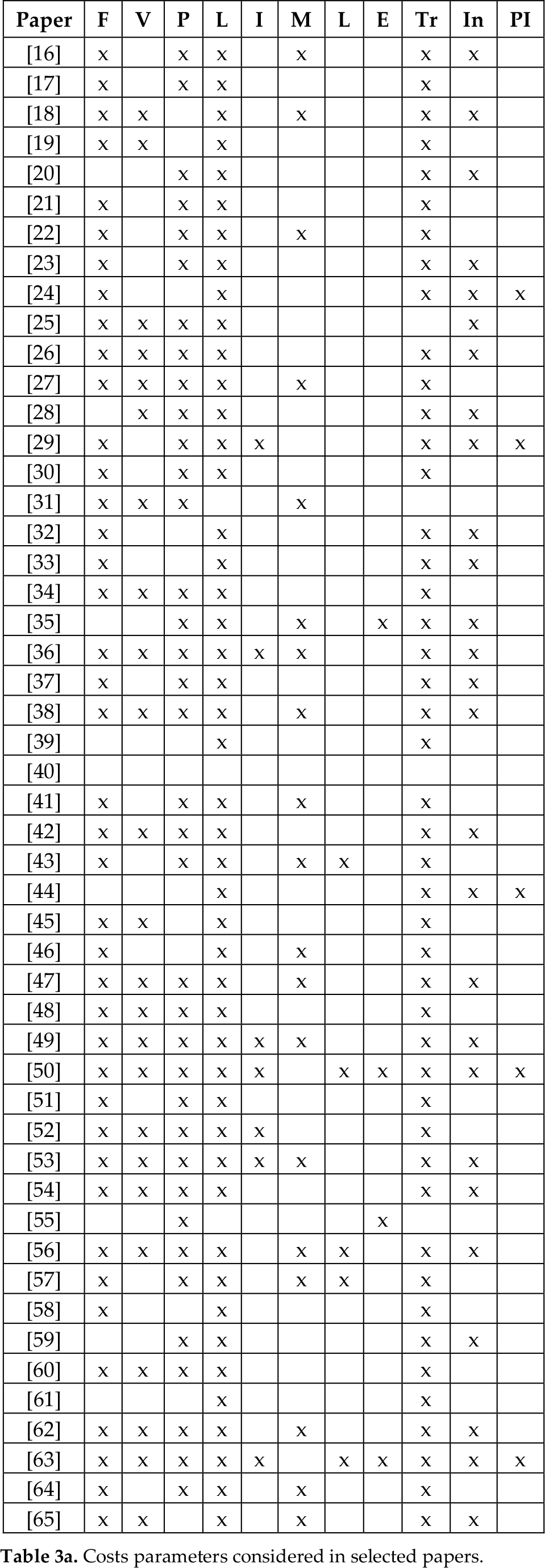
Commonly, supply chain models aggregate or segment costs in a non-mutually exclusive or non-collectively exhaustive manner. In order to fix this misalignment between the literature and reality, we propose a multi-hierarchical segmentation of costs for the comparison of the papers. Firstly, a differentiation between fixed costs (FC) and variable costs (VC) can be performed. However, in supply chain problems, cost can be segmented into production costs (P) and logistics costs (L). Deeping the segmentation, production costs can be split into investment costs (I), material costs (M), labour costs (L), energy costs (E) and overheads, which we intentionally excluded by our analysis because of their low impact on these kinds of problems. Moreover, logistics costs can be divided into transportation costs (Tr), inventory costs (In) and pipeline inventory costs (PI).
As mentioned above, it is possible to find models where some of these costs are neglected or else overlap one another.
On the other hand, revenue sources are constituted by demand (D) and prices (P). Since all the selected models that are based on the profit maximization function include these two factors, we considered as comparison parameters their variability during the planning horizon. Moreover, the eventual introduction of transfer pricing (TP) policies is assessed. Finally, in order to evaluate the completeness of the profit structure, the use of local taxes (T) and exchange rates (ER) has been evaluated. Indeed, according to Beckman and Rosenfield (2008), these parameters can significantly affect the profit performances of a multinational company.
Tables 3a and 3b show paper classifications in terms of the economic parameters taken into account in the models (V=variable, F=fixed, where applicable)
Costs parameters considered in selected papers.
Revenues and financial parameters considered in selected papers.

4.3 Constraints
Typically, supply chain models need flow conservation constraints to represent truthfully the behaviour of production networks. Since this kind of constraint is always adopted, we neglect them in our analysis.
However, other typologies of constraints can be considered in order to evaluate model exhaustiveness. In particular, in supply chain design other constraints that are usually used include facility capacity (FC), supplier capacity (SC) and transportation capacity (TC).
Moreover, there are two other parameters that are usually underestimated in this kind of problem. Financial capacity (FiC) represents money availability for the investment necessary to reconfigure the supply chain, and it has increasingly assumed significance due to cash problems following the 2008 crisis. Technology selection (TS) represents the possibility of considering different technologies as a function of activity location. These constraints have a high degree of importance in delocalization problems, where it is not always possible to use a standard technology.
Table 4 shows the paper classifications in terms of the constraints used in the models.
Constraints considered in selected papers.

4.4 Model Features
Usually, model complexity is related to supply chain complexity and the typology of the objective function. In particular, in order to evaluate the complexity of the mathematical functions, the following parameters have been chosen: typology of the objective function (OF), which can be a minimization (m) or a maximization (M) problem, and the variables number (VN) of the models. On the other hand, to evaluate complexity of supply chains, the chosen parameters were: number of echelons (NE), number of periods (NP), which can be single (s) or multiple (m), and number of products (NPr), which can be single (s) or multiple (m).
Table 5 shows the paper classifications in terms of the models' features.
Model features considered in selected papers.

5. Discussion
Some important remarks can be made following the analysis of the comparison tables:
Around 96% of the papers are focused on facility location and capacity sizing problems, only 38% of these integrate the sourcing problem, while technology selection is considered in only 20% of cases (Figure 1). To our knowledge, four years after the Hammami study in 2008, only one paper in which the models include all the strategic decisions has been found. This outcome suggests that the literature still has an issue connected with the integration of strategic decisions concerning supply chain strategies.

Strategic decisions' distribution in the selected papers.
Around 74% of the models aggregate variable and/or production costs without considering the single drivers separately. Thus, the drivers considered in the literature do not tend to be mutually exclusive or collectively exhaustive. 38% of the models include materials costs, but just 8-10% of them consider labour and energy costs which, according to Beckman and Rosenfield (2008) and Paulonis and Norton (2008), are the principal cost factors for supply chain reconfiguration (Figure 2).

Cost parameters' distribution in the selected papers.
While facility capacity and supplier capacity are always used whenever the relative strategic decision is considered, transportation capacity and technology selection constraints are applied in 35% and 50% of the cases, respectively, in which the relative strategic decisions are considered (Figure 3). Moreover only one model (0.02%) considers the financial constraint, while after 2008 money availability represents one of the main economic issues for multinational companies. This outcome proves an important absence in the literature in terms of model applicability to real environments.

Constraints' distribution in the selected papers.
78% of models are built on objective functions of cost minimization, whereas the other 22% are based on profit maximization. Independently of the objective function type, demand is considered in 98% of the models, where in 52% of cases it is modelled as fixed and in 46% as variable (Figure 4). Relative to profit maximization functions, prices are considered fixed in 64% of cases and variable in the other 36%. However, taxes and transfer pricing accounted for less than 50%. Moreover, the exchange rate is considered in only 8% of the papers. This outcome suggests that the literature exhibits a lack of a financial point of view. Indeed, nowadays the high turbulence of the economy greatly affects exchange rates and, thus, the global profits of multinational companies.

Model features' distribution in the selected papers.
To those who want to design a model for the strategic planning and design of a supply chain, we kindly recommend using an objective function of profit maximization, which integrates as much strategic decisions as possible, is explicit as to as many economic parameters as possible, and which considers the financial aspects of the problem.
6. Conclusion and Future Directions
In this paper, a literature review of mathematical models for supply chain design is proposed.
The analysis of the selected papers shows that:
The literature still has an issue in connection with the integration of strategic decisions concerning supply chain strategies; Only 8-10% of them consider labour and energy costs; Only 0.02% of them considers financial constraints; Only 8% of them consider the exchange rate.
Based on the above issues, the future research directions will consider the development of a supply chain model using a profit maximization objective function, including as many strategic decisions, economic parameters and financial aspects as possible, and in order to increase real applicability to the context of globalization.