




Abstract
Innovation debates dealing with regional economic development have generally focused on densely populated, technologically advanced areas and areas around university cities, undervaluing rural regions and their integration in national innovation systems. However, some statistics indicate that remote and rural regions may also have good innovation potential. This study examines more closely the innovation situation of the firms located in a remote rural region in Finland. The study is based on a structured survey including four main questions describing the innovation situation in the firms. The study outlines the most important features regarding the innovation, correlations between the main results and differences between the firm size categories and sectors. In general, the results indicate, e.g., high importance of a firm's own innovation activities, and reveal some marketing goals of innovation and financial barriers. A correlation analysis reveals several significant correlations between the main results of the survey.
1. Introduction
In general, promoting economic growth is a primary policy area of rural regions, requiring self-sufficiency and access to financial capital and innovations [1]. In this respect, the typical characteristics and problems of peripheral regions include: a high degree of unemployment and difficulty in generating new jobs, a high number of people moving away from the region, a low number of expanding or dynamic sectors, marginal importance from the viewpoint of the national innovation system, and a low amount of available political RDI resources [2]. This is reflected in innovation debates dealing with regional economic development, which have generally focused on densely populated, technologically advanced areas and areas around university cities, undervaluing rural regions and their integration in national innovation systems [2]. According to Viljamaa et al. [3], an identified common challenge of remote and rural regions is financing, since investors prefer firms in new economies locating in growth centres. Additionally, the small size of firms means typically limited resources for R&D, and the lack of resources is in general a big challenge in comparison with growth centres, causing more dependence on funding from outside the region [3]. Moreover, ownership and management in small firms are many times interwoven, affecting the organizational culture and leading to a lower ability to influence the external environment. This means greater uncertainty in this environment [4]. Landbaso et al. [5] describe the emergence of a regional innovation paradox of small firms in peripheral regions: the availability of resources is limited in comparison with large city areas, the firms' knowledge of the availability of resources and services outside the region is low, and the innovation systems are typically underdeveloped; however, precisely these regions have the greatest need to promote the use of public financing to support innovation, to improve the prerequisites of firms for innovation, and to search and use innovation services [6].
Despite the many problems, some statistics indicate that remote and rural regions may have good innovation potential. Hyvönen and Saarinen [7] have studied the geographical distribution of innovations in Finland. They divided areas into three categories where the central areas represented current growth centres, intermediate areas were located close to the growth centres within the distance of the working area, and the periphery represented other areas outside these. The corresponding R&D investment in the central and intermediate areas was 81.5% [8]. According to Hyvönen and Saarinen [7], the number of innovations in the growth centres has decreased during the last 60 years, while it has been constantly close to 40% in the periphery, despite the low percentage of R&D investments.
This paper examines closer the innovation situation of the firms located in a remote rural region in Finland. The focus of the study is especially on those SMEs whose own innovation capability is insufficient to utilize the internal and especially the external resources needed for the innovation development, but which have a need to develop their products and operations. The object of the study is to provide information for regional decision-makers to plan policy instruments and innovation services which meet the needs of the SMEs.
2. Current understanding
The innovation environment is a wider concept than the innovation system, providing a larger and deeper perspective on factors influencing innovation. The innovation processes are systemic, social and complex, i.e., innovation capability is not based only on internal factors of firms; environmental factors are also important factors affecting innovation operations [9]. Considering the dynamics of change between environment and industry, De Wit and Meyer [10] argue that the environment selects suitable firms from the perspective of industry dynamics, while the industry leadership perspective believes that firms form and create fitting environments. De Wit and Meyer [10] state that the list of drivers of industry development is endless, and the drivers can be divided roughly into those external and those internal to the industry. According to Sternberg and Arndt [11], firms and other organizations have very diverse characteristics regarding innovation, and these characteristics influence the innovation environment and innovation system. Factors of this kind include, for example, the market dependency of firms on some actors in the value chain, such as customers, which can increase the incremental nature of innovations, firm size, innovation types, innovation objectives, innovation sources, and the locus of innovation activities [12]. According to Kautonen et al. [13], the regional innovation environment means the operation environment, which consists of resources and learning processes that can be utilized by firms and which aim to advance cooperation between the actors and reduce the uncertainty of operations. Koskenlinna et al. [14] state that the innovation environment should support the innovation operations of firms through research and knowledge brokers and create methodologies which support innovation operations.
Innovation systems can be studied at different spatial levels, like national, regional, local and firm level [15]. According to Edqvist, innovation systems can be regional within a country, based on sectors or some technology segment without geographical definition. Cooke and Schienstock [16] understand a region as a subunit of a system that is characterized by limited size, homogeneity in relation with some defined criteria, differentiation from border regions by defined criteria, and defined internal cohesiveness. According to Cooke et al. [17], a regional innovation system (RIS) consists of links between producers of knowledge, knowledge intermediating organizations, and firms. According to the OECD [18], a region usually refers to an administrative or political unit, but a functional regional unit may differ from political borders. In this study, region means a geographically defined area. Asheim [19] defines three types of RIS based on variety in concepts and relationships: territorially embedded RIS, regionally networked innovation system, and regionalized national innovation system. In a territorially embedded regional innovation network, the stimulus for cooperation stems from geographical, social and cultural proximity, and knowledge flow is interactive and local [19]. According to Sotarauta et al. [20], a regional innovation system is a cooperative model, where the purpose of interaction between the different actors is to increase the innovativeness of firms. This reflects at least partly the characteristics of a regional networked innovation system, which is according to Asheim [19] the ideal type of RIS, having such characteristics as planned and systematic networking and interactive knowledge flow with local knowledge organizations.
Regionalization of innovation policies is justified because of differences in innovation operations and processes between regions, a need to adapt national innovation policies to meet specific regional targets, a need to link innovation policies with regional development policies, and the possibility to choose the most suitable approaches and solutions, among other reasons [21]. Furthermore, regional innovation policies provide opportunities for better allocation of resources, planning and implementation of structural changes, and avoidance of path-dependent trajectories [22]. According to the OECD [23], one problem is that regional innovation policies may suffer from too narrow a perspective for innovation, but despite this, a regional innovation system (RIS) provides possibilities for a wider range of interventions than, e.g., funding of public research. According to Isaksen and Remoe [24], good practices concerning the implementation of innovation policies should account for the adaptability of development instruments based on regional conditions (firms and sectors). Additionally, the development actions should promote the learning of policymakers, and innovation policies should consider holistic development needs of firms besides technology issues [24].
The OECD [23] emphasizes the diverse nature of regional innovation policies concerning differences in institutional setups in relation to national institutions, RIS with its strengths and weaknesses, and strategic choices at the regional level. According to Wintjes and Hollanders [25], regional policymakers should focus on the design of place-based innovation policies, which stress entrepreneurial processes based on regional specializations. This differs from concentrating on excellence-based centres, which is not a suitable perspective for all regions. This is in line with the third generation innovation policy presented by European Commissioner Hübner [26], which involves different stakeholders and is based on regional characteristics rather than isolated industrial policies. The diversity of regions has been described also by Cooke [27], who makes a distinction between RISs representing old economy regions, typically regions in Europe, and the characteristics of new economy innovation systems (NEIS). The main differences are between the R&D-driven nature of institutional RIS (IRIS), and its emphasis on user-driven and incremental innovations, technology and science parks, partnership funding, and linkages to external supply-chain networks, and entrepreneurial RIS (ERIS), which emphasizes incremental and disruptive innovations, incubators, start-ups, initial public offerings, and market focus [27]. Cooke [28] sees that ERIS provides better possibilities for knowledge flows, but states that in many OECD countries the conditions for the development of ERIS are not yet suitable. Moreover, Cooke [27] defines differences between RISs representing higher and lower innovation system potential: higher RIS potential is characterized by a cooperative culture and interactive innovation instead of the competitive culture, the standalone R&D and the individualism that are typical for low RIS potential. The region in question in the present study can be categorized as closer to a typical region in Europe representing an old economy, and its innovation system still has many features of low potential, although an aim to higher potential can be recognized, e.g., in activities regarding the development of interactivity between the actors.
It is generally argued that the development of innovation systems in peripheral regions is difficult due to a lack of complementary technologies and relevant actors, i.e., organizational thinness [29]. Landbaso et al. [30] define structural problems of less-favoured regions to include poor capacity of firms to identify their innovation development needs, lack of innovation intermediaries, weak financial systems, lack of efficient business services, weak co-operation between public and private sectors, sector-based specialization, low participation in international RDI networks, weak public assistance for innovation, and poor suitability of aid systems for the innovation needs of SMEs. However, a regional innovation policy is especially significant for peripheral regions, due to the more difficult utilization of national innovation policy instruments [3]. Tödtling and Trippl [29] propose some innovation policy approaches accounting for special problems of peripheral regions, e.g., the strategic orientation of the regional economy should focus on strengthening the regional economy, and the innovation strategy should focus on the improvement of the strategic capability and innovation capability of firms.
The general strategic priorities of regional innovation policies include development based on current advantages, such as technology-led development in certain fields, support for socio-economic transformation, and catching-up through capability development [23], which indicates a need to identify the main weaknesses regarding innovation capability. Landry and Amara [31] have identified several common dilemmas in policymaking regarding practice-based innovation, which is more common in peripheral regions than science-, technology- and innovation-driven innovation. For example, it is typical that cluster strategies focus on internal factors of regions, neglecting the utilization of external resources, while policymakers favour the development of radical innovations, neglecting the development of incremental innovations. Policymakers also tend to favour knowledge-intensive firms instead of traditional firms and non-innovative firms [31]. In order to direct innovation policy instruments correctly and to develop relevant innovation services, it is important to understand the different knowledge bases of firms, which are divided by Asheim [19] into analytical, synthetic, and symbolic knowledge bases: analytical knowledge is typical in connection with scientific discoveries and technological inventions, synthetic knowledge is usually linked to problem solving in practical contexts and dealing with novel combinations of existing knowledge, and symbolic knowledge is associated with aesthetic characteristics, such as design, images and cultural artefacts [19]. These differences may be reflected in the different innovation support needs of firms.
3. Research question
The goal of this study is to examine the innovation situation of firms located in one rural region. More precisely, it will answer the questions:
What are the main innovation activities, the most important barriers to innovation, the innovation goals, and the different types of innovation in the innovation processes of firms?
Are there differences between different firm-size categories and sectors?
How do the main characteristics of the firms correlate with each other?
4. Research methodology
The study was conducted during 2011 in the region of Pielinen Karelia, which is located in a peripheral area in Eastern Finland next to the Russian border. Pielinen Karelia is a sub-region of the region of North Karelia and a part of the province of Eastern Finland. The region consists of two towns and one municipality. According to the EU [32], the region is classified as a predominantly rural and remote region, which means that more than 50% of the population live in local rural units and less than 50% of the population can reach a city of at least 50 000 inhabitants within 45 minutes. In Pielinen Karelia the accessibility by road to the closest city Joensuu is more than 60 minutes (approx. 100 km), and it can be thus classified as a rural and remote region. The nearest airport is in Joensuu. The distance from the region to the capital Helsinki is about 500 km.
The empirical data is based on the CoCo project administrated by Karelia University of Applied Sciences, the purpose of which was to advance innovation development of the firms in the region. The data is based on a survey including 50 firms located in the region. The logic of purposeful sampling was used in the selection of the 50 firms in order to find the most typical firms. The objective of purposeful sampling is to select information-rich samples for a closer study to learn more from the central issues under study [33]. The purposiveness in this study was based on typical case sampling based on certain criteria: the firms had to have a need or an interest to develop their products or operations. The objective was to find especially those SMEs whose own innovation capability was insufficient to utilize the internal and especially the external resources needed for the innovation development. Most of the firms (61%) were micro-size enterprises (employing less than 10 persons, with a turnover of less than 2 MEUR). The share of small firms (employing less than 50 persons, with a turnover of less than 10 MEUR) was 18%, and the rest were medium-size or large firms (21%). The firms were mainly manufacturing organizations (67%) and 33% represented the service sector. The manufacturing firms represented mainly the metal industry (20%) or the wood industry (16%). The firms representing the service sector were mostly from the social and health care sector (10%) and tourism sector (10%).
The innovation environment-related aspects of the innovation activities of the firms were studied using the four main categories described in Table 1. The categories of the barriers of innovation and the importance of innovation activities provided information on the current service needs of the firms. The questions on innovation types and goals provided information on the current innovation activities, in addition to future needs. Kautonen [12], among others, states that such factors as the type of product and the objects of innovation activities influence the regional innovation system. The importance of the different factors was assessed by using a four-stage Likert scale from “not important” to “very important”. The differences between firm size categories and industries were tested by the Mann-Whitney U-test. The null hypothesis in all tests was that there is no difference between the groups. Effect size (r) based on z-score was calculated when the Mann-Whitney U-test indicated significant difference between two groups. Value r ≥0.5 indicates large sample size, r ≥ 0.3 medium sample size, and r ≥ 0.1 means small sample size [34]. In addition, Cronbach's alpha values indicating internal consistency of the results are presented in the connection of the tables. Alpha values were calculated separately for the answers representing each group. According to Metsämuuronen [35], the Cronbach's alpha value 0.6 indicates good internal consistency. Frequencies and other statistical details are presented in Annex 1.
Structure of the questionnaire.

5. Findings
5.1 Importance of innovation activities
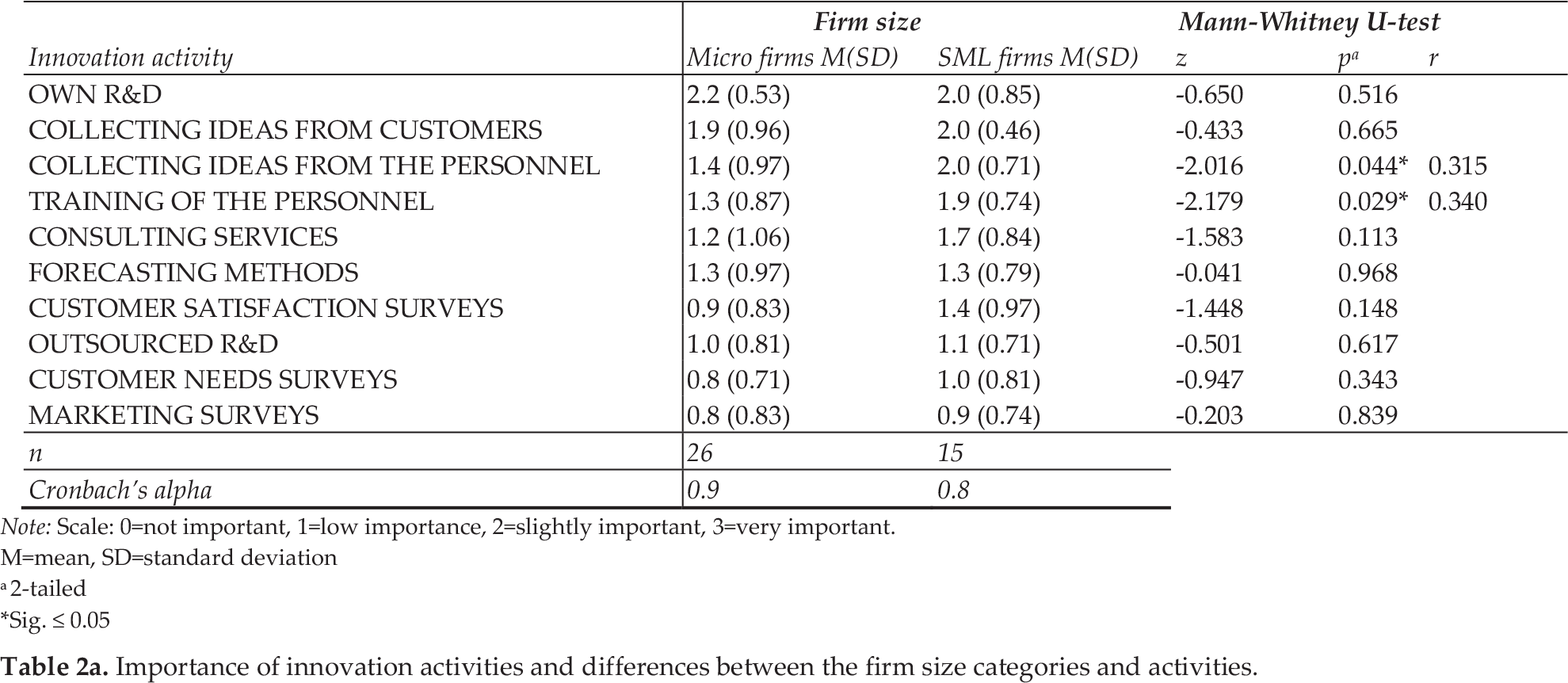
Table 2a illustrates the differences between two firm size categories and the importance of different innovation activities. As shown in the table, the results highlight the role of a firm's own R&D as the most important innovation activity in general. The second most important innovation activity is collecting ideas from customers; on the other hand, the use of customer needs surveys and marketing surveys has low importance. Internal consistencies in the groups are good (α = from 0.8 to 0.9).
Importance of innovation activities and differences between the firm size categories and activities.
Note: Scale: 0=not important, 1=low importance, 2=slightly important, 3=very important.
M=mean, SD=standard deviation
2-tailed
Sig. ≤ 0.05
Significant differences between the firm size categories can be seen in two activities. Bigger firms (SML firms) emphasize more collecting ideas from the personnel (p < 0.05) and training the personnel (p < 0.05) than micro-size firms. Effect size is at medium level (r > 0.3) in both cases.
Table 2b presents differences between sectors and innovation activities. When comparing the two main sectors, it can be noted that manufacturing firms highlight the use of forecasting methods significantly more than service firms (p < 0.01). The effect size shows medium level sample size (r > 0.3). Other statistical details regarding innovation activities are presented in Table I and frequencies in Table V (Annex 1).
Importance of innovation activities and differences between two main sectors and activities.

Note: Scale: 0=not important, 1=low importance, 2=slightly important, 3=very important.
M=mean, SD=standard deviation
2-tailed
Sig. ≤ 0.01
5.2 Importance of innovation types
The aim of the study was to identify the most important innovation types in firms. Table 3a illustrates the differences between two firm size categories. The innovation types are divided into five classes, applying the definition presented by the OECD [36].
Importance of innovation types and differences between the firm size categories and types.

Note: Scale: 0=not important, 1=low importance, 2=slightly important, 3=very important.
M=mean, SD=standard deviation
2-tailed
Sig. ≤ 0.05
In general, product and marketing innovations are the most important innovation types, while process and business innovations are less important. Product innovations are most important for bigger firms, while marketing innovations are significantly more important for micro-size firms than for larger firms (p < 0.05). The effect size (r > 0.3) indicates medium-level sample size for the difference. In addition, it can be noted in the table that process innovations are more important for larger firms than for micro firms.
Table 3b illustrates the differences between two main sectors and different innovation types. It can be seen in the table that product innovations are more important for manufacturing firms, while marketing and service innovations are more important for the service sector. However, the differences between the sectors are not statistically significant. Other statistical details regarding innovation types are presented in Table II and frequencies in Table V (Annex 1).
Importance of innovation types and differences between sectors and types.

Note: Scale: 0=not important, 1=low importance, 2=slightly important, 3=very important.
M=mean, SD=standard deviation
2-tailed
5.3 Importance of innovation goals
The purpose of this study was to identify the most important innovation goals in firms. Table 4a describes the differences between two firm size categories and different innovation goals. The table shows that, in general, getting into new markets, quality improvement, and the growth of markets are the most important goals of innovation. The least important goals are the improvement of production capacity and flexibility, as well as the improvement of ecology.
Importance of innovation goals and differences between two firm size categories.

Note: Scale: 0=not important, 1=low importance, 2=slightly important, 3=very important.
M=mean, SD=standard deviation
2-tailed
Sig. ≤ 0.05
When comparing the different categories, it can be noted that quality improvement and the improvement of ecology are more important for bigger firms than for micro firms. The growth of markets is more important for micro firms. The only statistically significant difference is in reduction of production costs, which is more important for larger firms (p < 0.05). The effect size shows medium sample size (r > 0.3). Internal consistency is good in the group representing micro-size firms (α = 0.8), but weak in the groups representing SML firms (α = 0.5).
Table 4b describes the importance of innovation goals and the differences between two main sectors. It can be noted that the growth of markets and improved production flexibility are more important for manufacturing firms than for service sector. However, the differences between the sectors are not statistically significant. Other statistical details regarding innovation goals are presented in Table III and frequencies in Table V (Annex 1).
Importance of innovation goals and differences between two main sectors.

Note: Scale: 0=not important, 1=low importance, 2=slightly important, 3=very important.
M=mean, SD=standard deviation
2-tailed
5.4 Importance of innovation barriers
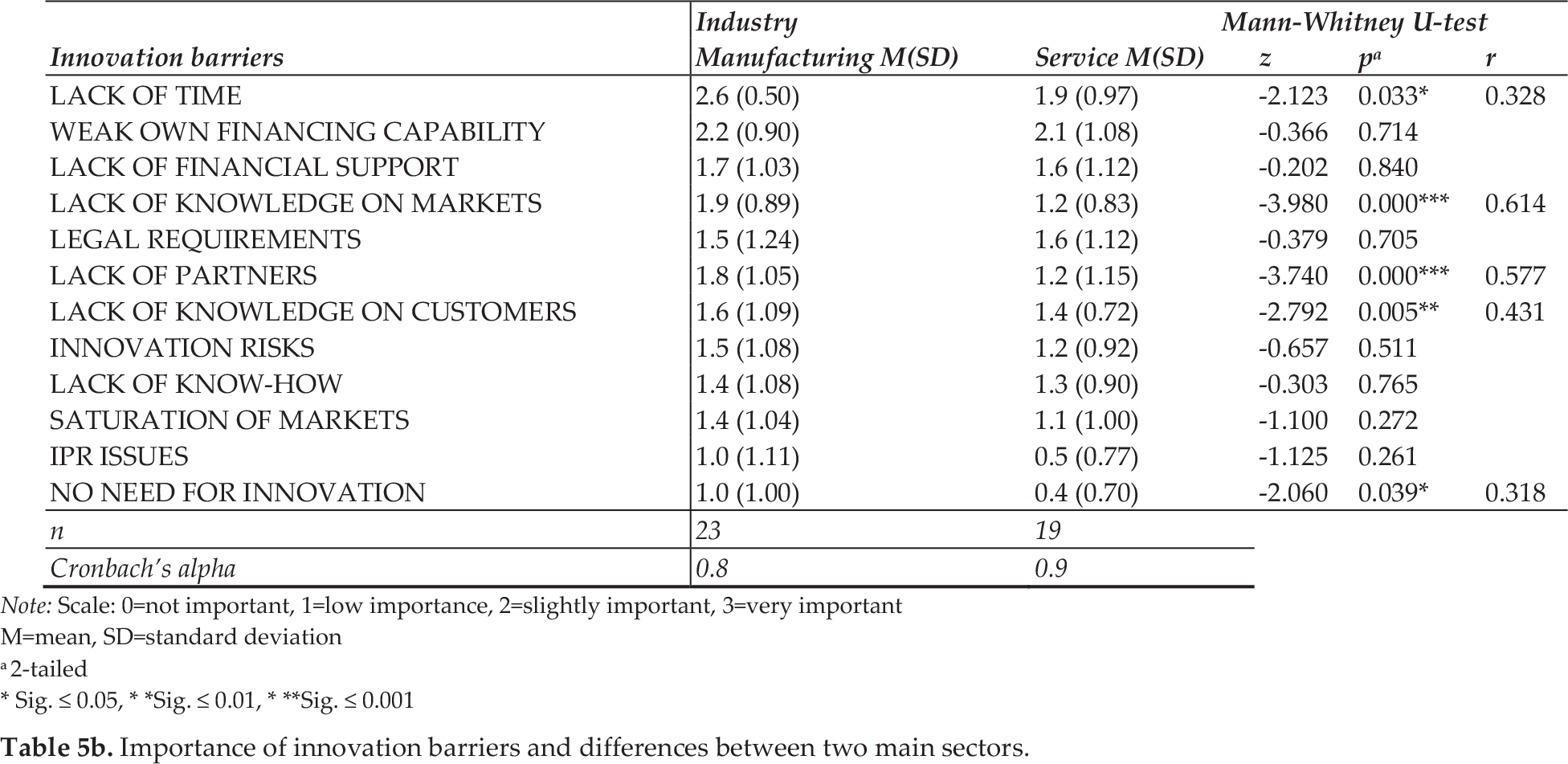
The aim of this study was to identify the most important barriers to innovation in firms. Table 5a describes the importance of different innovation barriers to firms and compares the differences between two firm size categories. It can be stated that the lack of time and weak own financing capability are the most significant barriers to innovation in general. On the other hand, IPR issues and low need for innovations are not considered as important constraints.
Importance of innovation barriers and differences between two firm size categories.

Note: Scale: 0=not important, 1=low importance, 2=slightly important, 3=very important M=mean, SD=standard deviation
2-tailed
Sig. ≤ 0.01
Sig. ≤ 0.001
In terms of the main differences between the firm size categories, it can be seen that lack of partners is a significantly more important barrier for micro-size firms than for larger firms (p < 0.001). Lack of knowledge on customers is a significantly smaller problem for larger firms than for the micro-size firms (p < 0.01). Additionally, lack of knowledge on markets appears to be a bigger barrier for bigger firms than for micro firms (p < 0.01). The effect size shows large sample size (r > 0.5) in all three cases. It can be also noted that weak own financing capability and legal requirements are more important barriers for micro-size firms than for bigger firms. Internal consistency is sufficiently good in both groups (α = from 0.7 to 0.9).
Table 5b describes the importance of different innovation barriers to firms and compares the two main sectors. Five statistically significant differences can be recognized. Lack of time is a bigger obstacle for manufacturing firms, with a significant difference to the service sector (p < 0.05) and the effect size indicates medium sample size (r > 0.3). Lack of knowledge on markets is a significantly lower barrier for the service sector than for the manufacturing sector (p < 0.001) and the effect size shows large sample size (r > 0.5). Lack of partners is a more important barrier for the manufacturing than for the service sector (p < 0.001, r > 0.5), as well as lack of knowledge on customers (p < 0.01, r > 0.3). IPR issues and low need for innovations are not considered as important constraints, although the difference is significant between the sectors regarding need for innovations (p < 0.05, r > 0.3). Other statistical details regarding innovation barriers are presented in Table IV and frequencies in Table V (Annex 1).
Importance of innovation barriers and differences between two main sectors.
Note: Scale: 0=not important, 1=low importance, 2=slightly important, 3=very important M=mean, SD=standard deviation
2-tailed
Sig. ≤ 0.05
Sig. ≤ 0.01
Sig. ≤ 0.001
5.5 Correlations between the main results
Correlations in general aspects of the innovation environment were studied for 11 main results including all firms in the study (Table 6). Not all variables passed the D'Agostino and Pearson omnibus normality test. Thus, the Spearman nonparametric correlation test was used in the correlation analysis. Cronbach's alpha for the 11 variables was 0.936, indicating good internal consistency of the study.
Spearman correlation matrix between the main results of the survey and significance of correlations.

Statistically significant correlations were found between nine variables. Very significant correlations (p < 0.001) were found between
the importance of product innovations and larger product range as a goal of innovation (rs =0.557; p=0.000), and weak own financing capability and lack of financial support as barriers to innovation (rs =0.492; p=0.001).
Significant (p < 0.01) correlations were identified between
the importance of own R&D and collecting ideas from customers as own innovation activities (rs=0.478; p=0.001), the importance of marketing innovations and weak own financing capability as a barrier to innovation (rs=0.514; p=0,001), the importance of getting into new markets as a goal of innovation, and growth of markets as a goal of innovation (rs =0.427; p=0.005).
Additionally, almost-significant correlations (p < 0.05) were found between
the importance of own R&D and importance of product innovations (rs =0.320; p=0.039), collecting ideas from customers as a firm's own innovation activity and the improvement of products as a goal of innovation (rs =−0.312; p=0.044), the importance of the growth of markets as a goal of innovation and weak own financing capability as a barrier to innovation (rs =0.331; p=0.032), and the importance of the growth of markets as a goal of innovation and lack of time as a barrier to innovation (rs =0.383; p=0.012).
6. Contribution of the study
The results based on the survey on innovation environment issues indicate that the firms taking part in the study:
value high R&D of their own, but are not very interested in customer needs surveys or marketing surveys; value product and marketing innovations, but are less interested in process innovations; see marketing-related goals of innovation as important, but improvement of production capacity, flexibility and ecology as less important; consider lack of time and weak financing capability as the main constraints to innovation.
The most important innovation types are product innovations and marketing innovations. The importance of product innovations correlates with the importance of own R&D and aims to increase product range. The results support Saartenoja [37], who states that product innovations are a typical type of innovation in rural regions. The importance of product innovations also supports the findings of Forsman and Rantanen [38]. However, it can be noted that the classification of innovations into different categories is more difficult and not as relevant today as it used to be. The main focus should be on business processes instead of innovation types. Prahalad and Krishnan [39] note that innovations are more and more mixed, including, e.g., service and product innovations at the same time.
The importance of getting into new markets, the growth of markets and quality improvement are high on the list of goals of innovation. Growth of markets correlates with the importance of the goal of getting into new markets.
Marketing-related goals of innovation are important, especially for micro-size firms and manufacturing firms. In general the differences between the variables of innovation goals are relatively small. The differences are significant concerning the importance of reduction of production costs, which is higher for larger firms than for micro-size firms. The results do not support Ruuskanen's [40] statement that entrepreneurs in rural regions do not necessarily seek growth or economic profits. This can be explained partly by the purposive sampling used in the study, which excluded firms with no interest in developing their innovation activities or products.
The results highlight own R&D as the most important innovation activity of firms. Own R&D correlates with the collecting ideas from customers. On the other hand, the use of customer needs surveys and market research is very low. Low use of market research among SMEs has been remarked upon, for example, by Kaufmann and Tödtling [41] and Asheim [4]. Asheim connects the low use of market research to low strategic capability of firms. On the other hand, Miller and Morris [42] connect the use of customer needs research to the traditional linear market concept, in contrast to the new market concept, which emphasizes co-creation of value with customers. Collecting ideas from the personnel and the training of personnel are significantly more important for larger firms than for micro-size firms. Additionally, forecasting methods are significantly more important for manufacturing firms than for service firms.
Lack of time and weak own financing capability are the most important barriers to innovation. Correlation analysis implied that lack of financial support as a barrier to innovation correlates with weak own financing capability as a barrier to innovation. Furthermore, weak own financing capability correlates with the importance of the growth of markets as a goal of innovation and the importance of marketing innovations. Lack of time as an innovation barrier is significantly more important for manufacturing firms than for the service sector. Wintjes and Hollanders [25] claim that lack of capital is always among the most commonly mentioned barriers in innovation surveys. Lack of time and weak own financial capability as the biggest obstacles to innovation appear in the results of many earlier studies (see, e.g., 43, 41, 44, 4, 45, 46). According to Asheim [4], limited financial and management resources are special features of micro-size firms, which impact their support needs. Hottenrott and Peters [47] have studied innovation capability and financial constraints to innovation and found that financial barriers do not depend on the availability of funding per se, but that firms with high innovation capability and low availability of funds suffer especially from financial constraints. Moreover, lack of knowledge on markets is a significantly more important barrier to the manufacturing sector than to the service sector. According to the results, lack of partners and lack of knowledge on customers are also higher barriers for micro-size firms and the manufacturing sector than for bigger firms and service sector.
7. Practical implications
The results provide information for regional decision-makers, educational institutes, firms, development agencies and other actors for the development of targeted strategies, interventions, policy instruments, innovation services and innovation systems. Innovation policy concerns all actors in the system, including firms (production structure), research organizations and educational institutes (knowledge infrastructure) besides policy actors, which represent the support structure [48].
In general, the innovation environment supports the innovation operations of the firms insufficiently in terms of the utilization of innovations and support for the financing of innovation development. This supports the statement by Nauwelaers and Wintjes [49] that there is a lack of market orientation in policy tools and commercial aspects of innovation. Political development actions and development of innovation services should be of help here. The results also indicate the existence of the innovation paradox of peripheral regions described by Landbaso et al. [5].
The present study concerned the innovation development needs of firms in a peripheral region, and especially in micro-size and small firms. Most of the firms in the study were micro-size firms because they form a majority in the region, and especially they need support in innovation development. This emphasizes the need to account for the small size of the firms when developing innovation services and policy instruments in the region. Many commercial services have been typically targeted for large firms rather than for micro-size firms.
8. Annex 1
Importance of innovation activities. All groups.

Lower data amount due to computer problem.
Results of the importance of innovation types.

Results of the importance of innovation goals.

Importance of innovation barriers.

Lower data amount due to computer problem.
Frequencies (n).
