




Abstract
In this paper, a robust output feedback tracking control scheme for motion control of uncertain robot manipulators without joint velocity measurement based on a second-order sliding mode (SOSM) observer is presented. Two second-order sliding mode observers with finite time convergence are developed for velocity estimation and uncertainty identification, respectively. The first SOSM observer is used to estimate the state vector in finite time without filtration. However, for uncertainty identification, the values are constructed from the high switching frequencies, necessitating the application of a filter. To estimate the uncertainties without filtration, a second SOSM-based nonlinear observer is designed. By integrating two SOSM observers, the resulting observer can theoretically obtain exact estimations of both velocity and uncertainty. An output feedback tracking control scheme is then designed based on the observed values of the state variables and the direct compensation of matched modelling uncertainty using their identified values. Finally, results of a simulation for a PUMA560 robot are shown to verify the effectiveness of the proposed strategy.
Keywords
1. Introduction
Because sliding-mode control is robust with respect to system uncertainties and has a fast transient response, it has received a great deal of attention from the research community [1–3]. The main idea of SMC is to design a sliding surface first and then to design a control law that forces the system's state to reach and remain on the sliding manifold, which is designed to achieve control objectives. However, the major drawback of SMC in practical applications is undesired chattering due to high frequency switching. Numerous techniques have been proposed to avoid the dangerous chattering of SMC. The sign function can be replaced in a small area of the surface by a smooth approximation, which is the so-called boundary layer control that implies deterioration accuracy and robustness. Another approach is to use a higher-order sliding mode that yields less chattering and better convergence accuracy with respect to the conventional sliding mode [4–12, 22]. In particular, second-order sliding modes are widely applied to zero the outputs with a relative degree of two or to avoid chattering while zeroing out the relative degree of one. The main difficulty of second-order sliding modes, such as the sub-optimal algorithm [5, 8] or the twisting algorithm [6, 8], is the necessity of using the first time derivative of the sliding variable. The super twisting algorithm [9–12] does not require the time derivative of the sliding variable and is suitable for reconstruction of the velocities from the position information.
Output feedback (OFB) tracking control has received considerable interest in robotics literature due to its potential to eliminate the need for a tachometer, which can often become contaminated by noise, and to reduce the number of sensors in the robot design. The main issue of the OFB controller is the need for a controller scheme to compensate for parametric uncertainty and the lack of link velocity measurements. As an outcome of the research directed at this topic, several output feedback tracking control schemes have been developed for the system with only position measurement [13–24]. For example, Type-1 and type-2 fuzzy logic controllers have been designed for a backlash servomechanism based on only position measurement [13–16]. In these, a genetic algorithm is applied to optimize the Membership Functions of the Type-1 and Type-2 fuzzy system. Another approach has been proposed based on the design of a velocity observer by using a linear observer [17–18], a traditional sliding mode observer [19–20] and a neural network observer [21]. However, none of these approaches can provide exact reconstructions or finite time convergence of the derivatives or else they will produce chattering. Because of the advantages of high order sliding modes in terms of their ability to reconstruct exact, finite time derivatives, the super-twist algorithm of the SOSM observer has been developed for use with mechanical systems [8–12], stepper motors [22] and helicopter systems [23]. This type of observer ensures finite time convergence to the value of observed velocities without filtration but for uncertainty identification, the values are reconstructed from high switching frequency signals, necessitating the application of a filter. Unfortunately, the use of filtering provides a time delay and decreases the performance of the uncertainty compensated system [23]. In order to overcome the filtration requirement, third order sliding mode observers have been developed [24–25]. However, the convergence time is larger when using this approach. It affects the stability property of the system.
This paper proposes a new output feedback controller scheme for uncertain robot manipulators based on a super-twist SOSM observer. Unlike previous approaches that used a SOSM observer to estimate both velocities and uncertainties and thus required a filter [9–10, 22–23], two SOSM observers are integrated to estimate the velocities and identify the uncertainties. The first SOSM observer is used to estimate the state vector in finite time without filtration but for uncertainty identification, the realization of the observer produces high switching frequencies, necessitating the application of a filter. The application of the filter creates a time delay and error which decrease system performance. To obtain the exact uncertainty estimation without filtration, a second SOSM-based nonlinear observer is then designed. By integrating two SOSM observers, the resulting observer can theoretically obtain exact estimations of both uncertainty and velocity without filtration. The stability and convergence of the proposed observer is proved by the Lyapunov theory. Finally, an OFB tracking control is proposed based on the estimated velocities and uncertainties.
The remainder of this paper is arranged as follows. Section 2 describes the robot dynamic and problem. Section 3 presents two SOSM observers for velocity estimation and uncertainty identification. Section 4 describes an output feedback tracking control scheme. Section 5 provides computer simulation results on a PUMA560 robot to verify the effectiveness of the proposed algorithm. Section 6 outlines some conclusions.
2. Problem statements
According to the Lagrange theory [18], the dynamic equation of an n-link robot manipulator can be described by

where
Assumption 1: The states of the robot system are bounded at all times.
Assumption 2: The modelling uncertainty is bounded such that

where
To simplify the subsequent design and analysis, Eq. (1) can be rewritten as

where
Using

where
In this paper, we investigate an output feedback tracking control scheme for the uncertain robot manipulator expressed in Eq. (1) based only on position measurement. A new observer which integrates two SOSM observers is proposed to obtain exact estimations of both the velocity and uncertainty.
3. Second order sliding mode observer for velocity estimation and uncertainty identification
In this section, the proposed observer is described. First, the first SOSM observer is designed to obtain an exact velocity estimation, but for uncertainty identification, it is reconstructed from high frequency switching making a filter necessary. The application of a filter then introduces a time delay and error. To overcome this obstacle, a second SOSM-based nonlinear observer is designed. These observer schemes are explained in detail in the following subsections.
3.1 States observer and uncertainty identification based on first second-order sliding mode observer
3.1.1 States observer
Based on Eq. (4), the second-order sliding mode observer is designed as [25]

where α i is the sliding mode gain.
Substituting Eq. (4) into Eq. (5), the estimation error is obtained as

where
Let

Based on the Lyapunov approach introduced by Moreno and Osorio in Ref. [26], Theorem 1 gives the convergence of the estimation error to zero in finite time:
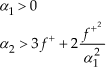
then the observer scheme is stable, and the states of the observer in Eq. (5) (◯1, ◯2) converge to the true states (x1, x2) of the system in Eq. (4) in finite time.

Let us consider a Lyapunov candidate as

The Lyapunov form expressed in Eq. (10) can be described in a quadratic form by
As shown in Ref. [26], L is continuous, positive defined, radially unbound and continuously differentiable everywhere except at x˜1 = 0. Thus,

where

By combining Eqs. (9) and (12), the time derivative of L(x˜) is obtained as

where
Based on the inequality in Eq. (11) and after algebraic manipulation, it can be shown that
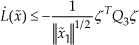
where
Under the condition expressed in Eq. (8), Q3 becomes larger than zero (Q3>0), and the derivative of the Lyapunov function L(x˜) is then negative, so that the stability property is proven. On the other hand, using Eq. (11), we have

We can write Eq. (14) as follows

where

Then, applying the solution of a different equation

is given by
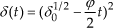
We combine the above results with the comparison principle from Ref. [27] for L(t)≤δ(t) when L(x˜(0))≤δ0 Therefore, x˜(t) converges to zero as L(x˜(t)) converges to zero after T = (2/φ)L1/2(x˜(t)) units of time.
3.1.2 Uncertainty identification
Considering the estimation error as expressed in Eq. (9), convergence for all t > to. Eq. (6) can be written as

Notice that

Theoretically, the equivalent output injection is the result of an infinite switching frequency of the discontinuous terms α2sign(x˜), which is called chattering. To eliminate this high frequency chattering, we use a low-pass filter that has the form

where a is the filter time constant. After filtration, we have

where every element of z̄eq is the filtered version of zeq and ε is the difference caused by the filtration process.
3.2 Uncertainty observer scheme based on second second-order sliding mode observer
In the first SOSM observer approach, the uncertainties are obtained by filtering the discontinuous injections signal that may cause a certain delay and error. To obtain the exact uncertainties without any filtration, a second SOSM-based nonlinear observer is designed in this section.
The proposed uncertainty observer is designed as follows:

where ω is the estimate of x2, A = ding{-λ1,-λ2,…-λn} is a stable matrix with λ > 0, and N̂(t) is the observer input, which is used to estimate the uncertainties and is designed as

where
The estimation error can be obtained from Eqs. (4) and (23) such that

Let

where ȳ is a known constant.
The stability analysis below is given to demonstrate that the estimation error in Eq. (25) converges to zero in finite time.

then the uncertainty estimation error

Considering the following candidate Lyapunov function:

where
Its time derivation along the solution of Eq. (29) results in the following:

where
Applying the bounds for the uncertainties

where
In this case, if the sliding mode gains satisfy the condition expressed in Eq. (27), then C3>0, implying that the derivative of the Lyapunov is negative definite, thus proving its stability.
Similar to the proof for Theorem 1, we can also ensure that the uncertainty estimation error converges to zero in finite time.
When the uncertainty observer error in Eq. (25) converges to zero, the uncertainty estimation can be obtained as

According to Eq. (24), Ñ(t) is the continuous function, then Eq. (32) indicates that the second SOSM can theoretically estimate uncertainty exactly, without the use of a filter.
4. Output feedback tracking control scheme for an uncertain robot manipulator
In this section, the proposed output feedback tracking control for uncertainty robot manipulator is described.
4.1 Design of robot controller for full states measurement robot manipulator without modelling uncertainties
Suppose that dynamical models of the robotic manipulators are known precisely (no modelling uncertainties) and the velocity measurements are available. The dynamical models in Eq. (3) can then be converted into the nominal models

The structure of the standard computed torque control (CTC) strategy is designed by the control law

where qd, q̇ d , and q̈ d are the vectors of desired position, velocity and acceleration, respectively. e = qd-q is defined as trajectory tracking error vectors. KP and KV are proportional and derivative constants, respectively. Substituting Eq. (34) into (33) yields

Errors asymptotically tend to zero if proportional gain KP and derivative gain KV are chosen in a favourable situation.
4.2 Output feedback tracking control of uncertain robotic manipulator without velocity measurements
As in the above analysis, applying CTC has two main drawbacks: it requires exact knowledge of the robot manipulator, which is usually not a valid assumption, and it requires velocity measurement, which is not usually available.
Considering the controller law (34) for robot dynamics with modelling uncertainties described by Eq. (3), we have the tracking error:

The tracking error e does not converge to zero in the presence of uncertainties under the nominal CTC controller in Eq (34). Additionally, it requires the velocity measurement, which is not available in robotic systems. To overcome these drawbacks, a modified CTC (illustrated in Fig. 1) is designed as:

The structure of output feedback tracking controller scheme

where τ0 is the nominal CTC control for the nominal system (no modelling uncertainties) and τc is the compensating torque, which is the identification-based compensator of the modelling uncertainties. In this case, the exact estimated velocity ◯2 which is obtained by the first SOSM observer is used to realize the control τ0 i.e., the controls τ0 is designed as

The estimated uncertainties of the second SOSM observer are used to compensate for the modelling uncertainties of robot dynamics:

4. Simulation results
In order to verify the effectiveness of the proposed controller scheme, its overall procedure is simulated for a PUMA560 robot in which the first three joints are used. The PUMA560 robot is a well-known industrial robot that is widely used in industrial applications and robotics research. Its explicit dynamic model and the parameter values necessary to control it are given in Ref. [28].
The three degree of freedom (3-DOF) PUMA560 robot is considered with the last three joints locked. Figure 2 shows its kinematic description. The uncertainties used in this simulation are given as follows:

and


3-DOF PUMA560 robot manipulator
Matlab/Simulink is used to illustrate the performance of all simulations, and the sampling time in all simulations is
The simulations set are divided into two parts. For the first simulation set, we verify the capability of two integrated SOSM observers in terms of velocity estimation and uncertainty identification compared with that of only one SOSM observer In the second simulations set, the tracking performance of the proposed OFB controller schemes is compared with those of conventional CTC.
For the first set of simulations we assumed that velocity measurement is available. Figure 3 shows the capability of the SOSM observer to estimate the velocities. It can be seen that the observer provides a good estimate of the joint velocities of the robot manipulator. Figure 4 shows the comparison between the first SOSM with the filter time constant a = 0.1s and the second SOSM observer with A = diag{10,10,10} in terms of uncertainty identification. From the data presented in this figures it can be seen that the second SOSM observer has less uncertainty estimation error and chattering than the conventional first SOSM observer which needs a filter. Additionally, by eliminating the low-pass filter which provides the time delay, the second SOSM converges faster than the conventional first SOSM. From these results, we see that the proposed observer which integrates two SOSM observers provides a good estimate of both velocities and uncertainties without filtration.

Estimation of joint velocity

Comparison of uncertainty estimation between first SOSM with a filter and second SOSM observer.
In the second set of simulations, comparison between the proposed controller schemes is made with the conventional CTC scheme. Here, the estimated velocities and estimated uncertainties are used. Figure 5 shows the tracking performance results, and Fig. 6 shows the detailed tracking error. From these figures, it can be seen that the tracking error of the CTC is quite big for systems with modelling uncertainties. By using the uncertainty compensator obtained by the proposed controller, the tracking error is greatly decreased.

Comparison of tracking performance between conventional CTC and CTC plus estimated uncertainties

Comparison of tracking error between conventional CTC and CTC plus estimated uncertainties
5. Conclusions
In this paper, a novel output feedback tracking control scheme based on the second-order sliding mode observer is proposed for uncertain robot manipulators. Two second-order sliding mode observers for use in uncertain robotic systems are designed which ensure the finite time convergence of estimated velocities and uncertainties towards real velocities and uncertainties without the need for a low-pass filter. This observer scheme can reduce chattering and lead to less uncertainty estimation error than that of the conventional SOSM observer. The estimated velocities and uncertainties are used to design an output feedback tracking control scheme based on computed torque control. The results of computer simulations for a 3-DOF PUMA560 robot comparing the proposed controller scheme and conventional CTC verify the effectiveness of the proposed strategy.
Footnotes
6. Acknowledgments
This work was supported by the Ministry of Knowledge Economy under the Human Resources Development Program for Convergence Robot specialists and under the Robot Industry Core Technology Project.