




Abstract
This article investigates a customer co-creation project at the front end of the innovation process at a large well-known Italian food manufacturer, which is enabled by social media. The purpose is to shed light on the role of such technology in transforming the characteristics of the FEI, in terms of boundaries and knowledge distance: what type of innovation ideas – exploratory or exploitative – does the practice enable? Could social media be used to manage the explore-exploit paradox, thus transforming the practice into an ambidextrous one?
The empirical analysis highlights that the investigated customer co-creation practice has evolved from the initial stage of idea exploitation to a stage in which both exploitation and exploration are simultaneously accomplished.
1. Introduction
Today, the common understanding of the innovation process builds on the observation that firms rarely innovate alone and that the innovation process can be seen as an interactive relationship between producers, users and many other different actors [1, 2], [3, 4]. Recently, the term open innovation has been used to characterize such a system, where innovation is not solely performed internally within a firm, but in a cooperative mode with other external actors [5, 6]. Based on the idea that one of the fundamental sources of knowledge for innovation is the customer [7, 8], [9], the term customer co-creation was introduced to define an innovation approach where customers are actively involved and take part in the design of a new product [10, 11]; for extended reviews of the active role of customers in the innovation process refer to [12, 13],[14].
Although the term co-creation is not new, it is now receiving more attention both from scholars and practitioners – largely driven by the increasing use of the Internet and social media tools as companies endeavour to differentiate themselves from their competitors. With innovation becoming ever more critical in a time of prolonged economic volatility, co-creation and social media for innovation are among the issues that, according to several scholars, deserve further research to help organizations improve their innovation capabilities. Several questions remain open in these fields and their possible integration is invoked [15]. Some of the hot topics include: to what extent customers can be creative; what tools and processes enable effective co-creation efforts with customers; what are the effective strategies for using social media for innovation; what types of social media work best for a specific innovation effort (i.e., incremental, really new, radical). This article investigates a customer co-creation project at the frontend of the innovation process enabled by social media, and in use at a large Italian food manufacturer. In so doing, we adopt a different perspective: instead of focusing on “the right” social tool to perform a certain activity, we wonder what types of ideas – exploitative, exploratory or both – could be gathered by means of a specific tool, and how these change over time.
The article is organized as follows. First, the theoretical background is discussed, briefly reviewing literature on customer co-creation, with a specific focus on co-creation enabled by social media at the front end of innovation. Second, the methodology is described, together with the framework adopted to analyse the practice. Third, the empirical evidence is presented. Finally, discussion and conclusions are presented.
2. Theoretical background
In [2], theterm “customer co-creation” is introduced to define strategies of open innovation 1 with customers. This perspective represents the new understanding of open innovation with customers (as also presented, e.g., in [16, 7]), following the recent firm-centred literature that argues companies organize and facilitate the process of user/customer innovation [17, 18], [19]. This contrasts with earlier user-centred contributions in many industries (see e.g., [20, 21], [22, 23]), which are generally dominated by the concept of the lead user, seen as intrinsically motivated to innovate autonomously and without an interaction with a manufacturer (for a review of the lead user research refer to [12]). It then is the task of the firm “just” to identify and capture the resulting inventions [2].
Thus, taking a firm-driven perspective, [2] aims to investigate the different roles customers/users take in co-creation processes and the methods and tools facilitating these roles. They identify eight typologies of co-creation with customers, based on three dimensions: the customers' autonomy in the process, the nature of the firm-customer collaboration (dyadic versus community based), and the stage of the innovation process when the customer integration takes place, i.e., the frontend of the process (idea generation and screening) or the backend (product design and testing). For the purposes of this article, only literature contributions concerning the “dyadic (1:1) co-creation at the front end” typology, with greater or lesser degrees of freedom depending on the nature of the task assigned to customers, will be presented (for the other typologies, see [2]). Literature contributions on methods and tools facilitating co-creation in the frontend of innovation (FEI) process will be reviewed with a special focus on social software. Specifically, for the purposes of this paper, literature contributions regarding the role of social media in enabling the gathering of exploitative and/or explorative ideas at the FEI will be examined.
2.1 Dyadic Co-Creation
According to [2], dyadic collaboration involves a firm and one customer at a time, while community-based collaboration involves networks of customers who collaborate among themselves more or less independently of the firm. According to these authors, the FEI process centres on two essential activities: (1) generating novel concepts and ideas, and (2) selecting specific concepts and ideas to be pursued further [14]. Regarding degrees of freedom, generating ideas is a task which is more open and creative than selecting from a predefined set of ideas.
As regards idea generation, the main challenge for the firm is how to incentivize users to transfer their innovative ideas [24]. Some companies promise cash rewards or licensing contracts for innovative ideas; others build on non-monetary acknowledgments promising peer or company recognition and facilitating a pride-of-authorship effect. These rewards or recognitions are only for the “best” of these submissions, thus leading to the idea of using a competitive mechanism to foster and encourage user innovation [24]. The nature of the competition should encourage more or better users to participate, inspire their creativity and increase the quality of the submissions [25, 26].
As regards idea selection, in order to identify those with the highest potential, literature contributions frequently refer to idea screening and evaluation [27, 28]. Methods to screen ideas generally involve some evaluation steps by the customers themselves with the final word being given by management [28]. As the number of ideas may potentially be very large, the challenge is to find a method to efficiently select them. In [27], for example, several idea-screening algorithms are described that perform this selection adaptively based on the evaluations made by previous consumers.
2.2 Customer Co-Creation and Social Media
For some time, market researchers have tried to tackle the issue of co-creation with the development of focus groups or in-context scenarios (in-home, in-shop and other in situ locations) that enable them to closely observe consumer behaviour. Close observation of consumers aims to achieve a deeper understanding of their behaviour, but seems based on the assumption that research participants will not develop ideas able to inspire product or brand managers to veer hugely from a chosen course of action [29]. There always seems to be a clear delineation between the role of the researchers, marketers, the product/brand developers and the designers, and that of the consumer. In addition to conventional methods, many companies are starting to adopt social media to develop co-creation initiatives [30, 31]. For the purposes of this paper, social media can be defined as a group of Internet-based applications that build on the ideological and technological foundations of Web 2.0, which allow the creation and exchange of user-generated content [32].
Social media represents a revolutionary new trend, as it changes the rules of communication with customers. This allows firms to engage in timely and direct end-consumer contact at relatively low cost and achieve higher levels of efficiency than are possible with more traditional communication tools. In the field of customer co-creation, the use of social media represents a great opportunity for firms, as it brings company and user closer together, thereby increasing and strengthening user involvement and engagement in the innovation process [33, 34]. Moreover, using different contact channels can be a worthwhile and profitable strategy for firms to be active wherever their customers are present, thus becoming part of their life. However, not many firms seem comfortable in a world where consumers can speak so freely with each other and businesses have less and less control over the information available about them in cyberspace [32].
Social media tools seem to play a role in transforming the characteristics of FEI, changing its boundaries and knowledge distances, making it, under certain circumstances, more efficient and effective (see e.g., [35, 36], [37, 33]). In fact, the pervasiveness of social media and the fact that some of them have more than 100 million users (e.g., Facebook, Twitter, LinkedIn) makes them a large virtual ecosystem where companies and their customers could engage in a common and equal creative effort. As such, online channels like communities, discussion forums, blogs and other virtual worlds hold great promise for implementation of customer co-creation [9]. Several examples of customer co-creation enabled by social media are reported in the literature [28, 38].
3. Methodology
A longitudinal case study was developed for the purposes of the paper. This case study forms part of a broader panel of cases in the food sector that the authors of the present paper have built up over several years see e.g.,[39,39,40],[42]. The qualitative analysis allows the researchers to understand contextual specificities and is consistent with the explorative aim of this work. The company which has been selected for the case study – Barilla – is a highly innovative company. Every year it launches approximately 50 new products and is involved in about 150 innovation projects where different actors, both inside and outside the company, actively interact.
3.1 Data Collection and Analysis
The in-depth analysis of learning routines embedded in the“The Mill I Wish” project described below followed the guidelines of Antonacopoulou'sframework [43, 44] for analysing practices (place, procedures, purpose, principles, practitioners, past and present).
Observations were made, documentation was collected, interviews were conducted and data systematized. Data was coded in order to identify themes, recurring comments and parameters that could be analysed in relation to the research issue, according to the techniques of case study research described in[45]. The research design sought to ensure trustworthiness in the findings by establishing credibility through triangulation and prolonged engagement, transferability by using thick descriptions, dependability with an audit trail of all documentation, and confirmability through using independent and neutral researchers and an interview schedule that is agreed by researchers and company managers to be unbiased. This addressed issues of validity and averted the danger of confirmatory evidence bias. The interview schedule was designed to explore and unravel the issues and the thinking of the interviewees themselves as much as possible, in a non-directive way [45]. Triangulation was achieved through multiple sources of information and multiple interviews over time (Table 1).
Sources of evidence for the case study research

3.2 Case Setting
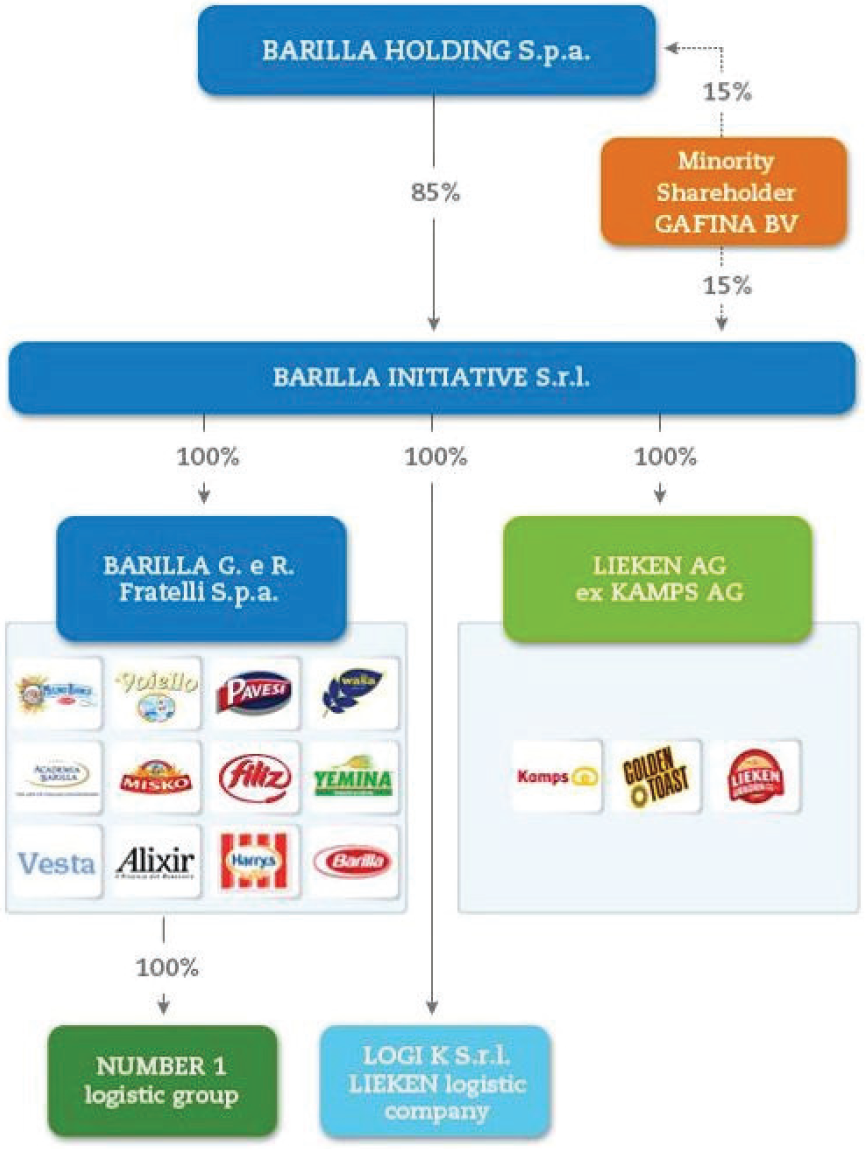
Barilla, originally established in 1877 as a bread and pasta shop in Parma, is today one of the top Italian food producers (Fig. 1): it is a leader in the pasta business worldwide, in the pasta sauces business in continental Europe, in the bakery products business (on which the present paper focuses) in Italy and in the crisp bread business in Scandinavia. The company employs more than 15,000 people, exports to more than 100 countries and in 2010 had net sales of 4,029 M€, EBTDA 556M€, and EBIT 211M€. The company has been managed for over 130 years by one family's entrepreneurial experience and is now run by the fourth generation siblings.
The Barilla Group
The MulinoBianco (White Mill) brand was created in 1975 to launch a new line of oven-baked products. The concepts of wellness and healthy eating were captured by associations with nature and “Old World” traditions. The word “Mulino” (mill) stood for a simple and ancient way of making wheat products; “Bianco” (white) suggested the psychological perception of purity, force and brightness. Although the White Mill (WM) marketing strategy is imbued with “good old days” values, Barilla is a global modern company, highly innovative and with a special focus on social, environmental and economic sustainability (for more details see the sustainability report available at http://www.barillagroup.com/corporate/en/home/responsabilita/bilancio-multimediale.html). The company innovation portfolio – which is constantly revised on the basis of defined priorities –comprises about 150 projects at different stages of advancement that will be finalized within two to three years. In 2010 Barilla invested 42M€ in R&D and employs about 250 people dedicated to research, technological and product innovation and quality control (source: http://barillagroup.com).
This article sheds light on the characteristics of the company customer co-creation practice based on a Web 2.0 platform – “The Mill I Wish” (MIW, from now on) – and implemented since 2009. Through this platform customers can submit new ideas for the company, specifically in the WM business area. These ideas are subsequently voted on by other users, with the winning ideas being considered for implementation by the WM marketing department.
4. Analysis
The MIW project is analysed in terms of purpose, principles, place, procedures and practitioners, according tothe Antonocopoulou framework [43]. Each of the above aspects has been analysed in longitudinal terms (past, present and potential).
4.1 Purposes
MIW started in 2009 with the following main purposes:
To gather all lovers of the brand in an organized community online, leveraging several examples of spontaneous online fan-clubs born around specific WM products, such as the biscuit “Pan di Stelle” or the cult snack “Soldino”, now out of production. The Facebook (FB) page “Give us back the Soldino” in 2009 had about 10,000 members, while Pan di Stelle fans numbered about 700,000. WM consolidated its presence online through the creation of FB pages for every main product and, above all, through the creation of MIW to interact directly with customers transforming the brand-customer relationship from one-to-many to many-to-many. In the words of the Digital Communication Manager (DCM): “Reconciling all the Pan di Stelle Facebook fan pages we gave a house to many Pan di Stelle lovers on the Web. Through MIW we want to create a platform of communication and relationship to give voice to the people”.
To obtain feedback on WM initiatives and to get new insights from the community online. The DCM speaks of a sort of “recruitment” of people to engage in a new relationship with the brand. As regards the kind of insights the company expected from MIW, the DCM, in the first round of interviews, admitted: “We don't expect breakthrough ideas from our customers online. MIW represents more an innovation of communication than a tool for involving consumers in the innovation. We receive precious insights listening to our customers, but these insights are necessarily incremental in nature. We pursue radical innovation activating completely different search practices, going far from our business and from what we know. Crowd-sourcing is not useful when you have not a clear idea of what you are looking for and when you have scarce information”.
In MIW's first year of activity about 4120 ideas were recorded, of which only two were selected for implementation. The community seemed to be driven by people seeking to re-create the past, maybe re-connecting with their childhood, proposing the revival of old products, old packaging, old gadgets, etc. As several WM products have been on the market since the mid-seventies, and since 35 is the average age of the MIW users, the community formed by those who were children in the seventies was prevailing. The mechanism for these users to vote for their preferred ideas seemed to have a conservative effect that cut out the potentially most innovative ideas. WM does listen to the “ex-children” community, which demonstrates genuine devotion to the brand, for example re-issuing old products/packaging in limited edition, and has recently activated a blog entirely dedicated to gadgets that is run by someone who hasbeen responsible for WM gadgets and promotions since 1978. Therefore in this first phase the exploitative nature of this co-creation project surely prevailed. However, despite the general conservative nature of the online community, a couple of disruptive ideas have been proposed. They were not the most voted by the community but the marketing unit selected them for implementation. In spring 2009, two users proposed that WM should support WWF oases in Italy. MIW answered: “All the WM team liked this idea so much that we decided to implement it, even though it was not one of the 10 most voted ideas. We contacted WWF colleagues to understand how we could work together to support WWF oases in Italy”. From this idea three successful projects started on FB. With one of them, the “count-tree”, WM committed to plant one tree in a WWF oasis for every 10 users who voted for their preferred WM product in the line “Fruit histories” (milkshakes and fruit-cups) in a sort of competition on the FB page. Only one week after the launch of the application, 2500 users had voted and 250 trees had been planted. After 20 days the final target of a whole orchard had been reached, and the competition is now continuing with new initiatives.
The DCM interpreted this fact as a signal of the innovative potential of MIW, which was empowered by new procedures and the involvement of new professional figures. The explorative potential of the MIW co-creation practice is now emerging with the results of the second interview with the DCM, one year after the first. When asked if MIW also had an explorative purpose, the DCM answered: “Of course breakthrough ideas also come up through MIW. How would you define the idea of a WM thematic fun park? I don't know if it will be realized, but surely it is a mould-breaker idea!”.
4.2 Principles
According to the DCM, there are three main principles driving MIW: “Firstly, MIW is not supposed to be an institutional company web site, and least of all a ‘brochure website’ in fact, it does not talk to customers, but listens. Secondly, its aim is not to teach but to learn. Thirdly, it is an operative platform aimed at promoting actions rather than talks.”
Such principles are clearly manifested both on the MIW homepage, which displays the message “What matters here is your voice”, and in the specific procedures setting the rules of participation in MIW (for example that related to the Tutor as described in § 4.3). By means of tutorship, the company aims to be present without showing off, remaining as neutral as possible.
As regards the operative nature of the platform, the DCM explains: “MIW is not about explaining why our products are better than the others, but about engaging customers in open and active conversation, finding out what they might find interesting and enjoyable. In fact, a key element in the success of the initiative is fostering customer participation, leveraging the so-called intrinsic motivation of community members, who have more to do with obtaining a reward from the activity itself than with its outcome”.
According to the interviewees there is actually a fourth basic principle which frames the whole project: to maintain genuine and sincere interaction with customers.
Such principles have been defined since the beginning of the project and they represent the pillars of the whole initiative.
4.3 Procedures
In MIW, two kinds of procedures can be identified: frontend and backstage procedures. The former define how to collect information and ideas from customers; the latter define how such information and ideas are managed by WM employees. Concerning frontend procedures, users must register an account to submit an idea or comment/vote on others' ideas. Upon registration, users have the option of searching for ideas or directly submitting their own. Ideas are collected in a structured way, according to areas (products, promotions, packaging, environment and social issues, other) and thematic fields (e.g., new ingredients, new recipes, new products as regards the area products). Ideas are then voted by the community and those which receive the highest rankings (top ten) are considered for implementation by Barilla top management. A tutor is available to provide users with help. He/she provides suggestions on how to formulate ideas in order to make them clearer and get better chances of being chosen by the community, but he/she does not provide any judgments about the quality of the ideas. He/she is also able to open new discussion threads and delete inappropriate posts to safeguard the company's reputation.
Recently, a new procedure has been introduced in MIW to more effectively pursue more the purpose of getting new ideas from the community. Each brand manager can now launch a quantitative/qualitative poll about a specific issue; then, the Marketing Research Unit identifies users to be involved in the poll in order to ensure a stratified sample of the population under investigation. This procedure rewards customers with indirect financial incentives (free products) on the basis of the intensity of their participation in the polls.
Concerning backstage procedures, at first only the ideas selected by the community enter the evaluation and feasibility processes, on the basis of the assumption that decision-makers do not have time to wade through so many thousands of ideas. Now, ideas identified by the marketing staff can also enter the above-mentioned processes. This new procedure is called “Cerca-spulciatrova”(search-examine-find): each brand manager may choose an idea regardless of the success it found in the community. This procedure aims to limit the conservative attitude of the online community, already mentioned above.
In order to guarantee company engagement in MIW at all levels, three kinds of procedure are defined: a weekly review is organized involving Directors, the Business Development and Innovation Unit (BD&I) and the Digital Communication Unit; a monthly newsletter is sent to BD&I, MKT, the Marketing Research Unit and Trade; and periodical reviews are organized involving the whole company.
4.4 Place
MIW is a consumer portal where WM customers can share ideas and suggestions about the company's products, promotions, initiatives, social/environmental commitment, etc. MIW takes the concept of crowd sourcing and opens it up to any customer, upon registration. MIW is what integrates and cross-promotes WM'sweb presence, deriving from disorganized, organicallygrown initiatives. In fact, MIW also has an account on FB. This account opens up a channel for customers who prefer to use FB as their method of communication. MIW is also linked in a bi-directional way to the institutional brand web page.
MIW also includes a blog, also published in RSS (Really Simple Syndication) format, where different WM employees write and talk about new projects implemented or products launched, as well as about how ideas from customers are realized or suggestions used. Comments from customers are enabled on the basis of the official internet etiquette (http://www.networketiquette.net/), also used for all other kinds of communication enabled in MIW. This means that the company may intervene whenever the above-mentioned rules are not followed. Cutting off “flame wars” is a priority.
4.5 Practitioners
Practitioners involved in MIW belong to two main categories: the external users, essentially WM customers, who interact from outside the company with the application, and the internal users, who are WM personnel who use the platform from inside the company at several levels. Of course the interaction is customers-brand/brand-customers and the intention is that it is only mediated by the platform.
External users are, as already stated, mainly WM customers and lovers of the brand, even if participation is open to everybody. From the data on participation after the first year of activity, external users are 27% men and 73% women, and the median age is 35.
Initially, during the first interviews, internal users were essentially the members of the Digital Communication Unit who had designed and implemented the application. Only when an idea had been selected by external users (by means of the vote online) and examined by the DC Unit was it submitted to the brand manager of the relevant area for evaluation. Thereafter, the systematic internal users were DC employees with several roles: tracing the selected ideas to inform external users on the work in progress, running the blogs, monitoring the correct use of the application, examining the most voted ideas andalso some ideas chosen at random that had been discarded by the community, etc.
From the second round of interviews, a change in the internal users emerged. As a consequence of the new procedures implemented, such as search-examine-find, there was a more systematic involvement of managers in different units.
5. Discussion and conclusions
Table 2 shows the main characteristics of the MIW co-creation project according to Antonacopoulou's framework. Some characteristics of the practice (Place and Principles) remain the same over time, while the Purposes, the Procedures and the Practitioners involved changed, making MIW practiceambidextrous [46, 47].
MIW project according to Antonacopoulou's framework
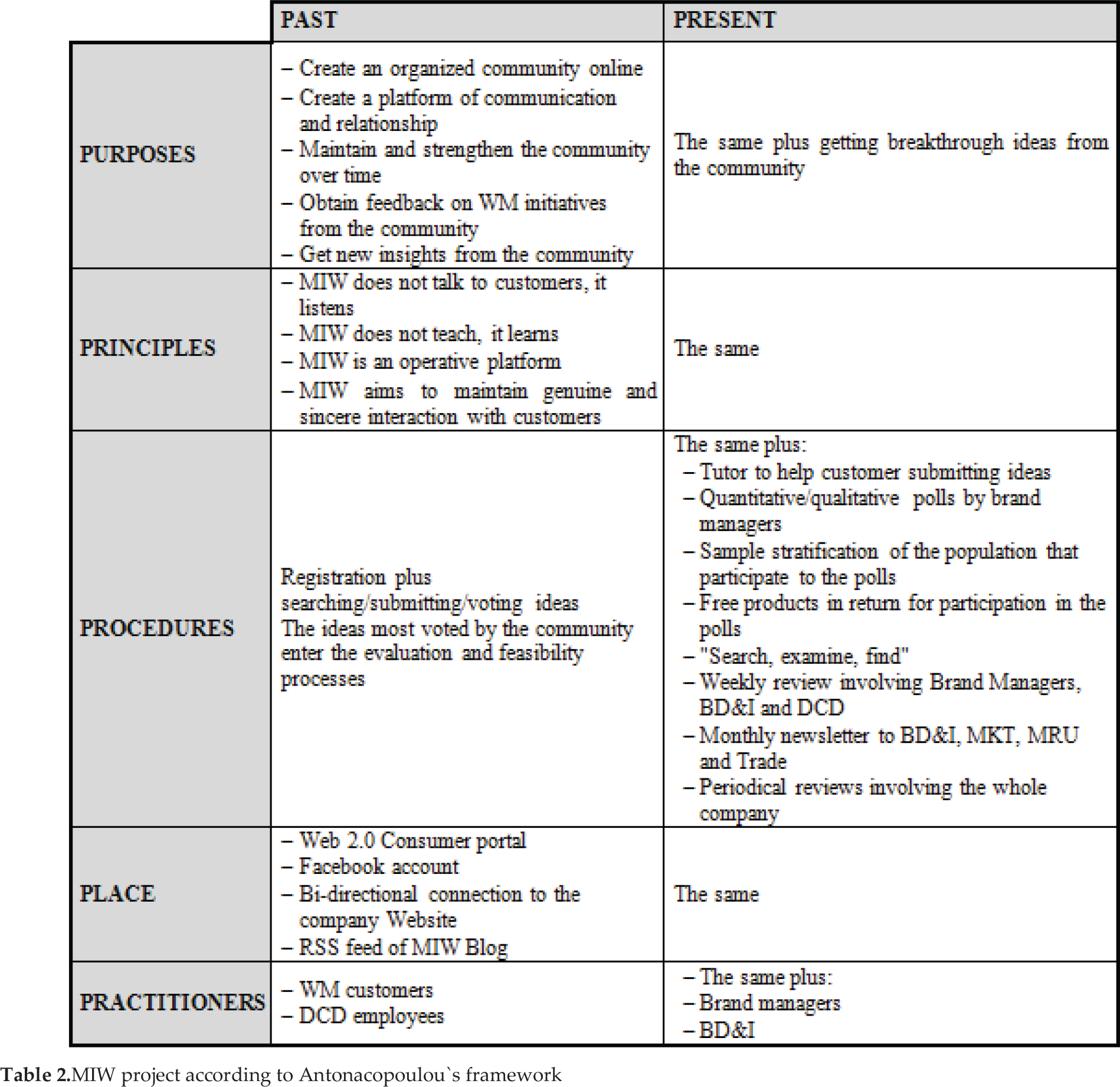
The evolution of the practice towards ambidexterity will be discussed, underlining how the use of the social tool changed to include exploration activities by means of the extension of the purposes, the adoption of new procedures and the involvement of new practitioners. In this case references will concern the literature on social media and their potentialities in the FEI, as well as the literature on how the use of a technology may contradict designers' expectations and generate unpredicted outputs.
As emerged from empirical evidence, the ambidexterity of the investigated practice seems to derive from an extension of its former purposes, as well as from the introduction of new procedures and the inclusion of new categories of practitioners.
While the extension of purposes to include, in this case, explorative intentions is in line with the small literature on the topic (see e.g., [48, 49]), the deep reassessment of procedures and the involvement of new practitioners emerge as new elements to transform a practice into an ambidextrous one. First it must be said that the explorative potential of MIW, however unexpected, did emerge from the beginning of the project. Such a potentiality had not been a priori recognized, possibly due to the fact that the tool had been designed to involve customers and lovers of the brand, in other words a narrow community. MIW had been conceived to “search near” and was not expected to find something distant, i.e., a radically new idea. This explorative capability of the tool seems to be connected to features of social media that are able to extend the potentiality of “search near”, addressing a community online that is virtually infinite [35]. The critical aspect concerns procedures that must be able to select and cream off contributions, and practitioners inside the company who must be able to understand the potential innovativeness behind an idea. As regards procedures, the change mainly regarded the backstage procedures with the aim, on the one hand, of limiting the conservative attitude of the online community (the procedure search-examine-find), and on the other hand of increasing the commitment of the whole company. Concerning the practitioners, more specialized employees, such as those working in the BD&I department, were involved. In the first phase, the DCD acted as a sort of “idea-router”, involving, at different points, the relative brand manager, the marketing unit or the platform innovation manager. In the second phase, with the new procedure “search-examine-find” and with the launch of specific polls, brand managers and the marketing unit were stimulated to interact directly with the tool and to use it to look for new ideas on specific themes of interest. Barilla in fact understood that it is selected managers and experts in specific fields who can usefully interact with customers and, through this interaction, identify radical innovative ideas. So, on the one hand, new procedures were introduced in order to enlarge the commitment of the whole company, and on the other hand a carefully selected group of employees were chosen in order to directly interact with customers.
This article has two main points of originality: (1) a (hot) multidisciplinary topic and (2) the methodological approach. In terms of (1), the work builds on three converging research streams: co-creation with customers, social media, and ambidexterity. While there is a growing literature on ambidexterity, contributions on the other two streams are few and to our knowledge no work has yet addressed the “three helix”.
As for (2), the longitudinal case study was developed by using the specific co-creation practice as a unit of analysis. This article adopts a micro-level perspective, which is recognized as an underdeveloped approach in the ambidexterity literature.
As the empirical evidence shows, the investigated practice seems to be able to concurrently gather incremental and radical ideas. This aspect emerged with time, as an unexpected outcome. In fact, at first managers were rather sceptical about the innovative potential of MIW. This attitude can be explained by the difficulties that managers often have in understanding the nature of and motivation behind users feeding social media systems. Managers have to learn to deal with situations in which resources, expertise and employees are not assigned or pre-set by formal authorities in the organization. Instead, resources are people “out there” who are attracted to providing suggestions on existing or new products. They are attracted to tasks that they feel attached to because of self-interest, that they see as a challenges matching their expertise, or where they find an intrinsic reward. Believing that these resources are no less valid for being free represents a significant internal cultural change, which can be achieved by increasing the involvement of the whole company.
In this study, we have tried to reduce many of the reliability problems that are inherent in qualitative research by using multiple informants from different hierarchical levels, triangulation of different types of data sources, and a systematic data analysis. Generalization remains more of an issue. Further research is needed to prove whether this finding can be verified in other contexts.
Further research is also needed to make the methodology more robust by:
incorporating comparison with cases in other contexts
deepening interviews with current informants
enlarging the informant base.
Despite these limitations, MIW can be considered a complete and rich example of a new and growing phenomenon, i.e., using social software for customer co-creation.
Footnotes
1
This definition is based on an understanding of open innovation focused on “inbound open innovation,” i.e.,“the practice of leveraging the discoveries of others” [48: 229] to support sourcing and acquisition of external ideas and knowledge to the innovative process. Inbound open innovation is supplemented by “outbound open innovation,” i.e.,“the commercialization of technological knowledge exclusively or in addition to its internal application” [ ].
].