




Abstract
A continuing stream of new mobile data services are being released that rely upon the collection of personal data to support a business model. New technologies including facial recognition, sensors and Near Field Communications (NFC) will increasingly become a part of everyday services and applications that challenge traditional concepts of individual privacy. The average person as well as the “tech-savvy” mobile phone user may not yet be fully aware of the extent to which their privacy and security are being affected through their mobile activities and how comparable this situation is to personal computer usage. We investigate perceptions and usage of mobile data services that appear to have specific privacy and security sensitivities, specifically social networking, banking/payments and health-related activities. Our annual survey of smartphone users in the U.S. and Japan is presented from 2011. This nationally representative survey data is used to show demographic and cultural differences, and substantiate our hypotheses about the links between use and privacy concerns.
1. Introduction
As people find online shopping, social networking and the search for health info to be immediate and enjoyable, the volume and frequency of these activities has grown rapidly. On a near daily basis we hear about new service offerings that rely upon collecting user's data, either with or without user awareness. Facebook, for example, has announced a mobile service that will track mobile users' app behaviour. The company will use this data to deliver targeted ads and collecting a fee from marketers when an app is installed on a user's mobile phone. Going a step further from conventional practices of tracking user's clicks on promotions and websites, Facebook would collect data on app usage and behaviour; given the 488 million users that access Facebook via their mobile site each month, this information potentially has enormous value [1].
Continued user growth in what can be termed “risk-sensitive” activities that involve money, health, location and personal identity seems paradoxical, given the debates surrounding the unintended consequences of this activity: namely breaches of personal identity, financial risks and other negative consequences of personal information becoming public. If people were truly afraid of what might happen when they volunteer personal information “in exchange” for an online service, the argument goes, they would not make this trade. Thus, many of the mobile services that are predicted to have potential future value, include social media, location-based services, mobile commerce and healthcare are at the moment based on the continued willingness of customers to opt-in to this trade-off. However, since most people probably do not understand exactly what is done with their personal information and the potential consequences at this early stage, and regulations have not caught up with service offerings, the use case and business models appear in flux in this undefined space.
Common understanding of what constitutes privacy is also changeable and through the years, particularly as a result of information and communication technologies, definitions have changed [2]. Characterizations of online privacy have emerged from concepts developed over the past two hundred years in relation to other technologies seen to threaten private life, beginning with possible privacy threats posed by newspapers and cameras [3]. Privacy is generally defined as the right to control access to one's person and to personal information about oneself. A basic implication is that consent is a part of the equation [4]. The advent of the Internet has brought in the topic of intrusion as an added dimension to privacy along with the topic of surveillance; both are now considered additional categories in definitional boundaries of privacy [5]. Increasingly, however, the central issue in online privacy discussions is the collection, transfer and reuse of personal information and the individual's control of their information after it has been received by others [5,5,6].
The growth of computer databases and possible misuse of information is seen as the central threat to individual privacy in the modern age [8]. Daniel Solove characterizes privacy issues in cyberspace today in Kafkaesque terms in that many people know that their information is held by unseen entities, but they have no control over what is done with this information. Much of the information that is passed to databases is not necessarily sensitive information, but concerns daily activities, preferences and hobbies [9] which perhaps individuals are more comfortable giving up than financial or health-related info. Whether or not the voluntary surrender of this kind of information is problematic, or how exactly third parties are profiting, remains murky for the average person.
The easy to use aspect of mobile services versus granting of consent is also an issue: people on the whole do not wish to be encumbered by a lot of steps when trying to use a service, given that one of the primary values of the mobile phone is its fast, on-the-go quality. This is a consistent finding in the Global Mobile Survey for U.S. users, as well as users in all other markets included. Thus, the mobile world has an apparent design difficulty to ensure privacy notification, given the need for unobtrusiveness as a design choice. Users will necessarily be unaware of possible privacy breaches, although this situation in some cases is not necessarily intended [10].
Thus, the mobile device and mobile Internet present a new platform of uncertainty for the user in terms of understanding how their personal information may be transmitted to marketers, other companies and institutions. The mobile context of social media and location-based services present added privacy issues. Again, Facebook has offered a service called “Deals,” allowing local businesses to offer promotions based on the user's location. The privacy implications were not clearly presented to potential users [4]. This example illustrates how individual responsibility is the clear default in the current mobile environment. While users may have some apprehension that their privacy might be diminished when using their mobile phone, the full picture is not apparent.
The Wall Street Journal carried out a study of apps available for Android and the iPhone platform finding that in fact the majority collect personal information ranging from age, gender and location to phone identifiers which is then provided to other companies without the user's knowledge or consent [11]. It is difficult, if not impossible, for smartphone users to stop being tracked as they can on computers by deleting or blocking “cookies” - the small files that track use. Many apps included in the Wall Street Journal study did not offer written privacy policies at the time they were tested. The piece of information most often shared was the unique ID number assigned to each phone which cannot be deleted. Overall, standard practices for handling information do not yet exist; neither Google nor Apple require permission to access some forms of the device ID or to send it to outsiders. Assembling this information into profiles of mobile phone users is a burgeoning area and developers are often encouraged to release more data about customers. Some ad networks provide “kits” that insert ads into an app or track where users spend their time in the app itself. From the Wall Street Journal test apps, Google was the largest recipient of data through its companies like AdMob, AdSense, Analytics and Doubleclick. Apple uses knowledge about its users gained through iTunes and its App Store, and includes the kind of music and video a person uses and apps that are downloaded. There are signs that Apple is targeting people more intensively through social-networking sites such as Ping, a service within iTunes that lets users share music choices with friends [11]. With user willingness to pay for apps remaining low to non-existent, a high volume of business models for mobile services revolve around advertising. This is also due to the inherent obstacles of the mobile experience and advertising: the personal aspects of the mobile phone which can provoke annoyance with the appearance of an ad on a smartphone, user's fragmented time and attention when using a mobile device, the small screen size which limits the impact of an ad and other factors. As a result, making an ad as meaningful as possible is a sought after goal, which to be met requires the knowledge of the user [12].
The debate around privacy/security and online services often focuses on the trade-offs that users make when they decide that they want things like information, entertainment or discounts and make the decision to supply personal information in return for value or access to services. Eric Schmidt, CEO of Google has phrased it in terms of a line that should not be crossed; the use of facial recognition and real-time tracking are two examples. He has said, “What we have learned is that people disagree on where that line is…” [13]. A reluctance to pay for electronic services and content, present in the mobile as well as the online world, suggests a degree of willingness on the part of the consumer to provide personal information as the cost of doing business; at least for some kinds of services like music and other entertainment. Downloads of free apps, which for the most part have unclear policies and privacy protections, are used more frequently and downloaded more often than apps that require payment. From all app downloads on Android, nearly 100% are free, which compares with around 92% of iPhone apps in December 2011 [14].
1.1 Literature Review
The dimensions of privacy and definitions vary across disciplines, but at their core, most acknowledge the role of the individual in controlling access to their own information as central [15,15,16]. The theft or misuse of personal information is the basis of discussions of online privacy given the value that this data has when collected, mined, categorized and shared [8]. A growing literature on information privacy and its diminishment resulting from information and communications technologies (ICTs) exists that analyses how people make decisions about revealing their personal data. An individual's concept of privacy is changeable depending on the benefit they expect in return for revealing their information. This privacy “calculus,” essentially a cost-benefit analysis, has been used to help explain how users balance decisions to adopt and use technologies. For example, [17] the study of the privacy balance between utility and adoption of location-based services (factoring in other conditions such as how easy it is to use the service, how well it performs, and other facilitating conditions that have been examined and modelled in other research). Gupta et al. found that adoption models need to consider the role of this “negative utility” as a factor for usage behaviour. Additionally, they found that privacy concerns did influence use of LBS services, but varied depending on the type of LBS, suggesting that the degree of control an individual has is important. Other factors like cost, quality of the service and dependability are other factors that need factoring into the complete equation [17].
1.2 Perceptions of Privacy and Security in the U.S. and Japanese Culture
Although all cultures share at least a minimal conception of personal privacy, there is no coherent global conception of privacy. What is considered personal information that should not be passed along in one culture may be considered acceptable in another [18]. Innovations have threatened privacy considerations through time; currently the Internet and mobile devices are created new dilemmas that specific traditional cultural norms may not be able to accommodate.
Comparing U.S. and Japanese cultures, the practices surrounding privacy are different, in large part due to the emphasis on the individual in the U.S. vs. the importance of group association in Japanese life. As conceptions of privacy are often associated with individualism rather than group loyalty, it is sometimes assumed that there are fewer concerns about privacy in Japanese culture [18]. Public baths, the construction materials of Japanese homes that include thin walls that are opened during the day are examples that suggest minimal privacy. The connotations of “public” and “private” are different in Japanese culture relative to the U.S. with individual private concerns considered subordinate to the public domain [19].
However, similar to the U.S., the Japanese also have privacy customs and restrictions on access to places, people and objects; fundamental situations that define privacy [20]. Because the privacy of an individual will be considered to be protected within a group, in addition to other subtleties of practice, there may in the end be less protection in terms of regulation and protection for new situations like the Internet and mobile devices [20]. In terms of individual perception of privacy and security when using electronic networks, both U.S. and Japanese users face a similar situation of not being able to see definitively how their personal information is collected and perhaps aggregated, and who has access to this data. Thus, attitudes are difficult to measure until awareness of consequences is apparent. In terms of the “road map” for mobile services and privacy, areas needing attention have been identified, including raising users' awareness and finding ways to automate an adaptive means to address privacy preferences for people using mobile services [21].
1.3 Hypothesis
We analyse the survey data to address the following hypotheses:
Users with the highest degree of privacy/security concerns will also have the greatest sensitivity to using services that make them vulnerable.
Users with the least degree of concern will have the greater confidence in using services that could also risk privacy and security breaches.
Users with greater experience with mobile services will also have more understanding of privacy/security issues and thus confidence (higher frequency of usage) compared to those with less experience.
Users with less experience accessing mobile services will have less understanding of privacy/security issues and thus more difficulty making a cost-benefit calculation which will result in lower use.
3. Methodology: Analysis of Global Survey Data
The data presented here is based on analysis from a nationally representative survey of U.S. smartphone users and Japanese users carried out in June 2011. This effort was part of a global project called the Global Mobile Survey (GMS), a loosely organized consortium of universities and research entities that has collected survey-based data on mobile users in Europe, the U.S. and Asia over the past eight years using a standard survey instrument. The U.S. survey is a representative sample of the population by age, gender, education level and income, and is carried out online. The sample size was 1,114 and all respondents were smartphone users. Japan's survey data was collected in August 2011 with a sample size of 2,000 respondents. Distribution of the respondents corresponds to national population statistics for population, age and gender. We thank the Japanese members of the GMS group, (Yoshihisa Takada, Keio University, and Ichiro Kawamura and Yoshiharu Fujita, Institute for Information and Communications Policy (IICP), Ministry of Internal Affairs and Communications) for their 2011 data collection efforts and comments on the data interpretations in this paper.
Survey questions were asked to gauge the respondent's level of concern about privacy and security when using mobile applications and services for financial transactions, health-related activities and overall general perceptions of this issue. A series of statements were ranked on a five point scale gauging high to low levels of concern. We use a sample in which we have users with both the highest and the least degree of concern about privacy/security and their mobile device use.
Table 1 below shows the first question that is examined:
Global Mobile Survey Question: To what extent do you generally agree with the following statements about your use of the mobile Internet and your privacy?

The first four statements reflect a high degree of privacy/security concern about mobile devices; the last three show a low degree.
Global Mobile Survey Question: To what extent are you concerned about the following security issues when using your cell phone to make financial transactions?
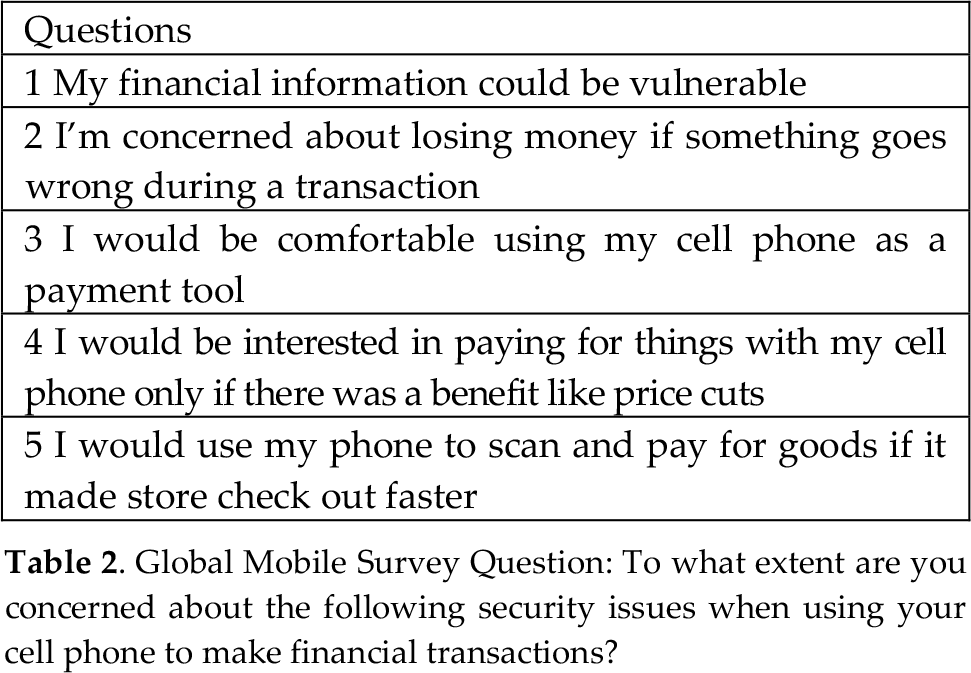
The first two statements reflect a high degree of privacy/security concern about mobile devices; the last three show a low degree of concern.
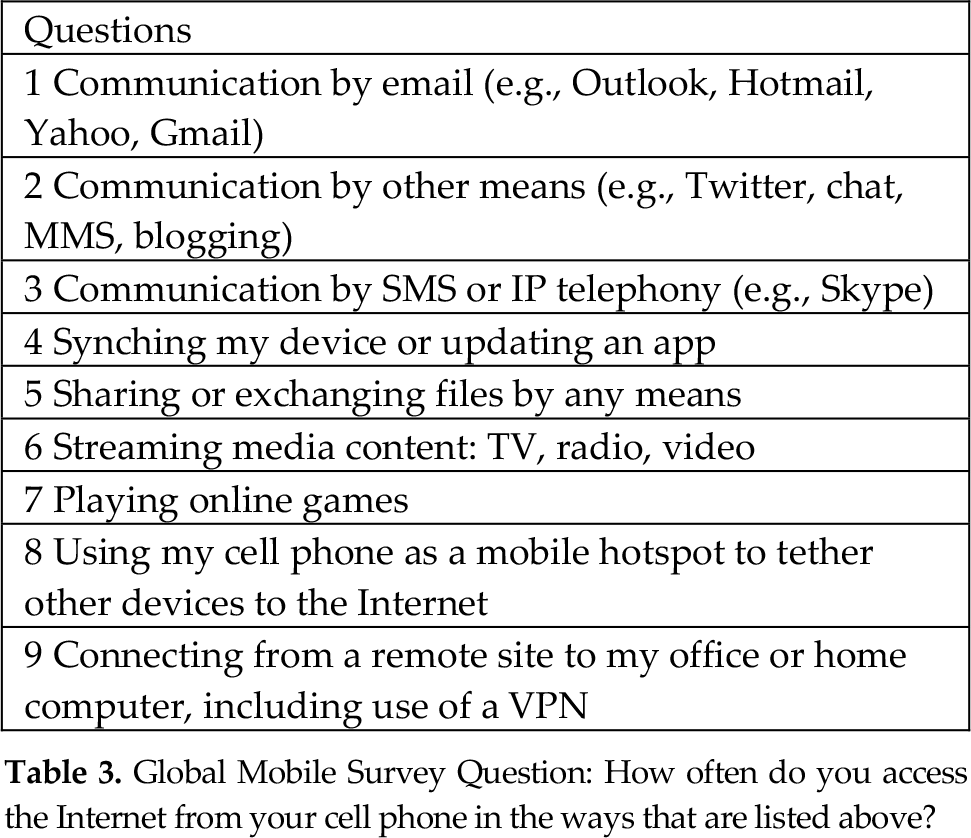
We look at demographic variables including age, education and income to measure the different degrees of concern of these groups. Next, the privacy/security questions on the use of different mobile services are compared. First the results are compared to three key demographic variables: age, income and education level. Next, we analyse the degree of privacy/security concerns with high usage (daily or more) of various means of accessing the Internet services, ranging from the most simple and frequently used method - email - to the more sophisticated, connecting remotely, such as through a VPN. These access methods are listed in Table 3 below:
Global Mobile Survey Question: How often do you access the Internet from your cell phone in the ways that are listed above?
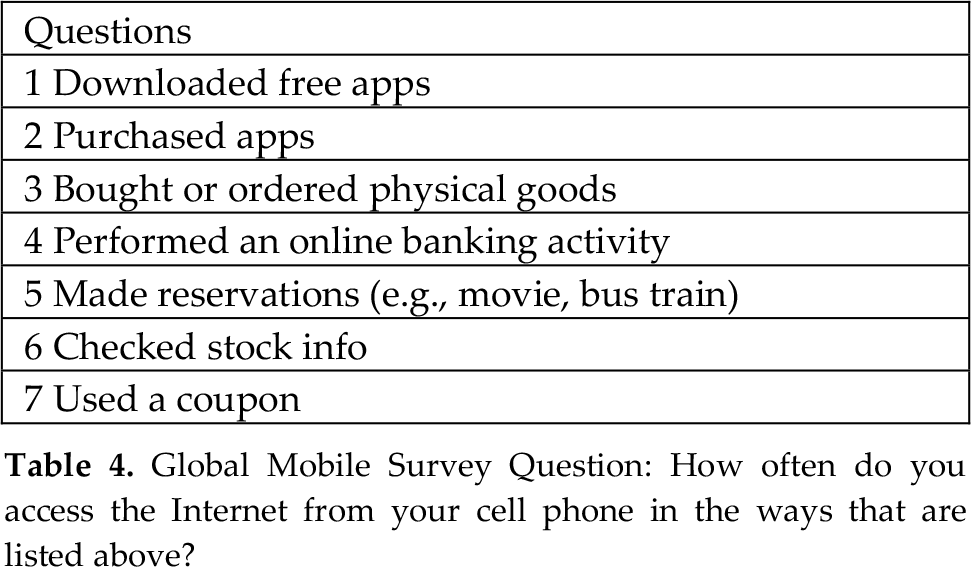
Finally, we look at high usage (weekly or more) of m-commerce services. These services are listed in Table 4 below:
Global Mobile Survey Question: How often do you access the Internet from your cell phone in the ways that are listed above?
4. Results
4.1 Privacy/Security and Demographics: Concern Increases with Age
The first result shown below in Figure (1) is the age breakdown issues surrounding privacy for U.S. respondents.
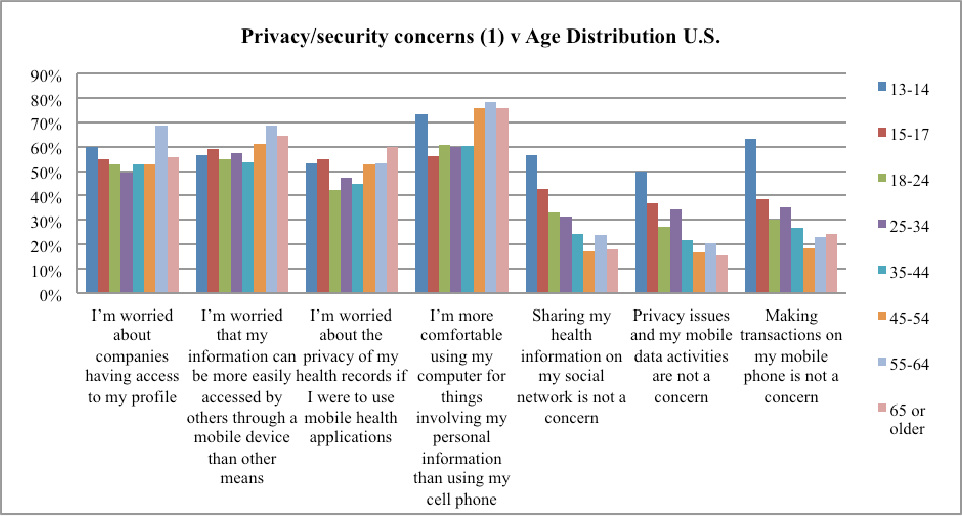
Age breakdown of survey responses for privacy/security (1) related to mobile online activities for the U.S.
We observe that for the first four statements of users older than 18, as age increases the proportion of users with a high degree of privacy/security concern also increases. Viewing the last three statements which describe a low degree of concern, as age increases there is less agreement. Thus, as age increases the proportion of users with a high degree of concern also increases. This could be expected as people in higher age demographics tend to have less experience with mobile services and therefore, perhaps, less understanding of the associated privacy/security issues and more apprehension. This finding is consistent with other studies that have found that adults over the age of 55 tend to have higher sensitivity to privacy and security concerns in an online environment [22].
The exception to this analysis is users under 18 years old, who seem to have at the same time high and low degrees of privacy/security concerns. This result might be explained by a lack of understanding of privacy/security issues on mobile devices leading to inconsistent results.
Looking at the results for Figure (2) below we see the percentage of respondents for each age group asked about the extent to which they agree with the following statements about their use of the mobile Internet and their privacy. We observe that for the first four statements which refer to a high degree of concern, the results are similar to the U.S.; as age increases the proportion of users with a high degree of privacy/security concerns increases. On the other hand, with the low degree of concern statements, as age increases the extent of agreement decreases except for respondents older than 65 who seem to have a higher proportion of low level concern. Generally, as age increases the proportion of users with a high degree of concern increases, and similarly users with a low degree of concern decrease. Again, this is expected as older users tend to have less experience accessing mobile services. A notable exception again is users older than 65, who seem to have even less concern than some younger age groups.

Age breakdown of survey responses for privacy/security (1) on related mobile online activities for Japan
Overall, more than half of the respondents are worried about companies having access to their profiles (at least 50% of every age group). Additionally, at least 50% of every age demographic have the impression that their information can be more easily accessed by others on a mobile device than by other means. This is an interesting finding given that there are generally far fewer reports about people's information being taken from a mobile device (other than when the device itself is taken without permission) relative to other means ranging from online to physical mail. Surprisingly, unauthorized access to personal health information, which many consider to qualify as sensitive, does not appear to be as great an issue, although degree of concern clearly increases by age.
The next relationship of interest is privacy/security (1) versus income distribution. For the U.S. Figure 3 shows the relationship. It can be seen that for those with the highest degree of concern there isn't any specific trend except for respondents with income over $150,000 a group that seems to have a higher percentage of users with concern than the other income groups. For the low degree concern statements both the people with the lowest income (lower than $15,000) and the highest income have a higher proportion of users with a low degree of concern than the other groups.

Income breakdown on survey responses for privacy/security (1) on related mobile online activities for the U.S.
Now we turn to the income level breakdown for Japan. Figure 4 below shows the income level breakdown of users for the privacy/security question (1). In terms of a high degree of concern there isn't any specific trend except for respondents with incomes over $150,000 who seem to have a higher percentage of users with a high degree of concern compared to other income groups. For the low degree of concern statements, there is a definite trend.
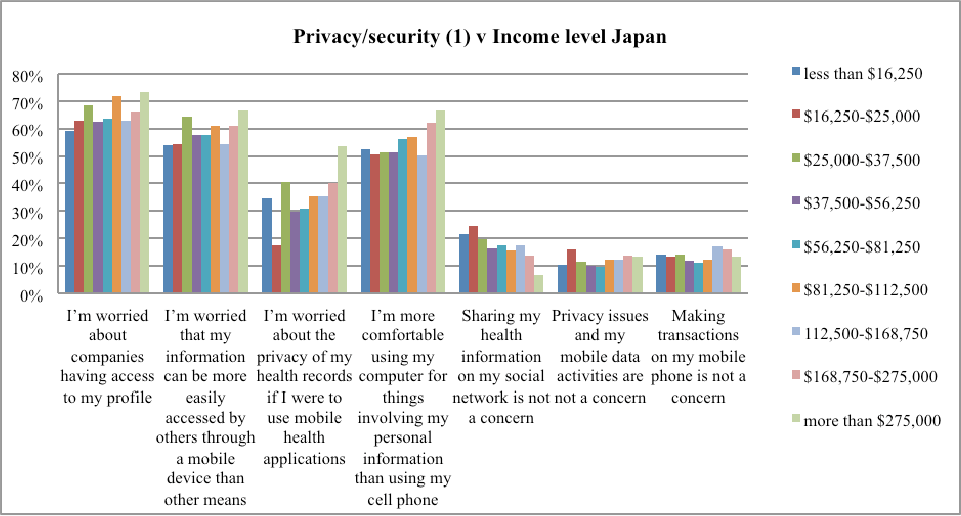
Income breakdown on survey responses for privacy/security (1) on related mobile activities for Japan
Finally, we compare the privacy/security (1) question with level of education. For the U.S. there isn't any definitive trend for the statements reflecting a high degree of concern. For the low degree statements, the only visible pattern is the proportional increase for the lowest levels of education. On the other hand, the Japanese respondents show a clear pattern of increased concern corresponding to higher educational attainment. For the low degree of concern statements, there isn't a specific trend.
Overall, a similarity is seen between Japanese and U.S. respondents in their degree of concern about privacy and security relative to age and income. However, even though the trend is similar, there is an important difference: for the U.S. there is a higher general proportion of users with a low degree of concern than in Japan.
4.2 Privacy/Security Concerns despite High Degrees of Use of Mobile Internet Services
Next, we examine Internet service usage/access and m-commerce. We show responses that were highest on the scale for Internet service use/access (daily or more) and also highest for m-commerce activity (weekly or more). First we look at high use/access to Internet services and privacy/security (1) in Figure 5. We see the privacy/security perspective of respondents with high levels of access/use of Internet access/services. For almost all the items listed, the proportion of users is high in agreeing or strongly agreeing with the statements related to a high degree of privacy/security concern. For almost all the Internet services shown, the proportion of users with a high degree of privacy/security concern is more than 50%. It is also significant that for more advanced services like playing online games, tethering or using a VPN, the proportion of users with a lower degree of privacy/security concern increases, but this proportion is still slightly lower than that of high concern. This is unexpected as we anticipated that frequent use of more advanced methods of mobile Internet access and services would reflect a greater comfort level with mobile security and privacy.

High (daily or more) usage of mobile Internet services for privacy/security (1) for the U.S.
Now we look at the high use of Internet access/services and the privacy/security (1) question in Japan, shown below in Figure 6.
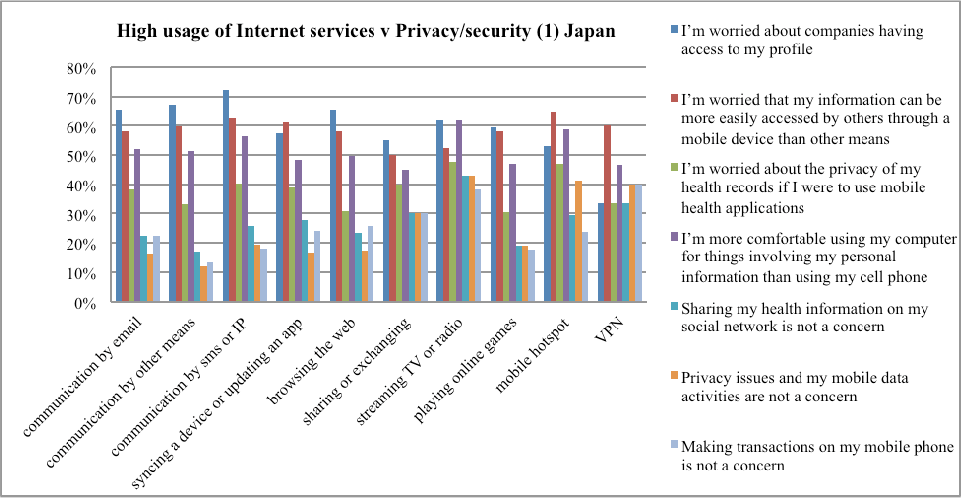
High (daily or more) usage of mobile Internet services for privacy/security (1) for Japan
For most categories of Internet access/services, the proportion of users that agree or strongly agree with the statements about having a high degree of privacy/security concerns are high, the exception being the statement “high degree of concern for the usage of healthcare applications.” This statement has a general lower proportion of agreement than the other statements expressing concern. Also, it is important to note that in Japan there seems to be less concern about healthcare applications than in the U.S. Also, for almost all Internet access and services, the proportion of users with a high degree of privacy/security concern is consistent throughout all services that are listed. These trends don't apply however for VPN services. This finding could have several explanations, but the most likely is that for this service the sample is small, therefore the results are not reliable. It is also interesting to compare these results to the U.S. results where the low degree of concern statements are in higher proportion that those in Japan, indicating that in Japan there is a higher degree of concern than in the U.S.
4.3 Privacy/Security Concerns and M-Commerce Use: High Use and High Concern but More “Sophisticated” Use Associated with Lower Degree of Concern
Next we look at m-commerce use in Figure 7 below. Attitudes towards privacy and security for downloading free apps and performing online banking seem to be very similar, compared to the other categories. There happens to be an ease of use quality, as well as popularity (measured by frequency of use), for these services. It is noteworthy that for these two services the trend is different from the other categories. On the other hand, for the services that are more advanced, like making stock transactions, using coupons or buying physical goods, the trend is also similar and a greater level of concern about privacy and security is visible. It is worth noting that respondents that have high use of m-commerce have at the same time a high degree of concern about privacy/security. Also, for the activities that are popular and that people are more likely to use, such as downloading free apps and online banking, the difference in proportion between the low and the high degree of concern is significant. In other words, the degree of privacy and security concerns are great. Yet when the activity is more advanced, like making a stock transaction or buying physical goods, the difference in proportion between the two degrees is almost insignificant, suggesting a lower level of concern overall. Our hypotheses that people with greater experience using mobile services will have less concern about privacy and those with less experience have more concerns appears to hold in these findings. Furthermore, it is important to point out the behaviour of people with low levels of m-commerce service usage. The results show that this group has a lower degree of concern for privacy/security. This behaviour can be explained by the fact that non-use of m-commerce probably isn't due to security/privacy issues but other factors like lack of experience or interest in using mobile services. Our annual survey of mobile data service use consistently shows that m-commerce remains the least frequent activity of users in all markets included in this study over the past six years. Ease of use, alternative substitutes and general lack of ubiquitous services have all hampered use, irrespective of privacy and security issues [23].

High (weekly or more) usage of m-commerce services for privacy/security (1) for the U.S.
Finally, m-commerce usage is shown in Figure 8 for Japan. Again, the proportion of users of m-commerce that have a high degree of concern is higher than those with low degree for all statements, except for ‘concern about health records for the usage of healthcare applications.’ This is also a characteristic seen in Figure 6. It is also interesting to compare these results to the U.S. users' behaviour regarding privacy of health records. As in the previous figure we can see that compared to the U.S., Japanese users have a lower proportion of users who have a low degree of privacy/security concern. Thus, Japanese users appear actually to have more concerns about privacy/security issues than U.S. users. This finding is unexpected given conventional wisdom that concepts of privacy in Japan are minimal. In addition, this concern with privacy and security is worth noting when we look at the general use of m-commerce services in the U.S. and Japan. See table below:

High (weekly or more) usage of m-commerce services for privacy/security (1) for Japan
Global Mobile Survey Question: How often do you use the wireless data services listed above? Frequencies for high (weekly or more) usage for the entire sample of U.S. and Japanese users
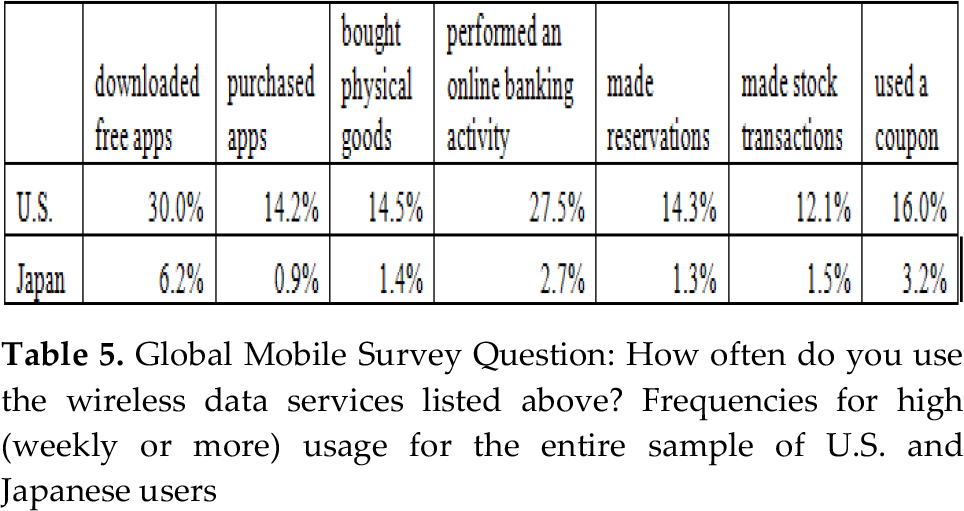
This table shows that U.S. usage of m-commerce services is higher than it is in Japan where there is also a higher degree of privacy and security concern, consistent with hypothesis 4 that higher concern results in lower use of services.
4.4 Privacy/Security Concerns for Financial Transactions and M-Commerce

High (weekly or more) usage of m-commerce services for privacy/security (2) for the U.S.

High (weekly or more) usage of m-commerce services for privacy/security (2) for Japan
5. Discussion: Privacy Concerns Exist in the Face of Mixed Use Patterns
A prevailing concept about privacy at the moment in the consumer sphere uses the idea of trade-offs made by the individual who willingly divulges personal information in exchange for something of value in return such as use of services or discounts [24]. This trade-off presumes knowledge on the part of the individual who makes a rational decision to take part in this bargain. Our data suggests lack of awareness by the user when their data, such as age, gender, habits, address and other items, are collected, aggregated or sold to a third party. The expectation in some cases may be that the individual's privacy is protected; for example, Apple has a privacy policy, although enforcement of this policy is currently in question. Privacy and security concerns do not seem to be based on an understanding of current circumstances and are also filtered by habits, expectations and cultural practices. As our survey data indicates, (Figure 1) privacy and security concerns are present when substituting the mobile phone for a task rather than using a computer. People are more comfortable using their computer for things involving personal information and also feel that their information is more vulnerable on a cell phone than on a computer. This privacy “calculus” stands out in the survey data.
We also see that in general older people are more concerned with privacy and security – in particular related to health information - younger people are also concerned and perhaps more aware of trends in mobile technology in general. Our survey data shows that despite many claims that younger people are not concerned about privacy, substantiated often by use of social networking sites like Facebook, where personal information is readily shared to connect with others; in fact younger people are concerned about companies having access to their information and using it without authorization. Well over 50% of those between the age of 13 and 45 have this sensitivity. Interestingly, people who buy apps have a higher concern than those who download free apps, perhaps reflecting a choice where it is assumed that payment provides more privacy and security.
Our first hypothesis is that users with a high degree of privacy/security concern would also have sensitivity to using services that increased this risk, and we did find that some services were associated with higher degrees of concern, (i.e., health-related matters seem to be a sensitive area for all U.S. users). Surprisingly, other services used frequently see continued use despite concern. The second hypothesis that users with less concern will also have greater confidence using services that could risk privacy and security breaches seems to be supported for online banking and downloading free apps. Hypothesis 3 and 4 is likewise supported by the survey findings for m-commerce use in that more advanced users (defined in terms of the difficulty of using the service) have lower levels of concern and users with less experience have greater concern and use services less. Finally, comparing cross-nationally, we found more agreement between the U.S. and Japanese users in terms of privacy and security concerns than differences, although there are clear distinctions in social views and traditions in these two countries. In particular, both cultures are sensitive to the possibility that companies are able to collect their information and utilize it without informing the user. To conclude, it seems clear that privacy and security issues surrounding the use of mobile devices remain unseen to the user, and to a large extent it is up to the individual to take precautions and make decisions in the face of incomplete knowledge.
The World Economic Forum (WEF) has initiated efforts to explore how people's data flows can be harnessed within their control, given the assumption that personal data is a new economic asset that needs an operational structure so that consumers have the ability to make better informed decisions about what is done with their data. Further, it has been suggested that personal data is on its way to becoming the currency of the information economy – despite the lack of ways to exchange, store and use this data [25]. Notably, the lack of ways for consumers to share in the value that is potentially being created by the aggregation of information created by and about them will be a stumbling block to achieving full effectiveness and enablement of this new ecosystem [26]–[27]. As users become more knowledgeable about how their data is collected and used, it will be interesting to see how use patterns and attitudes evolve towards either greater acceptance, as some have argued, or to increased vigilance and caution.