




Abstract
This article develops a strategic clustering for Mobile Middleware Technology Providers (MMTPs), shedding light on the business models and the strategic positioning currently adopted by this actor typology. The paper combines a literature review and a multiple case study approach – 24 in-depth cases based on 72 semi-structured interviews were performed – to deal with a significant and relatively new issue, i.e., the role of technology providers in the mobile value network. Through the creation of a system of strategic clustering matrices, four key business models currently adopted by MMTPs – “Pure Play”, “Full Asset”, “Third Parties Relationship-focused” and “Platform and Content Management” – are identified, and insightful conclusions on the impact of this actor's newly emerging influence on the market's competitive dynamics are drawn. The framework created supports a wide set of mobile communications stakeholders – both incumbent and new entrants – in their decision making and strategy analysis process.
1. Introduction
The recent strategic reorientation of Mobile Network Operators (MNOs) towards the mobile content market [1]–[2], i.e., the market for value added, non-voice services – to cope with the gradual levelling off of average revenue per user [3], determined a deep readjustment of the whole mobile value network [4], in terms of actors involved and coverage of key activities related to the process of creating managing and delivering mobile digital content and services.
Within such context, a relatively new actor typology emerged: the Mobile Middleware Technology Provider (MMTP), supplier of the Mobile Content and Service Delivery Platform (CSDP) used to create, manage and deliver the content portfolio developed by Mobile Network Operators (MNOs) and Mobile Content & Service Providers (MCSPs).
The existing literature dealing with middleware technology enablers for the mobile value network is quite fragmented and fails to provide a clear and unified definition of Mobile Middleware Technology Providers [5, 6]–[8, 9]. In particular, questions arise concerning the business models MMTPs will design and adopt to compete in the market.
A comprehensive definition of this actor typology can be found in [10, 11]: MMTPs are traditionally positioned on the platform layer – the technology enabling value chain for the mobile content market – and their core role encompasses some or each activities related to the development of middleware mobile content and service delivery platforms, ranging from platform design to platform manufacturing, provisioning operations and management [12].
Given the current market fluidity, these players have the opportunity to take a more central role in the network, also extending their traditional business – focused on the CSDP design and manufacturing – downstream, towards the commercial management of content published on their platforms. However, since such market making activities have always been an MCSP prerogative, this recent trend could cause strong competitive attritions.
Therefore, the purpose of this study is to develop a strategic clustering of MMTPs, shedding light on the business models currently adopted, as well as assessing the potential overlapping of positioning between such an actor typology and other incumbent players.
The resulting framework will be based on a mediation between the internal and external strategic analyses, and will propose a system of classification matrices to obtain a strategic clustering of an extremely significant sample of companies classifiable as MMTPs.
2. Method
In order to collect both qualitative and quantitative information concerning MMTPs, the literature analysis on the mobile content market and value network was integrated by the adoption of the multiple case studies research methodology [13]: from December 2010 to June, 2011, 24 in-depth exploratory case studies – based on 72 both face-to-face and phone semi-structured interviews – on MMTPs were performed, focusing on the identification of key strategic classification variables, sets of variables and dimensions. Adhering to the research methodology employed [14], the firm sample was not randomly selected, but firms were picked as they conformed to the main requirement of the study, while representing both similarities and differences considered relevant for the data analysis. The main predetermined filters used to discriminate among firms, thus identifying which companies could be labelled as MMTPs, were: the presence of a well-defined line of business – if not the core business – dedicated to the commercialization of content and service delivery platforms or CSDP modules and the presence of an offer directed to the mobile telecommunications market.
A multiple case study approach reinforced the generalization of results [15] and allowed performing a cross analysis on platform characteristics and their combinations (to see which variables changed and which remained constant) due to the presence of extreme cases, polar types or niche situations within the theoretical sample [15].
As the validity and reliability of case studies rest heavily on the correctness of the information provided by the interviewees and can be assured by using multiple sources or “looking at data in multiple ways” [13, 16], multiple sources of evidences or research methods were employed: interviews (to be considered the primary data source), analysis of internal documents and study of secondary sources (research reports, websites, newsletters, white papers, databases, international conferences proceedings). This combination of sources allowed obtaining “data triangulation”, essential for assuring rigorous results in qualitative research [17].
3. External strategy analysis on the CSDP market
According to the Positioning School approach [18], a firm's performance is strongly influenced by the market's structure, which is in turn affected by the interaction of the competitive forces acting within it [19]. However, competition cannot be narrowly defined, yet it goes well beyond established industry rivals to include four other competitive forces as well: bargaining power of customers, bargaining power of suppliers, threat of potential entrants and threat of substitute products or services [19]. It is then the intensity and the interplay of these forces that drive an industry's profit up or down.
Therefore, to understand and assess the market returns issue, thus gaining a valuable insight on the market's attractiveness, the renowned Five Forces model will be applied and integrated in the overall framework of analysis.
As the initial, mandatory step of the external strategy analysis, a definition of the market under scrutiny shall be provided: the analysis focuses on the content and services delivery platforms market, a segment of the wider market related to telecom's service layer [5, 7]–[8, 20].
The model's application allowed identifying an internal competition of medium intensity, tempered by: the market's high rates of growth [21]; the competitors' heterogeneity; platform differentiability; and the relatively low exit barriers, due to the key assets reconversion. The new entrant threat is quite high, especially with reference to players coming from neighbouring business areas within the ICT industry, because of the medium entry barriers and the low risk of coordinated retaliation by the incumbents. The threat related to existing substitutive products, e.g., the media platforms and, to some extent, the generic enterprise IT platforms, will not constrain the diffusion of ad hoc CSDPs for managing mobile digital content. The supplier's bargaining power is low, while customers enjoy a significant power in the case of MNOs and a medium power in the case of MCSPs.
In light of the previous consideration, the CSDP market is characterized by moderate to high attractiveness: the internal analysis is hence meant to supplement such findings, by identifying the sources of competitive advantage for the analysed players.
3. Internal strategy analysis on core resources and competencies
Resources and competencies portfolio for MMTPs

To integrate the previous external analysis, an internal strategic analysis was performed, with the purpose of individuating the core resources and competencies (R&C) a MMTP relies on to create a solid and sustainable competitive advantage [22, 23].
As the existing literature does not define the set of key assets and know-how for technology providers, the literature gap is filled through the case studies carried out. The R&C portfolio, whose identification took into consideration the “five tests” – inimitability, durability, appropriation, substitutability and competitive superiority – capable of discriminating from generic to critical assets and know-how [24]–[25], is divided into two main categories: platform technology and content management.
The internal analysis will support the assessment of the different positioning and business models adopted by the competitors.
4. The strategic clustering of MMTPs
Taking into consideration the combined external and internal analysis performed, as well as the information and data collected through the multiple case studies carried out, the second major step in the model is the creation of a system of noteworthy “strategic classification matrices”, based on the crossing of significant classification variables identified through the literature analysis, as well as the case studies: such matrices allow obtaining a strategic clustering of the MMTPs comprised in the sample of analysis, thus indentifying the main business model configurations currently adopted. The rationale used to judge a dimension's significance was its impact on the company's strategic positioning and business model employed.
The first classification variable identified concerns the actors' value proposition: according to the key functionalities offered, it was possible to identify five distinct CSDP categories, characterized by different purposes [4]:
Content creation platforms, prevalently related to the activities of concept, development and production of the digital content or service. They offer tools for service creation, workflow management, service testing, as well as for aggregation of internally produced and third party uploaded content.
Content management platforms; mainly covering the activities spanning from content publishing to content delivery, offering several functionalities: content storage, publishing, aggregation, filtering, retirement; metadata management; digital rights and intellectual propriety rights management; content adaptation; authentication and access control; user and device profiles management; over-the-air configuration; third party relationship management.
Business management platforms; meant to handle digital content from the wider business perspective, ensuring the integration between the specific VAS business and legacy systems, e.g., BSS/OSS, database and data warehouse, customer relationship management, enterprise resource planning, billing and accounting system. The key functionalities are related to service orchestration, reporting, portfolio and campaigns management and subscriber management.
Transactional platforms; interconnected to MNOs' systems and supporting the activities related to the so-called “CBA process”: content charging, content billing and revenues accounting among the involved parties. These MCSDPs commonly possess some functionalities of SMS/MMS/WAP-based service delivery.
Transversal platforms; showing cross coverage of modules and functionalities that makes it difficult to identify a prevalent purpose, thus making them multi-purpose platforms.
The following figure shows the symbols employed in the overall technology provisioning matrices to identify each platform category.
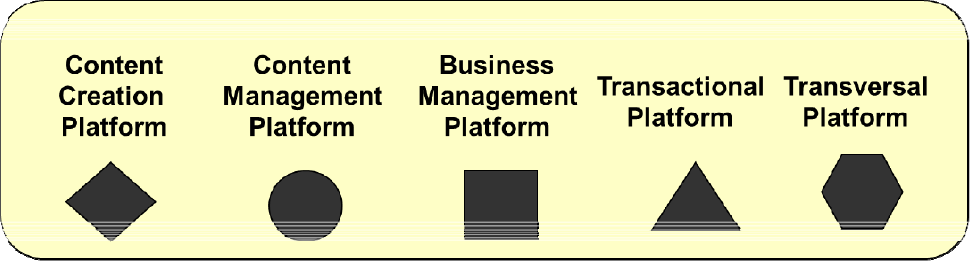
The five CSDP categories
The first matrix presented crosses two classification variables. “Additional Services Delivered” details the services integrated with the platform that can assume the following values:
Technology management of a CSDP's operations;
Contractual support to enable the establishment of agreements with third parties – Content Providers (CPs) for content provisioning or MNOs for interconnections;
Commercial management of the content published on the platform.
Platform provisioning modality describes the way the CSDP is supplied to the MTTP customer. Three main choices are available [26]:
Selling;
Hosting, where the MMTP keeps the platform in house and delivers it in Application Service Provisioning (ASP);
Outsourcing, implying a platform installation within the customer's business, with an overall management on the supplier's side.
The first mapping gives rise to five different clusters or combinations of the two noteworthy variables.
Analysing the matrix as a whole, the mere technology management of the platform emerges as the most popular alternative – followed by 17 companies out of 24: such a finding testifies that the large majority of MMTPs with pure technological background are prone to maintain their core business on technical activities. The contractual support alternative and the commercial management of mobile digital content, followed by four and three firms, respectively, still represent a niche solution, though showing an interesting trend of extension of the traditional business scope characterizing MMTPs.

Additional Services Delivered / Platform Provisioning Modality matrix
The second strategic clustering matrix aims at classifying the players in terms of their orientation towards platform technology or content management resources and competencies – starting from the consideration that such a dimension of analysis heavily influences the current business model adopted, as well as the strategic options at hand.

Core Resources and Competencies matrix
Through the matrix, two main typologies emerge:
Technology-oriented players – eight companies out of 24, focusing their competitive strategy on the development of R&C related to CSDP design, manufacturing and installation, with no specific investment in the field of content management.
Service-oriented players – 16 companies out of 24, looking for the best trade-off between content management and platform technology R&C. These companies possess the highest inner potential, as they own a store of assets capable of enabling the provisioning of an end-to-end both technical and commercial service with reference to mobile rich media content.
The strategic map shows an evident gap in the “high content management R&C” — “low platform technology” quadrant that could be explained with the unavoidability of platform technology assets and know-how for a MMTP, that can hardly configure itself as a pure content oriented firm: such positioning is currently taken on by MCSPs.
Considering that recently the CSDP market segment saw the entry of many players coming from neighbouring markets, a further relevant dimension of analysis to be taken into account is the “Business Area of Origin”, so as to understand how such a factor affects the companies' business models and the way they compete. The third strategic clustering matrix crosses the player typologies identified in terms of the R&C they possess with five main business areas to which the analysed players belonged: mobile content; network equipment; IT platforms; system integration and software engineering.
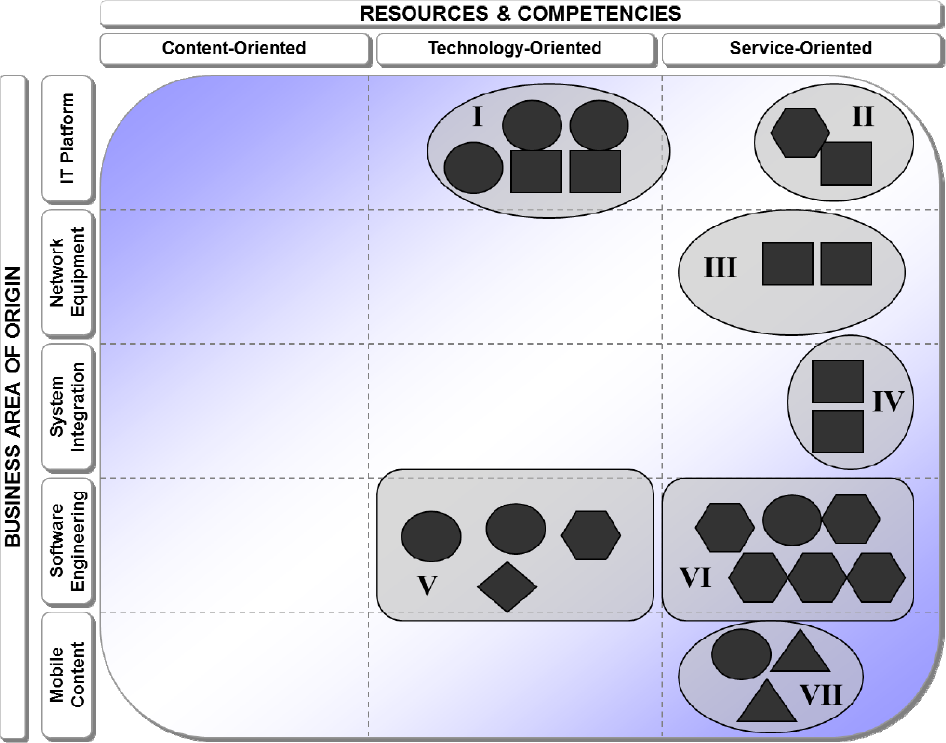
Core Resources and Competencies / Business Area of Origin matrix
The map allows identifying seven distinct clusters. Mobile content players are concentrated in cluster VII, showing a clear tendency towards service-oriented R&C. The competitors originally related to software engineering are almost equally split between technology-oriented – cluster V – and service-oriented R&C – cluster 6: the clusters are the most populated, testifying to the closeness between this business and that of CSDP development. The collocation of IT platform providers is definitely unbalanced towards technology R&C – cluster I and II – confirming that such players decided to penetrate the market so as to take advantage of contingent opportunities, adapting their offer of generic platforms without developing specific competencies. On the contrary, it is interesting to notice that the few network equipment vendors – cluster III – and system integrators – cluster IV – are showing a significant attention towards “soft” elements, far from their core business related to network infrastructure, building up an R&C portfolio also dedicated to content management.
Given the previously described strategic classification variables and the resulting matrices, the final strategic clustering allows identifying a taxonomy of the main business models currently adopted by MMTPs. The “Business Model” matrix is created by crossing two significant variables: the player typology in terms of R&C possessed, influencing the positioning and competitive potential; and the additional services delivered, detailing the typology of complementary services offered and so making explicit the value proposition and the tendency towards extending the traditional prerogatives proper of the platform management process, thus embracing commercial aspects.

Business Model Taxonomy matrix
Through the strategic clustering [27]–[32], four distinct business models emerge:
Pure Play Technology Providers. The model is adopted by technology-oriented firms proposing a mere technical management of platforms. It is named “pure play” since a full coherence between R&C developed and platform management emerges, and the alignment between internal resources and external positioning perfectly falls back on the technological dimension. The cluster is populated by eight companies, coming either from the software engineering market, e.g., First Hop, Microsoft, Neodata – or the IT platform market – like IBM and Nee. These players opted for such a solution in order to maintain their focus on their traditional core, to stay away from any conflict with their current and potential customers – mainly MCSPs –, and to avoid being forced to internally develop a new set of R&C related to the market making of digital content.
Full Asset Technology Providers. The model is employed by service-oriented players who, though having a rich R&C portfolio at hand, limit their offer to the CSDP technology management, adopting a “wait and see” strategy on the content commercialization front. The width and depth of their resources and competencies, however, makes them high competitive potential players and creates the conditions for a future expansion of their scope. Companies like Alcatel-Lucent, Bea Systems, Dylogic, HP, Logica CMG/Acision, Reitek and Reply belong to this cluster.
Third Party Relationship-focused Technology Providers. These service-oriented companies have enhanced their value proposition offering contractual support services for establishing agreements with their customers' third parties – MNOs or CPs. Examples of companies adopting such positioning are Ericsson, Mblox, Qualcomm and Sybase 365.
Platform and Content Management Technology Providers. The cluster is populated by a few service-oriented players – specifically, Comverse, Nokia-Siemens Networks and Txt Polymedia – that decided to extend their business to embrace true commercial management of content. Such innovative and atypical positioning is adopted by players with technical background that shows a remarkable openness towards end-to-end applications and services management for their customers.
As a whole, the map shows how the large majority of the interviewed companies – 17 of 24 – are still focused on the technology management of the platform and today do not pose a real threat to MCSPs for content management. However, the presence of innovative positioning related to contractual support and overall platform and content management, as well as the generalized tendency of creating a rich portfolio of R&C – 16 players are defined as service-oriented – could determine unexpected trends in the near future of the market.
5. Scenario analysis: future trends in business models evolution
In order to integrate the “static” strategic clustering, a scenario analysis aimed at dynamically evaluate the possible business models evolutions in the short- to medium-term was performed.
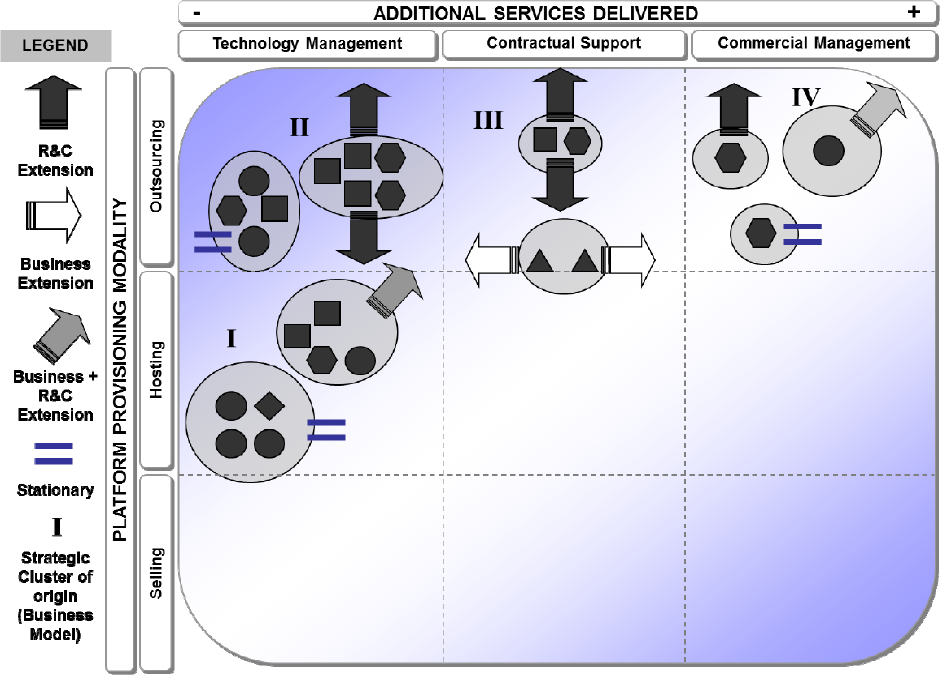
Scenario Analysis matrix
The findings highlight that although many clusters are inclined to look for a business extension – through the increase in the range of additional services provided or R&C portfolio enhancement, only a few players are actually moving along both dimensions, seeking a different competitive positioning – expressed by the business model employed. Specifically, some Pure Play TPs will shift to the cluster of Full Asset TPs, enriching their resources and competencies.
Unexpectedly, in the time interval under consideration, no significant trends taking the Full Asset TPs towards more innovative models are foreseen: these companies appear to be willing to leave their competitive potential unexpressed, under the banner of their “wait and see” strategy [25].
Concerning Platform and Content Management players, quite diverse movements are registered, related to different underlying motivations and approaches towards the downstream activities of content market making: Comverse seized a contingent opportunity offered by Vodafone to manage the market making of the operator's ringbacktones service [33], and will most likely maintain this position with no further investments; Txt Polymedia, thanks to the close relationship with the Italian Media Company Mediaset, will work on extending its R&C portfolio related to content management; Nokia will explore an extension on both R&C and products/services, aiming at positioning itself not only as a device manufacturer and a platform vendor, but also as a content provider and aggregator.
6. Conclusion
This study provides an original reference model for supporting the strategic analysis of Mobile Middleware Technology Providers. The framework is created through a research methodology integrating multiple case studies and a significant literature analysis.
The external strategic analysis allows us to conclude that the market for CSDPs is characterized by a medium to high attractiveness, while through the internal analysis the core resources and competencies for an MMTP where identified and further divided in “Platform Technology” and “Content Management” categories.
The strategic clustering matrices led to the identification of four key business models currently adopted by MMTPs – “Pure Play”, “Full Asset”, “Third Parties Relationship-focused” and “Platform and Content Management” –, and the final scenario analysis led us to the conclusion that MMTPs will not pose a real threat to MCSPs business in the short- to medium-term, though a generalized trend of enhancing content-oriented resources and assets was noticed.
The paper's value for researchers, on an industry-specific level, can be brought back to the creation of a reference framework capable of addressing the emergent phenomenon related to the rise of middleware platform providers within the mobile content market.
The study also offers an original contribution to strategic management as a research field: the framework proposed rests on the integration of an external and internal strategy analysis based on the Positioning School and the Resource Based View, respectively; and the model employs a typical internal analysis concept – the core resources and competencies endowment – with strategic positioning purposes – as a variable to interpret the competitive positioning of the actors under scrutiny.
The value for practitioners lies in the provision of a valuable tool supporting a wide set of stakeholders – both incumbent and new entrants – in their decision making process and in the strategic interpretation of the competitive arena, allowing the identification of analogies and differences between different strategic clusters, as well as between different players within the same cluster.
The research represents a multifaceted attempt at defining the business models designed by MMTPs. However, it does not analyse the potential different performances coming from the alternative business models adopted.
Future research avenues will have to concentrate on the provided framework's validation, as well as on the identification of a specific link between business models and achievable performances.