




Abstract
It is the consensus of scholars that the productivity of the construction industry is very low when compared with other industries. Concurrent Engineering (CE), which has a primary goal of reducing the total time from designing a product to releasing it into the market, while creating better designs as well, has been identified as one of the concepts that has yielded effective adaptation in the construction industry. An exploratory survey was used to identify 63 variables with the capacity to influence the uptake of Concurrent Engineering in Nigeria and was used to design a questionnaire, which was distributed to 50 stratified construction industry stakeholders. A statistical software package (STATISTI-XL) was used to analyse the severity index of each variable, in order to establish the importance of each variable in influencing the uptake of Concurrent engineering and also to compute the Kendall's coefficient of concordance, which assess the levels of agreement among the judges on the consistency of the rankings. A Kendall's coefficient of concordance of W=0.57365 was recorded. A lack of awareness emerged as the most important barrier against the integration of this concept into the Nigerian construction industry. The top five variables are all human factors that can be ameliorated by proper education.
Keywords
1. Introduction
The construction industry generally has been faced with continuously increasing and sophisticated demands, which call for the most efficient use of the available resources. Many of the services and parts of the structure of modern facilities are now so technically specialized that they have to be designed by many specialists. In response, the construction industry has evolved, with the fragmentation of the production responsibilities into many sub-processes split amongst many participants, who belong to different organizations with different policies, objectives and practices (Aniekwu, 2002). This increases the channels of communication necessary in the design and production processes. The atmosphere created under these circumstances is one of rivalry, bureaucracy, distrust, suspicion, misunderstanding, buck passing, etc. In this situation, the project team is reluctant to make any decision that deviates from drawings or specifications, even if it is an improvement. There is no incentive to improve the process and, needless to say, the resources are not optimized.
Successive National Governments and institutional reports have examined the activities of the construction industry and have commented upon the need for improvement; Simon 1944, Phillips 1950, Emmerson 1962, Bowley 1963, Banwell 1964, Higgins and Jessop 1965, Bishop 1972, Munday 1979, Ball 1980, NEDO 1978, 1983, 1988, Kirmani 1988, British Property Federation 1983, Latham 1993, 1994 and DETR 1998. The reports identified, amongst other factors, the fragmented nature of the construction process and industry (evident in the large number of firms operating within it), the distinct separation of the professions, poor communication, a lack of concurrency, institutional barriers, ad hoc problem solving approaches, lack of trust and collaborative spirit within the client/design/construction team as responsible for the consistently low levels of performance.
Attempts have been made to integrate construction design and production processes through the use of various procurement strategies, such as design and build, fast tracking, project management etc. (Fellows, 1997). Practitioners and researchers have turned to the manufacturing industry as a point of reference and source of innovation. Accordingly, a concept known as CONCURRENT ENGINEERING (CE) has become the focal point of research. This concept advocates the use of a multi-disciplinary project team, whereby participants are brought together during the design stage to determine how downstream issues may be affected by design decisions.
While these problems may be the same the World over, the direct consequence in the global south is a lack of capacity of local industries to implement their national construction objectives, thus relying on foreign skills and technologies. Similar problems in the manufacturing sector have been overcome through the introduction of CE in place of serial or sequential project delivery method (Fig. 1).

Conventional product design approach.
The need for adopting concurrent engineering in construction is discussed in several publications (de la Garza et al. 1994, Eldin 1997, Love and Gunasekaran 1997, AbulHassan 2001) and their contributions are summarized as follows:
CE is a philosophy that can overcome the disadvantages of existing fragmentation and specialization in the construction industry, if applied properly (de la Garza et al. 1994).
CE is a scheduled reduction tool that could reduce project delivery duration by 20–25% without an associated increase in project cost (Eldin 1997).
CE is an approach imported from the manufacturing industry to assist in overcoming the construction industry's poor productivity and performance (Love and Gunasekaran 1997).
CE application in a construction project tended to increase project delivery speed and project quality without a significant impact on project unit cost (AbulHassan 2001).
Countries of the global south, more than any other, are in need of new approaches in project delivery to enhance the capacity of their industries and to deliver their national goals
2. Concurrent Engineering
The term Concurrent Engineering was coined in the late 1980s to explain the systematic method of concurrently designing both a product and its downstream production and support processes (Evbuomwan and Anumba 1995, Huovila et al. 1997). It was proposed as a means to minimize product development time (Prasad 1996). This was necessitated by changes in: manufacturing techniques and methods, management of quality, market structure, increasing complexity of products and demands for high quality and accelerated deliveries at reduced costs. These changes resulted in a shift in corporate emphasis, with the result that the ability to rapidly react to changing market needs and time-to-market, became critical measures of business performance (Constable 1994, Thamhain 1994).
Cleetus, J. of West Virginia University's Concurrent Engineering Research Centre defined concurrent engineering as “a systematic approach to the integrated development of a product and its related processes-from conception to disposal-that emphasizes response to customer expectations and embodies team values of cooperation, trust and sharing in such a manner that decision making proceeds with large intervals of parallel working by all life-cycle perspectives, synchronized by comparatively brief exchanges to produce consensus” (CERC Homepage 1998).
In the context of the construction industry, Evbuomwan & Anumba (1998) defined Concurrent Engineering as “an attempt to optimise the design of the project and its construction process to achieve reduced lead times and improved quality and cost by the integration of design, fabrication, construction and erection activities and by maximising concurrency and collaboration in working practices”, This is in sharp contrast with the traditional approach to construction project delivery. Concurrent Engineering is a departure from the traditional sequential approach to product development and thus requires a new design environment and technology in order to support the extensive interdisciplinary co-operation and integration inherent in the concurrent approach (Fig.2).

Concurrent Product Design Approach.
The success of CE in manufacturing was one of the main motivations for adopting CE in construction (de la Garza et al. 1994, Anumba and Evbuomwan 1995, Evbuomwan and Anumba, 1995, 1996, Huovila and Serén 1995, Hannus et al. 1997, Kamara et al. 1997, Love and Gunasekaran 1997, Anumba et al. 1999). It is also based on the assumption that because construction can be considered as a manufacturing process, concepts that have been successful in the manufacturing industry can bring about similar improvements in the construction industry. Furthermore, the goals and objectives of CE directly address the challenges that currently face the construction industry.
3. Research Methodology
The theoretical framework for this study is adopted from the national readiness index methods, which was developed at INSEAD (Kirkman et al. 2002, Dutta 2002). It assesses the extent to which the construction industries environment in the global south can encourage the uptake of new technologies and innovations based on the following four key components, each of which is further broken down into relevant factors with many variables:
A multi-stakeholder effort and
The willingness to innovate will lead to
4. Environment Components
An innovation-conducive environment is a key prerequisite for stakeholders in a given economy to lever new developments, such as CE, for enhanced growth. The business environment of any industry constitutes the atmosphere in which all the industry transactions are carried out. They consist of tangible and intangible systems and structures, which affect and regulate the relations, actions and interaction of all the participants of that industry. This component is analysed under the following four factors:
Market Environment (16 Variables)
Political and Regulatory Environment (8 Variables)
Construction Infrastructure Environment (14 Variables)
Security Environment (5 Variables)
Capacity Component
A multi-stakeholder effort is required in the adoption of new technologies. Although the government has a natural leadership role to play when it comes to establishing an innovation-friendly environment and to motivating CE penetration, a multi-stakeholder effort involving the government, the business sector and civil society is required. An effective multi-stakeholder effort can lead to leapfrogging stages of development, to a structural transformation of the economy and to increased growth prospects. The capacity component gauges the preparation and willingness of the stakeholder groups to embrace CE in their daily activities and transactions. The component is further analysed thus:
Individual Capacity (4 Variables)
Business Capacity (5 Variables)
Government Capacity (5 Variables)
Usage Component
The stakeholders who are better prepared and show greater interest towards CE will be more likely to use it more extensively and effectively and will lead to increased impact. This link between enablers and usage/impact comes from prior research in the management literature, where all models of total quality management made an explicit distinction between enablers and results (Insead 2002). This component measures the actual and potential usage of new technologies by an economy's main social actors and can be broken down into the following factors:
Individual Usage (5 Variables)
Business Usage (13 Variables)
Government Usage (13 Variables)

Culture Component
Culture is the code that gives meaning to all of people's actions and acts as the glue that binds all developmental efforts together and creates the value system for all judgments. The ability to communicate and pursue shared goals is hinged on the ability to cross-acculturate. These factors relate to cultural values, which shape the behaviour within the environment in which construction organizations operate. They relate to issues such as the synthesis of attitudes, values, beliefs, behaviours, work ethic, business ethics, attitude to environment, interaction with others, religion and stereotypes that have been passed on or learned. It is about patterns of meaning; it is about shared beliefs, perspectives, and worldviews; it is about shared behaviour, practices, rules and rituals. It is broken down into the following factors:
Individual Culture (5 Variables)
Business Culture (4 Variables)
Government Culture (3 Variables)
63 variables emanating from these components and factors were used to design a questionnaire which was distributed to 50 stratified construction industry stakeholders, including clients, architects, structural engineers, mechanical engineers, electrical engineers, quantity surveyors, contractors, construction material suppliers, specialist subcontractors and developers. The judges were required to rank the variables in their order of importance, with the most important ranked 1 and the least important ranked 63.
The Kendall's coefficient of concordance was used to assess the levels of agreement among the judges, i.e., the consistency of the rankings of the judges. It is a statistical test of agreement among two or more judges, or of the consistency of two or more sets of rankings in a contest. It is a normalization of the statistic of the Friedman test and can be used for assessing agreement among raters. Where the object i is given the rank ri,j by judge number j, where there are in total n objects and m judges. Then the total rank given to object i is

and the mean value of these total ranks is
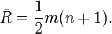
The sum of squared deviations S is defined as

and then Kendall's W is defined as
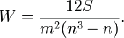
Kendall's W ranges from 0 (no agreement) to 1 (complete agreement). Where R is the sum of the squared differences from the mean rank and K is the sum of k3 – k. k is the number of tied cases for a particular rank, total n = total number of objects and m = total number of judges. S = squared deviation.
5. Data Analysis and Discussion of Results
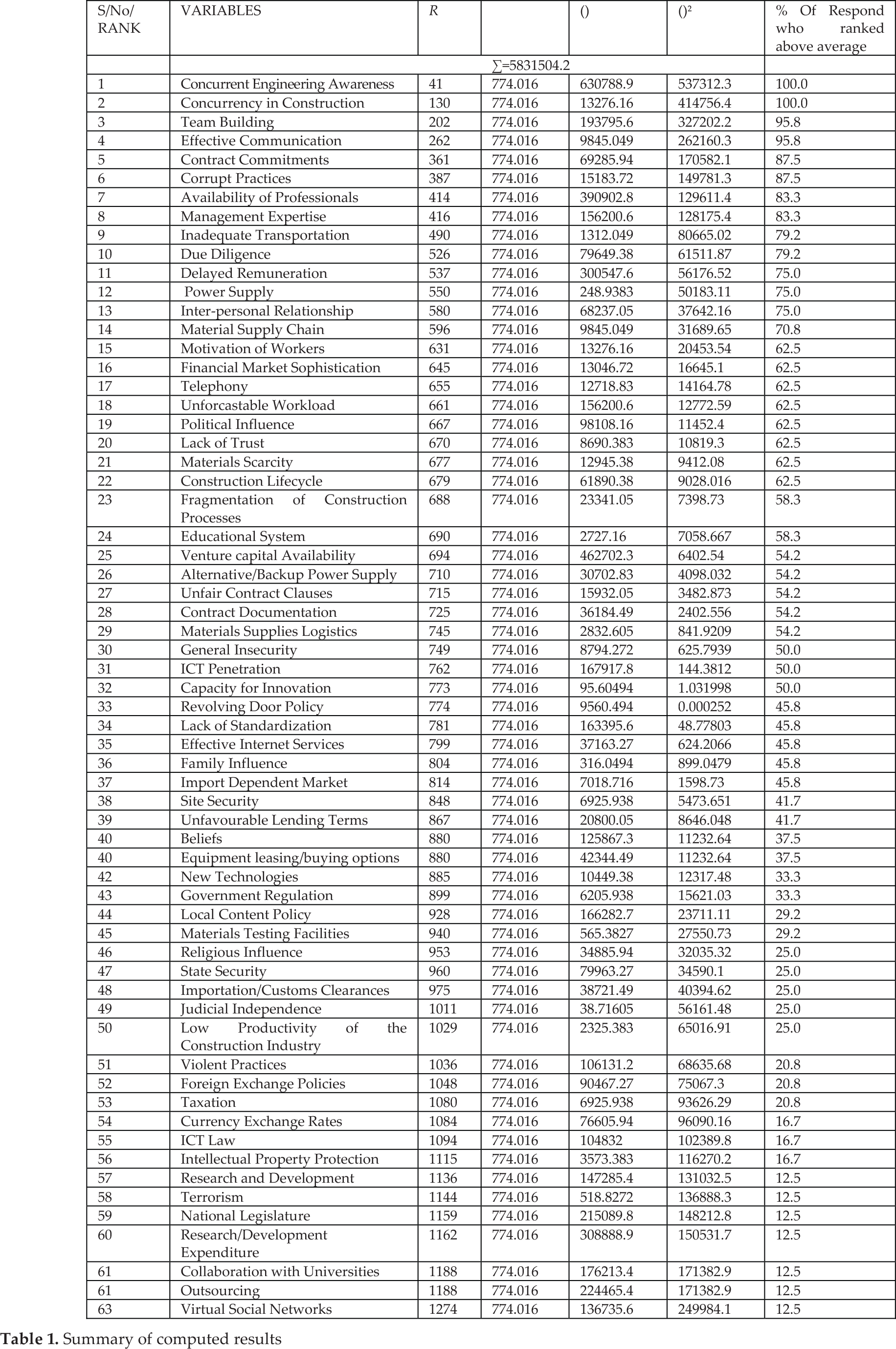
A total of fifty (50) questionnaires were completed and returned and were analysed. Appendix 1 shows the various variables for the determination of Kendall's W; the ranking of the variables with the most important variable ranked “1” and the least important ranked “63”. It also shows the relative importance of each of the 63 variables in the implementation of concurrent engineering, as a function of the percentage of respondents who ranked them above average or below average. The number of variables assessed
The Kendall's coefficient of concordance
While the 1st and 4th variable emanate from the capacity of stakeholders to adopt CE, the 2nd and 5th variables relate to the adequacy of the infrastructural environment of the construction industry, which can mostly be ameliorated through government intervention. The 3rd most influential variable relates to the cultural acceptance and values that shape the behaviour within the environment in which construction organizations operate. Factors of capacity and culture pertain mostly to the segregated individual, corporate or government deficiency or absence of the knowledge of this concept in the operational environment in the global south. This situation could arise from the deficiency in the quality of training and education in these areas or it could result from the level of importance and acceptability attached to it. This will relate to the readiness of the industry in adopting this concept and can be ameliorated through individual effort and education.
Of the 10 most influential variables, 6 variables are related to the infrastructural environment factor which is intrinsic in the structure of the environment and may require an adjustment to some existing conditions in order to remedy them. 3 variables are related to the stakeholders' capacity factor and 1 variable is related to the cultural factor. However, the 4 most important variables are all related to the core issue of the integration of construction processes.
The five least important variables are listed below
6. Conclusion
The following conclusions can be made from the work reported on the barriers to the uptake of CE into the Nigerian construction industry:
Despite some differences in viewpoints held by each professional, there is substantial agreement among them on the variables that can influence the adoption of CE (Kendall's coefficient of concordance
The most challenging barriers to the uptake of CE in the Nigerian construction industry are environment factors, which relates to the inadequacy of the infrastructure (market, political and regulatory), as well as the security environment to support the implementation of CE. They are intrinsic to the structure of the environment and may require the adjustment of some existing conditions and institutions in order to remedy them.
Improved formal or informal education strategies for all stakeholders would perhaps affect this situation positively more than any other remedies and can have both short and long term effects.
The study is part of an on-going research and has presented the subjective results of a study of a stratified group of professionals in the Nigerian construction industry and therefore should not be taken as an absolute statement of the true barriers to the adoption of CE in the Nigerian construction industry. However it is hoped that results may have contributed to the debate in this area.
Footnotes
7. Appendix 1
Summary of computed results
| S/No/RANK | VARIABLES | R | () | ()2 | % Of Respond who ranked above average | |
|---|---|---|---|---|---|---|
| Σ=5831504.2 | ||||||
| 1 | Concurrent Engineering Awareness | 41 | 774.016 | 630788.9 | 537312.3 | 100.0 |
| 2 | Concurrency in Construction | 130 | 774.016 | 13276.16 | 414756.4 | 100.0 |
| 3 | Team Building | 202 | 774.016 | 193795.6 | 327202.2 | 95.8 |
| 4 | Effective Communication | 262 | 774.016 | 9845.049 | 262160.3 | 95.8 |
| 5 | Contract Commitments | 361 | 774.016 | 69285.94 | 170582.1 | 87.5 |
| 6 | Corrupt Practices | 387 | 774.016 | 15183.72 | 149781.3 | 87.5 |
| 7 | Availability of Professionals | 414 | 774.016 | 390902.8 | 129611.4 | 83.3 |
| 8 | Management Expertise | 416 | 774.016 | 156200.6 | 128175.4 | 83.3 |
| 9 | Inadequate Transportation | 490 | 774.016 | 1312.049 | 80665.02 | 79.2 |
| 10 | Due Diligence | 526 | 774.016 | 79649.38 | 61511.87 | 79.2 |
| 11 | Delayed Remuneration | 537 | 774.016 | 300547.6 | 56176.52 | 75.0 |
| 12 | Power Supply | 550 | 774.016 | 248.9383 | 50183.11 | 75.0 |
| 13 | Inter-personal Relationship | 580 | 774.016 | 68237.05 | 37642.16 | 75.0 |
| 14 | Material Supply Chain | 596 | 774.016 | 9845.049 | 31689.65 | 70.8 |
| 15 | Motivation of Workers | 631 | 774.016 | 13276.16 | 20453.54 | 62.5 |
| 16 | Financial Market Sophistication | 645 | 774.016 | 13046.72 | 16645.1 | 62.5 |
| 17 | Telephony | 655 | 774.016 | 12718.83 | 14164.78 | 62.5 |
| 18 | Unforcastable Workload | 661 | 774.016 | 156200.6 | 12772.59 | 62.5 |
| 19 | Political Influence | 667 | 774.016 | 98108.16 | 11452.4 | 62.5 |
| 20 | Lack of Trust | 670 | 774.016 | 8690.383 | 10819.3 | 62.5 |
| 21 | Materials Scarcity | 677 | 774.016 | 12945.38 | 9412.08 | 62.5 |
| 22 | Construction Lifecycle | 679 | 774.016 | 61890.38 | 9028.016 | 62.5 |
| 23 | Fragmentation of Construction Processes | 688 | 774.016 | 23341.05 | 7398.73 | 58.3 |
| 24 | Educational System | 690 | 774.016 | 2727.16 | 7058.667 | 58.3 |
| 25 | Venture capital Availability | 694 | 774.016 | 462702.3 | 6402.54 | 54.2 |
| 26 | Alternative/Backup Power Supply | 710 | 774.016 | 30702.83 | 4098.032 | 54.2 |
| 27 | Unfair Contract Clauses | 715 | 774.016 | 15932.05 | 3482.873 | 54.2 |
| 28 | Contract Documentation | 725 | 774.016 | 36184.49 | 2402.556 | 54.2 |
| 29 | Materials Supplies Logistics | 745 | 774.016 | 2832.605 | 841.9209 | 54.2 |
| 30 | General Insecurity | 749 | 774.016 | 8794.272 | 625.7939 | 50.0 |
| 31 | ICT Penetration | 762 | 774.016 | 167917.8 | 144.3812 | 50.0 |
| 32 | Capacity for Innovation | 773 | 774.016 | 95.60494 | 1.031998 | 50.0 |
| 33 | Revolving Door Policy | 774 | 774.016 | 9560.494 | 0.000252 | 45.8 |
| 34 | Lack of Standardization | 781 | 774.016 | 163395.6 | 48.77803 | 45.8 |
| 35 | Effective Internet Services | 799 | 774.016 | 37163.27 | 624.2066 | 45.8 |
| 36 | Family Influence | 804 | 774.016 | 316.0494 | 899.0479 | 45.8 |
| 37 | Import Dependent Market | 814 | 774.016 | 7018.716 | 1598.73 | 45.8 |
| 38 | Site Security | 848 | 774.016 | 6925.938 | 5473.651 | 41.7 |
| 39 | Unfavourable Lending Terms | 867 | 774.016 | 20800.05 | 8646.048 | 41.7 |
| 40 | Beliefs | 880 | 774.016 | 125867.3 | 11232.64 | 37.5 |
| 40 | Equipment leasing/buying options | 880 | 774.016 | 42344.49 | 11232.64 | 37.5 |
| 42 | New Technologies | 885 | 774.016 | 10449.38 | 12317.48 | 33.3 |
| 43 | Government Regulation | 899 | 774.016 | 6205.938 | 15621.03 | 33.3 |
| 44 | Local Content Policy | 928 | 774.016 | 166282.7 | 23711.11 | 29.2 |
| 45 | Materials Testing Facilities | 940 | 774.016 | 565.3827 | 27550.73 | 29.2 |
| 46 | Religious Influence | 953 | 774.016 | 34885.94 | 32035.32 | 25.0 |
| 47 | State Security | 960 | 774.016 | 79963.27 | 34590.1 | 25.0 |
| 48 | Importation/Customs Clearances | 975 | 774.016 | 38721.49 | 40394.62 | 25.0 |
| 49 | Judicial Independence | 1011 | 774.016 | 38.71605 | 56161.48 | 25.0 |
| 50 | Low Productivity of the Construction Industry | 1029 | 774.016 | 2325.383 | 65016.91 | 25.0 |
| 51 | Violent Practices | 1036 | 774.016 | 106131.2 | 68635.68 | 20.8 |
| 52 | Foreign Exchange Policies | 1048 | 774.016 | 90467.27 | 75067.3 | 20.8 |
| 53 | Taxation | 1080 | 774.016 | 6925.938 | 93626.29 | 20.8 |
| 54 | Currency Exchange Rates | 1084 | 774.016 | 76605.94 | 96090.16 | 16.7 |
| 55 | ICT Law | 1094 | 774.016 | 104832 | 102389.8 | 16.7 |
| 56 | Intellectual Property Protection | 1115 | 774.016 | 3573.383 | 116270.2 | 16.7 |
| 57 | Research and Development | 1136 | 774.016 | 147285.4 | 131032.5 | 12.5 |
| 58 | Terrorism | 1144 | 774.016 | 518.8272 | 136888.3 | 12.5 |
| 59 | National Legislature | 1159 | 774.016 | 215089.8 | 148212.8 | 12.5 |
| 60 | Research/Development Expenditure | 1162 | 774.016 | 308888.9 | 150531.7 | 12.5 |
| 61 | Collaboration with Universities | 1188 | 774.016 | 176213.4 | 171382.9 | 12.5 |
| 61 | Outsourcing | 1188 | 774.016 | 224465.4 | 171382.9 | 12.5 |
| 63 | Virtual Social Networks | 1274 | 774.016 | 136735.6 | 249984.1 | 12.5 |