




Abstract
Graphene has generated great sensation owing to its fascinating properties with possible potential applications. This two-dimensional material exhibits half-integer quantum Hall effect and an ambipolar electric field effect, along with ballistic conduction of charge carriers. In this article, we provide a overview on some aspects of graphene devoting the special attention to synthesis, functionalization, self-assembly, surface properties, gas adsorption and fluorescence quenching ability of graphene. Graphenes with varying number of layers can be synthesized by using different strategies. Graphene can be functionalized by different means in order to disperse it in various solvents. We also present the self-assembly of graphene at the liquid-liquid interface besides its surface properties including adsorption of hydrogen, carbon dioxide and methane. The remarkable property of graphene of quenching fluorescence of aromatic molecules is shown to be associated with photo-induced electron transfer.
1. Introduction
Graphene, a single sheet of sp2 hybridized carbon atoms densely packed in a honeycomb lattice, has received a great attention due to its fascinating properties.[13] A remarkable feature of graphene is that the energy of electrons is linearly dependent on the wave vector near the crossing points in the Brillouin zone. The charge carriers mimic relativistic particles which can be are satisfactorily on the basis of the Dirac equation rather than the Schrcodinger equation.[1,4,5] Graphene, exhibits exceptional electronic, optical, magnetic, thermal and mechanical properties, including high values of its Young's modulus (
2. Synthetic aspects
The method involving micromechanical cleavage from highly ordered pyrolyitc graphite (HOPG) [5], a layer is peeled off the HOPG crystal by using scotch tape and then transferred on to a silicon substrate. Single-layer graphene (SG) was also prepared by epitaxial growth on silicon carbide (SiC), in which single crystal SiC substrates or commercial polycrystalline SiC granules heated in vacuum to high temperatures in the range of 1200–1600 °C.[15] As the sublimation of silicon is higher than that of carbon, excess carbon is left behind on the surface, which rearranges to form graphene. Large area and high quality SG films were prepared more conveniently employing chemical vapor deposition (CVD) by decomposing hydrocarbons. Different hydrocarbons such as methane, ethylene, acetylene and benzene were decomposed on various transition metal substrates like Ni, Cu, Co, Au and Ru.[16] In our experiments, nickel (Ni) and cobalt (Co) foils with thickness of 0.5 mm and 2 mm respectively were used as catalysts. These foils were cut into 5×5 mm2 pieces and polished mechanically and the CVD process carried out by decomposing hydrocarbons around 800–1000 ºC. By employing a nickel foil, CVD was carried out by passing methane (60-70 sccm) or ethylene (4-8 sccm) along with a high flow of hydrogen around 500 sccm at 1000 ºC for 5-10 minutes. With benzene as the hydrocarbon source, benzene vapor diluted with argon and hydrogen was decomposed at 1000 ºC for 5 minutes. On a cobalt foil, acetylene (4 sccm) and methane (65 sccm) were decomposed at 800 and 1000 ºC respectively. Figures 1(a) and (b) shows high-resolution TEM images of graphene sheets obtained by thermal decomposition of methane on a nickel foil.[3] The inset in Figures 1 (a) shows selected area electron diffraction (SAED) pattern.

TEM images of graphene prepared by the thermal decomposition of (a, b) methane (70 sccm) on nickel at 1000 ºC and Raman spectra of graphene prepared by the thermal decomposition of hydrocarbons on a nickel sheet: (c) methane (70 sccm) at 1000 ºC, (d) ethylene (4 sccm) at 900 ºC. (From reference 3)
Raman spectroscopy is an important tool to characterize graphene and provides information about the quality and number of layers in a given sample. The G-band (around 1580 cm−1) in the Raman is sensitive to doping and other effects. While the 2D band (around 2670 cm−1) effects the number of layers. The D band (around 1340 cm−1), the defect related band, also a signature of the quality of the graphene film. The Raman spectra of graphene obtained on a nickel sheet by the thermal decomposition of methane and ethylene show an intense 2D band relative to the G band with hardly any D band (see Figures 1 (c) and (d)), clearly indicative of SGs.[16] High cooling rate enables the formation of minimum number of layers and efficient transferon to substrate.
A radio frequency plasma enhanced chemical vapor deposition (PECVD) system was used to synthesize graphene on a variety of substrates such as Si, W, Mo, Zr, Ti, Hf, Nb, Ta, Cr, 304 stainless steel, SiO2 and Al2O3. This method reduces the energy consumption and prevents the formation of amorphous carbon or other types of unwanted products.[17–19] Graphene has been prepared in gas phase employing a substrate free atmospheric pressure microwave plasma reactors. Preparation of SG by chemical method involves reduction of single-layer graphene oxide (SGO) dispersion in dimethlyformamide with hydrazine hydrate.[20] The obtained reduced graphene oxide (RGO) may yet contain some residual oxygen functionalities and readily soluble in dimethyl formamide (DMF). Exfoliation of graphite in N-methyl pyrrolidone or surfactant/water solution employing ultrasonication also yields stable SG dispersions.[21, 22] Gram quantities of single-layer graphene has been obtained by a solvothermal procedure using sodium and ethanol.[23]
Few-layer graphene (FG) has been prepared by thermal reduction of GO (EG) at high temperatures in an inert atmosphere.[24–26] FG is also obtained by chemical reduction of SGO with hydrazine hydrate, sodium borohydrate and ethyleneglycol.[2] It is shown that FG can also be obtained under mild conditions using ascorbic acid.[27] In another approach FG is obtained using sugars such as glucose, fructose and sucrose as reducing agents.[28] Microwave irradiation has been used for the quick and scalable chemical reduction for the synthesis of graphene.[2] Hydrothermal route was employed to prepare graphene from graphene oxide. In this procedure water behaves as supercritical water (SC) and play the role of reducing agent.[29] GO is also reduced photochemically employing UV-irradiated to prepare graphene in which H3PW12O40 is used as photocatalyst.[30] It is also demonstrated that environmental bacteria was employed as an electron donor to reduce graphene.[31] Graphene can be prepared by heating nanodiamond in an inert atmosphere.[26, 32, 33] In this preparation, pristine nanodiamond powder (particle size 4-6 nm, Tokyo Diamond Tools, Tokyo, Japan) placed in a graphite container was heated in a graphite furnace in a helium atmosphere at different temperatures (1650, 1850, 2050 and 2200°C) for 1 hr. We observed that there is a slight increase in the number of layers and decrease in lateral dimensions in the samples heated at 2200 ºC in comparison to 1650 ºC. We show typical TEM images of EG and DG in 2 (a) and (b) respectively
We have recently found that graphene can be prepared by arc evaporation of graphite in the presence of hydrogen. This procedure yields graphene (HG) sheets with 2-3 layers having flake size of 100-200 nm.[34] This makes use of the knowledge that the presence of H2 during arc-discharge process terminates the dangling carbon bonds with hydrogen and prevents the formation of closed structures. The conditions that are favorable for obtaining graphene in the inner walls are the high current (above 100 A), the high voltage (>50 V), and the high pressure of hydrogen (above 200 torr). In Figure 2 (c) and (d) we show TEM and AFM images of HG sample respectively. This method has been conveniently employed to dope graphene with boron and nitrogen.[35] To prepare boron and nitrogen doped graphene (B-HG and N-HG) the discharge is carried out in the presence of of H2+diborane and H2+ (pyridine or ammonia) respectively. Cheng et al. employed hydrogen arc discharge process as a rapid heating method to prepare graphene from GO.[36]
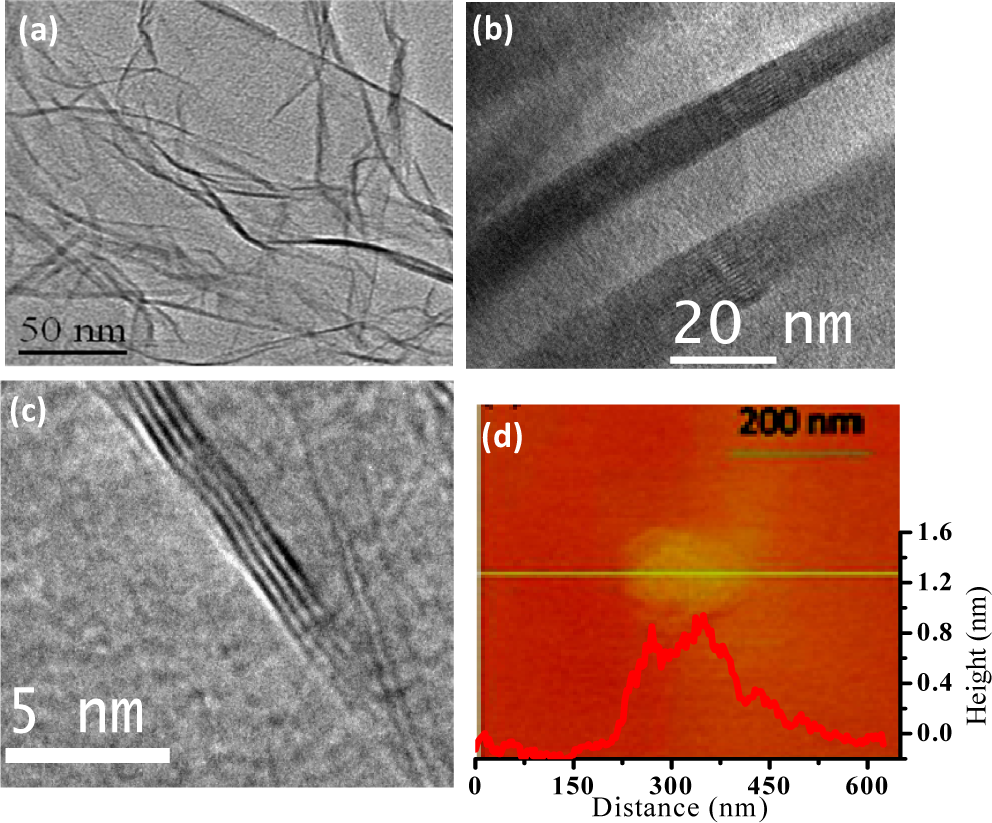
TEM images of (a) HG, (c) EG, (d) DG and (b) AFM image of HG along with height profile. (From reference 3 and 14)
3. Functionalization and Solubilization
Pristine graphene is insoluble in liquids such as water, polymer resins and most solvents. To make graphene more easily dispersible in liquids, it is necessary to physically or chemically attach certain molecules or functional groups to graphene without significantly changing its desirable properties. Functionalization of graphene has been carried out by employing different strategies.[2, 37] For example, Haddon and co-workers have achieved functionalization of graphene by employing covalent modification. To solubilize graphene in non polar solvent amidation of graphene has been carried out. In this procedure acid-treated graphene containing surface –OH and –COOH groups was first reacted with SOCl2 to create -COCl groups, followed by reaction with a long chain aliphatic amines.[38] Another method employed by these workers is by grafting aryl groups through diazotization reaction.[39] Soluble graphene layers in THF can be generated by the covalent attachment of alkyl chains to graphene layers via reduction of graphite fluoride with alkyl lithium reagents.[40] Such covalent functionalization enables solubilization in various solvents such as CCl4, THF and CH2Cl2 (Figure 3(a)).[26] Similar procedures have been employed by Subrahmanyam et al as well.[41] The reaction of graphene with a mixture of concentrated H2SO4 and HNO3 gives water-soluble graphene which is stable for several months. Graphene is solubilized in CCl4 by interaction with organosilane and organotin reagents such as hexadecyltrimethoxysilane (HDTMS) (see Figure 3 (b)) and dibutyldimethoxytin (DBDT).[41] To functionalize graphene some typical organic reactions such as diazonium,[39, 42, 43] nucleophilic ring-opening,[44] carbodiimide-activated esterification,[45] 1,3-dipolar cycloaddition,[46] amide bond formation,[47] in situ living free-radical polymerization,[48] etc. have been employed. Graphene sheets that are covalently functionalized with 1-(3-aminopropyl)- 3-methylimidazolium bromide are dispersed in water, DMF, and DMSO.[44]

Photographs of (a) dispersion of the amide-functionalized EG in dichloromethane (b) dispersion of HDTMS treated EG in CCl4, (c) dispersion of PYBS treated EG in DMF and (d,e and f) water dispersions of EG treated with IGP, SDS and CTAB. (From reference 14)
Without disrupting the electronic structure, graphene can be functionalized through non-covalent modification by wrapping with surfactants or through π-π interaction with aromatic molecules such as 1-pyrenebutanoic acid succinimidyl ester (PYBS) (Figure 3(c)) and the potassium salt of coronene tetracarboxylic acid (CS).[49] Non-covalent interaction of graphene with surfactants such as Igepal CO-890 (polyoxyethylene (40) nonylphenylether, IGP), sodium dodecylsulfate (SDS) and cetyltrimethylammoniumbromide (CTAB) gives water-soluble graphene. Figure 3 (d, e and f) shows photographs of water-soluble graphene obtained with IGP, SDS and CTAB respectively.[41] Interaction of CS with few-layer graphene causes exfoliation and selectively solubilizing single-and double-layer graphenes in water through molecular charge-transfer interaction (see Figure 4). Some stabilizers such as sodium dodecylbenzene sulfonate (SDBS),[22] perylene-based bolaamphiphile detergent,[50] sodium cholate,[51] 1-pyrenemethylamine hydrochloride[52] and 7,7,8,8-tetracyanoquinodimethane,[53] etc. have been used as promoting agents to obtain graphene dispersions. Water-soluble graphene can also be prepared by PEGylation method in which, acidified graphene is treated with excess of polyethylene glycol (PEG) and conc. HCl under solvothermal conditions.[26] Using DDAB as a phasetransfer agent graphene has been dispersed in chloroform.[54]

Illustration of the exfoliation of few-layer graphene with CS to yield monolayer graphene– CS composites. (From reference 49)
4. Assembly at the Liquid-liquid interface
Self-assembly of nanocarbons of different dimensionalities is of interest because of its possible use in designing in transparent conducting electrodes, solar cells and other devices. Self-assembly of C60 nanosheets comprising hexagonal, rhombohedral and mixed polygonal aggregates were prepared by solvent engineering,[55] while size-tunable hexagonal nanosheets have been generated at the liquid-liquid interface.[56] In the case of single-walled carbon nanotubes (SWNTs), water dispersions containing surfactants mixed with non-polar solvents are reported to give rise to interfacial assemblies.[57] Nanosheets of graphene can be generated at the liquid-liquid interface.[58, 59] Membranes of graphene oxide (GO) can be obtained at the liquid-air interface by evaporating the hydrosol of GO.[60] Ropes and bundles of carbon nanotubes have been formed along with the graphene by the reduction of GO admixed with the nanotubes.[61] Layer-by-layer assembly has been employed for the formation of nanofilms of reduced graphene oxide with multi-walled carbon nanotubes.[62]
In the Figure 5(a) shows a FESEM image of a film of formed at the interface with a dispersion of a 3.3 μg of SWNTs in 10 ml of toluene after 12 hours of assembly. These films show a dense and homogeneous network of SWNTs. In the Figure 5(b) we show a TEM image of the graphene film formed at the interface with 3.3 μg of graphene in 10 ml of toluene after 2.5 hours. We have also obtained films of few-layer graphene at the interface after different durations of assembly and after complete evaporation of the organic layer. The lateral dimensions of films formed at the interface are generally around 15-25 μm after 2.5 hours of assembly.[63] Figure 5(c) and (d) respectively show the height profiles of films formed after 2.5 hours of assembly and after the complete evaporation. The average height profiles of these two films are 4-7 nm and 35-40 nm respectively. There is an increase in the film thickness with increase in time duration of assembly as expected.
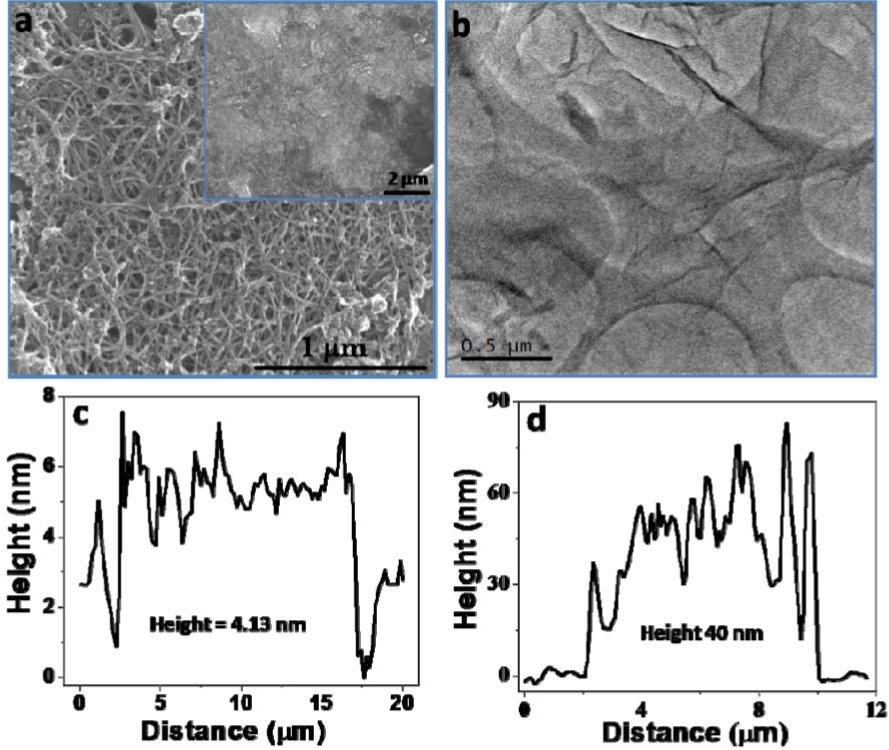
(a) FESEM image a SWNT film (3.3 μg in 10 ml) formed at the interface after12 hours. Inset is the image obtained after complete evaporation. (b) TEM image of a graphene film (3.3 μg in 10 ml) formed at the interface after 2.5 hours. (c) and (d) show AFM the height profiles of graphene films (3.3 μg in 10 ml) assembled at interface after 2.5 hours and after complete evaporation respectively. (From reference 63)
In the Figure 6 (a) we show the Raman G-band of graphene film along with the bands in the composites of graphene with C60. Pure graphene shows the G-band at 1590 cm−1 while composites containing C60 exhibit stiffening of the G-band. The G-band occurs at 1596 cm−1 when the concentration of C60 is 23 μM and shifts 1601 cm−1 when the C60 concentration is 46 μM. These results suggest the occurrence of charge-transfer interaction between C60 and graphene, similar to that found between graphene and electron-acceptor molecules like TCNE and nitrobenzene.[64] UV–visible absorption spectra of the composite films shown in the in Figure 6 (b) has characteristic electronic absorption bands of C60 with only changes in the intensities.[63]
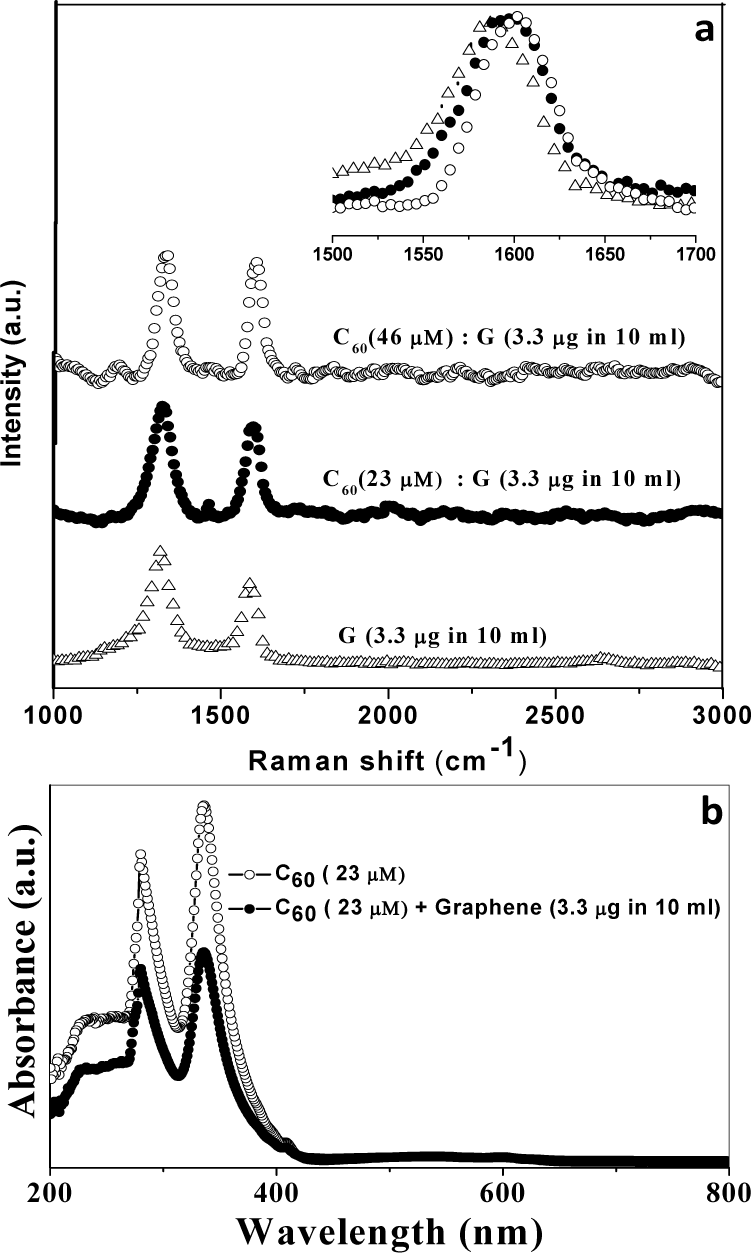
(a) Raman spectra and (b) electronic absorption spectra of composite films of C60 and few-layer graphene film. Inset in (a) shows stiffening of Raman G-band of few-layer graphene film in the presence of C60. (From reference 63)
5. Surface Properties
Theoretical calculations predict to show a large surface area by Single-layer graphene close to 2600 m2/g.[65] Surface areas of few-layer graphene samples (EG, DG, HG and RGO) prepared by different methods have been measured employing Brunauer-Emmett-Teller (BET) method. [66, 67] The surface areas are in the range of 270-1550 m2/g following the trend EG > DG > RGO > HG. Thus, few-layer graphenes show large surface areas, some of them approaching the value of single layer graphene.
Uptake of CO2 by the graphene samples was measured at 195 K and 1 atm.[66] The uptake values vary between 5 and 45 wt % with EG exhibiting the highest uptake. Figure 7(a) shows typical CO2 adsorption and desorption curves of the EG sample. The uptake of CO2 by EG at 298 K and 50 bar is 51 %. First-principles calculations show that CO2 molecules sit alternatively in a parallel fashion on the six-membered rings.[66] Employing first-principles calculations, adsorption of different gas molecules (CO, NO, NO2, O2, N2, CO2, and NH3) on graphene nanoribbons has been studied.[68] It is shown that NH3 can modify the conductance of the nano-ribbons, while other gas molecules have little effect. This property can be used to detect NH3 out of other gases.

(a) Carbon dioxide and methane adsorption and desorption isotherms of EG measured at 195 K, 1 atm and 298 K, 50 bar respectively. (From reference 69).
Adsorption of methane on the graphene samples was measured at 273 K and 298 K.[69] Typical adsorption data of EG at 298 K, 50 bar shown in Figure 7(b). The weight uptake of CH4 by graphene samples varies between 0 and 3 wt % showing EG highest value. In Figure 8(a), we show the uptake of CO2 and CH4 against the surface area. The uptake values of CH4 and CO2 vary linearly with the surface area. A plot of the CH4 uptake versus CO2 uptake is nearly linear (Figure 8(b)). EG and RGO with relatively high CO2 and CH4 uptakes contain oxygen functionalities on the surface. Interestingly, In the case of HG with little or no uptake of these gases, the surface of HG was clean with negligible oxygen functionalities. EG and RGO with relatively high CO2 and CH4 uptakes contain oxygen functionalities on the surface. Interestingly, in the case of HG with little or no uptake of these gases, the surface of HG was clean with negligible oxygen functionalities.

(a) Plot of the BET surface area and the weight percentage of methane uptake (at 298 K and 50 bar) and carbon dioxide uptake (at 195 K and 1 atm); b) Plot of weight percentage of methane uptake and weight percentage of carbon dioxide uptake. (From reference 69).
6. Hydrogen storage
Hydrogen uptake data of different graphene samples have been reported.[66] In Figure 9 (a) H2 adsorption and desorption curves of the EG sample are shown. H2 adsorption measurements at 1 atm and 77 K show that DG, EG and HG can absorb 1.2, 1.7 and 1.0 wt% of H2. These samples show higher uptakes at 100 bar and 300 K, the values being 2.5, 3.1 and 2.0 wt% for DG, EG and HG respectively. The adsorption is completely reversible and comparable to that of carbon nanotubes[70] and porous open framework materials.[71] The values of the H2 uptake at 1 atm and 77K by the various graphene samples vary linearly with the surface area (see Figure 9 (b)). By extrapolation of the linear plot to the surface area of single-layer graphene, we estimate its H2 uptake to be around 3 wt% at 1 atm and 77 K. Though the H2 uptake of graphenes are low compared to the 6.0 wt% target of the US Department of Energy, there is scope for significant improvement, by producing samples with a smaller number of layers and higher surface areas. It is possible that single layer graphene will exhibit 5-6 wt% of H2 uptake at 100 atm and 300 K. First-principles calculations show that the H2 molecule sits alternatively in parallel and perpendicular orientations on the six-membered rings of graphene layer and that single-layer graphene can accommodate up to 7.7 wt% of hydrogen.[66]
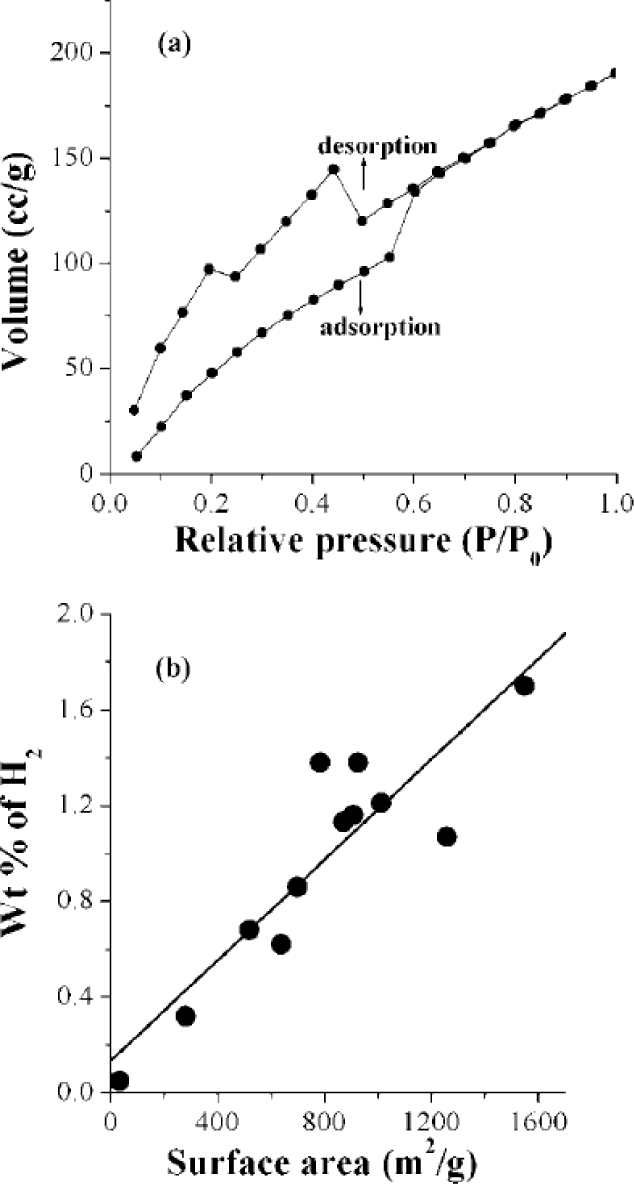
(a) Hydrogen adsorption and desorption isotherms of EG at 1 atm and 77 K. (b) Linear relationship between the BET surface area and the weight percentage of hydrogen uptake at 1 atm of pressure and 77 K. (From reference 66).
Birch reduction of few-layer graphene samples enables chemisorption of hydrogen up to 5 wt %. [72] Birch reduction of EG and HG has been carried out with lithium in liquid ammonia at –33 °C [73] Spectroscopic studies reveal the presence of sp3 C-H bonds in the hydrogenated graphenes. Elemental analysis of reduced EG (EGH) and HG (HGH) samples showed the hydrogen content to be around 5 wt % in the samples obtained with the use of excess Li. The hydrogenated graphene containing  wt % hydrogen is stable and can be stored over long periods. We have examined its thermal stability in detail. In Figure 10 we show the change in weight percentage of hydrogen in the EGH and HGH samples on heating to different temperatures (as obtained from elemental analysis). All the hydrogen gets released around 500 °C. Gas chromatography shows that the evolution of hydrogen starts around 200 °C and is complete at 500 °C (see inset Figure 10) We also find that irradiation of the hydrogenated samples with UV radiation or with a KrF excimer laser results to dehydrogenation. In the case of UV irradiation, dehydrogenation occurs over a few hours, whereas the same result is obtained within 2 min using the laser.
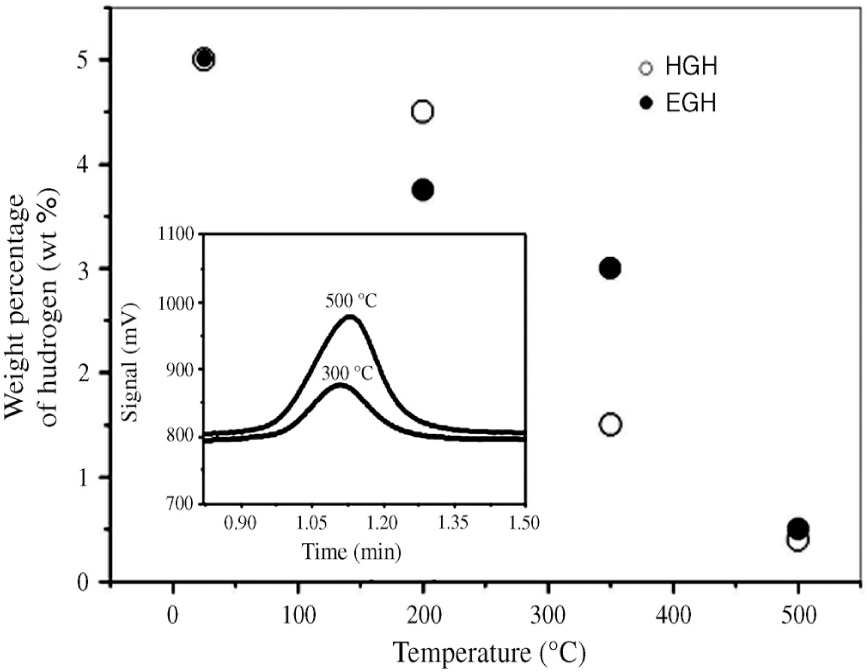
Change in the weight percentage of hydrogen of EGH and HGH with temperature. (Inset) The evolution of hydrogen as recorded by a gas chromatograph. (From reference 72)
7. Fluorescence quenching
Fluorescence quenching property of graphene has been made use for the selective detection of biomolecules[74] and other purposes.[75, 76] Quenching of the fluorescence of porphyrin by graphene and photophysical properties of porphyrin-graphene complexes have been reported .[47, 77] Theoretical studies show that long-range energy transfer is operative in the fluorescence quenching of a dye molecule in the presence of graphene. The quenching of the green emission of ZnO nanoparticles accompanying the photoreduction of graphene oxide is, however caused by electron transfer from ZnO. Electron transfer has been similarly invoked in the case of TiO2-graphene Error! Hyperlink reference not valid.] The interaction of graphene with pyrene-butanaoic acid succinimidyl ester, (
Absorption spectra of

Electronic absorption spectra and of (a)
These spectra show characteristic absorption bands of
In Figure 12 (a), we compare the transient absorption spectrum of the pure

(a) Effect of addition of EGA on the transient absorption spectrum of
8. Conclusions
Different procedures have been reported in literature for the synthesis of graphene. Reduction of single-layer graphene oxide in solution allows easy manipulation and transfer of graphene onto substrates. CVD enables the preparation of high quality and large area single layer graphene films. Arc discharge of graphite in a hydrogen atmosphere yields graphenes containing 2-3 layers and is suited for doping with boron or nitrogen. Functionalization of graphene by covalent and non-covalent modifications results in stable dispersions. Self assembly of graphene sheets at liquid-liquid interface leads to large area graphene films. The surface area of graphene depends on the number of layers and the method of preparation, but is generally large (600–1600m2g1). Hydrogen can be stored in graphene using either physisorption or chemisorption. Graphene has been effectively employed as a fluorescence quencher.