




Abstract
Building a global Network Relations with the internet has made huge changes in personal information system and even comments left on a webpage of SNS(Social Network Services) are appreciated as important elements that would provide valuable information for someone. Social Network is a relation between individuals or groups, represented in a graph model, which converts the concept of psychological and social relations into a logical structure by using node and link. But, most of the current personalized systems on the basis of Social Network are built and constructed mainly in the PC environment, and the systems are neither designed nor implemented in mobile environment. Hence, the objective of this study is to propose methods of providing Personalized Mobile Information Retrieval System using NFC (Near Field Communication) Smartphone, which will be then used for Smartphone users. Besides, this study aims to verify its efficiency through a comparative analysis of existing studies.
Keywords
1. Introduction
Social Network is a social structure made of individuals called “nodes,” which are connected by one or more specific types of interdependency, such as friendship, kinship, financial exchange, dislike, sexual relationships, or relationships of beliefs, knowledge or prestige [1]. Social Network's link represents not only the flow between personal information, but the relation status through quantitative expression. The overall graph model of Social Network is composed of many nodes and the links that connect them, and each node's direct/indirect connection forms the entire network.
However, the current Personalized Systems based on Social Network were designed and constructed under the PC and it didn't provide the step-by-step transferring methods from PC to Smartphone. To solve these problems, this research actively analyzes an individual's characteristic based on the Social Network environment and develops a Personalized Information Retrieval System which can search for what a user wants accurately. Personalized Information Retrieval System for efficient personalized information provision proposed in this study differs from existing ones in methodology as follow:
Firstly, as the system is built on the basis of NFC (Near field communication), it attempts to provide its own custom service fast and easily using its information stored in NFC. Once SNS and NFC Smartphone are associated with each other, payment is made by touching a NFC tag when visiting well-known restaurants, and the information recorded in SNS is supposed to provide search results customized to individual's tastes and preferences when carrying out a search in individualized search system. That is, typing the same search keyword may bring different search results on NFC Smartphone as individuals have different preferences.
Secondly, the existing Personalized Information Retrieval System fails to analyze the search system using Smartphone in Social Network environment. With an increasing number of web users using Smartphone and its individualized service under research, Smartphone environment does not provide user's search rankings suited to personal preferences. For example, when a user who wants to come by a pasta restaurant offering pasta for about 10$ and listens to rock music asks for information search via Smartphone, search results should also be prioritized and provided in favor of user's personalization taste. But, the existing systems do not show search rankings in consideration of individual's tastes and tastes. Therefore, in this study differentiated search results are provided on the basis of personalization information in User Profile Registry when a user carries out a search using Smartphone in Social Network environment.
Finally this research attempts to correct uncertain or vague relation between users on the existing Social Network environment and promote a more accurate and personalized information feeding, by suggesting a Personalized Information Retrieval System using Social Network's quantitative model
Most of the current web information is developed based on HTML. Semantic assigns a meaning to a document and the Semantic Web is a high-end automated intellectual technology that allows not only humans but machines to understand information. In order for a machine to take information from web and work, there has to be a simple semantics for the machine to process. Semantic Web exists to express such semantics in a standardized method. Semantic Web's basic data model consists of resource, property type, and property value. Each resource is equivalent to a single object, has various property types and values, and each object forms an organic link through property types and values. Studying the link allows the relationship between nodes to be inferred and analyzed. Unlike the existing Semantic Web, Social Network has a structure of object, sub-object, property and relation. A node (person), which is an object, is composed of concept and role in a form of sub-object that has various characteristics. Existing Social Network model has a limit on expressing quantitative information; hence it is not a solution for its uncertain or vague issues of Social Network. Exclusion of comments and links leads to only incomplete relations to be formed. In summary Social Network's basic structure system has fragmentary correlations between objects and does not support sub-system for each object, which cripples an object from forming organic relations with others, making it difficult to comprehensively reflect personal information. On the other hand, Semantic Web has certain properties as sub-system, which materializes objects. It creates a relationship regulation among them, enabling extensive relation inference, and furthermore the quantitative model would upgrade Social Network's basic structure for more various relationship analysis or inference.
This study is organized as follows. We compared some related work in the next section. Social Network formal model is suggested in section 3. In section 4 and 5, the architecture of a Personalized Mobile Information Retrieval System is suggested, along with the principles, characteristics of its modules and execution results. Section 6 compared our method to existing methods to verify efficiency and viability of our research. Conclusions are provided in the final section, along with plans for further studies.
2. Related Work
2.1. Comparison of the System based on Personalized Methods
These days web pages are personalized based on the interests of an individual. There are two categories of personalization: rule-based & content-based system and social tagging system. Web personalization models include rules-based filtering, based on “if this, then that” rule processing, and collaborative filtering, which serves relevant material to customers by combining their own personal preferences with the preferences of like-minded others [2].
[1] presented the problem of comments-oriented document summarization and aim to summarize a web document by considering not only its content, but also the comments left by its readers. It identified three relations (namely, topic, quotation, and mention) by which comments can be linked to one another, and models the relations in three graphs. To generate a comments-oriented summary, they extracted sentences from the given web document using either feature-based approach or uniform-document approach.
In [3], a personalization algorithm for recommendation in folksonomies which relies on hierarchical tag clusters is proposed. Their basic recommendation framework is independent of the clustering method, but they used a context-dependent variant of hierarchical agglomerative clustering which takes into account the user's current navigation context in cluster selection.
The research reported in [4] presents an approach to personalized search that involves building models of user context as ontological profiles by assigning implicitly derived interest scores for existing concepts in domain ontology. A spreading activation algorithm is used to maintain the interest scores based on the user's ongoing behavior. In this paper, experiments show that re-ranking the search results based on the interest scores and the semantic evidence in an ontological user profile is effective in presenting the most relevant results to the user. This research said that one of the key factors for accurate personalized information access is user context.
2.2. Comparison of related works based on Social Network Model
Researches based on Fuzzy theory [5,6,7,8,9] uses the theory to interpret vagueness of relationships between taxonomy and extracts representing node from fuzzy diagram to group up taxonomy. Then it analyzes Social Network through semantic information of grouped taxonomy.
The researches related to Social Network reliability modeling [10,11,12] constructed a Social Network by extracting reliability directly from user information, however, it has a difficulty with reflecting qualitative elements of offline environment. Reliability is a quantitative concept, which helps clarifying uncertain relationships between individuals or organization in case of contacting or trading. Based on user's question, it infers reliability and reputation of ‘directly' linked target or it infers reliability and reputation of ‘indirectly' linked target from information of users directly linked to it.
Using statistical approach, traditional Social Network models used to graph or show in a Matrix form [11,12,13]. Even though the visualization research for effective management of Social Network's various properties has been undergoing, there was a difficulty with managing concept and property of a node because graphing or expressing in matrix take complicated structure.
Using the relations between Social Network words, topology maintenance [14,15,16] has been done by analyzing various words from the web or utilizing granular computing method [4,5,6,7,8,9] for a semantic interpretation. Granular computing [4,6,9] takes human way of thinking to solve a problem and analyzes Social Network's objects, the users, by subdividing them into sub-objects. But such taxonomic model still has vagueness issues with polysemous words.
3. Social Network Formal Model
This section discusses Social Network Formal Module; the core module of personalized information system.
3.1. Analysis of the Problem of the Social Network and its solution
An example of uncertainty issue is like the following: “The milk is half-full.” It should mean “there is half-full milk,” but uncertainty leads to different approach like, “Of all milks, half of them are full.” Thus an object's property value only has binary value, true or false, and the result has to satisfy true/false condition and drawn quantitatively from possible objects. Also vagueness brings another issue. “The apple is ripe” does not specify how much ripe the apple is, and such unspecified information leads to unclear property values.
In order to solve such uncertainty issues on Social Network, there needs an effective approach. Uncertainty issue can be defined by saying whether each node's relationship will “happen or not” among nodes belonging to a certain domain. Even if relationship between indirectly linked objects can be inferred, it is hard to tell if the relationship may actually happen within the basic structure of Social Network. If one can judge formation of relationship within a certain domain, unnecessary relationship inference may be omitted and enables efficient use of an object's quantitative information.
Addressing vagueness issue requires a more effective approach as well. Analyzing formation of relationship between objects alone cannot solve the problems caused by vagueness. Specially comparing credibility among E-commerce vendors or friendliness on blogs requires comprehensive and quantitative information and the basic structure of Social Network lacks to support them. The following figure illustrates a detailed example of credibility damage caused by vagueness of taxonomy. Even the simple word “Apple” causes vagueness because it is hard to tell if it is a fruit or an IT corporate company.
3.2. Structural Modeling of Social Network Formal Model
Different from Semantic Web, Social Network's structural elements are object (user), sub-object, property, and relationship, which can be understood using Granular computing method. ‘Social Network Standardizing Model' converts the existing basic structure with object (node) and relationship (link) to where an object has sub-system and utilizing small unit of semantic groups, such as class, cluster, and subset, and it enables an effective modeling of complicated application containing various knowledge and information.
4. Personalized Mobile Information Retrieval System
This section describes the overall structure of the suggested system. The architecture of the system is composed of Interface Management Module, E-engine Ontology Server, Social Network Formal Module and Semantic Management Module. It also describes the functions and characteristics of its modules in detail.
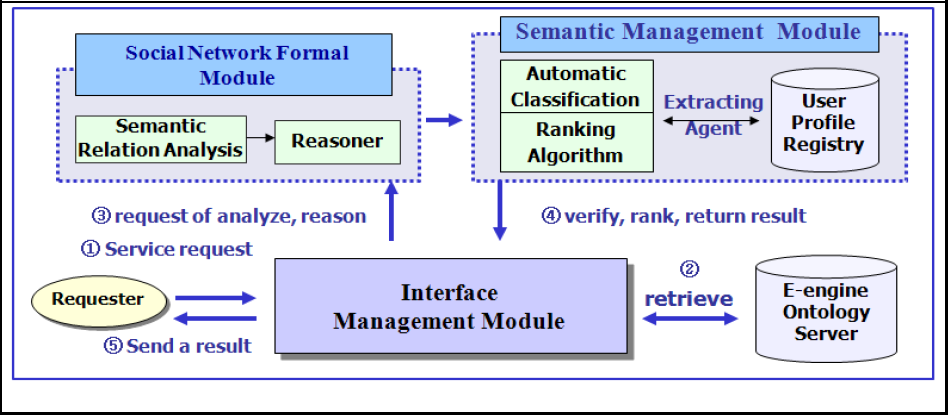
System Architecture
4.1. Interface Management Module
Interface Management Module performs component design of metadata linked to semantic comment and content information, in order to consider the question's semantic connection. Also it provides search word input method and User Context Search screen interface to take user's desired information as input. Such keywords or text based searching method may trouble with returning an accurate and credible result, but it will be a personalized result with the maximum reflection of the user's requests. In addition, it asks the user again to induce the user to type the right searching word, based on the semantic information from semantic domain of Ontology Server. Searching process efficiency will be maximized by utilizing through Search Manager, Classification Manager and User Interface Manager.

System Architecture of Interface Management Module
4.2. E-engine Ontology Server
E-engine Ontology Server is a systematic method of expression that can improve the present condition where information is processed simply as data and the semantic context must be provided by man, and allow information to have value as knowledge. In other words, two different data can possess the same meaning and syntax if they are observed semantically. For example, the tag for the data “movie” can be expressed either as <movie>, <cinema> or <screen>. So the three tags actually have the same meaning and they must be integrated into a single abstract schema or a semantic connection technique must be applied. Here the World Map is in charge of such standard rules and ontology. It is a key factor of the Semantic Web for it is the foundation that enables each individual factor to have a common understanding through artificial intelligence knowledge expression. The ontology can be classified into the domain ontology, the metadata ontology and the conceptual ontology. The domain ontology is an ontology restricted to a certain field and the metadata ontology is an ontology that is used for describing the contents of the online information resource. Meanwhile the conceptual ontology, like the frame ontology, is a meta-level ontology that expresses the object-oriented concepts such as frame and slot that are used in expressing concepts in an object-oriented way. This ontology is a description of the concepts and relationships concerning about keyword and context.
4.3. Social Network Formal Module
Social Network Formal Module returns the closest matching result through semantic relation analysis and inference based on the user's input (keyword or text). Social Network Standardizing Module uses personalized searching method that analyzes individual's intimacy by forming relationship between users. The result reduces the chance of uncertainty and vagueness and provides more customized information for users. Special feature of Social Network is that it has links between its members, which reflect the current social phenomenon. User has more than one purpose when interacting on Social Network and his/her purpose can be described as a one-way or two-way information exchange. The existing Social Network standardizing model is not a solution for its uncertain or vague issues and exclusion of comments and links leads to the only incomplete relations to be built. Thus Social Network's basic structure system has fragmentary correlations between objects and does not support sub-system for each object, which cripples an object from building organic relations with others, making it difficult to comprehensively reflect personal information.
Because Social Network reflects a series of ‘direct' relationships in terms of relation inference, it cannot extend the inference any further than ‘direct' relationship. As a countermeasure for that, this research grafts Semantic Web and Granular Computing technologies in effort to design Social Network that may reflect many elements, such as a person's hobby, situation, or whereabouts. Semantic Web's sub-system consists of properties that specify an object and it forms a relationship regulation among them. Such regulation allows various extended relation inferences and evolves the current basic structure through Standardizing Model, enabling versatile analysis and inference.
4.4. Semantic Management Module
Semantic Management Module categorizes and ranks the search result received by Rule-based Search Module. Using information extraction agent, it classifies relevant web pages and stores the result in the registry. Then it ranks each page and shows to the user at the end.
For the process of classification and ranking, relevant pages' similarity shall be measured. To make the measurement, we choose the measuring algorithm, introduced by the previous paper[18], using synonymous relation between individual term and general relationship between terms.
5. Implementation Results
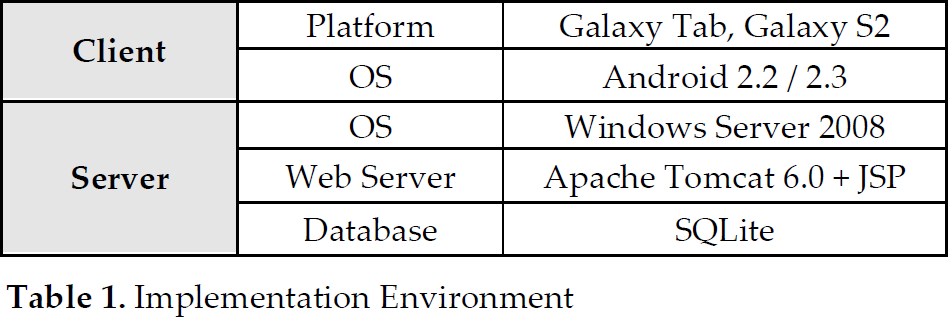
This section describes the implementation results of the system. Implementation devices were Galaxy Tab and Galaxy S2(NFC Smartphone) and the client was run using Eclipse on Android 2.3. Apache Tomcat and JSP served as a verification server and SQLite was used for Database system.
Implementation Environment
5.1. Design Scenario
John who is driving in a car, wants to find the most famous pasta restaurant in Kangnam area which is located in Seoul. As the precondition, the restaurant should be located within 5 miles from her current location. With this situation and conditions, the analysis on the user should be conducted through the user information profiles in the user profile registry first to satisfy the user's requirement. By analysis of the user's information profiles using the privatized agent, the information that John ordinarily orders meals at restaurants within a 60$~80$ price range and prefers restaurants which provide paste. Then, the Personalized Mobile Information Retrieval System finds the restaurant best fitting these criteria and provides the information to John by comparing the fact that John prefers restaurants in the 60$~80$ price range providing diverse services relative to the price, which is found out through the user profiles, and the service search result analyzed by the Matchmaking Engine. The Server also analyzes the location of John and guides him to a restaurant which is within the radius of 5miles from his location. As above, it is necessary to find out the information which best fits the request of the service requester by analysis on the service search results and the user information profiles. For this, the technology to determine the user's preferences using a rule based search engine is needed and the service for context awareness and location awareness on the user should be provided simultaneously.
5.2. Implementation Results
A user runs an implementation app and registers an ID with his/her mobile phone number. Once the registration procedure completes and the Login button is pressed, it moves to the activity screen where the user can search for information about food.

User Registration and Login Process
The user who completed authentication procedure types a food name he/she wants to find through the input window. Figure 4 shows how to search for ‘pasta' using a search input window. Enter a search word and press the ‘Search with Naver' button, and the app brings a list of restaurants matching the entered data using the search API at a Naver Developer Center. Then, the app compares the data in User Registry of the corresponding user with the results returned through a search engine. The results from the comparison show a list of restaurants after extracting the most compatible price data on the basis of what the user once searched. Figure 4 shows the results.

Search Results Screen for User 1
Figure 4 indicates that User 1 searches for a pasta restaurant close to where he/she is and marks the position coordinate of its search results on the map. The user displays the position data on the screen by producing the coordinate value of a requested restaurant, by means of the Naver map API, within the analysis findings based on the past data of the user who would take pasta mainly at 17000KRW (17US$) price range.

Search Results Screen for User 2with Different Preferences
Figure 5 shows the results for a user with different preferences, in which the findings from an app analysis present, though the same search word ‘pasta' was entered, on the screen a list of different restaurants, depending on individual's tastes, based on the past data with information that User 2 mainly enjoyed pasta at 11000KRW (11US$) price range.
6. Experimental Results and Analysis
This section deals with how to differentiate the method used in basic research by complementing the following features. Table 2 shows a qualitative comparison between the proposed method and other methods. With regard to security, NFC is examples of very short range communication technology and obviously offers higher security.
Compare our suggested method with related work
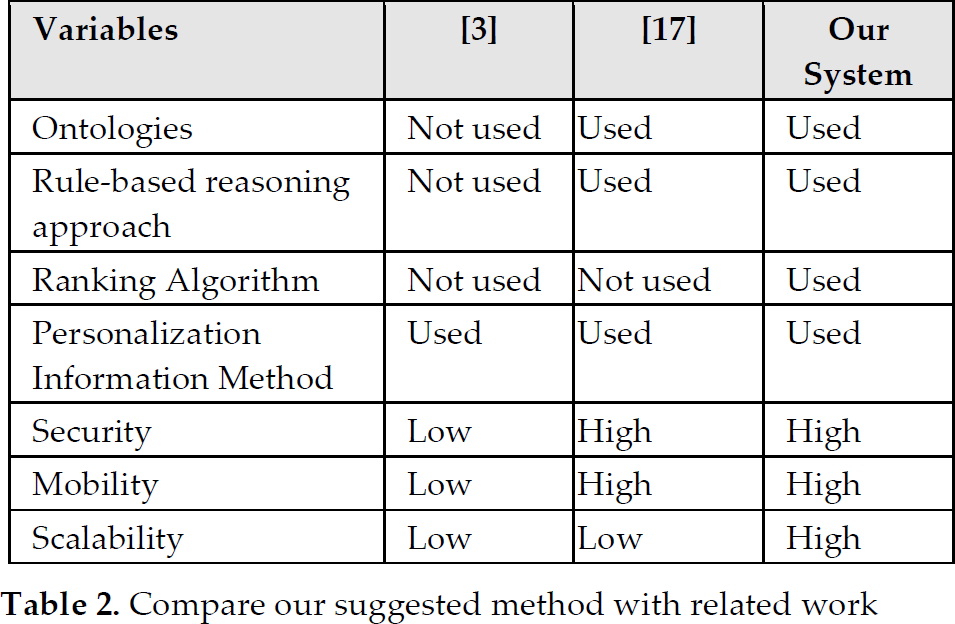
[3] described a framework using independent of the clustering method and personalization algorithm for recommendation in folksonomies, but it didn't clearly apply raking algorithm. On top of that, it has not been implemented as a research paper on algorithm and also shows vulnerability to mobility, expandability and security. In [17], they designed a novel architecture for NFC phone-driven, personalized, context-aware smart spaces. It used predefined ontology and rule-based reasoning. Yet, it holds drawbacks, such as a low level of expandability and a failure in providing search results suited to individualized features with individualized algorithm applied.
7. Conclusions
Personalization is an important issue to ensure the preferences of users and relevance to context. Individuals can be assisted to accurately deduce the control context of smart space and enjoy enhanced comfort[17]. Today's web information is linked by various relationships. Prevalence of the internet has moved many things from offline domain to online domain and more reliable and logical data, which may include relationship between network members in its various ranges, are required at the same time.
Social Network is a social structure composed of nodes, which are formed by one of more interdependent relationships. As an important medium, it reflects intimacy and interest between users and converts the concept of personal relations into digital information through Social Network. Hence the growing participation of more users and their relations only magnifies the significance of Social Network Service today.
In this paper, we present a novel approach for designing and constructing Semantic Web based Information System using NFC based on Social Network Services to solve the problems of Uncertainty and Vagueness by assigning personal interests and providing exact information.
This study designed a Personalized Mobile Information Retrieval System based on the differentiated technologies, in order to supplement the defective point of the previous studies that they could not suggest an integrated Web based Information System from the overall standpoint of view, as they lay too much stresses on methodological aspect. This system also provide an automated framework fundamental for searching methods by mirroring a user's preference. In addition, the system enables its unique customized service to be provided fast and accurately by utilizing its data stored in NFC.
It enables a more exact and credible search results using NFC by providing the personal preference through the result generated from the Semantic Management module.
As future research task, the adding of screen interface which can provide users need in detail and limitation conditions in more detailed division and the designing on a methodology which can examine the efficiency and exactness of the proposed system objectively is needed. Besides, once SNS service and NFC Smartphone are combined with each other, further functions may have to be added so payments can be made by touching a NFC tag when visiting popular restaurants
Footnotes
8. Acknowledgments
This research was supported by the MKE(Ministry of Knowledge Economy), Korea, under the “Employment Contract based Master's Degree Program for Information Security” supervised by the KISA(Korea Internet Security Agency).