




Abstract
This paper presents an experimental investigation on virtual texture force perception, where the Just Noticeable Difference (JND) method is used to evaluate the effects of texture spatial period and human exploratory speed on texture force perception. Two experiments have been conducted in this study. The first experiment focused on JNDs of texture force under different spatial periods (0.055–90mm) without limiting subjects' exploratory speeds. It was found that JNDs of texture force were between 6.20% and 9.80%. The spontaneous exploratory speed was highly affected by spatial period. It increased and then became stable as the spatial period increased. The second experiment assessed the effect of spatial period and human exploratory speed on JNDs of texture force. The spatial period had a significant effect on JNDs of texture force, which decreased as spatial period increased in the range of 2.9–14.9mm. Although the subject's exploratory speed has no noticeable effect on JNDs of texture force, the effect of interaction between spatial period and exploratory speed was significant. The experiment result indicated that when texture spatial period is small, low exploratory speed can be chosen to get small JND of texture force.
1. Introduction
Texture is considered as one of the important physical properties of objects. With the development of virtual reality technology, texture haptic rendering and perception has become increasingly important. People are required to not only see a variety of visual scenes, but also touch textures of virtual objects in order to realize better identification and control of the object. Texture haptic rendering can be used in many applications, such as surgical simulations, online shopping, robot teleoperation, etc.
Currently, there are mainly two different approaches to simulate tactile texture by hardware: point contact and distributed contact [1–3]. The former uses a force feedback device to produce force feedback, in order to simulate the haptic sensation produced in the process of a human hand holding a probe to slide over a real texture surface. The latter utilizes a tactile stimulation array to simulate roughness of texture surface or vibration stimulus. From the perspective of implementation, it is easy to realize the measure and control of haptic texture through a point-contact force feedback device, and even more important is that the parameters of the force feedback device are comparable with the parameters of the real texture environment. Thus, it can provide a reliable basis for analysing texture sensation. Many researchers have utilized this device as a tool for the research of haptic texture perception characteristics and experimental evaluation.
Before simulating realistic haptic texture, a primary issue is to investigate the inherent mechanisms of formation of human tactile texture. That is to say we should understand how the haptic texture sensation is generated. In fact, haptic texture is the result of interactions between the human and the environment. On the one hand, haptic texture is the reflection of the surface profile, which is affected by the texture's physical properties such as spatial period, hardness and friction coefficient. On the other hand, the haptic texture is one kind of human response to external mechanical stimuli, which is often affected by their subjective cognitive characteristics. The researchers have been experimentally exploring a variety of objective and subjective factors that affect human texture perception. Texture roughness perception is the focus of research and it can be divided into 3 categories according to perception environment: real texture felt with bare fingers, real texture felt with a rigid probe, virtual textures felt with a force feedback device[4].
As for real texture perception with bare fingers, Katz proposed the duplex theory of tactile texture perception in 1925 [5]. It was concluded that differentiation of coarse texture (i.e., texture size or spatial period> 100–200μm) is subject to a “spatial sense”, while discrimination of fine texture (i.e., texture size or spatial period<100–200μm) mainly depends on vibrotactile stimulation. Vibrotactile stimulation can be considered as a force signal changed periodically over time, whose frequency f t is used as a measure. In active texture perception, the frequency f t is defined as the ratio of exploratory speed and texture spatial period d0, namely

Therefore, adjustment of vibrotactile cues can be achieved by changing exploratory speed or the spatial period of texture. Subsequent research has verified Katz's findings. Hollins studied the roughness perception of both coarse texture and fine texture, respectively [6–8]. The results indicated that roughness perception is mainly affected by spatial sense for rough texture and the effect of exploratory speed can be neglected. As for fine texture, roughness perception mainly depends on a vibrotactile stimulation, which can be sensed by the Pacinian Corpuscle (PC) receptor, a kind of fast adapting skin receptor [9].
Taylor and Lederman [10] systematically and comprehensively analysed the difference of roughness perception of real texture surface with bare fingers and with a rigid probe: when texture surface is felt with bare fingers, roughness perception of coarse texture mainly depends on “spatial sense”, which means skin deformation caused by the spatial differences in the texture surface, and roughness perception of fine texture mainly depends on vibrotactile stimulation. On the contrary, texture roughness perception through the probe, regardless of coarse or fine texture, both depend on vibration signals. Later, Klatzky and Lederman found that the spatial period of texture, force value and exploratory speed are the main factors influencing the texture roughness perception with a probe [11]. Moreover, LaMotte and Srinivasan have conducted an experimental study from a neurological point of view, where they pointed out the role of the PC receptor in the identification of vibration signals [12]. Yoshioka and Zhou put forward a non-direct contact method by using a probe, which proved the multidimensional analysis process of texture perception and detected theeffect of movement speed and contact force on texture perception [13].
Virtual texture is haptic stimulus generated by contact with a virtual texture surface. People can perceive texture properties through haptic stimulus directly. Considering contact force is generated by a force feedback device, Choi et al. also investigated the effect of different controlling parameters of haptic rendering devices on texture perception, such as refresh rate, output characteristics and diameter of the probe [14, 15]. Although the experimental study of virtual texture force and its perception is fruitful, the results of these studies are not comparable because of the diversity in the definition of virtual texture. For example, Lederman and Minsky have proposed the expression of tangential texture force [16]. Campion et al. have focused on the effect of the tangential friction, which is sinusoidal, on texture perception and considered that roughness perception is in connection with friction coefficient and friction amplitude, while not affected by the spatial frequency of periodic friction [17]. Kornbrot et al. defined texture force as sinusoidal form and their experiment results showed that texture roughness perception decreased as spatial period increased [18, 19]. Klatzky and others have considered that a quadratic equation can be used to describe the relationship between roughness perception and texture interelement spacing [20]. Headley's experiment mainly discussed the effect of ridge and groove width on square wave texture perception and indicated that when ridge width is constant, roughness perception would reduce as groove width increases. While groove width is constant, the relationship between texture roughness perception and ridge width follows the inverse-U shape[21]. Jones has found that the JND for force is about 10% in a force matching experiment [22]. Pang and Tan used the JND method to test the human ability to distinguish the resistance when pushing a moveable tablet using a finger - JND is about 5% ~ 10% [23]. Tan has reported that the JND of texture height perception in a certain texture spatial period is about 10.1%[24].
Previous research has shown that haptic texture perception is closely related to texture properties, such as texture spatial period, and human exploration habits. However, little research has been conducted into the texture force generated by a general force feedback device. Considering the fact that haptic texture can be commonly represented as a force stimulus occurred between the subject and object surface, so it is necessary to analyse human sensitivity to texture force and important factors that affect texture force perception to achieve realistic texture perception. Without considering forces exerted by subject and tangential force, this paper utilizes a 3-DOF force feedback device to simulate a texture force that is perpendicular to the texture surface, and investigates the relationship between texture spatial period and the JND of texture force perception. JNDs of texture force under different spatial periods without limiting subjects' exploratory speeds are first measured in order to reveal subjects' spontaneous ability of texture force perception and their exploratory habit. Then the JNDs of texture force under some specified exploratory speeds are obtained and compared with those under spontaneous exploratory speed to see if it is optimal to use spontaneous exploratory speed, thus revealing inherent characteristics of haptic texture perception acquired from the interaction with a force feedback device.
2. Texture Force Model
In order to exclude the effect of undesired factors on the experimental results, a similar texture force as shown in [24] is used in this experiment. It is a square wave force signal which is perpendicular to the virtual texture surface. Neglecting the tangential friction, the amplitude of the texture force changes periodically with the spatial location, as shown in Figure 1, and can be expressed as:

where F0 is the amplitude of the texture force, which is a constant, and d0 denotes the spatial period. The ridge-to-groove ratio is 1:1 and the amplitude of the texture force is not affected by the depth of the subject's active compression if neglecting the influence of hardness of virtual object. In this study, the subjects control the force feedback device to slip over the surface of virtual texture, whose density level is characterized by the spatial period. A grouping method (i.e., an extension method of constant stimulus) is used in the experiment to measure subjects' JNDs of texture force, through which the effects of texture spatial period and human exploratory speed on texture force perception will be investigated in detail.

Illustration of texture force used in the experiment
3. Experiment 1
In order to estimatethe human ability of virtual texture force perception under different texture spatial periods, the first experiment measured JNDs of texture force under different spatial periods for each subject. Due to the fact that the subject's exploratory speed possesses spontaneous characteristics when he/she touches an object and each subject has his/her own optimal exploratory speed, there is no limitation on exploratory speed in the experiment.
3.1. Experimental Method
Grouping method (i.e., an extension method of constant stimulus) is used to measure the JND of texture force in this experiment. In the experiment of a given spatial period, the standard stimulus F0 is 0.8N, and the amplitudes of comparison stimuli, which have 6 levels, are 0.68N, 0.72N, 0.752N, 0.848N, 0.88N, 0.92N. One standard stimulus and 1 comparison stimulus are presented to the subjects each time and they then evaluate which force is bigger. In the experiment for a spatial period, there are 6 comparison stimuli and each comparison stimulus was compared 8 times with standard stimulus. Therefore there are 8×6=48 times in each experiment. The presentation order of comparison stimuli is arranged according to the grouping method: 6 comparison stimuli are divided into 3 groups and in 1 group the amplitude interval between standard stimuli and each comparison stimulus is the same. For example, the amplitude interval between 0.68N and 0.8N is the same as that between 0.8N and 0.92N, and both are 0.12N, so that they are put into the same group which is denoted by symbol L. Similarly, 0.72N and 0.88N are in group M, and 0.752N and 0.848N are in group S. For 1 spatial period experiment, 48 tests are divided into 6 rounds. In each round, a standard stimulus is compared with 2 comparison stimuli in 1 group 4 times randomly. The comparison stimuli in 1 group can be used in 2 rounds and the order of groups can be LMSSML or SMLLMS. Each subject needs to be tested 14×48=672 times and about 5–6 hours (divided into 4–5 servings, about 1 hour each) are needed to complete all the experiments.

Human computer interface in the experiments (a) virtual texture perception using omni-force feedback device (b) experimental panel
3.2. Experimental Result and Analysis
1) The relationship between the JND of texture force and the texture spatial period without limiting exploratory speed
The relationship between average JNDs of texture force and spatial period (in logarithmic scale) is shown in Figure 3. It can be seen that the scale of the JNDs of texture force range from 6.20% (the corresponding spatial period is 15mm) to 9.80% (the corresponding spatial period is 70mm). This result is comparable with that obtained in a fixed spatial period in the literature [24].
With the increasing spatial period, the JNDs of texture force will firstly increase in the range of 0.055–0.5mm, then decrease in the range of 0.5–15mm and then increase again in the range of 15–90mm. In the experiment, it can be seen that when the spatial period is smaller than 0.1mm (i.e., 100μm), subjects normally cannot get the perceived difference of various spatial periods. Such a threshold of subjective perception is similar to the boundary of coarse and fine textures found in a previous study[6]. Moreover, the error bars, which represent the standard deviation, showed consistency of subjects' perception ability. The large error bar reflects the great difference among subjects and low consistency. In contrast, the small error bar reflects little difference among subjects and high consistency. Furthermore, in the scale of spatial period from 2.9 to 15mm, the JNDs of texture force are relatively stable, which is from 6.20% ± 1.55% to 7.28% ± 2.89%.

The JNDs of texture force under different spatial periods (the error bar denotes standard deviation)
3) Subjects' spontaneous exploratory speeds
During the experiment, although there was no restriction on exploratory speed for each subject, it was recorded to analyse how subjects perceive textures. The single-factor repeated analysis on variance of the spatial period shows that the spatial period has significant effect on exploratory speed (F(13,196)=7.36, p<0.001). The average exploratory speeds of all subjects are shown in Figure 4, in which the scale of average speed ranges from 87.26mm/s (the spatial period is 0.1mm) to 140.58mm/s (the spatial period is 90mm). But the scale of a single subject's exploratory speed ranges from 26.78mm/s to 224.01mm/s, which is comparable with that shown in the literature (23mm/s-157mm/s) [23]. From Figure 4 it can be seen that with the increasing spatial period, the average exploratory speed of all subjects will firstly increase and then stabilize. This can be probably explained by the fact that the force feedback device has a maximum speed limit, or the increasing speed may lead to a short texture perception time, which is not helpful for contact force perception. The result also indicates that the larger the spatial period is, the faster the subject is accustomed to perceive objects.
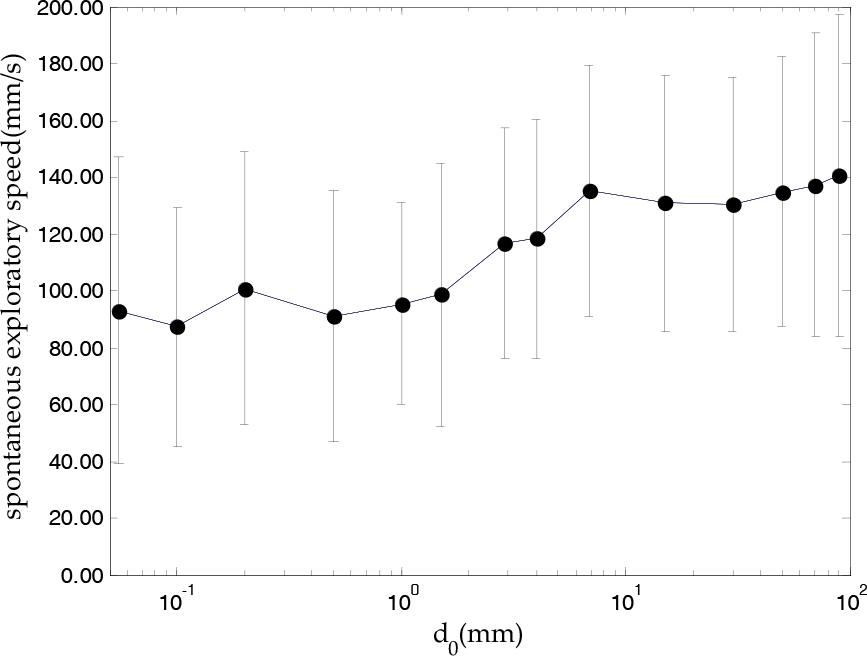
Average spontaneous exploratory speeds under different spatial periods
4. Experiment 2
The results in experiment 1 illustrate that different exploratory speeds are used for perception in different texture spatial periods. However, it remains an issue that needs further exploration as to whether or not exploratory speed has an impact on the JND of texture force. Two factors are involved in this issue: first, previous findings by Klatzky and Lederman have shown that when subjects used the probe to perceive real texture, vibrotactile cues are the decisive factor. Since exploratory speed is one of the influencing factors in vibrotactile cues (the frequency of vibrotactile cues is defined using Equation (1)), it is most likely that exploratory speed will affect the texture perception. On the other hand, if exploratory speed does affect texture perception, it will generate different tactile sensations when the subject perceives the same texture under different exploratory speeds. Nevertheless, practical experience tells us how it can generate different feelings when touching the same texture. Moreover, during the process of experiment 1, at least 3 subjects reported vibrotactile sensations within the range of 2.9–15mm. Based on these two reasons, we carried out experiments on the JNDs of texture force under different levels of combinations of texture spatial period and exploratory speed. The texture force model and experimental devices used in the experiment are the same as with experiment 1, but the experimental interface is slightly different with the interface shown in Figure 2(b), and a moving oriented ball above the two rectangular texture planes is used to guide the subjects with specified exploratory speed.
4.1. Experimental Method
4.2. Experimental Result and Analysis
1) Significant influential factors on the JNDs of virtual texture force
Using texture spatial period and exploratory speed as within-subject factors to perform two-factor repeated measures variance analysis, the results showed that the JND of texture force is significantly affected by texture spatial period[F(3,228)= 2.84, p<0.05]. The subject's exploratory speed does not affect the JND of texture force [F(2,228) = 0.51, p> 0.05]. The interaction between texture spatial period and the subject's exploratory speed influences the JND of texture force significantly [F(6,228)= 2.34, p <0.05].
2) The relationship between the JND of texture force and texture spatial period with specified exploratory speeds
Since texture spatial period significantly affects the JND of texture force, it is necessary to investigate the changing trends of the JNDs of texture force under different spatial periods. The JND of texture force is obtained from averaging JNDs of texture force of 3 exploratory speed levels in 1 spatial period. From Figure 5, it can be seen that in the spatial period ranging from 0.49mm to 14.9mm, the average JND of texture force decreases slowly with the increase of the texture spatial period (7.12%±2.08%-8.83%±4.24%) and so does the standard deviation, which is similar to the tendency of the JND of texture force when the spatial period is in the range of 0.5 to 15mm in experiment 1.
3) Analysis of the interaction between texture spatial period and exploratory speed
Exploratory speed does not influence the JND of texture force significantly, while the interaction of texture spatial period and exploratory speed does. For further analysis on the effect of the interaction of texture spatial period and exploratory speed, simple effect analysis is conducted in this study. Simple effect is used to analyse whether exploratory speed can affect the JND of texture force significantly in each level of spatial period and whether spatial period can affect the JND of texture force significantly in each level of exploratory speed.

The average JNDs of texture force under different spatial periods
The simple effect of texture spatial period under 3 different exploratory speeds shows that when exploratory speed is 40mm/s and 80mm/s, spatial period does not significantly affect the JND of texture force (the corresponding F and p values are [F(3,76)=0.06, p>0.05], [F (3,76)=0.9, p>0.05], respectively). However, when exploratory speed is 120mm/s, spatial period significantly affects the JND of texture force [F (3, 76) = 5.73, p <0.01]. The results can be further seen in Figure 6, where the JNDs of texture force do not significantly change in different texture spatial periods under low exploratory speed (40mm/s and 80mm/s). On the other hand, the JNDs of texture force differ significantly in different spatial periods under high exploratory speed (120mm/s), and it decreases with the increase of spatial period.
The simple effect of exploratory speed under the 4 levels of texture spatial periods indicates that the JNDs of texture force have no significant changing trend with the increase of exploratory speed, when the spatial period is 2.9mm, 6.9mm, 14.9mm (the corresponding F and p values are [F(2,57)=0.61,p>0.05], [F(2,57)=0.5,p>0.05] and [F(2,57)=2.06,p>0.05], respectively). However, when the spatial period is 0.49mm, the JNDs of texture force change significantly with the increase of exploratory speed [F(2,57)=3.63,p<0.05]. In Figure 7, it can be seen that when the spatial period is 0.49mm, the lower the exploratory speed is, the smaller the JNDs of texture force will be.

JNDs of texture force under different spatial periods

JNDs of texture force under different exploratory speeds
Therefore, when exploratory speed is high, there is a significant effect of spatial period on the JND of texture force and when spatial period is small, the effect of exploratory speed on the JND of texture force is crucial. It can be seen from both situations that low exploratory speed can be chosen to get a better perception effect when the texture spatial period is small.
The results can also be compared with previous research conducted by Klatzky and Lederman[10], where the effect of texture spatial period and exploratory speed on real texture roughness perception using a probe are investigated. They concluded that the spatial period has significant effect on texture roughness and exploratory speed does not, but interaction between the two factors affects texture roughness significantly. Such a conclusion is similar to the findings from our experiment.
Furthermore, interaction between two factors in our experiment reveals that when texture spatial period is 0.49mm, high exploratory speed makes the JNDs of texture force larger. That is, high exploratory speed can reduce the perceived resolution of texture force. This conclusion is also consistent with the experiment result of Klatzky [10]. In Klatzky's experiment, when spatial period is small, the roughness rating decreases as exploratory speed increases. This means the perceived sensitivity of roughness will decrease when high exploratory speed is used.
The differences between roughness perception and texture force perception lie in the fact that roughness perception is a subjective judgment of texture property, while the JND of texture force perception is an objective revelation of human ability to perceive texture force. Subjective roughness rating, which can be fit into a quadratic equation of spatial period, varies as spatial period changes from 0 to 4mm. It shows that perception of roughness, one of texture properties, changes greatly as the spatial period changes. As for the JND of texture force, it is also affected by spatial period, but compared with roughness perception, the JND of texture force changes slightly, only from 5% to 10%, in the spatial period range of 0.49–6.9mm.
4) Analysis on whether there is a minimum JND of texture force with subject's spontaneous exploratory speed
After understanding the JNDs of texture force under different texture spatial periods and exploratory speeds, it is necessary to study whether there is an optimal texture force perception under spontaneous exploratory speed. That is to study whether there is a minimum JND of texture force with a certain spatial period under a subject's spontaneous exploratory speed. Both experiments 1 and 2 have spatial periods of 2.9mm and 6.9mm. Furthermore, the spatial periods of 0.5mm and 15mm in experiment 1 are close to the spatial periods 0.49mm and 14.9mm in experiment 2, respectively. Therefore we can compare the JNDs of texture force in these 4 spatial periods and the results are shown in Figure 8.

Comparison of JNDs of texture force under different exploratory speeds
As can be seen in Figure 8, the average spontaneous exploratory speed is 91.10mm/s within texture spatial period 0.49–0.5mm. The corresponding JND of texture force is not the minimum, but it accords with the rule that the JNDs of texture force increase with the increase of exploratory speed when spatial period is 0.49mm. Selection of subjects' exploratory speed is not only related to texture spatial period, but also related to spontaneous perception habits and the psychological state of the subjects. The smaller the exploratory speed is, the longer the time taken for an experiment. Although we can get better perception results with a low exploratory speed, most of the subjects want to spend the shortest time on completing the experiments. In other spatial periods, the JND of texture force corresponding to spontaneous exploratory speed is not necessarily the minimum, which is consistent with the conclusion that exploratory speed does not significantly affect texture force identification. Furthermore, our findings match the conclusion drawn in a previous study [23], where an experiment was conducted to test the human capability to distinguish resistance force when pushing a tablet and “the most comfortable exploratory speed” does not necessarily produce the minimum JND of texture force. In a nutshell, using spontaneous exploratory speed to perceive texture does not necessarily generate the best perception resolution.
5. Conclusion
In this study we experimentally investigated how variations in texture spatial period and human exploratory habit influence the JND of square wave texture force. Without limiting the subjects' exploratory speeds, the JNDs of texture force under different texture spatial periods are measured in experiment 1. We find that the JNDs of texture force are in the range of 6.20% – 9.80%. We then record the spontaneous exploratory speed when subjects perceive the texture. The results show that texture spatial period has a highly significant effect on a subject's spontaneous exploratory speed. That is, the exploratory speed increases with the increase of texture spatial period and then tends to stabilize.
Considering the effect of texture spatial period and exploratory speed on the JND of texture force, a 2-factor repeated measuring experiment is designed in experiment 2. The results of variance analysis indicate that texture spatial period and the interaction between texture spatial period and exploratory speed have a great effect on the JND of texture force. The average JND of texture force decreases with the increase of spatial period. Moreover, the results of simple effect analysis indicate that the smaller the spatial period is, the lower the JND of texture force will be with lower exploratory speed, while the smaller the spatial period is, the higher the JND of texture force will be with high exploratory speed. In addition, with low exploratory speed, there is better spatial period adaptability as compared to high exploratory speed. In order to find whether we could get the optimal texture force perceptive resolution with spontaneous exploratory speed, 4 different texture spatial period ranges (0.49–0.5mm, 2.9mm, 6.9mm and 14.9–15mm) are studied and the results show that the subjects do not always possess the best texture perception sensitivity under spontaneous exploratory speed. This is closely related to other factors such as texture spatial period and the mental state of the subjects. The experimental results provide important data on contact force modelling of virtual texture rendering and are helpful in finally realizing realistic texture expression.
Footnotes
6. Acknowledgments
This research was supported in part by the Natural Science Foundation of China under Grant 60905045 and 61105075, Programme for New Century Excellent Talents in University under Grant NCET-10-0330, Natural Science Foundation of Jiangsu Province under Grant BK2009103.
References
 : Texture Perception