




Abstract
The u-Business service is prevailed trend due to rapid development of telecommunication technology and the growth of ubiquitous computing environments. However, since the majority of u-Business service cases such as home network service, location-based service have not been focused on user requirements, and deduced business services and built systems considering only technical issues, there may be a possibility to be an obstacle for spreading advanced future u-Business services. Therefore, this study investigated user requirements to model the u-Bookstore business service as a killer service of u-Businesses and designed a system for a large bookstore. By exploiting various ways to deduce u-Service's requirements needed in the future-enabled ubiquitous computing business environments and proposing directions to implement them. This study result is anticipated to suggest validity for developing ubiquitous computing technologies, and it is expected to utilize as fundamental data for spreading u-Business.
1. Introduction
The recently developed Embedded Computer converts physical space (real world) into intelligent space (electronic space). The user of embedded computer environment does not have to aware his/her condition. This environment grasps the user's needs and provides the necessary service to him/her regardless of limits of time and space. We call this kind of computing environment as “Ubiquitous Environment. It could be defined as a computing environment to deliver any information by using arbitrary devices on all networks and to deliver information of the most suitable form by automatically recognizing users' current contexts [1]. The u-Business carried out in ubiquitous computing environments is a business system that makes objects and processes, which forms customers' business environments, intelligent and connects them with networks to create value.
However, the current u-Business services, which are being provided to user, did not reflect user requirements in development progress and those services have been designed only considering the current technology level. Such u-Business services without reflection of user needs could be an obstacle to u-Business service diffusion. [3, 4, 5, 6]. Therefore, this study would like to provide fundamental data for designing a business model as well as to suggest validity of developing technologies required for implementing services by examining potential users' requirements for the current or future services and then proposing business services and technologies to solve them based on a systematic business service development methodology.
2. Literature Review
2.1. Concept of Ubiquitous Computing and Its Services
The ubiquitous computing was suggested for the first time by Mark Weiser at Research Institute of the Palo Alto, Xerox, U.S. in 1988. The concept of ubiquitous computing was introduced as a term of 'ubiquitous computing and UbiComp' was used to propose a vision of the next computer generation. Although the computing to date has a key role of the online (virtual) space concept and its main purpose is to put reality into an online space, on the contrary, the ubiquitous computing has the main purpose of implanting the computing into every reality [2]. For this purpose, tiny computers should be embedded into objects and environments to make them intelligent. It means that the computers, which constitute a part of objects, could recognize contexts of adjacent spaces, and persons could also perceive or track changes of target objects and their adjacent environment from a geographically distant place. The ubiquitous computing requires that every computer has to connect via networks, and computers connected via networks have characteristics to provide context-aware services to users by using human-friendly interfaces as users is not aware of using computers [7]. This environment aims for making 5 anys (any time, any where, any network, any device, any service) of 5 Cs such as computing, communication, connectivity, contents, and calm.
2.2. Concept of u-Business and Its Services
The u-Business has a few differences from the e-Business based on the Internet. The primary technology of e-Business is implemented through the web technologies based on networks among personal computers, but the u-Business is implemented through augmented reality and web realization technologies by networking various devices including personal computers, mobile terminals and chips etc. wirelessly [8]. The e-Business Activity is a conscious activity, which requires user intervention, and the u-Business activity autonomous activity, which is conducted by embedded computer. The e-Business marketing is a stillness activity based on customer information. Besides the u-Business marketing is a dynamic activity based on user context, so the u-Business marketing has a potential to create a new business opportunity.
2.3. Ubiquitous Computing Component Technology
The u-Smart space, which is designed by the technical architecture to support the u-Business services, is defined as follows. The u-Smart space (ubiquitous smart space) is a user-oriented space formed through mutual awareness, convergence, collaboration and interaction between physical spaces and virtual spaces (digital spaces).
To support collaboration technology, the concept of ‘Community Computing' is being introduced. ‘Community Computing' is a resource-sharing model in which users are provided with free or low-cost computer and Internet access, and this computing technology organize an autonomous community among the distributed objects to solve a certain problem. The community computing consists of a technology to provide appropriate services in time based on comprehensive and correct understanding on the environments, technology to minimize human's intervention to enable autonomous policy-based operating and management furthermore to enable autonomous recovery and repair even for unintended external attacks and malfunctions, finally, technology to provides tailed services suitable to different users by learning varied environments and executed results to optimize services continuously, and it could be divided into a u-Base technology, object technology, and system technology.
2.4. Case Studies on u-Business Services in the Book Selling Area
The 'selexyz' bookstore of BGN, a book-selling company in Netherlands, had achieved more intelligent sales automation by utilizing service-oriented information technologies to introduce the world's first electronic tags for the individual book level. This bookstore decided that real-time information management is required to increase customers' satisfaction by improving accuracy of the supply chain, customer-oriented integrating of information, integrating of stock level information etc., and it became to introduce electronic tags as its solution [9, 10]. Unlike the existing bar code with limited information entry and static characteristics, the electronic tag could be uniquely attached on every book to dynamically enter information and obtain enough information. Ultimately, such electronic tag's characteristics could change the existing utilization of real-time information focused on business management into the customer-centered, so that more improved service had been provided to the bookstore's customers. From a view of the value chain for selling books, the process of u-Business services is as follows. First, a delivery-contracting company for large bookstores attaches electronic tags on every book requested for purchase, and inform the large bookstores of information related to it [11]. The delivery information informed electronically in advance is automatically compared with the electronic tag on the delivered product to carry out acceptance examination in process of warehousing in the large bookstore. The books confirmed for warehousing are recognized through RFID tag, and then they are conveyed to certain arrangement positions, according to arrangement plan. Especially, when special order requested books are stored, request for pickup is sent to the customer. The special order request is indicated, and its stock would be kept until the corresponding customer receives it. In addition, the customer kiosk could recognize information and locations on books, which electronic tags are attached, to provide customers the information of books in stock and their bookshelves' positions [13, 14]. The sales management system, which manages the product and price information on books, observes moving of the electronic tags, and carries out modification on the stock information automatically if the payment is made.

u-Business Service of Large Bookstore
3. Deduction of Business Service by Implementing u-IT
3.1. Design Methodology for u-Business Service
Since the u-Business could be seen as an expanded concept of the e-Business, from various business service design methodologies studied previously, this study applied the business service development methodology proposed by the 'Rayport and Jaworski (2001)' in Harvard University, U.S. to employ it [12]. According to this methodology, chances of the u-Business are discovered by first analyzing the current or future evolving value systems based on features, which ubiquitous computing has, for developing the u-Business services. However, because the current u-Service environment is not implemented yet, for this purpose, a virtual u-Scenario as well as the current work process are designed to conduct analysis on users' requirements. At the next stage, The business process-centered u-Business services are developed, including definitions of necessary resources and capabilities. The purpose of this process is to satisfy user requirements.

u-Business Service Design Methodology
3.2. Design of u-Bookstore Service
The book industry has a faster information technology support speed than other industries, books to be dealt have the same property, and it has large bookstore oriented industry governance, so that it has an excellent advantage in terms of technical and business values. Therefore, this study drew a u-Business service from a view of the value chain of the book industry performed with large bookstores as the center. In general, the value chain of large bookstores could be divided into main and supporting activities, and the main activity is again arranged into a supplier management, order management, warehousing management, inventory and store management, return management, customer management, sales management and delivery management etc.
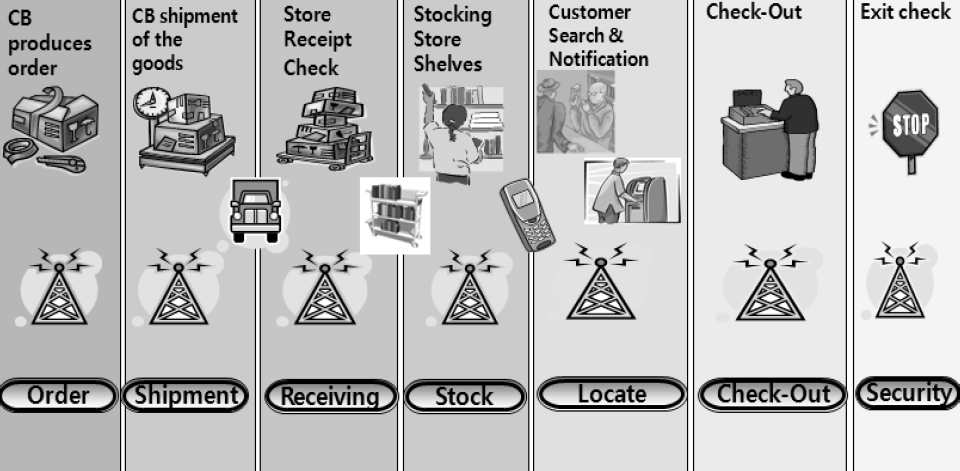
Business Process Flow of Bookstore
3.2.1. Deduction of Business Service Requirements and Design of Service Scenario
The u-Business service to solve problems for action stages of the book order management, inventory and store management and delivery management is designed through the features of the ubiquitous computing technologies and the meeting of experts in the related area as follows.
First, the following four services are designed to deal with the service requirements of the book order management action stage. First, for the problem that books are incorrectly evaluated and are delayed to be placed because a great amount of new published contracting books are received (300 kinds/day), a service is designed to receive the new published contracting books based on the book sales trend (book's formal elements title, author, publisher, price etc.; book's content-related elements - area, book's summary, testimonial etc.) associated to the external environment (the latest social issues, book promotion etc.) Second, for the problem that sales is decreased and the customer satisfaction is reduced because the order prediction is incorrect for books currently on sale to be out of stock, a service is designed to predict the quantity of books to be sold during a few days (months) considering the external environment (season, customer's propensity to purchase books for each branch, the latest social issues, book promotion etc.), development of book sales, and reader's review etc. Third, for the problem that persons are additionally required and time is delayed as well it is congested as at the receipt check (hot spot) because quality control (the ratio of damaged books, 5%) and warehousing for books arrived at the receipt check (10,000 books/day) is incorrect (users' entry errors) and its speed is slow, a service is designed to identify damaged books (being torn, printing defects, contamination), and to merge the result with the book information made by the publisher to process the book receipt in real time. Fourth, for the problem that customer congestion is increased for the certain bookshelves as well as the shortage of bookshelves (space is not enough between bookshelves) because it is arranged depending on only codes indicated on the books in process of arranging the books received into bookshelves, a service is designed to dynamically support arrangement of bookshelves considering kinds of books received, current development of book sales, customers' movement to purchase books (stop point), and store's congestion for each time slot etc.
Next, in order to deal with the service requirements at the inventory and store management action stage, the following three services are designed. First, for the problem that the inventory management is not correctly carried out (the correctness of understanding the stock is less than 80%) because the current condition of book sales, return and stock is not correctly gathered daily due to arbitrary placement of books read by customers, burglary, occurrence of entry errors and time difference between the sold time and the aggregating time for books sold etc., and additional persons are put to arrange books periodically for the responsible area, a support service is designed to track movement and sales of books in real time. Second, for the problem that sales is decreased because there are cases that customers do not find the desired books (bookshelves and books in the bookshelves), it is still insufficient and incorrect when seeing from a view of detailed location context although the search function is enhanced, and customers express inconvenience (lighting, space to read for a moment, warehouse's ambience, congestion and noise etc.) for reading books in the store, a service is designed to dynamically adjust space between bookshelves, and provide interested information, certain lighting and music according to customer's characteristic (interested area, physical information, preferred music) for customers entered the bookstore.
Finally, in order to deal with service requirements at the delivery management action stage, the following one service is designed. For the problem that there is a case of delayed delivery when the quantity of books to be delivered is rapidly increased because the delivering books are aggregated for each time slot to deliver in process of delivering books to remotely ordering customers, a service is designed to dispatch the delivery vehicles in real time based on the accumulated information including the ordering customer's information (location, loyalty, the time limit for delivery demand etc.), delivery means (domestic delivery, overseas delivery, quick service delivery, delivery moving between points), weight and volume of delivering books, traffic conditions etc. for each time slot.
3.3. Evaluation of the u-Business service
A statistical method is carried out according to the evaluation model in order to draw a priority service (killer service) from the services for users among the designed u-Business services. The model's evaluation factors are usefulness, economic feasibility, scalability, convenience and receptivity etc. With this designed evaluation model, a survey for services between companies was conducted for 11 interested persons engaged in the large bookstore, and a customer targeted service survey was carried out for 24 customers with experiences of purchasing books in the large bookstore. The survey was conducted for 10 days from August 20 to 30, 2009, and collected survey was analyzed to draw a killer service through the multi-variate variance analysis. Because the result of multivariate analysis was statistically significant at the significance level of 0.5 as Table 1, it was considered that the respondents' evaluation had significant statistical differences for each service.
u-Business Multivariate Analysis for the u-Bookstore

Evaluation of the u-Bookstore Service
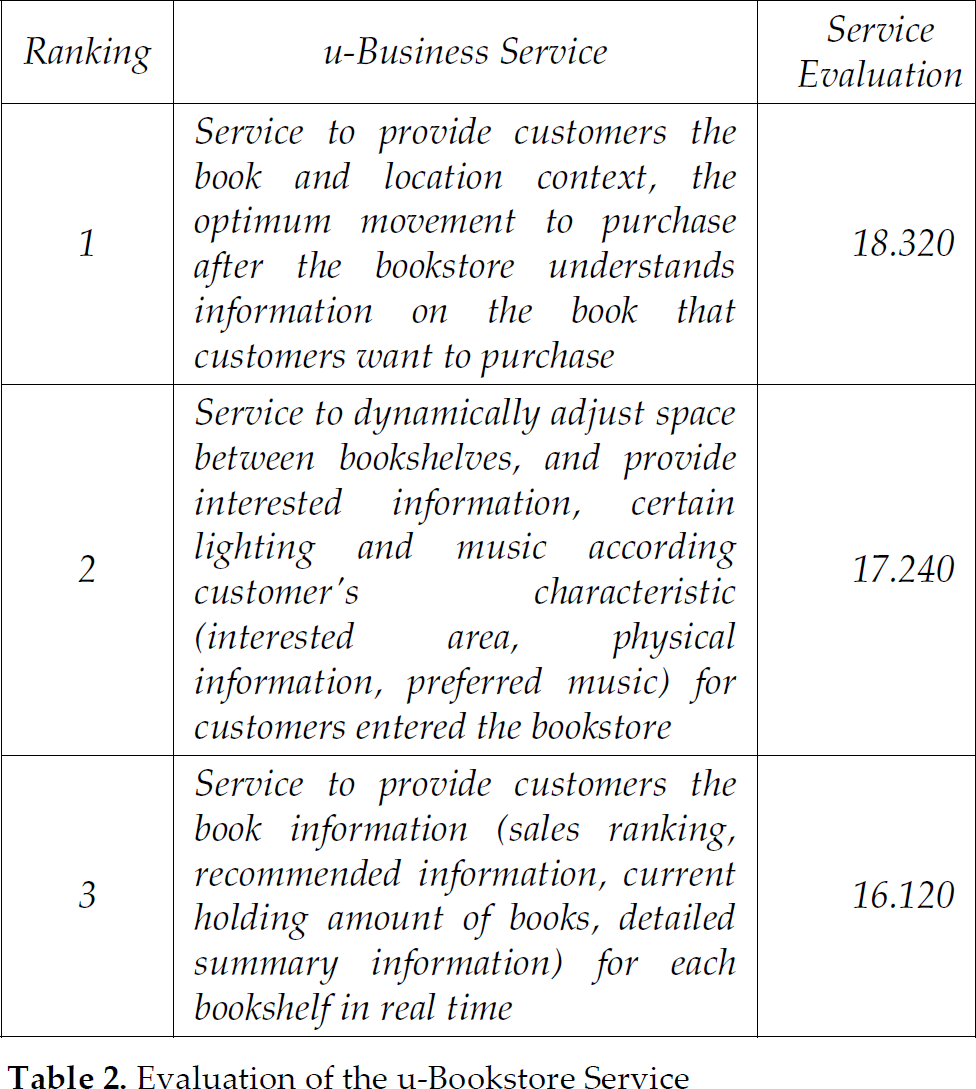
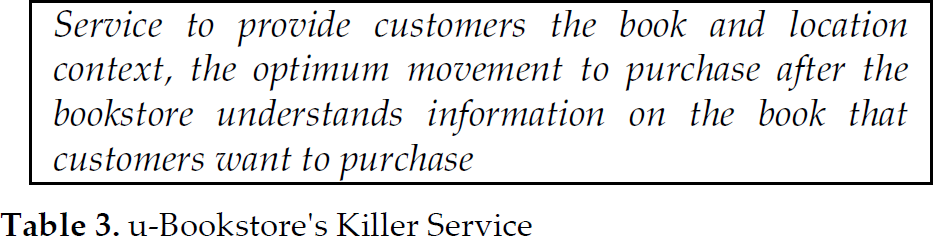
Next, values for each service's evaluation item are added to calculate overall service evaluation result, in order to finally draw a killer service, the service evaluation's average is found to decide the ranking among services. The ranking result for services by the service evaluation is as Table 2. It would like to build a u-Bookstore service for the 'service to provide customers the book and location information, the optimum movement for purchase after the bookstore understands information on the book that customers want to purchase' that is ranked at No. 1 among the evaluated services.
4. Development of the Business Service System by Implementing u-IT
4.1. Value Proposition of u-Bookstore Business Service
The uBookstore service proposed by this study is defined in Table 3. This service recognizes diverse information regarding user. The information includes his/her age, gender, lifestyle, preferred books, taste of reading and etc, so this service could provide optimum movement to bookshelf, which satisfies user requirements. This uBookstore service could cause effects of service quality improvement as followings. First, it can shorten time for purchasing books including increase in customer satisfaction, and providing customer with optimum movement may distribute a degree in crowd. Second, the accumulated data through this service might be analyzed to understand hot spots of customers, this analysis results could be used for marketing strategy.
u-Bookstore's Killer Service
In order to perform this service, it could manage user's identification information from an information terminal possessed or worn by the user and the information on the book that the user want to purchase, and could exchange information with the store management system. And, it should manage the book stock information for each bookshelf and the information on current condition of customers for each area at the current time as well as the facility information for each area in real time, and the store management system could operate as a supervisor system that provides various services by exchanging information with every customer who enters the large bookstore. In addition, it could convert the collected user information and the current store's information (books and customers) into the standardized information to manage it synthetically, and it could extract features on current book sales by using it as an input value. Finally, it could analyze differences by comparing features extracted for customers' locations and congestion, book stock information with the existing data, and could calculate the optimum movement to purchase books by using them.
4.2. Development of Scenario-based u-Bookstore Service System
This chapter describes various service scenarios and system components, which forms uBookstore. The system components have been designed in the perspective of ‘Community Computing'. The stage 1 of the u-Bookstore service flow is as figure 4. Examining the procedure of u-Bookstore service, it recognizes a customer's location by the transition of activity context to change the customer's context from the street to the bookstore. The customer is identified by checking the customer's authentication information after verifying the situation that the customer's location context is moved into the bookstore. And, it forms a community for providing the customized book information to the identified customer. Next, it provides the latest best seller and the new published book's information for the field preferred by the customer. Then, it selects books, which the customer wants to read, considering best sellers, new published books and the books that he/she would like to purchase previously. It forms the best route setup community for reading and purchasing books based on the selected books. As the best route setup community is formed, the best route is set considering the current location of the customer, the current congestion of the bookstore, the stock information of books to be read etc. Finally, the customer moves to the bookshelf. Figure 4 provides flow chart of u-Bookstore service. uPAN (Personal Area Network) is the technology, which recognizes a current status of network (the number and place of node, status of communication channel, communication protocol, etc) dynamically, and reorganizes the network autonomously. uZone is a specific area consisting of few uPAN.

Flow Chart of u-Bookstore Service (Stage 1)
The stage 2 of this u-Bookstore service flow chart could be described as below explanation. The service, which recognizes a customer's location context to change it from the street to the bookstore, follows the procedure as figure 5. At first, it collects data from various sensors around the customer. And, it converts the collected data into data, which the u-Mobile object could use, and optimizes it. Finally, by reasoning the data unified into a certain form to deduce the current location context of the customer, it could verify that the customer moved from the street to the bookstore. Figure 5 indicates the customer recognition and converting context process.
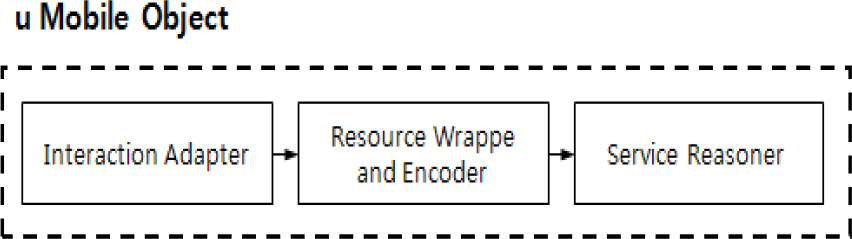
Process of Recognizing Customers and Converting Context
The stage, which sends the identification (customer number or personal identification number) and preference information for a customer and the current context of a customer, goes through the following procedure as figure 6. At first, it creates the identification and preference information for the customer, the current context of the customer. For sending the created information, it carries out packaging. And, it delivers the packaged personal identification number and preference, and the context information to the u-PAN. It connects the u-Mobile object with the u-Personal Area Network. Next, it calculates the optimum transmission rate and frame size suitable to the current wireless environment, and inserts the protocol control information including the beacon (activated synchronization signal) control, collision control, transfer/receiver/retransmission control, wireless environment detection, performance status monitoring etc. into the header and tail. Then, it modulates the packaged data received from the u-Mobile object into electrical signals, and selects and sends the appropriate transmission signals (20kbps~400Mbps) considering the number of users in the network and the channel condition at the current location. And, it inserts the protocol control information into the header and tail, so that data is not lost and duplicated, or out of sequence. Finally, it connects the homogeneous wireless networks each other in the bookstore, and sends data delivered from customers.
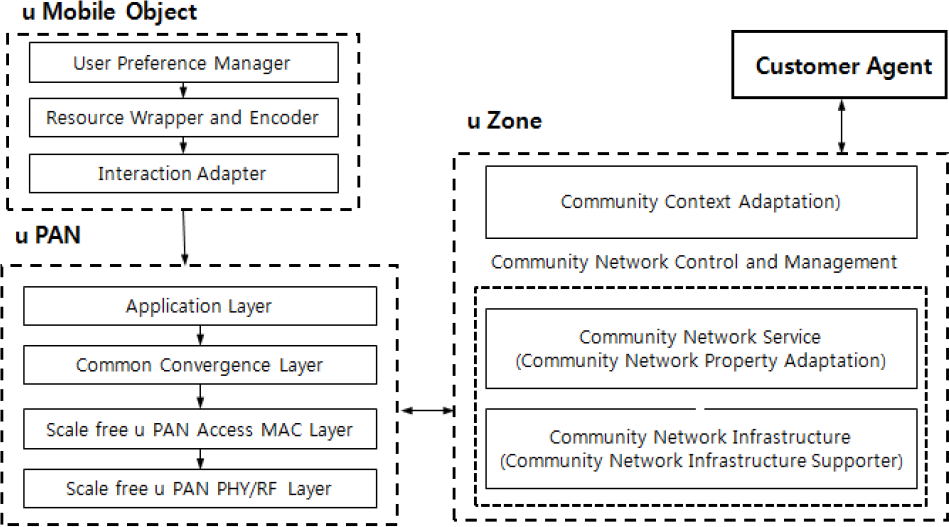
Process of Sending Customer Identification, Preference and Context Information
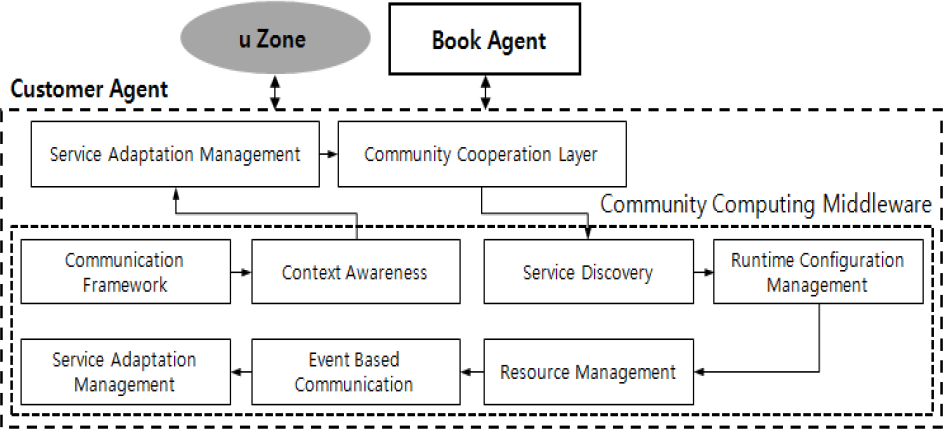
Process of Making a Community to Provide Customized Book Information
The stage, which forms a community to provide customized book information to customers after identifying them entering the bookstore, goes through the following procedure as figure 7. At first, it receives packet-type data sent from the u-Mobile object to reorder the sequence, and then carries out the error correction. Next, it uses customer's identification information, customer's preference, current context information of the customer to infer the 'the latest best sellers and new published book information service for the field preferred by the customer' and to create the 'the latest best sellers and new published book information service for the field preferred by the customer.' Then, it creates and manages a community for providing the 'the latest best sellers and new published book information service for the field preferred by the customer.' It makes a dynamic channel with the book agent and keeps it as the optimum condition after searching the book agent for providing the 'the latest best sellers and new published book information service for the field preferred by the customer.' It searches information held by the book agent, such as the best sellers and new published books for the field preferred by the customer, to carry out packaging. Next, it receives the information from the book agent through the transmission protocol and speed suitable to the community's characteristics. Finally, it learns the 'the latest best sellers and new published book information service for the field preferred by the customer' provided, and carries out the self growing.
The community organizing process to provide the optimum movement is illustrated as figure 8. First, it receives packet-type data transmitted from the u-Mobile Object. After this process, it rearranges the sequence of data and conducts the error correction. At the next phase, it converts data into information to create customers' purchased book lists. And then it organizes community members consisting of Book Agent, Bookshelf Agent, and Traffic Control for providing the optimum movement for purchasing books. After these processes, Book Agent provides book information, and Bookshelf provides bookshelf information. Lastly, Traffic Control Agent provides real-time information about bookstore crowd.

Process of Making a Community to Provide the Optimum Movement to Purchase Based on a Book List
The process of reasoning ‘Optimum Movement Service' as a suitable service for customer context is described as figure 9. Specifically, The context information is created by integrating and transforming the collected data from various nodes.

Process to Reason Services and Create Services for Optimum Movement to Purchase
The every related service management for optimum movement for purchase is conducted by Society Manager. The Society Manager manages member for Community Computing, this task includes community organization/disorganization, community member search and management processes.

Process of Creating, Learning & Managing a Community to Provide Services for Optimum Movement to Purchase
The process, which searches a book agent, bookshelf agent and traffic control agent required for providing the service for the optimum movement to purchase, carries out the following stage as figure 11. At first, it searches agents available to provide the service for the optimum movement to purchase by referring the agent yellow page. Next, it evaluates similarity between the agents, which are required for providing the service for the optimum movement to purchase, and the real agents in the bookstore, and then draws a book agent, bookshelf agent and traffic control agent.

Process of Searching Agent to Provide Services for Optimum Movement to Purchase
The process, which makes a dynamic channel with the required book agent, bookshelf agent and traffic control agent, and keeping optimum condition, carries out the following stage as figure 12. At first, it creates a dynamic channel with a book agent, bookshelf agent and traffic control agent required for providing the service for the optimum movement to purchase. Then, it optimizes allocation of the system resources including CPU, thread and memory etc. based on the existing history for the formed dynamic channel. Finally, it readjusts the dynamic channel between the book agent, bookshelf agent and traffic control agent depending on the internal and external conditions.

Process of Making a Dynamic Channel with Required Agents
The process, which searches book information from the book agent, bookshelf information from the bookshelf agent and real-time in-bookstore congestion information from the traffic control agent to conduct messaging, carries out the following stage as figure 13. At first, it optimally searches resources required for providing the service for the optimum movement to purchase from the resources possessed by the book agent, bookshelf agent and traffic control agent forming the community, and creates a resource table. It downloads a resource framework suitable to the created resource table, and installs it. Then, it manages virtualization to share the resources to be used. Finally, it actually provides the optimum resources such as the book, bookshelf and real-time in-bookstore congestion information etc. suitable to the customer's context and services.

Process of Messaging Real-time Bookstore Congestion Search Information
The real-time detection of changes in event and security vulnerability among communities, and problem solving of information transmission requires support in an independent form as figure 14.

Supporting Process for Agent Network Services
The process, which builds the 'the latest best sellers and new published book information service for the field preferred by the customer' provided, carries out the following stage as figure 15. At first, it carries out new naming to bind the collected resources with the service for the optimum movement to purchase. Next, it supports interaction between the created service for the optimum movement to purchase and the other services supported by the bookstore. Finally, it readjusts the interaction method between services when the condition is changed.

Process of Building Best Sellers and Recently Released Book Information Service for the Area Preferred by Customer
The process, which stores data, context and services etc. used in the service for the optimum movement to purchase, carries out the following stage as figure 16. At first, it stores the lower and higher level context information used in the service for the optimum movement to purchase. Next, it stores the model on environment, context, users and services for the context recognition used in the service for the optimum movement to purchase. Finally, it stores names, main attributes etc. for the service for the optimum movement to purchase to be provided.

Storage Process of Data, Context and Services for Optimum Movement to Purchase
5. Conclusion
In this study, I have designed u-Business service system in the perspective of business process for large bookstore by utilizing ubiquitous computing technologies. For developing this system, I have expanded the existing e-Business developing methodology considering u-Business characteristics. Specifically, I put more priority on grasping user needs than understanding the current status of technology. The u-Business service has been designed to meet user requirements. The u-Business killer service was deduced by using service evaluation model. Then the necessary resources were identified and the capability system was developed to realize the u-Business killer service system. This study results could be used as a service for composing u City, which is complex of ubiquitous computing technologies.
As a result, the 'service to provide customers the book and location information, the optimum movement for purchase after the bookstore understands information on the book that customers want to purchase' was selected as a u-Business killer service required from large bookstores. For the selected u-Business service, resources and an information system were designed based on the community computing and a service scenario was described stage by stage, and then the system modeling for it was carried out stage by stage together with the service scenario. In detail, the u-Bookstore business service system was built as a u-Business service, each business flow was described according to the stage 1, 2 and 3 for the u-Bookstore system.
By exploiting various ways to draw u-Service's requirements needed in the future-enabled ubiquitous computing business environments and proposing directions to implement them, this study's result is anticipated to suggest validity for developing ubiquitous computing related technologies, and it is expected to utilize as fundamental data for spreading u-Business.