




Abstract
The use of Information and Communication Technologies has significantly improved the efficiency of modern supply chains. Existing IT architecture is too rigid to allow new technologies such as RFID technologies to be implemented. With the aid of virtualisation and integrated with cloud services, infrastructure hardware and network devices can be consolidated into a physical device, reducing the cost of ownership. However, for such cloud services model to work correctly, a high speed network is required between each site and the cloud service provider. This poses huge challenges for real-time system such as RFID-enabled supply chains. Since modern supply chains operate on a global platform, it is almost impossible to assure availability of high speed networks across the global supply chain. This paper proposes two solutions to supplement the virtualisation and cloud services model. A sub-cloud services solution, where each service is distributed across multiple hosts across different countries and regions is proposed to enhance accessibility to higher bandwidth networks. The second solution is the Queued Burst Device Compression system incorporates a compression service that compresses RFID data sets into much smaller packages. This solution is proved to work by a multiple-in-single-out queuing model and is suitable for low bandwidth networks such as GPRS and 3G wireless environmenst.
1. Introduction
Supply Chain Management (SCM) is a highly competitive low margin high volume industry, where consolidation, plant and equipment, time and information management drive the performance of each link within the SCM realm. Most supply chains have been using the Internet as the communication backbone and benefit from the ability to transact with reasonable response (Sheng, Q. et al, 2010). Recent developments in passive Radio Frequency Identification (RFID) has further improved efficiency and accuracy over conventional barcode system by having the ability to scan without line of slight (Landt, J., 2005). The use of standardized Electronic Product Code (EPC) network has enabled real-time information transfer between supply chain partners adopting a common standard (Hoey, J. et al, 2009). However, it is also very expensive to maintain a high quality network across the supply chain. For most small to medium enterprises (SME), the initial costs of setting up the network infrastructure outweigh the benefit received from technologies like RFID (Lutton, E., 2008).
Network resource and bandwidth are very important factors implementing RFID network. One cannot assume that every RFID network device will always terminate in a perfect network work environment (Golding, P. & Tennant, V., 2007). In some cases, companies would often utilise an array of General Pocket Radio Service (GPRS) or Third Generation (3G) wireless network services to initiate the establishment of a new or temporary site, where fixed line communication cannot be established.
However, standard RFID implementations require fixed static public IP address (Mo, J. et al, 2009). Establishing static IP address with GPRS / 3G wireless network is not always possible, since most network provider only have limited number of IP available. Furthermore, signal and network resource load from 3G network may not be enough to sustain a real-time network such as RFID (Yang, S. et al, 2009).
With the concept of virtualization, IT infrastructures can be consolidated into physical devices reducing the cost of ownership and provide better redundancy support (Petrucci, V. et al, 2010). When a virtualized infrastructure is linked to cloud computing, the system performance can be further improved by centralising information such as EPC-IS data within the cloud instead of being distributed behind the firewall of private networks. The effects are improved performance of data integration processes, reduced dependency to endpoint links as well as lower overall cost of ownership (Chen, C., 2010). However, since each physical device will need to communicate directly to each cloud services, cloud computing model can function correctly and effectively only if high-speed broadband links are available (Fig. 1). This poises a challenge for newly develop estates, where high speed broadband are not always accessible and organisations often rely on GPRS/3G wireless networks, which do not have adequate bandwidth performance for cloud computing.

Comparison between EPC-IS data hosted using cloud service provider and private end points
In this paper, two methods of optimising cloud services and end-points connection within the RFID realm are proposed. The first method is to introduce multi-hosted services Sub-Cloud Services (SCS) which route services depending on the location of the end-points via DNS lookup. By utilizing an Internet resource that is generally available, the setup cost for the system can be reduced significantly. The second method uses Queued Burst Device Compression (QBDC) technique that can optimise the communication of physical devices and cloud services and reduce the network overhead. The effect of using QBDC improves the communication network efficiency substantially and enables large amount of RFID information to be transmitted through low bandwidth networks.
2. Review of RFID Frameworks
One of the most well known RFID frameworks is EPCglobal's EPC Network. Many pilot demonstration projects have been reported. For example, two national demonstrator projects that track fast moving consumable goods and mobile assets across different cities and multiple enterprises have been reported (Mo, J. et al, 2009). The national demonstrator projects allowed different organisation with defined roles to interact with each other in a secure and transparent manner, using EPC Network. However, the rigid IT infrastructure of EPC Network imposed several restrictions to a broader implementation to SMEs.
In the EPC based IT infrastructure, it is assumed that all connections are always active. However in the real-world, it is very difficult for an organization to keep its network running all the time, let alone ensuring that the network of all related supply chain partners are also operating as well. Furthermore, each organisation could also face issues that are outside their control, such as link failure at their internet service provider (ISP) or physical failure at their end-point, which could ultimately reduce the overall reliability and availability to their supply chain network.
Since each organisation in the EPC Network stores its local Object Name Server (ONS) and their Electronic Product Code Information Server (EPC-IS) behind its company firewall, in order to validate critical transaction, such as change of ownership, the EPC-IS will need to query multiple EPC-ISs of other organisations. Therefore, the integrity of the supply chain transaction is heavily depended on the availability of the EPC-IS servers that are individually maintained by each organisation (Fig 2). If one of the links is broken, critical information for identifying the ownership of an EPC is missing and hence the transaction is a failure (Wamba, S. et al, 2006).

Possible data integrity issue when EPC-IS queries other EPC-IS databases through unreliable link
Apart from EPCglobal, three other major RFID frameworks exist. The Japanese Ubiquitous ID (UID) supports a better way of living by providing computing capacity to various entities in the living space (Ubiquitous ID Centre, 2006). Hence, UID promotes the sense of “context-awareness” and provides a platform for information exchange and collaborative operations using its own protocol. In China, there has been a lot of push to create a separate RFID standard for the upcoming large consumer market. The Chinese National Product Code (NPC) standard has been evolved from its own product coding scheme and is fast catching up with the world given its dominant position in manufacturing and consumer goods supplies (National Standard of PRC, 2003). The International Standards Organization is currently working on a universal standard that aims to encompass all industry de facto standards. The ISO 18000 series RFID standard has 7 parts. Part 6 is the closest to EPCglobal, UID and NPC with a frequency range of 860–960 MHz. Given these inconsistency among RFID systems, it is necessary to develop new systems that can work with these standards.
3. Virtualization of RFID Networks
Devices with different identification technologies can be emulated and then consolidate in a physical host (Mo, J. & Lorchirachoonkul, W., 2010). The virtual devices have the same characteristic as the physical devices and share the resource of a physical host. Therefore network appliances and servers can be consolidated into a physical host. The resources of the physical host are then managed by a hypervisor which acts as a central resource manager for all emulated virtual devices. Virtual devices are stored as an image file within the hypervisor, therefore it can be backed up with preset configuration, or be deployed as multiple instance. Organisations within the virtualized RFID system can scale up and improve their network efficiency and reliability easily.
RFID network virtualization concept can be integrated with cloud computing readily by centralisation of infrastructure across the internet cloud. Software as a Service (SaaS) is a common term used to describe applications that are hosted within the internet cloud (Houlding, D., 2007). Thus, complex RFID network infrastructure, such as the EPCglobal can be remodelled with virtualisation and cloud computing technique to provide greater scalability, reliability and affordability when compared to standalone physical infrastructure.
The reliability and performance of supply chain networks are improved when the applications are hosted within the internet cloud. Access to critical data, such as EPC-IS can be queried directly from the internet cloud, instead of behind an access point protected by firewalls that are managed individually. However, this would also mean that the physical RFID readers will also need to communicate directly with the SaaS. If there are multiple readers collecting large amount of data from a single site, a reliable internet link with high upload speed as a critical component for implementation of RFID networks.
However, high speed internet link is not always possible to acquire, especially in new develop industry estate. In many case, newly developed warehouse will often rely on GPRS and 3G wireless connection as their primary source of internet. To further improve the performance of wireless networks throughput in remote locations, some SCM organisations utilise network load balance technique, where multiple Universal Serial Bus (USB) GPRS/3G wireless adaptors, from various network operators are used to increase bandwidth and network performance in shared environments (Peng, M. & Wang, W., 2008; Jiang, W. et al, 2009). Wireless router manufacturer such as Cradle Point (http://www.cradlepoint.com) manufactured routers which have built-in wireless access point for multiple USB wireless interfaces. It also has a built-in quality of service (QOS) function to optimize the local network traffic. Since the resource of multiple network providers are used, it is very difficult to establish a reliable static public IP address, which is paramount for existing RFID network.
4. Cloud Services in Limited Bandwidth
Cloud computing assumes a high bandwidth environment. In May 2010, several shopping centres and distribution centres in Bangkok, Thailand was set on fire by Thais protesters (The Age, 2010). As part of a disaster recovery plan, temporary distribution centres were setup outside the city centre, however access to high speed broadband was not available. Thus GPRS / 3G wireless network were used as a primary internet link until the fire damaged distribution centres can be rebuilt. Designing the cloud system with a crippled IT infrastructure is a significant challenge.
4.1. Sub-Cloud Services (SCS)
For most SMEs, web based applications such as SaaS are commonly hosted from a single location. This is usually from a dedicated data centre or a secure robust office environment. In general, applications would communicate from a server to the clients via series of routers connected between different ISPs. As the physical distance between server and the client increase, so do the expected increase in the number of routes between ISPs.
In a global supply chain, organisations from around the world will need to access the same set of information. If the SaaS was hosted in a single location, the service level of SaaS cannot be guaranteed. This is particularly concerning when real-time transaction data are being transmitted directly from physical devices such as RFID readers with a low quality internet connection.
It would be very inefficient if RFID readers interact with a single hosted cloud service only. The RFID data can also take different routes to access the cloud service especially if the devices are in different countries/regions to the hosted site. Therefore, an Internet cloud should be not be viewed as a single cloud but as serveral small segments of sub-clouds that are jointed together by different routes to create an internet cloud network.
Within the internet cloud are series of routers which connect each access point to their destination. Typically, if the servers and the access points are geographically close to each other, there would be less routing between sites when compared to servers that are placed geographically further away. Thus the requirement for high speed smooth operating condition is one of the critical requirements in order to implement a real-time system, such as RFID, especially if cloud computing technologies were to be utilised.
In order to improve the performance of the cloud service across the global supply chain, sub-cloud services will need to be deployed across various major ISP around the world. When a registered device wants to access the cloud service, an IP lookup is performed to determine the location of the client and nearby servers are nominated. The nearby servers can be checked using ping and jitter measures (see next section). The information obtained from the registered device is then replicated to the adjacent hosts to provide additional redundancy and improve clustered performance (Fig. 3).
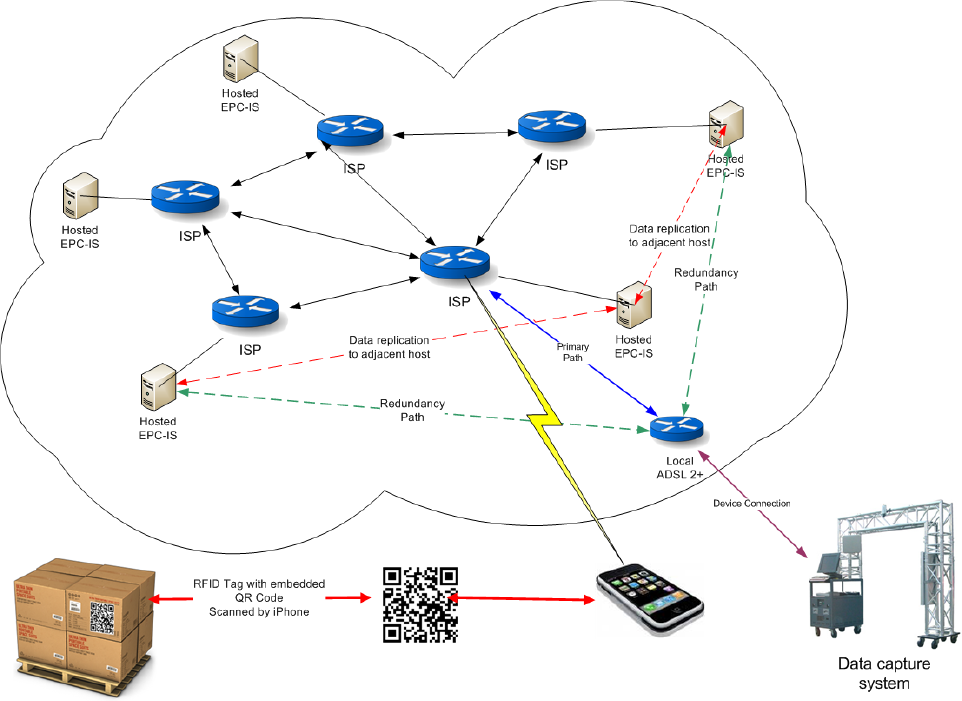
Multi-hosted sub-cloud services (SCS) providing additional redundancy and improved performance
Hence, the “sub-cloud services” solution will:
Reduce the volume of data required to be route between each physical endpoints.
Increase the reliability of the each service layers, by utilising data replication and publication across a multi-hosted solutions.
Ability to repackage so that it can then be used with other enterprise model.
4.2. Queued Burst Device Compression (QBDC)
When utilising a high quality internet connection, the ping speed between server and access point is relative fast. However, with a wireless connection, such as GRPS / 3G, the connections to the access points are terminated with additional wireless interface which have higher overhead than a wired DSL connection. Thus data rate are heavily depended on the reception quality between the mobile towers and the wireless access point. This is particularly detrimental to the response of the whole network if the low bandwidth segments are critical.
We propose a process called “Queued Burst Device Compression” (QBDC) technique. The technique compresses data between access points and sub-cloud services. Since nearly all RFID readers send back EPC tag information as a text string, which are highly compressible, instead of sending the RFID data immediately, the RFID readers redirect the EPC tag information to a QBDC application which stores the tags information into memory. At a defined burst interval, the QBDC application then write the tags information as a text file, which is compressed and then dispatched to the cloud service (Fig 4).

Data compression using Queued Burst Device Compression (QBDC)
Since the compression ratio is approximately 10 times those of the uncompressed data, it is in fact faster to queue the data and then transmitted in burst intervals than to send raw data directly from the RFID reader.
Products are often received in palletised packages between distribution centres. RFID tag readers are often place at loading dock doors to confirm the arrival of the products. For typical RFID operations like those in the national demonstrators (Mo, J. et al, 2009), over 100 tags are being read in a single pass. The data size for such a single pallet read is about 20k bytes. In normal EPC system, this data will be sent out immediately by the middleware on site to the server (often outside of the site). This case can be modelled by a typical single-in-single-out queuing model as shown in Fig. 5.
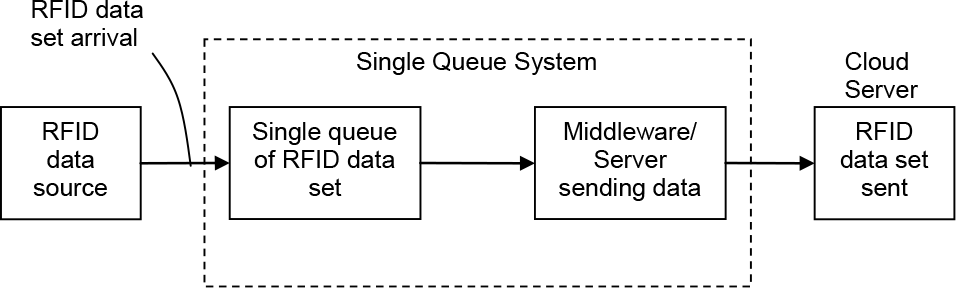
Single-in-single-out queuing system for RFID
However, there are many dock doors and RFID read requirements in a distribution centre. This will constitute a multiple-in-single-out queuing model as shown in Fig. 6.

Multiple-in-single-out queuing system for distribution centre IT infrastructure
This would then put pressure on the end point connection to the cloud service, especially if the upload speed is poor. If the total rate of the data streams exceeds the upload bandwidth, then any untransmitted data will have to remain in the queue.
To check the performance of the network, a test was conducted in Bangkok, Thailand in May, 2010. The ISP used was Total Communication Access and DTAC SIM with 100% reception. Currently, 3G is only available in the metropolitan area of Bangkok only and therefore cannot be the benchmark condition used to implement our solution. GPRS / EDGE provide most of coverage in Thailand. It is noted that SIM from Advance Information Service (AIS) was also tried, but the test with SIM could not obtain any valid result due to poor connectivity.
The test was conducted, using www.speedtest.net and www.pingtest.net during non-peak period (Table 1). A number of parameters were tested. These include:
Network Quality test using GPRS / EDGE network
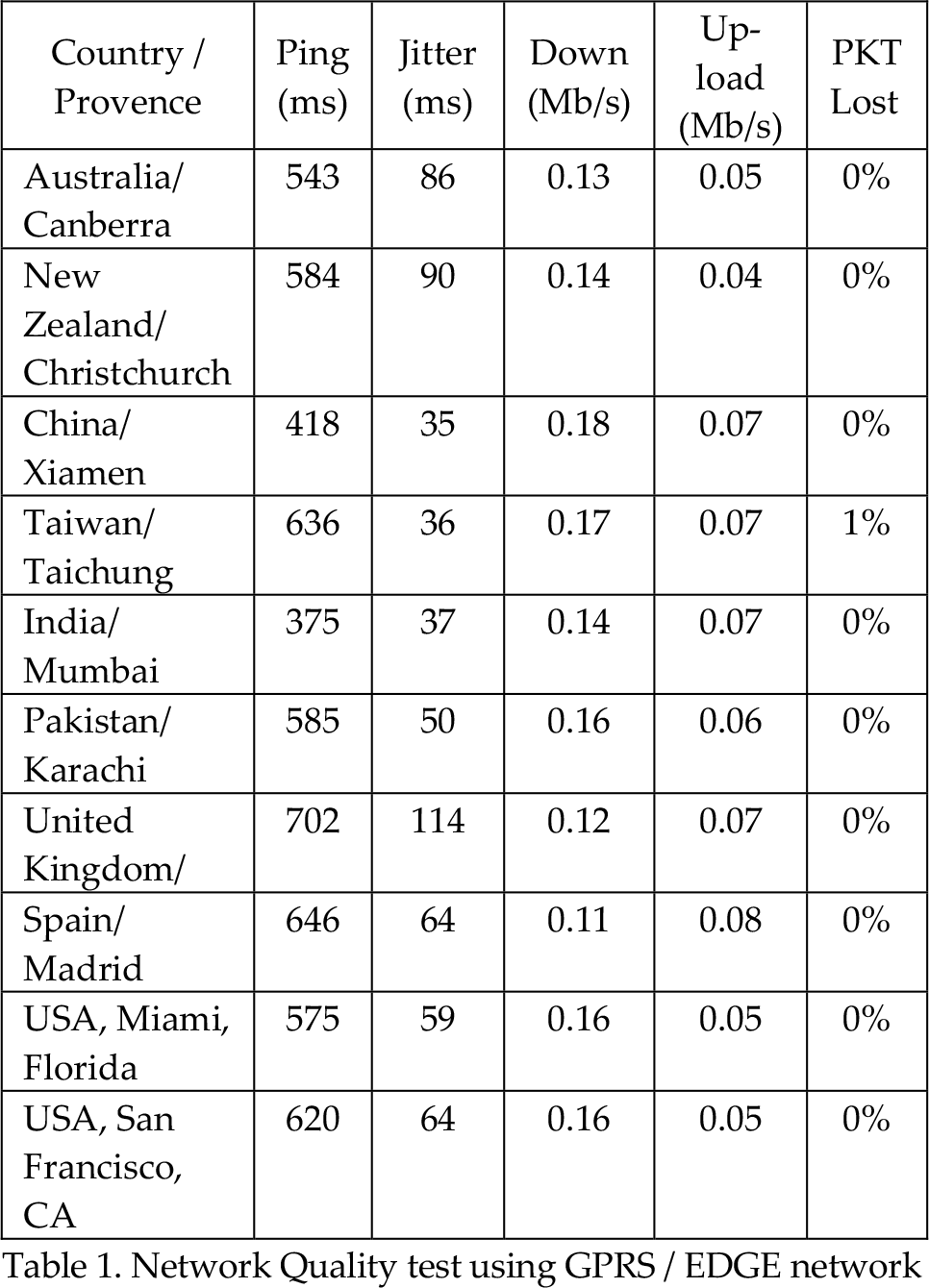
Assuming 100 RFID devices are on site, each with a refresh rate of 30 ms, the rate of RFID data set arrival will be 3.3 sets/ms. For a GPRS connection that has an upload speed of 0.05MB/s, the rate of data sending out is 2.5 sets/ms. This is obviously insufficient.
QBDC can help to prevent such failure by compressing the data sets in realtime and group them into RFID data package before tramitting to the cloud services. Basic zip encoding can have a compression ratio approximately 10:1 (Subathra, S. et al, 2005). Hence, instead of sending the RFID data sets out as they are received, the system sends the data out every n data sets (Fig. 7).
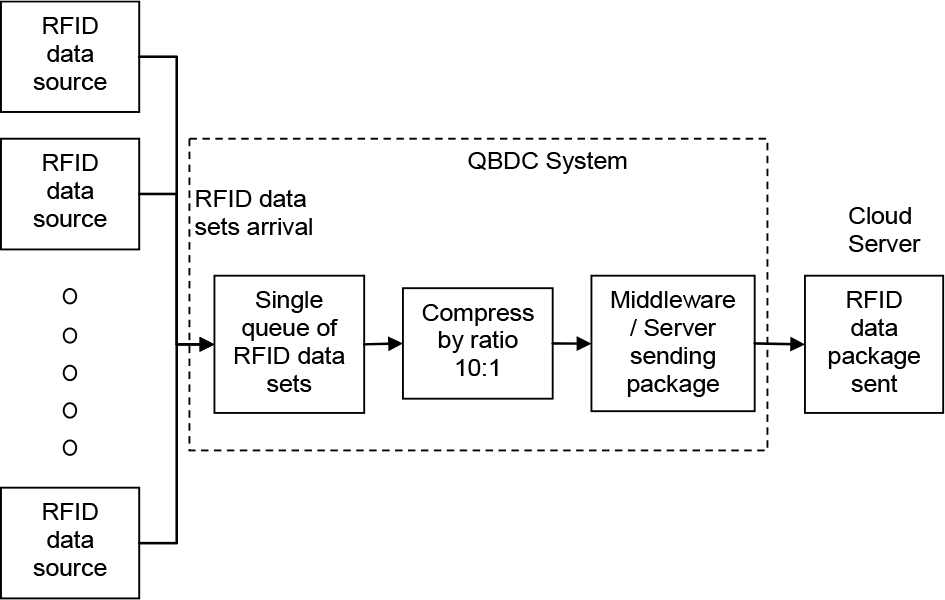
The QBDC queuing system
The queuing model is then changed to:
RFID package accumulation time = n/3.3 ms
Compression time = t ms
RFID package available rate = 1/[n/3.3 + t] packages/ms
RFID package clearance rate = 25/n packages/ms
Hence, even if t = 0, i.e. compressed immediately, the supply of RFID package rate is always less than the RFID package clearance rate.
5. Conclusion
In this paper we discussed the challenges in the deployment and maintenance of an integrated RFID system in low bandwidth network environments. Utilising virtualisation and cloud computing concepts to remodel the network services, a scalable, reliable and affordable implementation of RFID system can be achieved. However, a high quality internet connection is required at each end point in this infrastructure design. Unfortunately, high quality internet links are not always available. In many cases, low speed GPRS/3G wireless connections are the only available internet connections, especially in newly developed industry estate. Two solutions are proposed to enhance the performance of cloud computing implementation of RFID systems. Sub-Cloud Service (SCS) is based on a multi-hosted cluster environment, where each access point is automatically routed to the nearest sub-cloud host. The routing table is initiated by considering geographical closeness as well as ping and jitter measures. Techniques such as data replication between adjacent hosts can be used to improve reliability and performance of RFID servers in the cloud. The second solution is the Queued Burst Device Compression (QBDC) model, which provides on the fly compression for low quality links. QBDC stores data sets obtained from RFID readers in a queue, then compresses and sends it at defined intervals. The compressed data are decompressed and processed at the cloud hosts. A queuing model has been presented to prove that this process reduces the network overhead suffered when transmitting in small segments of transaction data across low quality internet links.