




Abstract
In the modern era, patient health is no longer the only concern for hospitals. Hospitals have to bear the responsibility of the patient safety and the patient comfort. However, due to the overcrowded and understaffed clinical areas with complex workflow patterns, there are different forms of medical care errors arisen in the healthcare system. According to recent statistic from World Health Organization, ten of milions of patient around the world are injured or dead every yearas a result of incorrect medical care. Rroughly 10% patients admitted to hospital in developed countries suffered some forms of medical care errors or medical adverse events. It is about 1.4 million of world population.
In order to enhance the patient safety and patient comfort in the current medical service system, an RFID-based Patient Tracking and Mobile Alert System integrated with information communications technology was designed and developed. Apart from identifying different patient's whereabouts, instant alerts are generated through mobile devices so as to enhance patients' safety and comfort. With a view of investigating the feasibility of RFID and mobile technology in the healthcare environment, a pilot study was conducted in Mindset Club in the Castle Peak Hospital in Hong Kong.
Keywords
1. Introduction
In the current understaffed and high population flow healthcare industry, it is not surprising to hear that patients suffer from medical care errors. According to recent World Health Organization (WHO) publication regarding patient safety (2009), ten of milions of patient around the world are injured or dead every year as a result of incorrect medical care. Rroughly 10% patients admitted to hospital in developed countries suffered some forms of medical care errors or medical adverse events. From the statistics of the WHO in 2006, around 1.4 million people worldwide were injured due to medical care error.
As stated by David Plow, Senior Analyst at the Millennium Research Group, medical care errors in the healthcare system arise from miscommunication, physician order transcription errors, adverse drug events, incomplete patient medical records or from overcrowded, understaffed clinical areas with complex workflow patterns (Medical News Today, 2007). For example due to the fact that real-time medical information is not available a physician may not know what treatment a patients has already received previously and so the physician may prescribe inappropriate treatment or procedures. In some cases, a patient may get injured or lost resulting from lack of communication between medical units.
Moreover, some patients are incorrectly identified and given totally inappropriate medical treatment because the working areas are understaffed. This not only increases the worry of the injured patients as well as that of their families, but also may affect their health condition. In the worst case, patient fatalities will be caused due to medical care errors. Therefore, the recent guidelines on patient safety has suggested that physicians should clearly identify their target patients (World Health Organization, 2006).
Traditionally, patients are identified by wristbands in hospitals. With the development of the technology, barcode systems are now widely used for patient identification. Up to 2006, it is estimated that 70 percent of all medication containers had bar codes Bar codes can also be used for identifying patients and staff (Nahas, H. and Deogun, J., 2007). However, due to the non-uniqueness and non-multiple reading properties of barcode system, medical care errors have still arisen in the understaffed and high population flow healthcare industry.
Radio frequency identification (RFID) is one kind of burgeoning technology and its applications ranges from supply chain management (Park, K. et al., 2010), production (Kwok, S. and Wu, S., 2009), inventory management (Choy, K. et al., 2007) and physical asset management (Kwok, S. et al., 2008b). Due to the increasing awareness of RFID and its advantages, many researchers have begun to investigate the use of RFID technology in healthcare management (Lahtela, A. et al., 2008; Garfinkel, S. and Rosenberg, B., 2006) and pharmaceutical management (EPCglobal standard, 2007). For example, RFID technology has been used for tracking of physical assets in hospitals (Janz, B. et al., 2005), blood transfusions (Domdouzis, K. et al., 2007) and psychiatric patient localization tracking (Huang, C. et al., 2008). These examples show that the RFID technology has benefits for healthcare industry. However, few studies addressed the integration of RFID devices with other technologies such as mobile and sensor devices and mobile messaging services to improve understaffed and high population flow healthcare environment and enhance patient safety.
RFID technology is capabile of communicating or integrating with other partners or platforms. It can be applied to meet international standards such as EPCglobal and ISO 18000 series. For example, in the pharmaceutical industry, RFID is being adopted to trace and track each pharmaceutical product. With the use of international standards, technology and networks, the product pedigree, which is a certified record that contains information about the distribution of each prescription drug (EPCglobal standard, 2007), can be retrieved for enhancement of logistic visibility, product authentication and anti-counterfeit applications (Kwok, S. et al, 2010; Kwok, S. et al, 2008a).
Apart from recognizing identity and tracking locations, RFID has been integrated with other sensors for monitoring and management (Jedermann, R. et al., 2006). For example, RFID with a temperature sensor embedded in it has been used in the healthcare industry for the wireless detection of patients' temperature and for monitoring (Opasjumruskit, K. et al., 2006). In order to manipulate the data effectively and efficiently, wireless communication networks such as 3G, GPRS, Wi-Fi, Bluetooth and Zigbee are adopted. This ensures real-time information acquisition and enquiry wherever the users happen to be.
Furthermore, mobile technologies have been increasing used in the healthcare industry to facilitate the work of physicians (Ting, J. et al., 2007). It is not limited to laptop, personal digital assistant (PDA) (Liang, T. et al., 2007) and mobile phone, but also includes portable data carrier and wireless communication devices. Apart from facilitating communication and exchange of information between physicians, it greatly helps in generating alerts as well as increasing the patient's satisfaction with the healthcare services. One of the significant examples is mobile messaging using mobile phones.
The Short Message Service (SMS), a value-added service in the mobile phone network, is one kind of communication protocol that allows text messages to be sent between mobile phones and other devices. It is based on the development of the GSM Phase 1 standard and is supported by almost all types of network standard including GSM, PCS and Code-division multiple access (CDMA). In general, the texting of SMS messages is limited to 160 characters. The messages can be received only if the mobile phone is within wireless transmitter range and if the mobile phone is switched on. In view of the fact that SMS uses up less bandwidth spectrum than voice telephony traffic and messages do not have to be delivered in real-time as is the case with voice telephony, the cost is relatively lower. Even though there is a cost for sending text messages, it is usually free of charge when receiving normal text messages (Elliott, G. and Phillips, N., 2004).
Besides, the SMS has been used to facilitate the Psychiatric Rehabilitation Services. Mental illness patients were reminded to carry out daily activities (Pijnenborg, G. et al., 2007), take their medication and to answer questions about their well-being with the use of SMS (Volcke, D. et al., 2007). It has been concluded that SMS text messages can be effective in compensating for cognitive impairment in some, but not all, individuals with mental illness (Pijnenborg, G. et al., 2007). Apart from this, patients felt cared for by receiving SMS. A high level of SMS compliance and benefits had been demonstrated by patients and psychiatrists (Volcke, D. et al., 2007).
According to Portio Research, SMS market in Asia is projected to grow from 540 billion messages in 2005 to over 1.2 trillion by 2010. The revenue generated from SMS usage grew from $11.1 billion in 2005 to $15.1 billion in 2009. Due to the growing penetration and revenue of SMS usage, an Enhanced Message Service (EMS) and a Multimedia Message Service (MMS) have been created. Apart from leveraging the SMS infrastructure, better quality and media rich message can now be delivered. With the increasing use of RFID devices, wireless communication networks and mobile technology, a more comprehensive patient tracking and monitoring system in the healthcare industry can be established.
In the healthcare industry, in order to improve patients' safety, it is important to clearly recognize patients' identities. With the development of the technologies, RFID devices can integrate with different sensors and mobile devices to provide automatic patient identification and real-time location tracking. By using emerging messaging services, instant mobile information transfer and alert can be conducted. In striving to achieve a high standard of patient safety in the healthcare industry, a framework of an RFID-based Patient Tracking and Mobile Alert System (RPTMAS) is proposed. A pilot study was conducted in the Mindset Club in the Castle Peak Hospital in Hong Kong to investigate the feasibility of using RFID technology in the healthcare environment.
3. Framework of an RFID-based Patient Tracking and Mobile Alert System in Health Care Organizations
A conceptual framework of the RPTMAS integrates RFID technology, Wi-Fi technology, Bluetooth technology, SMS technology and GPRS technology in a communication tier. This can be used to connect with applications of an RFID-based identification module, a location awareness module, an electronic medication module, an electronic activity registration module and a reach-out alert module, as shown in Fig. 1.
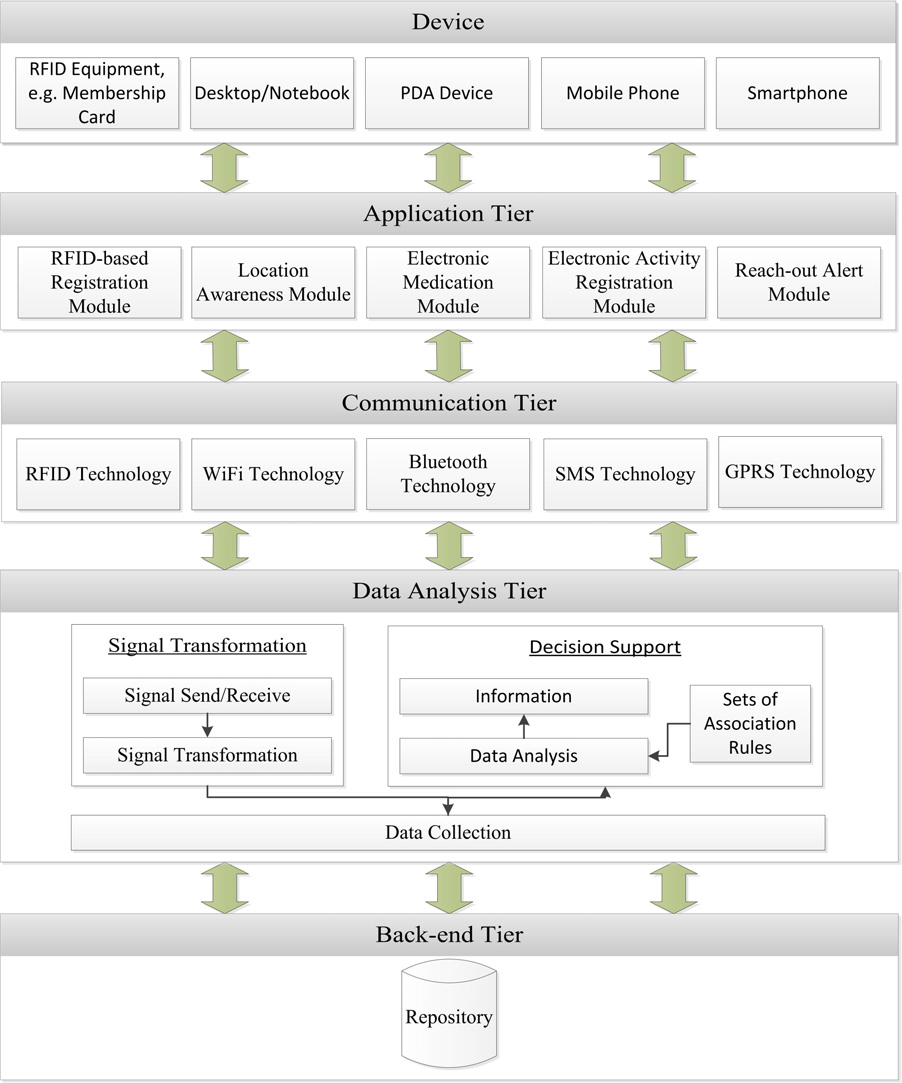
A conceptual framework of an RPTMAS
RFID technology is a wireless identification technology which is applied for user identification, real-time location awareness and document management in the framework of RPTMAS. Traditionally, patients' medical histories are recorded in a written format. A long time is needed for recording, searching for, reading and understanding hand written descriptions on medical records. The RFID technology applied in processes of patient identification and document management greatly improves the accuracy of case retrieval and provides the right medical services to the right patients. In these processes, the RFID signals are sent from RFID readers to passive tags, embedded in bracelets, membership cards and medical records, and signals are received by the reader. The data are transformed, by applying a number of sets of association rules into relevant information, which gives decision support to a caregiver.
In the current understaffed and high population flow healthcare industry, it would be difficulty for staff to know the exact location of each client at any given moment, and ensure they are not in some unauthorized area where only staff are supposed to go. In order to maintain a safe environment, RPTMAS can track people in indoor environments in an effective and efficient way, which is shown in Fig. 2.
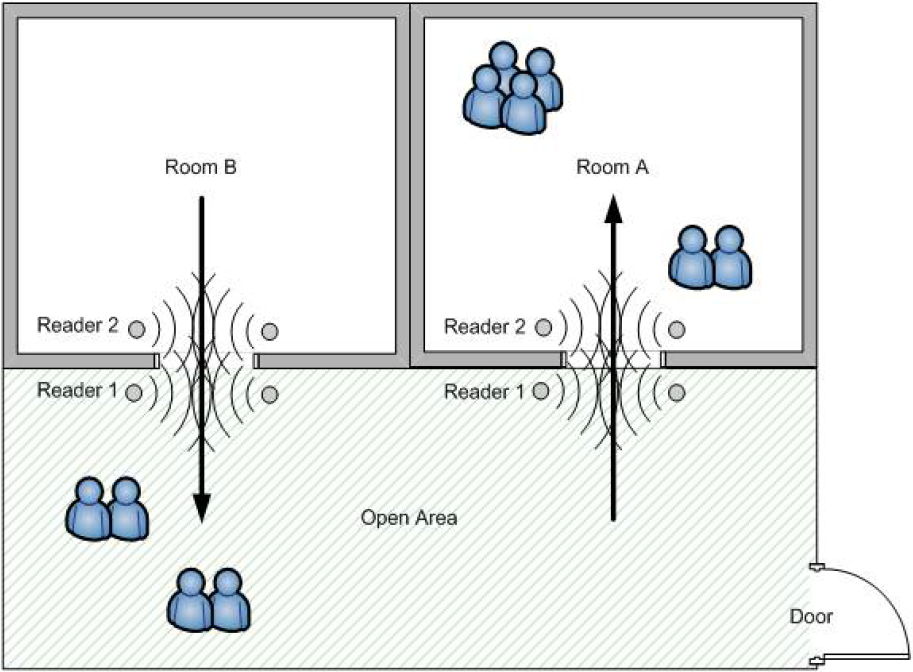
A schematic diagram of the Location Awareness Module
Two sets of RFID antennae are separately set up inside and outside an entrance for receiving signals generated by tags. The analysis of the data collected determines whether these people have walked into or out of the room and shows how many people have stayed in the room. The time when the signal is received and the sequence in which signals are detected by readers are two critical factors to identify the movement of people. If a signal from a tag is first detected by reader 1 and is subsequently detected by reader 2, the person to whom the tag is attached must have walked into the room. Furthermore, a pathway walked by people indicates their interest in products/services/activities provided in the rooms. By using data collected from the RFID equipment, human behaviour and people's preferences can be analyzed.
When an RFID system is designed for use in a health care organization, a number of readers are set up at certain locations for receiving signals from tags which are embedded in a membership card. When patients walk in or out of a room, the reader transmits signals to the passive RFID tag for energizing it and, in turn, signals are transmitted from the tag to the reader. Through sending and receiving a series of signals between the reader and the tag, the locations of the patients are identified and are automatically tracked in the system in real-time. In Fig. 3, a schematic diagram for applying the system for tracking patients as the visit various locations is shown. This shows a scenario in which some patients go to a wrong location in a healthcare organization

A schematic diagram for applying the RPTMAS for patient location tracking
When a patient walks from one zone to another zone, the location, arrival time and departure time are recorded. After the captured data is analysed, any abnormal event generates an alert message and an SMS notification is sent to mobile devices carried by staff, such as a smartphone, PDA device or mobile phone. The caregiver uses this instant information to take action for risk prevention. For on-site services, the caregiver can use a mobile device through a Wi-Fi network, Bluetooth technology or GPRS technology to check and update patient's status and treatments in real-time. This will improve, to a large degree, the efficiency with which information is retrieved and appropriate action is taken. However, there are limitations in implementing it in such health care organizations. The patients may not have put on the tag in the right way or they may even have thrown it away. The RFID tags are then undetected by the reader so the patient's whereabouts can not be successfully traced. Patient privacy is one of barriers for implementation of the RFID location tracking systems in an organization. In the following section, the feasibility of adopting RFID technology in a community psychiatric service is investigated.
4. Case Study and Discussion
Aiming at investigating the feasibility of using RPTMAS in the healthcare environment, a pilot study was conducted in the Mindset Club in the Castle Peak Hospital in Hong Kong. The Mindset Club is a multi-functional community centre which provides various activities such as vocational training and self-help groups for the patients of Castle Peak Hospital and their family members. Its aim is to provide a place and a platform for mental patients to be rehabilitated, that is to give and receive mutual support and to learn how to adapt and re-integrate into the community so as to increase their sense of belonging to the community. However, due to the increasing number of people undergoing rehabilitation, and consequently the greater number of attendant family members, it is hard for the staff to identify those who are being rehabilitated. The records of those being rehabilitated might get mixed up and thus increase the chance of medical care errors occurring. Moreover, since the number of employees in the club is limited, it is difficult for staff to keep track of all the club members and thus it is very hard to eliminate accidents.
With the aim of improving patient safety and comfort, a real time identifying and zone-based tracking system, RPTMAS was developed and implemented to monitor patients as well as those being rehabilitated. In this pilot study, the devices of RPTMAS were placed in the actual locations of the end-user's venue during daily life activities. In the following part, the real-life setting of the RPTMAS will be demonstrated in Fig. 4.

RPTMAS for Front End Operations
When a patient arrives at the Mindset Club, he should visit the reception first and use his RFID passive tag to carry out self-login. After placing his RFID passive tag on the antenna of the RPTMAS, the tag as well as patient information will be detected and the stored information will be shown in the system interface. (See Fig. 4a). If the information is correct, the patient starts to select the services such as meeting with staff or attending self-development classes provided by the club. The patient completes the self-login process after entering the required information. At the same time, a SMS will be sent to the patient's family member to inform them of the safe arrival of the patient. The SMS will include the arrival time of the patient as shown in Fig. 5a.

RFID Gateway in each room
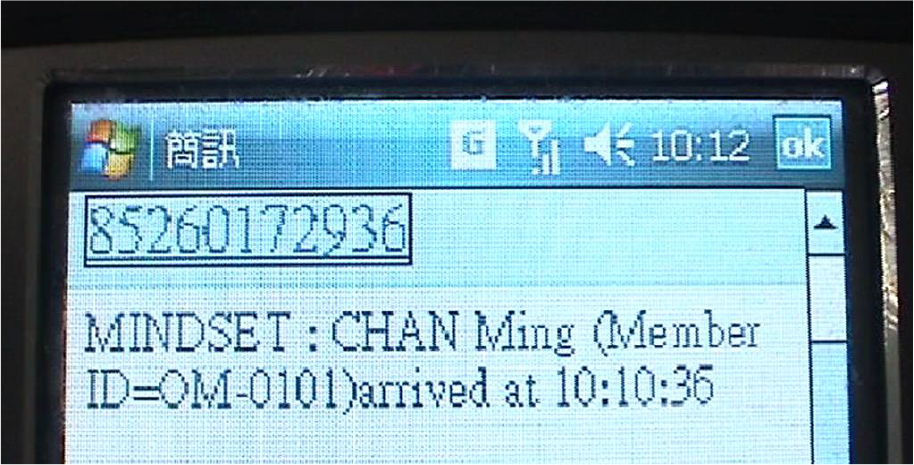
The safe arrival SMS of patient to family member
Apart from this, the RPTMAS can keep track the patient's real-time location in a zone-based level. When a patient has visited a forbidden area, where only staff can go, or stayed at a place over the usual time period, an alert message will be generated. The alert message will be displayed to a staff member via the SMS in the mobile devices such as smartphones or PDA and the online platform of RPTMAS and will give details of the patient and his or her real-time location. The staff member can take action at once to avoid any incident. The SMS sent by the RPTMAS is shown in Fig. 5b.

The alert SMS of patient to staff member
An investigation into the benefits after implementing the system will now be conducted. As mentioned before, several baseline measurements such as the average time spent by a member of staff to handle one daily duty like to recognize patient's identity or to check on the whereabouts of one patient and the accuracy of the data recorded in the patient's log have been calculated. A comparative analysis based on the statistics collected is shown below. As for the average time spent by staff to deal with one daily duty, it was found that the average time is decreased to 30 seconds which is a saving in time of over 80% when using the RPTMAS, the RFID-based system. The detailed calculation is shown in Table 1. Due to the significant drop in the time spent on dealing with one daily duty, the time spent on patient monitoring in general can be greatly increased. Moreover, the accuracy of the data recorded in patient's attendance record has been investigated. It is shown that all the 100 attendance records taken by the RPTMAS, the RFID-based system, are complete and correct. In the manual system, only 168 records in a sample of 200 records are complete with the right data. The detailed calculation is shown in Table 2.
Average Time spent in Handling One Daily Duty in minutes

Accuracy in Recording Data

Since the accuracy of the data recording has been enhanced, several medical care errors such as wrong patient identification and inappropriate treatment of the patient can be reduced. Therefore, the system can provide a cost-effective solution to the problem of patient monitoring.
Apart from great improvements in patient satisfaction, there are benefits gained by the staff. With the use of the system, staff can spend less time on daily duties. No matter when and where they are, they can find and access the information they want, such as patient's actual location, personal and medical information, within a very short period of time. In general, the time for searching patients in the club or finding patients' information used to take 3 to 5 minutes. Now, by using the RPTMAS, the RFID-based System, staff can access the information they want in 10 to 15 seconds. This leads to a great enhancement in staff productivity as well as in staff satisfaction. Staff can spend more time on monitoring patients due to the increased efficiency in recognizing patient's identity or checking on the whereabouts of one patient.
Moreover, the system provides an SMS function for staff to send messages to patients and their family members. According to many researches, SMS has significant benefits in patient's treatment. Apart from sending club information, staff can make use of the SMS to show their care and love to the patients, which will generate long-term community benefits.
In order to examine the feasibility of the study, a cost and benefit analysis will be made. To evaluate the cost, a general estimation of the cost of initial implementation of the RPTMAS will be shown. Since the fundamental computer equipment and network connection apparatus is already installed in the organization, only RFID hardware devices RFID middleware, system software as well as the system necessities such as tags, badge holders need to be purchased. The setup cost of initial implementation of the RPTMAS is shown in Table 3.
Setup Cost and monthly running cost of the RPTMAS
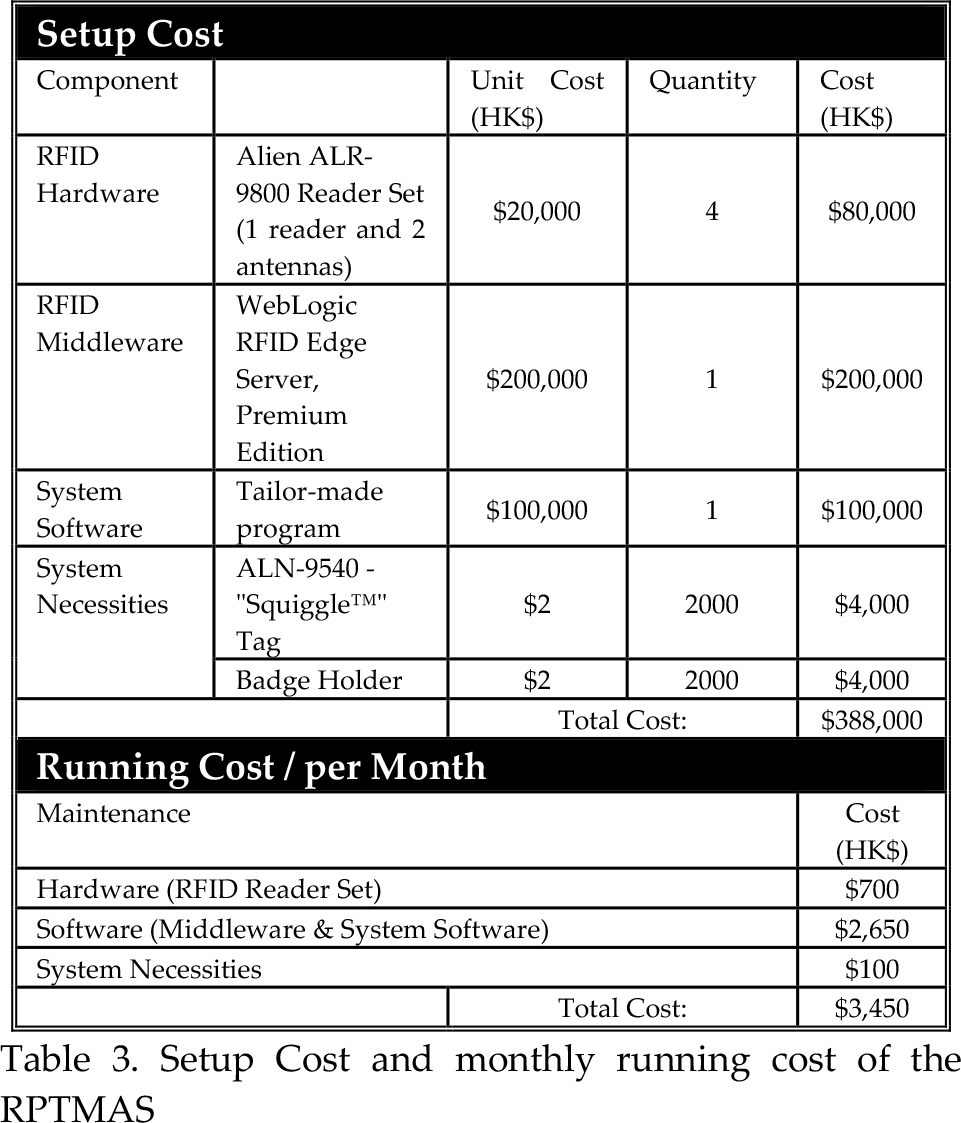
Apart from the physical installation cost, there is the continuous expense of running the system. According to the personnel in the organization, approximately 20 new patients would register as Mindset Club's members every month, and 5 patients per month, on average, would apply for replacement of their member cards due to loss or damage. In order to properly operate the system, a general estimation of the monthly running cost is given in Table 3.
Based on the above calculation, it is found that the total setup cost of implementing the RPTMAS is $388,000; and the operating cost for 12 months is $41,400.
Although there are many advantages of applying the proposed system in the healthcare industry, some limitations still can be found. As the system uses an RFID gateway as shown in Fig. 4b, the passive tag would be detected and located if it passes through a gateway of a particular room. It only provides a general estimation of the tag's location, i.e. inside the room but not the exact location in the room e.g. near the window etc. Moreover, only RFID passive tags were used in the system. Since this tag does not have any internal power source, it can only be detected when it is in the read range of the antenna. As a result, a special design for locating the antennas is required to ensure that the maximum number of tags can be read.
5. Conclusion
Medical care errors as well as medical adverse events have become a major threat to patients during their treatment in hospital. These errors are indeed devastating and traumatic experiences for the sufferers as well as their families and relatives. A lifelong pain will be inflicted on them which can never be entirely removed.
However, in the current high demand and short-staffed health industry, medical care errors may easily occur. Errors include incorrect identification of patients, miscommunication between physicians or incomplete patient medical records. Moreover, in the overcrowded, understaffed clinical areas, patients get lost or visit forbidden areas which may lead to unforeseen accidents.
With the aim of improving the situation, RPTMAS was developed. A pilot study was conducted in the Mindset Club in the Castle Peak Hospital in Hong Kong to examine the feasibility using of RFID and mobile technology in the healthcare environment. Apart from providing a cost-effective solution in patient tracking and monitoring, alert messages can be generated to healthcare personnel by using the wireless communication network and mobile technology. It can further monitor a patient's location at any given moment, and record the length of time a patient spends in a certain location. This information can help staff to make sure that patients are not left unattended in a room or visit unauthorized areas. In conclusion, the system that was designed can be successfully applied to the healthcare Industry. It provides a comprehensive way of monitoring patients' whereabouts, and also enhances patients' safety and comfort in the understaffed and high population flow environment.
Footnotes
6. Acknowledgements
The authors would like to express their sincere thanks to the Mindset Club of the Castle Peak Hospital in Hong Kong, the Research Office of the Hong Kong Polytechnic University and the Department of Industrial and Systems Engineering of the Hong Kong Polytechnic University for their support in making this research possible.