






Abstract

In April 2013, the National Institute of Neurological Disorders and Stroke (NINDS) hosted “Curing the Epilepsies 2013: Pathways Forward,” the third in a series of Curing the Epilepsies conferences held in partnership with epilepsy advocacy and professional organizations to assess progress in epilepsy research and help set a research agenda for future years. As an important outcome, these conferences have led to the development of the Benchmarks for Epilepsy Research, which reflect priorities for research toward clinically meaningful advances in understanding and treating the epilepsies. Following this tradition, and with input received prior to, during, and after the April 2013 conference, NINDS developed 2014 Benchmarks for Epilepsy Research. Table 1 lists the 2014 Benchmarks and the responsible stewards. The 2014 Benchmarks for Epilepsy Research are organized into key research goals in four areas in which significant progress should be likely over the next 5 to 10 years. While advances may arise from many different research directions and may not be predictable, these broad goals are intended to serve as a shared framework for focusing our community's efforts and benchmarking important advances in the field as they are achieved. Responsibility for achieving goals highlighted by the Benchmarks is shared by all members of the broad epilepsy community.
2014 NINDS Benchmarks for Epilepsy Research
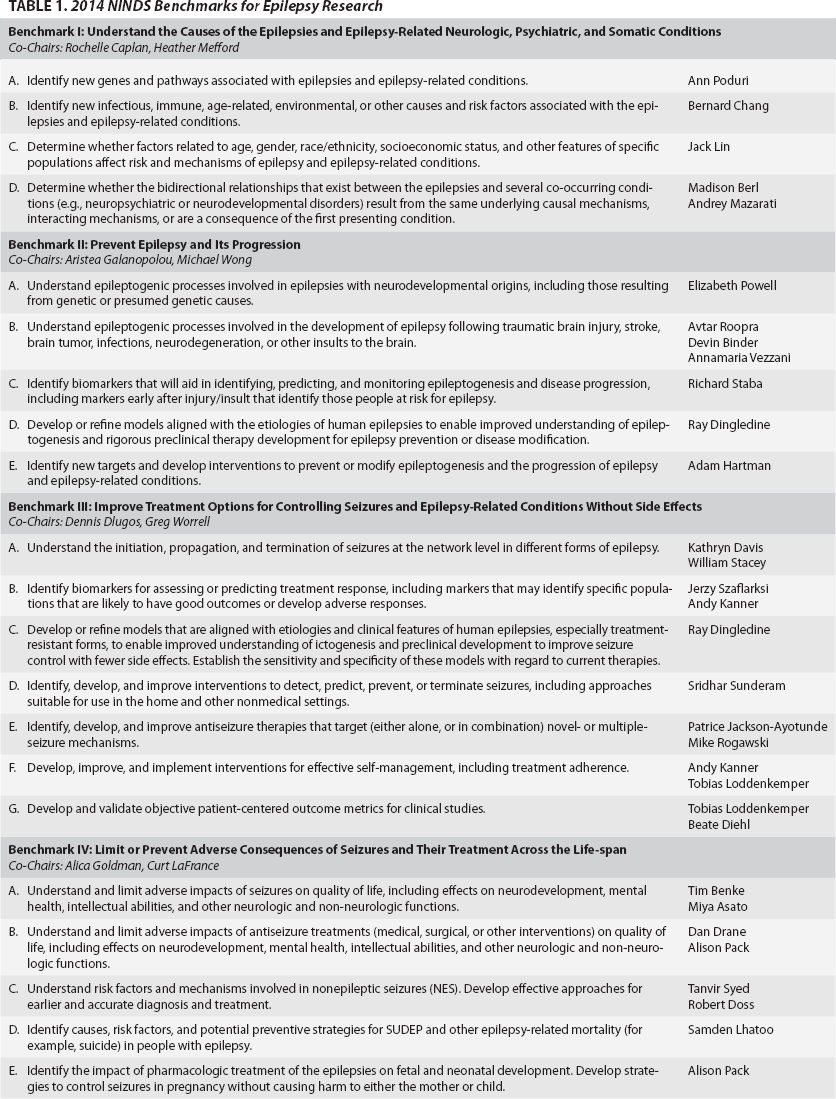
Several themes emerged during discussions to develop the 2014 Benchmarks. First, the epilepsies are a spectrum of rare and more common disorders that vary in disease course and likely in cause, and this heterogeneity represents both opportunities and challenges for epilepsy research. Distinct forms of epilepsy may ultimately require unique approaches to treatment and prevention. It is also likely, however, that individual epilepsy syndromes with known causes or other well-defined features will serve as gateways for understanding mechanisms with broader relevance to other epilepsies. Either way, the range of both causes and clinical features associated with the epilepsies suggests that knowledge and expertise in many disciplines, including neurology, psychiatry, neurosurgery, immunology, cancer biology, cardiology, cell and molecular biology, pharmacology and others, will be critical. As a second theme, there is growing appreciation of a spectrum of conditions beyond seizures that reduce quality of life for people with epilepsy, including cognitive impairment, neurodevelopmental and intellectual disabilities; psychiatric and behavioral disorders, stigma and other psychosocial issues, and effects on sleep, skeletal, endocrine, reproductive, and other body systems. These conditions, often called comorbidities of epilepsy, have complex relationships with the underlying causes of epilepsy, ongoing seizures and other pathological network activity, and with the effects of seizure treatments. To better reflect this complexity, the 2014 Benchmarks refer instead to epilepsy-related conditions and consequences, within a revised organization that encourages the integration of these topics into research on the epilepsies as a whole. In addition, the 2014 Benchmarks also reflect recognition of a range of factors specific to certain populations that should be considered in understanding the development and treatment of epilepsy and related conditions and consequences, including issues relevant to children, women, the elderly, and other groups.
While the scope of the Benchmarks broadly encompasses many areas of biomedical research on the epilepsies, NINDS recognizes that important advances will also come from areas not explicitly highlighted, such as fundamental basic research in neuroscience. Moreover, focusing on the Benchmarks and biomedical research alone will not be sufficient to ensure better outcomes and improved quality of life for people with epilepsy. A report from the Institute of Medicine (IOM) recently established recommendations and priorities that address public health aspects of the epilepsies beyond biomedical research, including issues related to surveillance and population research, measures for and access to high-quality care, patient and healthcare provider education, and public awareness (1). Together, the Benchmarks and the IOM report serve as complementary guides for the efforts of diverse stakeholders.
In this issue of Epilepsy Currents, the volunteers known as the “stewards” of the Epilepsy Benchmarks summarize research progress made since 2013. The Benchmark Stewards group was first organized in 2001 and since that time has included both established and new investigators who have helped NINDS assess progress in the Benchmark areas, identify key challenges and opportunities, and in some cases initiate workshops, symposia, or other activities to help advance research on Benchmarks’ topics. In 2013, the Epilepsy Benchmarks Stewards became a formal committee of the American Epilepsy Society (AES), which is jointly led by Co-Chairs from the AES and the NINDS. Benchmark Stewards are now selected through the AES Committee nominations process. As part of their responsibilities as Benchmark Stewards, these volunteers have assessed the research advances made since 2013 and identified both new opportunities and key issues that appear to be obstacles to further progress. A final assessment and progress report on the 2014 Benchmarks will be conducted in 2019 in preparation for a fourth Curing the Epilepsies Conference in 2020.
As a final note, although Epilepsy Benchmarks is formally a joint effort between AES and NINDS, over the past decade a plethora of national and international research consortia and global planning efforts have appeared, which increasingly emphasize the “research without borders” nature of epilepsy research. These include the EuroEPINOMICS and EpiTarget consortia, the International League Against Epilepsy (ILAE) Global Research Priorities and Advocacy Task Force, the Centers Without Walls projects of NINDS such as Epi4K and the Center for Sudden Unexpected Death in Epilepsy (SUDEP) Research, and others. Going forward, harmonizing efforts across national boundaries should accelerate progress toward the day when epilepsy no longer limits human potential. There should also be opportunities to leverage large-scale funding provided by the U.S. Brain Initiative by partnerships with other national efforts of similar scope such as China's Brain Database, Japan's Brain/MINDS project, the European Human Brain Project, and the Australian Brain Project. Epilepsy research, which integrates systems physiology, cell and molecular biology, clinical medicine, and other disciplines, lends itself well to large-scale projects.
A major directional change has appeared in the past 3 to 5 years in epilepsy research, away from the development of additional drugs that target ligand- and voltage-gated ion channels, and toward exploration of new mechanisms that regulate the function or expression level of those ion channels that control seizure threshold (2). Promising new targets and cellular processes involving different aspects of both innate and acquired immunity, metabolism, neuronal plasticity, and control of blood-brain barrier integrity are emerging. New algorithms for seizure detection and prediction are being developed in an ambulatory setting. The special challenges and experimental designs needed to study disease modification in epilepsy have received increasing attention (3). These advances and others are described in the four accompanying articles. We invite you to read the 2014 Epilepsy Benchmarks and the progress since 2013 summarized in the four following articles, and to consider how your unique research interests and talents may be aligned with the 2014 Benchmarks to accomplish these community-wide goals.