






Abstract
By storing CO2 captured from the atmosphere or point sources into oil fields, carbon capture and storage with enhanced oil recovery (CCS-EOR) increases the fields' output by raising reservoir pressures. Since CO2-EOR has been experimented with for decades and the revenues from the additional oil production improve projects' economics, CCS-EOR is the most readily deployable CCS technology. However, government support for CCS-EOR projects is sometimes contested on the grounds that the resulting increase in oil production undermines their environmental benefits. Addressing this concern requires determining the effects of implementing CCS-EOR on global CO2 emissions. This paper presents a simple approach based on a marginal reasoning consistent with economic decision-making. It produces analytical formulas that account for the effects on the global oil market of incentivizing CCS-EOR. In addition, we quantify the volume of oil that can be decarbonized by storing a ton of captured CO2 through EOR from different perspectives. We produce numerical results based on a first-cut calibration. They suggest that, from an economic perspective, CCS-EOR is a technology that mitigates global emissions. However, after accounting for the need to decarbonize the EOR oil, the reduction in emissions is significantly less than the stored quantity of CO2. If fully allocated to oil production, the environmental benefits of capturing a ton of CO2 and storing it through conventional EOR can allow the oil producer to decarbonize 3.4 barrels on a well-to-wheel basis and 14.4 barrels when offsetting its oil-upstream emissions only. Fiscal incentives granted by governments to support CCS-EOR as a climate-change mitigation technology should be sized accordingly. We compare our findings to the size of the subsidy in the revised Section 45Q of the 2022 United States Inflation Reduction Act.
Introduction
Carbon dioxide enhanced oil recovery (CO2-EOR) is the process of injecting CO2 into mature oil reservoirs to make the oil flow more easily to the well. Although CO2-EOR was initially developed to boost hydrocarbon recovery, it can also be used as a tool to store CO2 underground. When the CO2 is captured at emission sources such as industrial facilities or power plants, the whole process is called CCS-EOR. Among CCS technologies, CCS-EOR is considered as the most readily deployable one (Lyons et. al., 2021). 1
As noted by Lyons et al. (2021), the largest experience in storing CO2 is in EOR, which has a very low risk of CO2 leakage.
However, the status of CCS-EOR as a climate change mitigation technology is often contested on the grounds that, by increasing oil production, it would ultimately lead to additional CO2 emissions. This concern is regularly raised when projects storing captured CO2 through EOR are discussed in the press. See, for instance, Bloomberg (2022) 2 and Financial Times (2022) 3 .
Ratcliffe, V. (2022). Europe's hunt for clean energy in the Middle East has a dirty secret. Bloomberg. Accessed September 28, 2022. https://www.bnnbloomberg.ca/europe-s-hunt-for-clean-energy-in-the-middle-east-has-a-dirty-secret-1.1824762
Jacobs, J. (2022). 'Put up or shut up': Can Big Oil prove the case for carbon capture? Financial Times. October 20, 2022. https://www.ft.com/content/b8d6848d-le8a-4c57-b65b-52105b48bl78.
Addressing the question of the potential impact of CCS-EOR projects on global CO2 emissions is critical, since, presumably, the degree to which governments support these projects should be commensurate with their resulting reduction in emissions. Therefore, to design incentives that enable CCS-EOR projects, governments need to know whether the implementation of CCS-EOR reduces global CO2 emissions, and, if so, to what extent.
A serious response to this question requires determining whether or not the CO2 emissions of the additional oil production should be attributed to the CCS-EOR process. The literature 4 on lifecycle assessment, which attempts to estimate the greenhouse gas emissions associated with industrial processes, does not offer any consensus on this issue. Some authors argue that the emissions from consuming the additional barrels produced by EOR should be attributed to the CCS-EOR technology. Others argue the opposite by invoking the 'full displacement assumption,' i.e., these additional barrels replace barrels that would otherwise have been produced by other oil suppliers, so the emissions from the EOR oil should not be attributed to the CCS-EOR process. To our knowledge, the only economic study providing insights on this question was conducted by the International Energy Agency (IEA, 2015). It used a large-scale oil model to simulate the impact of new CO2-EOR projects on global emissions.
See Sekera and Lichtenberger (2020) for a review of lifecycle assessment studies for CCS-EOR.
In contrast to the numerical, simulation-based approach used by the IEA (2015), this paper develops an alternative approach to producing analytical formulas. It is based on marginal reasoning consistent with economic decision making. Its simple, partial-equilibrium framework identifies the effects of incentivizing CCS-EOR projects on global emissions. These effects are only implicitly accounted for in the numerical results of previous large-scale, technology-rich models with market-clearing commodity prices. Our approach, instead, allows us to abstract from the complexity of these models and to focus on the elements that are solely relevant to the question under consideration.
We believe that this stylized approach offers a sharper perspective and, therefore, is more conducive to clarifying the debate surrounding the impact of CCS-EOR projects on global emissions.
The next two sections develop our analytical framework and calculate the reduction in global emissions per ton of CO2 stored from a well-to-wheel 5 economic perspective. Section 4 contrasts different possible perspectives. Section 5 derives numerical estimates based on an illustrative calibration. Section 6 determines the volume of oil that can be decarbonized by storing a ton of captured CO2 through EOR. The final section discusses some implications of our results for the 2022 US Inflation Reduction Act and the global energy transition.
The term 'well-to-wheel' (used in the literature on lifecycle analysis) refers here to the amount of greenhouse gas emissions generated by producing, processing, distributing and using a barrel of oil. More recently, to measure a company's carbon footprint, the Greenhouse Gas Protocol has developed the accounting standards scopes 1, 2 and 3. Both an oil producer's scope 3 and a well-to-wheel analysis include the emissions from consuming the oil produced. In this sense, a well-to-wheel analysis can be viewed as comparable to the sum of the three scopes of the oil producer. However, scope 3 is broader than what is usually considered in well-to-wheel analyses (by, for instance, including the emissions from manufacturing the equipment used to produce the oil).
The oil market's equilibrium is given by the intersection of global supply and demand curves, with the supply curve indicating the aggregated production of all projects profitable at a given price. The oil market is assumed to be in equilibrium at the price p, with the supply of oil, s, equal to oil demand, q.
We consider a new policy supporting CCS-EOR projects that otherwise would not be profitable at the current oil price. The provided support, which can take different forms, such as fiscal incentives (i.e., subsidies) or public ownership, helps these projects materialize by rendering them profitable.
These projects either capture the CO2 emissions from industrial facilities or remove CO2 from the atmosphere through a direct-air-capture (DAC) installation, injecting the captured CO2 into an oil field to increase its output.
By adding new oil production, the implementation of the policy results in reshaping the oil supply curve, which shifts to the right in the vicinity of the current oil price. We assume that the implementation of the policy results in storing ß tons of CO2 in oil fields and producing α barrels of additional oil through CO2-EOR. 6 The α barrels of EOR oil are sold on the global market, impacting the initial market equilibrium. Figure 1 illustrates the implementation of the new CCS-EOR projects.
The IEA (2015) assumes that 99% of the CO2 delivered to the EOR operator remains stored. Hill et al. (2013) report that fugitive emissions released during CO2 re-injection cycles amount to less than 0.3% of the total volume of CO2 used for the Elk Hills CO2 project. Experience with EOR in the Weyburn field, with large-scale simulation over 5,000 years, suggests that it is well suited for long-term subsurface storage of CO2 (Preston et al. (2005). Here we do not consider possible changes in the relative quantities of CO2 stored and EOR oil produced throughout time (see, for instance, Nunez-Lopez and Moskal (2019) for a discussion of the issue) so that α and ß are taken to be time-invariant.
We begin by quantifying the effects of the α barrels of EOR oil on the market equilibrium. First, the global oil supply curve shifts to the right by α barrels, as shown by Figure 2.
Given the (unchanged) existing demand curve, this supply shift leads to a new supply-demand equilibrium where the quantity of oil that is consumed is increased by δq and the supply is increased by α + δs. Note that δs is a negative quantity since it represents the decrease in supply due to the lower price at the new equilibrium. In other words, the quantity of oil 'displaced' from the global oil market by the EOR oil is -δs.
At the new equilibrium, the change in supply equals the change in demand. We therefore have α + δs = δq. The equilibrium price p is changed by δp (with δp < 0). Figure 2 illustrates the changes in price and quantities.
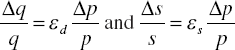
Let εs be the price elasticity of global oil supply and εd be the price elasticity of global oil demand. This implies:
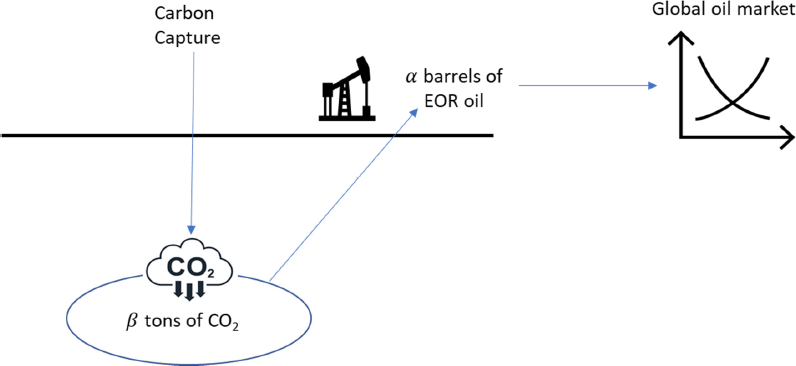
Implementation of CCS-EOR projects
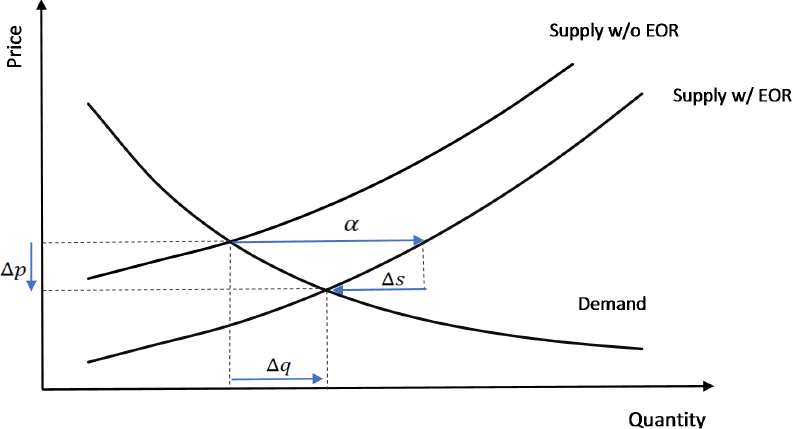
Impact of supporting CCS-EOR projects on the global oil market
Since q = s we have

and

The number of barrels displaced by the EOR oil is therefore
If the supply is perfectly inelastic (the supply curve is vertical), εs = 0, so that -Δs = 0, there is no displacement and all the emissions produced from the EOR oil must be attributed to the CCS-EOR technology. On the other hand, if the elasticity of global supply is perfectly elastic (the supply curve is horizontal) so that εs = +∞, there is ‘full displacement’ and no emissions from the EOR oil produced should be allocated to the CCS-EOR technology.
Capturing a ton of CO2 does not necessarily imply an equivalent reduction in emissions at the point source. For power or industrial plants, the point-source facility equipped with carbon capture is more energy intensive per unit of output than the same facility without carbon capture. Therefore, for the same level of output, the facility with carbon capture consumes more energy than without carbon capture, which leads to more CO2 to capture.
For DAC installations, the consumption of energy to fuel the capturing process can release emissions. Existing DAC technologies are energy intensive and require both electricity (to operate the large fans needed to suck air from the atmosphere and compress the captured CO2) and heat (to run the CO2 capture process). The required heat can be produced from various sources, such as natural gas and biomass. For instance, the DAC Orca plant in Iceland runs on geothermal energy. From a carbon accounting perspective, the emissions released during the process must be deducted from the quantity of CO2 captured.
In addition, the transportation of the captured CO2 to the oil field can generate some emissions. We thus assume that a ton of CO2 stored through EOR corresponds to an actual reduction in emissions of r tons at the point of capture (with r ≤ 1).
Consider a power or industrial plant and assume that the quantity of fuel required to produce a unit of output is iw with carbon capture and iwo without carbon capture. We assume the carbon capture rate is c and the CO2 emitted per unit of fuel is l. For a unit of output, the emissions without capture amount to liwo, whereas the emissions with capture amount to liw, of which cliw is captured. The reduction in emissions is therefore liwo -(1-c)liw. For a ton captured, the reduction in emissions is [iwo -(1-c)iw)/ciw. If o represents the emissions generated by the transportation of a ton of captured CO2 to the oil feld, we have:
Consider now the emissions related to the CO2-EOR part of the projects. We will refer to u + f as the well-to-wheel emissions of a barrel of EOR oil produced, where u is the producer's upstream emissions per barrel 7 of EOR oil produced and f is the midstream and downstream emissions per barrel of EOR oil (including the emissions from consuming the barrel). We also define v + g as the well-to-wheel emissions of a barrel of displaced oil, where v is the upstream emissions per barrel of displaced oil, and g is the midstream and downstream emissions per barrel of displaced oil.
The total amount of global emissions E attributable to implementing the CCS-EOR projects is obtained by summing three simultaneous effects:
This parameter is often referred to as the upstream carbon intensity and includes emissions from well to refinery gate.
the reduction in emissions due to the capture and storage of CO2, equal to r β tons;
the increase in emissions due to the EOR oil produced, equal to (u + f)α tons;
the saving in emissions due to the oil displaced, amounting to -(v + g) Δs tons.
We therefore have

Which gives

The quantity E represents the consolidated, global impact of capturing CO2 and storing it through CO2-EOR. To our knowledge, despite its simplicity, the analytical formula (1), which includes price elasticities that appear through the marginal calculation, is new to the literature. It offers a compact formulation of the result, with clarity on the role of the various parameters and the effects at play. In this sense, it is more transparent than numerical results derived from a large-scale simulation model.
In addition, formula (1) allows for decentralizing the calculations of impacts on global emissions, since it can be applied to every CCS-EOR project on a stand-alone basis without having to use a global, detailed supply-demand model. Note that the decentralization of calculations at the project level requires using consistent values for the elasticities εd, εs, and to some extent (it can depend on the characteristics of the EOR oil produced) v + g, for all projects.
Note that formula (1) was derived assuming that, by rendering additional quantities of CO2 available to EOR, public financial support for CCS-EOR projects results in shifting the global oil supply curve. However, for some CCS-EOR projects, the additional oil produced by injecting CO2 would have, in any case, been produced through another EOR technique. In such a case, the public support for a CCS-EOR project has no effect on the global oil market, and the CO2-EOR oil is not a source of incremental emissions since it displaces the same oil from the same oil field. The EOR oil can then be considered already decarbonized. Consequently, formula (1), which includes the need to decarbonize the EOR oil, gives a lower bound on the reduction in global emissions.
If a CCS-EOR project is not vertically integrated, there could be a need to allocate environmental benefits between its capture and CO2-EOR components. Two allocation rules can be envisaged:
The amount of emission reductions attributed to the facility where carbon capture occurs is E; the EOR oil is carbon free on a well-to-wheel basis.
The amount of emission reductions attributed to the facility where carbon capture occurs
is rß; the EOR oil has a per-barrel carbon intensity equal to
If we consider that the aim of the CCS-EOR project is to capture and store ß tons of CO2 (implicitly viewing the EOR oil as a by-product), we can compute the impact on global emissions of capturing a ton of CO2 and storing it through EOR, defined as

Formula (2) shows that capturing and storing a ton of CO2 with EOR reduces global emissions when
The reduction in global CO2 emissions remains equal to r only in the following two cases:
when storing CO2 has no effect on oil recovery (i.e., α = 0);
when the well-to-wheel emissions of a barrel of EOR oil, u + f, equal those of the corresponding displaced oil,
Formula (2) quantifes the impact on global emissions of capturing and storing a ton of CO2, on a well-to-wheel basis. We will refer to it as the ‘well-to-wheel economic perspective.’ It is, however, relevant to contrast this perspective with others. If we adopt an accounting perspective instead of an economic one, we will ignore the oil displacement effect. The emissions attributable to a ton of CO2 stored would then simply be
Furthermore, oil producers may argue that they are responsible for decarbonizing their own emissions, but not those of their customers. The environmental benefits of CCS-EOR projects would then allow producers to market oil that was produced without emissions. We can determine the reduction in emissions from this narrower, upstream perspective, which only considers the impact on oil-upstream emissions of capturing and storing CO2 through EOR. Both economic and accounting approaches apply also here.
Table 1 shows the reduction in emissions from capturing and storing a ton of CO2 calculated from these different perspectives.
Reduction in emissions per ton of CO2 stored.
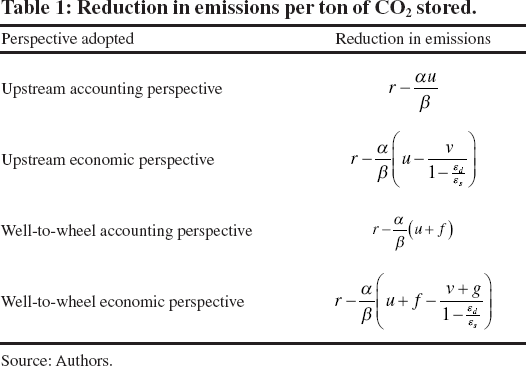
Reduction in emissions per ton of CO2 stored.
Source: Authors.
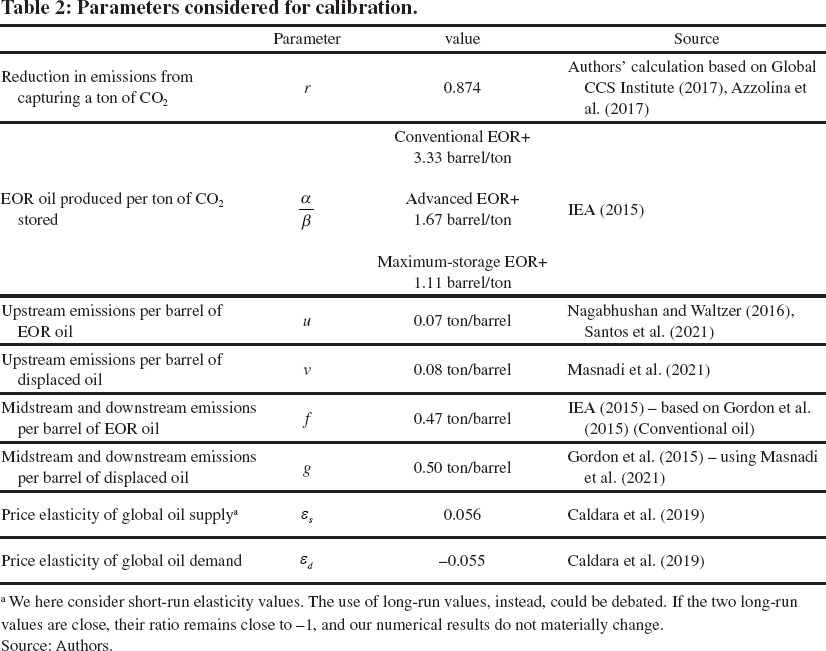
We propose here a first-cut calibration of formula (2). If an incentive to store CO2 exists, the oil producer can balance the goal of producing more oil with that of storing more CO2. The IEA
8
(2015) therefore reports three different values for
See also https://www.iea.org/commentaries/can-CO2-eor-really-provide-carbon-negative-oil, which reports an actual range of 1.67-3.33 barrels of EOR oil per ton of CO2 stored in the United States.
Conventional EOR+: a standard practice that maximizes oil production and minimizes CO2 use, with additional monitoring and verification practices;
Advanced EOR+: the co-exploitation of oil recovery and CO2 storage, with larger amounts of CO2 used;
Maximum storage EOR+: the maximization of the long-term storage of CO2 while achieving the same level of oil production as advanced EOR+.
We will compute the reduction in emissions per ton of CO2 stored for each value above.
We consider that the CO2 stored is captured from the emissions of a gas power plant with a combined cycle. Using the values reported by the Global CCS Institute (Irlam, 2017) and noting that the efficiency rate is the inverse of an energy intensity, we assume that the efficiency of the plant is 51.5% without capture

For CO2 equivalent (-eq) emissions of upstream, midstream and downstream oil activities, we use estimates 9 from the most recent literature. For the emissions related to the displaced oil, we use Masnadi et al. (2021), who estimate the upstream carbon intensity of the crude oil displaced from the global market by small demand shocks. The oils they identify as marginal are, presumably, those that the CCS-EOR projects would also displace. In their small shock scenario, they estimate 10 that the volume-weighted average carbon intensity of the displaced marginal crudes is 0.08 tons of CO2-eq per barrel, whereas they report an average carbon intensity of 0.05 tons of CO2-eq per barrel for the global production of crude oil. We therefore use 0.08 tons of CO2-eq per barrel for v.
Note that existing lifecycle analyses (LCA) are not necessarily comparable since the boundary set for the accounting of emissions can vary across studies.
Masnadi et al. (2021) consider three possible market structures. The results reported here are valid when competition is assumed to be either perfect or oligopolistic.
Masnadi et al. (2021) also find that 96% of the displaced oil is heavy crude. Gordon et al. (2015) report midstream and downstream emissions for two crudes categorized as heavy (Angola's Kuito and Brazil's Frade). We set g equal to the average quantity of emissions of the two crudes.
All assumptions and their sources are summarized in Table 2.
With our calibration, a barrel of EOR oil displaces half a barrel of oil from the global market, since
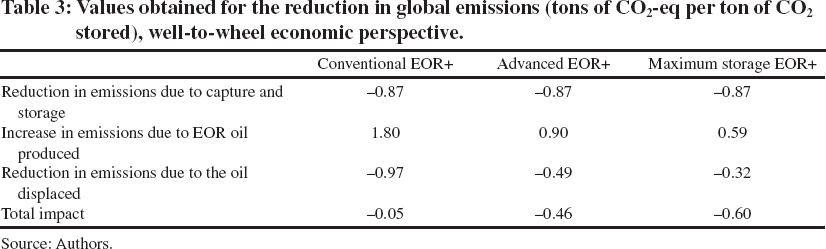
Table 3 shows the values obtained with our first-cut calibration for the reduction e in global emissions from the well-to-wheel economic perspective. It also shows the breakdown of the reduction into the three effects that add up in formula (2). Since the second effect - the increase in emissions due to the EOR oil produced - is accounted for, the resulting reduction e implicitly assumes that the EOR oil is fully decarbonized on a well-to-wheel basis.
The reduction e in global emissions, expressed in tons of CO2-eq per ton of CO2 stored, is -0.05 for conventional EOR+, -0.46 for advanced EOR+, and -0.60 for maximum-storage EOR+. In the three cases, CCS-EOR remains a mitigation technology since capturing and storing a ton of CO2 reduces global emissions, even after the full decarbonization of the additional EOR oil produced. The reduction in global emissions is small with the conventional EOR+ business model due to the larger volume of EOR oil to decarbonize.
IEAs (2015) numerical simulation yields a much higher estimate of -0.63 for the reduction in emissions with conventional EOR+. Two main reasons explain this difference: the elasticity values implicitly embedded in the large-scale model used for their study, and the fact that they do not account for the emissions relating to the capture of CO2. The IEA reports that, according to their modeling results, a barrel of EOR oil displaces 0.8 barrels of oil from the global market. According to our analytical approach, this amounts to assuming that the price elasticity of supply is four times the price elasticity of demand. This is inconsistent with the values reported, for instance, by Caldara et al. (2019), as shown in Table 2. Moreover, since the IEA only considers the CO2-EOR process, they implicitly assume r= 1, i.e., the volume of CO2 stored corresponds to an equivalent reduction in emissions.
Parameters considered for calibration.
We here consider short-run elasticity values. The use of long-run values, instead, could be debated. If the two long-run values are close, their ratio remains close to -1, and our numerical results do not materially change. Source: Authors.
Values obtained for the reduction in global emissions (tons of CO2-eq per ton of CO2 stored), well-to-wheel economic perspective.
Source: Authors.
Note that from a well-to-wheel accounting perspective, which ignores the effect of the produced EOR oil on the global market equilibrium, CCS with conventional EOR+ would not be a mitigation technology because capturing and storing a ton of CO2 would result in an increase in emissions since 3.33x(0.47+0.07)-0.87=0.93 tons of CO2.
Let us assume that the CCS-EOR projects considered above are undertaken by an oil producer who attributes the full environmental benefits of capturing CO2 to the EOR oil. This could be the case, for instance, if the CO2 is captured by DAC
11
installations. On a well-to-wheel basis, the quantity of global CO2 emissions attached to a barrel of EOR oil, i.e., its marginal CO2 content, is then given by
Attributing all the environmental benefits generated by a CCS-EOR project to the oil produced implies that these benefits cannot be attributed to the point of capture (otherwise there would be double counting). With DAC, there is no output to decarbonize at the point of capture, so allocating the benefits to the oil produced is a straightforward choice.

Formula (3) can be interpreted as follows: The marginal CO2 content of a barrel of EOR oil is equal to its well-to-wheel emissions less those of the oil it displaces and the CO2 stored per barrel of EOR oil.
With our calibration, the marginal emissions content of EOR oil, in tons of CO2-eq per barrel, is -0.05 for conventional EOR+, -0.35 for advanced EOR+, and -0.65 for maximum-storage EOR+.
EOR oil therefore has a negative CO2 content. However, the oil producer could wish to allocate the benefits of capturing and storing CO2 to a larger quantity of oil that would end up with a zero-carbon content.
We can determine the total amount of oil that the producer could label as carbon free. To do so, we equate the (negative) emissions attributable to the CCS-EOR projects, E, to those from γ barrels of conventional oil already produced by the oil producer, (u + f) γ. The volume of oil γ is therefore given by

The interpretation of this calculation is that, in theory, the oil producer can sell a + y barrels of oil with a certificate stating that consuming this oil has zero impact on global emissions. Using formula (1) we solve for y to obtain
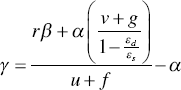
Capturing and storing a ton of CO2 decarbonizes the total quantity of oil

A ton of CO2 stored, therefore, offsets the well-to-wheel emissions of
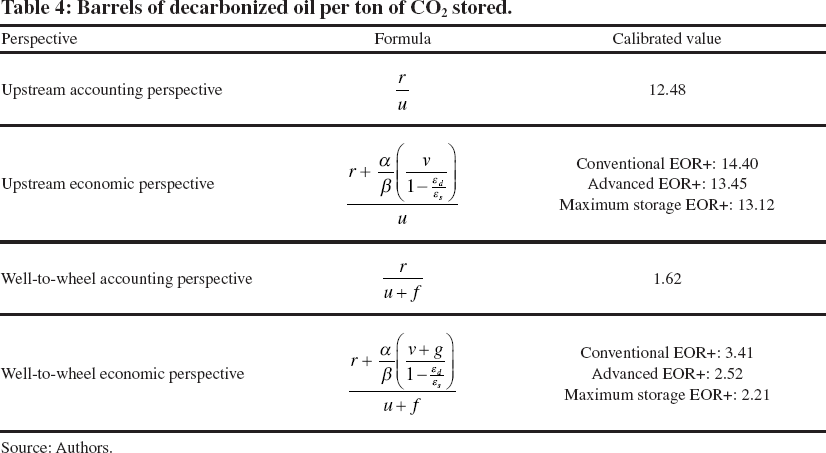
Table 4 summarizes the formulas and calibrated values giving the quantity of decarbonized oil per ton of CO2 stored from the different perspectives introduced in Section 4.
Barrels of decarbonized oil per ton of CO2 stored.
Source: Authors.
We can conclude that considering the impact of the EOR oil on the global market equilibrium substantially influences the results. With conventional EOR+, storing a ton of CO2 allows the well-to-wheel decarbonization of 3.41 barrels of oil when this impact is accounted for, as opposed to only 1.62 barrels when it is ignored. When considering upstream emissions only, 14.4 barrels of oil are decarbonized from an economic perspective. Interestingly, due to the oil-displacement effect, the higher the volume of EOR oil produced per ton of CO2 stored, the larger the volume of oil that can be decarbonized.
This paper has adopted an economic approach that helps to clarify the potential impact on global emissions of incentivizing CCS-EOR projects. It has produced analytical formulas from different perspectives (economic vs. accounting; well-to-wheel vs. oil upstream). For illustrative purposes, we have proposed a first-cut numerical calibration of our results.
Our analysis shows that CCS-EOR technology has the potential to mitigate global emissions. However, after accounting for the need to decarbonize the EOR oil produced, the reduction in emissions is much less than the stored quantity of CO2. Our illustrative calibration suggests that capturing and storing a ton of CO2 through EOR reduces total global emissions by an amount ranging between 0.05 and 0.60 tons, depending on the EOR technique used. The higher the volume of EOR oil produced per ton of CO2 stored, the bigger the need for decarbonization, with lower resulting reduction in emissions. For the three CO2-EOR techniques considered, CCS-EOR allows producers to sell the EOR oil decarbonized on a well-to-wheel basis while, in addition, generating a reduction in global emissions. If this reduction in emissions is also used to market oil decarbonized on a well-to-wheel basis (oil-upstream basis), capturing a ton of CO2 and storing it with conventional EOR+ allows for the decarbonization of 3.41 barrels of oil (14.4 barrels of oil). Our result captures the effect of the additional oil produced by CO2-EOR on the global oil market. We provide analytical formulas that allow for quantifying the oil displaced by EOR oil and the resulting consolidated environmental benefits.
The fact that CCS-EOR projects reduce global CO2 emissions by much less than the quantity of CO2 captured (after accounting for the decarbonization of the EOR oil) has policy implications, since fiscal incentives granted by governments to support CCS-EOR as a climate-change mitigation technology should be sized accordingly. However, since CCS-EOR projects benefit from the extra oil revenues generated, limited incentives may be sufficient to render these projects profitable and leverage them to upscale CCS technologies.
In this regard, we can examine the extent to which our calculation is consistent with the tax credit numbers provided by the revised Section
12
45Q, "Credit for Carbon Oxide Sequestration," in the 2022 United States Inflation Reduction Act. A ton of CO2 captured from industrial facilities or power plants and used for EOR generates a tax credit of $60, while if the ton is stored in a saline reservoir, it generates a credit of $85 (Financial Times2, 2022). For a ton of CO2 captured by DAC projects, the corresponding tax credits are $130 and $180, respectively. The legislation is heavily influenced by political negotiations, and the subsidy might have been tailored to the economics of CCS-EOR projects. Nevertheless, the ratios 60 over 85 (=71%) and 130 over 180 (=72%) could implicitly signal that the Biden administration considers that storing a ton of captured CO2 through EOR reduces global emissions by 30% less compared to storing it in a saline reservoir. Using the notations introduced in the paper, this amounts to assuming that the ratio
For an analysis of the potential effects of 45Q on CCS-EOR deployment in the US see Edmonds et al. (2020).
The ratio to equate to 0.7 is
With the conventional EOR+ business model, which generates the lowest decrease in emissions, the ratio
As many countries around the world are embarking on net-zero emissions (NZE) targets by the second half of this century, all technology options should be considered and, whenever relevant, encouraged. Since it has the potential to reduce global emissions, CCS-EOR must be recognized as part of the solution for achieving a net-zero world. In addition, coupling DAC technologies with CO2-EOR could accelerate the adoption of DAC technologies, a critical component of meeting the challenge of achieving NZE. Transitioning to a net-zero world implies a fundamental restructuring of the economy and energy systems. The marginal analysis developed in the paper will remain valid along the transition path, but the value of the parameters appearing in our analytical formulas might vary substantially throughout time due to technology progress and structural changes in the global oil market.
This paper adopts a purely economic perspective and does not discuss questions relating to geological or monitoring conditions. Our calibration should be refined and complemented by sensitivity analyses with respect to elasticity values, since these values are not precisely known. In addition, emissions relating to the manufacturing of equipment used for CCS-EOR may have to be added to perform a full lifecycle assessment. Finally, another extension of this analysis would be to calculate the (social) return of CCS-EOR projects from a public perspective, by performing a detailed cost-benefit analysis that would include the social cost of CO2. We recommend these considerations for further research.
Footnotes
Acknowledgments
The authors thank Frank Felder, Marzio Galeotti, Fateh Belaid, Adam Sieminski, Naser Odeh, James Smith, and the anonymous referees for their helpful comments and suggestions.
References
Supplementary Material
Please find the following supplemental material available below.
For Open Access articles published under a Creative Commons License, all supplemental material carries the same license as the article it is associated with.
For non-Open Access articles published, all supplemental material carries a non-exclusive license, and permission requests for re-use of supplemental material or any part of supplemental material shall be sent directly to the copyright owner as specified in the copyright notice associated with the article.
