






Abstract
In this paper, we investigate the combined effect of carbon policies and price controls in cross-border trade of electricity on power generation investments. It has been shown that price controls in cross-border trade of electricity may negatively affect renewable energy investments. However, the assessment of the impact of the simultaneous adoption of carbon policies and energy price controls has still not been addressed. Assessing this interaction is important to find out whether carbon policies can offset the negative impact of price controls on renewable energy investments or not. Results show that carbon policies can partially offset the negative impact of price controls, and that cap-and-trade programs are more effective to prevent this negative impact than carbon taxes. On the other hand, high levels of carbon taxes combined with price control regulation may increase renewable capacity investments, but without completely offsetting the negative effect of the price controls.
I. Introduction
The installed capacity of Renewable Energy Source (RES) power generation is globally growing at a high rate motivated by climate change awareness. By 2018, total RES generation capacity reached 2,378 GW, representing an 8% growth in that year (Prasad and Wohlgemuth, 2021). Most of this capacity corresponds mainly to solar and wind power due to factors such as technology maturity and cost reductions. Early adoption of RES generation has been incentivized by a mix of clean energy policies (such as feed-in tariffs, rebate/incentives programs, carbon policies, and renewable portfolio standards), which were implemented in many countries with various levels of success (Dahle and Sterling, 2020, Das et al., 2014, Yang et al., 2010, Saeidpour et al., 2020, Han et al., 2014). The main obstacle to the widespread deployment of intermittent RES generation has been the flexibility requirements for power systems to deal with the RES variability.
Regional integration of power systems through cross-border trade of electricity can help mitigate the variability of wind and solar power by diversifying generation portfolios across large geographical areas. This could favor a better utilization of the RES capacity, the deferral of transmission investments, and the reduction of emissions (Konstantelos et al., 2017, Martinez-Conde-Del-Campo, 2017, Wu et al., 2011). However, cross-border trade of electricity usually reduces the economic welfare of some actors and increases the welfare of others, when no effective compensation mechanism is incorporated. Studies carried out about European interconnections have shown that in integrated unregulated market schemes, cross-border trade of electricity creates imbalances in the economic surplus of generators and consumers (Egerer et al., 2013, Doorman and Froystad, 2013, Konstantelos et al., 2017, Kristiansen et al., 2018, Gorenstein et al., 2018). In the case of exporter countries, benefits for generation firms from exporting power because of higher prices, whereas consumers’ surplus is reduced. For importer countries, the opposite happens. Electricity price spikes and fluctuations that exporter countries experience due to interconnections may lead to undesirable political implications. Hence, particularly in South America, there is a consensus to gradually integrate power systems, getting under way by making contracts when there are business opportunities. Also, to reduce the impact of price spikes due to interconnections, direct subsidies, or price controls that introduce indirect subsidies, are also commonly implemented energy policies (Burniax et al., 2011, Matar et al., 2015, Lema et al., 2018).
The issue of the interactions among different policies is a very relevant aspect when developing a policy portfolio. These interactions affect how the policy maker should allocate benefits to specific policies. This issue has been in the literature for decades. In fact, one approach to deal with it was proposed by Murphy and Rosenthal (2006) more than a decade ago.
Accordingly, there is abundant evidence that simultaneously implemented clean energy policies do interact with each other, reducing or strengthening their effectiveness (Xin et al., 2020, Hao et al., 2020, Bhandari et al., 2017, Blyth et al., 2019). For instance, overlapping a renewable portfolio standard and a carbon tax yields an increase in RES power generation (Xin et al., 2020). As well, combined feed-in-tariffs and renewable portfolio standards work best at the early stage of the RES technological development (Hao et al., 2020). There is also evidence that some policy combinations such as carbon tax and renewable generation tax credits undercut one another, reducing efficiency (Bhandari et al., 2017). Furthermore, ambitious targets for RES, such as those seen in Europe, can have important interactions with carbon markets (Blyth et al., 2019). Energy efficiency and carbon policies also interact when simultaneously applied. In this case, energy efficiency policies combined with emission trading systems creates carbon price uncertainties which delay RES investments due to growing risks for investors (Hood, 2013).
Detailed analytical approaches are important to analyze market interactions of different jurisdictions. In this sense, the consideration of detailed models at both ends of a cross-border interconnection may be relevant to avoid ignoring credible distortionary impacts on investments, transmission expansion, and the distribution of welfare in one of the jurisdictions. Such detailed analytical approaches are proposed, for instance, by Billette de Villemeur and Pineau (2012) and Višković et al. (2019). In the same vein, Bushnell and Chen (2012) proposed an equilibrium model to evaluate the interaction of cap-and-trade programs and renewable portfolio standards, as well as the impact of allocation policies on prices, costs, and carbon leakage for different jurisdictions in the U.S. western electricity market. Allocation proposals seeking to reduce price increments and to limit carbon leakage may increase the cost of permits for firms with large levels of emissions, reducing their benefits. Although, in this paper, we do not study possible inefficiencies of price controls and carbon policies on carbon leakage, we recognize this is an important area of future research.
Carbon pricing policies, such as emission trading systems, increase customers’ energy prices if the cost of carbon is passed-through to customer’s energy bills in liberalized markets (De Gouvello et al., 2019, Marchán et al., 2017). This may also conflict with energy policies seeking consumer protection through price controls (De Gouvello et al., 2019).
Subsidies and price controls may have significant unintended adverse consequences including fiscal deficit, profit margin reductions, exercise of market power, incorrect price signals, rise of fossil fuel consumption, and increment of greenhouse gas emissions (Shi et al., 2017, Brown et al., 2017, Weare et al., 2003, Saha et al., 2019). Government policies, administrative rules, and market design can also impact investment incentives in power systems (Bhar et al., 2013, Doorman and Botterud, 2008, Rioux et al., 2017, Wogan et al., 2019, Muñoz et al., 2020). Muñoz et al. (2020) show that government price controls on cross-border trade of energy may disincentivize RES investments. This disincentive is attributed to revenue reductions of base load generation technologies (mostly RES) as a consequence of price controls. However, the extent of the disincentive when there is an interaction with different carbon policies is not evident. In this regard, the objective of carbon polices (which is to reduce emissions) may conflict with the objective of cross-border price controls (which is to protect domestic consumers against high energy prices). To the best knowledge of the authors, the effects of combining carbon policies and price controls in cross-border trade of energy have still not been addressed in the literature. Specifically, there is a knowledge gap regarding how this policy interaction impacts the effectiveness of the concerned policies.
Price controls can be modeled by means of Mixed-Complementarity-Problems (MCP), which include variables and constraints that emulate the price control rules (Gabriel et al., 2012, Murphy et al., 2016, 2019). Alternatively, equilibrium solutions can also be found in the literature using approaches that iterate between administrative rules and optimization problems (Muñoz et al., 2020, Hogan, 1975, Greenberg and Murphy, 1985, Diaz et al., 2020). In this paper, we use a similar approach to the one proposed in (Diaz et al., 2020), which we modify to model the simultaneous adoption of carbon policies and price controls.
The main contributions of this paper to the existing literature are twofold: first, the combined effect of price controls in cross-border trade of electricity jointly with standard carbon taxes and cap-and-trade programs is assessed. The analysis of these interactions is useful to determine the efficiency of carbon policies to promote RES investments under such a price control policy. In this regard, we investigate to what extent the potential undesirable outcome of price controls of discouraging investments in RES can be mitigated by the studied carbon policies, and which carbon policy can be more effective in pursuing this goal. Secondly, we assess the effect of these carbon policies together with price controls on generation firms’ revenues and consumers’ costs. These research questions can give insights to policy makers on the tradeoffs and effectiveness of the interactions between policy interventions.
The rest of this paper is organized as follows: In Section II, we discuss a price control rule imposed by the Chilean Ministry of Energy for cross-border trade of electricity and the iterative approach used to simultaneously account for price controls and carbon policies. In Section III, several case studies are presented and discussed. Finally, in Section IV, conclusions are presented.
II. Methodology
A. Cross-border Trade Price Control
RES (such as solar, wind, and run-of-the-river hydro) are alternatives to fossil fuels that help to mitigate global warming. Thus, the need to promote investments in RES power generation has been consistently increasing in most developed and non-developed countries. More and more countries are designing and implementing policies to incentivize the deployment of RES generation to supply the growing global demand. However, the location of RES is unequal among countries and regions. In this sense, the concept of global energy interconnection may solve the problem of geographical mismatches between clean energy production and consumption.
While cross-border trade of energy may favor the development of renewables, domestic consumers of exporter countries may reduce their welfare due to energy price increases. To address this issue, it is common for governments to implement energy policies with price controls.
In a price control scheme, producers that satisfy domestic demand are paid at an equilibrium price whereas producers that supply the exported portion are paid at another equilibrium price, as shown in Figure 1. Therefore, the possible price increases due to the energy being exported is not transferred to domestic consumers. The goal of these price controls is to shelter domestic consumers from rising energy prices due to the energy exports. However, generators supplying domestic demand face a partial revenue reduction, depicted in Figure 1 (gray area).
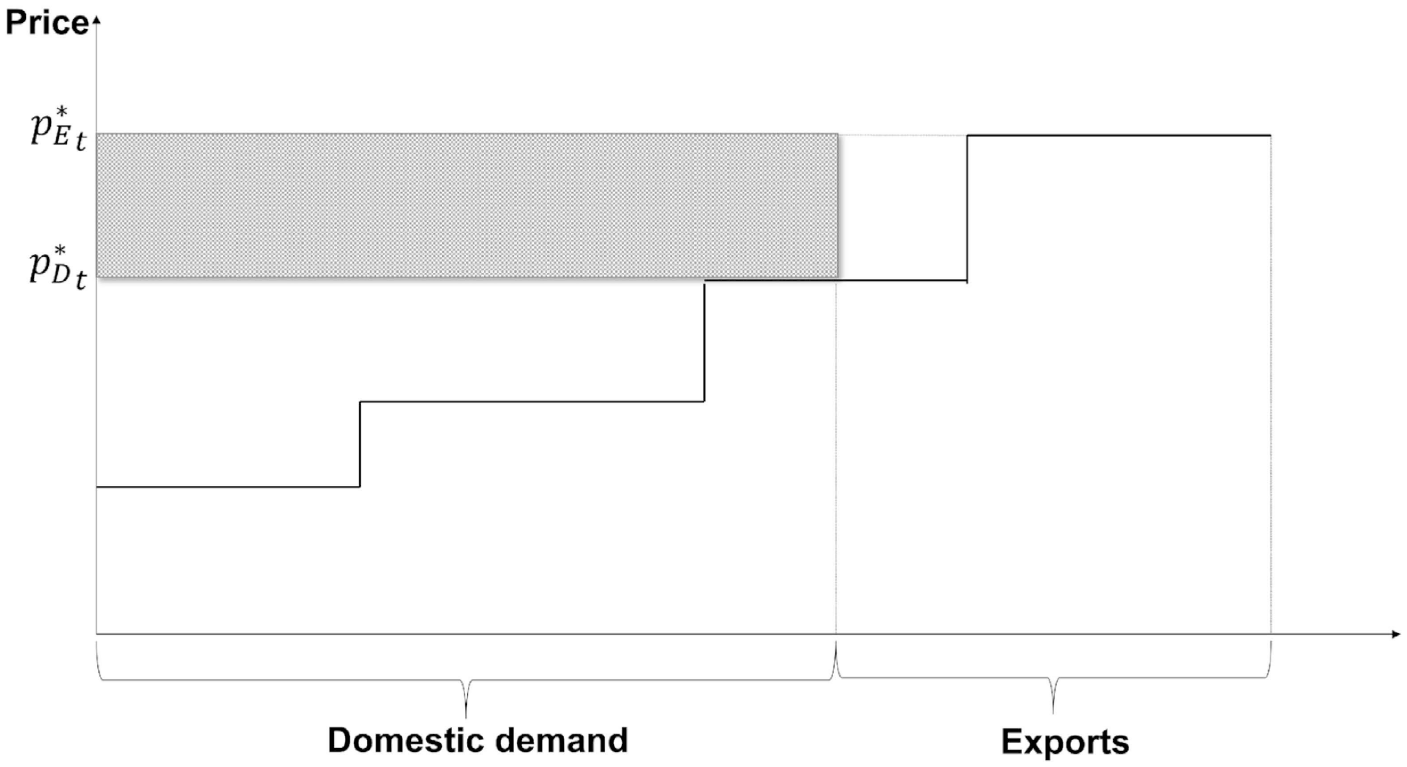
Energy prices under price control regulation
The total revenue reduction (or revenue loss, RL) for a planning horizon T can be expressed as in (1), where QDt corresponds to the total domestic demand of the exporter country at time t. Generators that supply most of the domestic energy (base-load generators) are subject to greater revenue losses than those generators supplying exports. This leads to distorted price signals for generation capacity investments.

B. Price controls in cross-border trade of electricity, the Case of Chile-Argentina
Price controls that protect domestic consumers against rising electricity prices due to exports are very common. In this paper, we study price controls on cross-border trade of electricity implemented in Chile, as an example to illustrate the combined effect of price controls and carbon policies. These price controls establish that generation units delivering exports from Chile cannot affect domestic electricity prices. Thus, a price differentiation arises as a result of the price control rule. Generation units supplying domestic demand are paid at an equilibrium price that does not take into account possible price increments due to exports. On the other hand, generation units supplying exports are paid at a clearing price computed considering the exported quantity. As a consequence of this price control rule, generation units supplying the domestic demand bear revenue reductions when the domestic and export equilibrium prices are different. The revenue reduction of base load generation technologies yields long-term distorted investment signals that may discourage investments in base load technologies, such as RES like in the case of Chile.
C. Carbon tax in Chile versus standard carbon tax
Chile has a modest $5/t carbon tax, which is mandatory for all stationary sources with a rated capacity above 50 MW. This carbon tax comes with a pass-through restriction that dictates that carbon taxes cannot be included in the dispatch and pricing of energy in the spot (real time) market. At the end, generation firms affected by carbon taxes receive a side payment that is financed by all dispatched units. Such a carbon tax yields some reductions in emissions but at much higher costs than standard carbon policies and cap-and-trade programs (Diaz et al., 2020). We do not replicate this specific side-payment rule in our simulation model. Instead, we focus our analysis on distortions that are introduced by price controls on widely adopted standard carbon taxes and cap-and-trade programs. In addition, a sensitivity analysis against carbon taxes is conducted, aimed at generalizing the obtained results.
D. Chilean electric power system
The Chilean electric power system is composed of three components: The National Electric System (SEN), the Aysen electrical system, and the Magallanes electrical system. The SEN represents nearly 99% of total installed generation capacity. Figure 2 depicts the installed capacity per technology in the SEN by October 2020 (CNE, 2020).
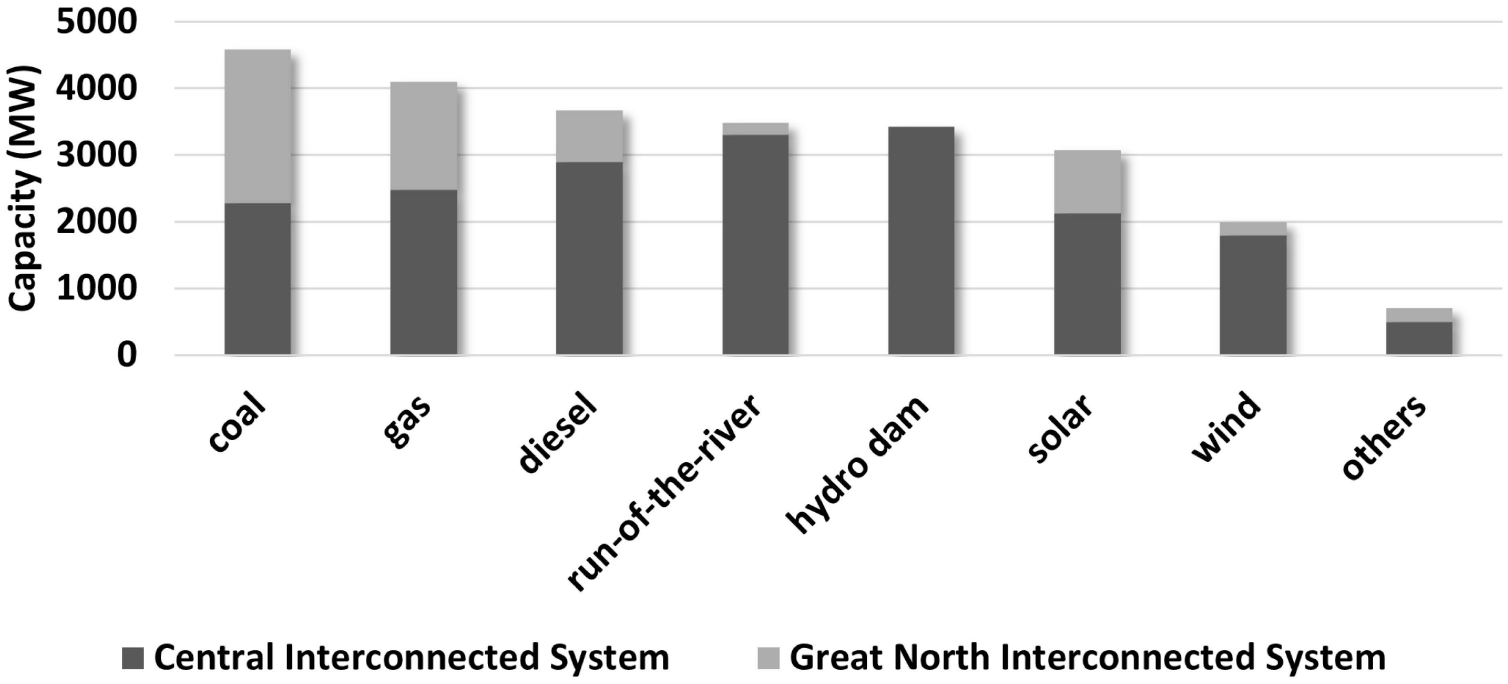
Total generation installed capacity in the SEN
In the last few years, there has been an important increase of non-hydro RES generation in Chile, especially solar and wind power. Solar photovoltaic has been the technology with the fastest growth, with an increase from 230 MW in 2014 to 3,070 MW in 2020. This is mainly driven by the high solar resources available in the north of the country. According to the long-term energy plan of Chile, a 73% share of RES is expected by 2030, mostly coming from solar power (Ministerio de Energía, 2019).
In this paper, we assumed a single node representation of the Chilean power system, considering the most representative generation technologies (commonly encountered in most power systems) as candidates for expansion, and assuming a greenfield scenario. The data required in the simulations have been obtained from (CNE, 2020) and (Energy Exemplar, 2016).
E. Electric power system in Argentina (SADI)
In the case of Argentina, the total generation capacity by 2019 is depicted in Figure 3 (CAMMESA, 2020). Roughly, 63% of the total installed capacity is thermal, 28% dam hydro, 4.5% nuclear, and 4.7% corresponds to RES (including run-of-the-river hydro). Like for Chile, the electric power system of Argentina in this paper is modeled as a single node.
On Dec 28th, 2017, the Argentina’s Congress enacted a Tax Reform (Act N. 27.430), setting a new carbon tax of $10/tCO2 (SH, 2018).
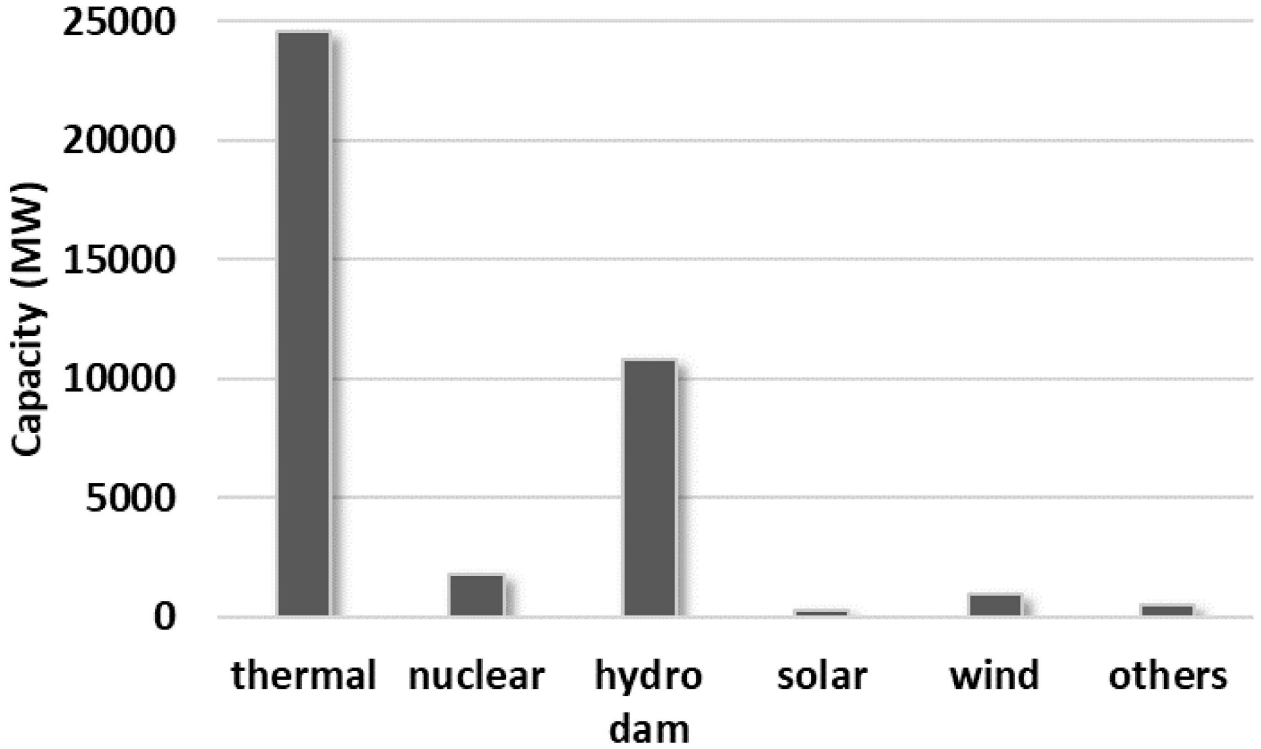
Total installed capacity in the SADI
F. Emission factors of power plants in Chile
Emission Factors (EFs) are obtained in this paper from databases provided by the Environmental Protection Agency (EPA) compiled in the document AP-42 (EPA, 2020). These EFs are arithmetic averages taken from industry reports.
The general formulation of equilibrium models of price controls together with carbon policies is discussed below.
G. Price control and standard carbon tax
A carbon tax is a cost that emitters pay per ton of CO2. It represents a financial incentive for emission reduction. Under a carbon tax, generation firms are obligated to pay costs that are proportional to the amount of their carbon emissions. Therefore, it provides a cost signal that encourages emitters to look for long-term alternatives such as RES power generation. Although the primary objective of a standard carbon tax is to reduce carbon emissions, it may indirectly procure long-term investments in low emitting generation technologies.
If a proper carbon tax is not chosen, emissions may continue to increase in the case that polluters are willing to pay for the extra cost of the tax, instead of investing in low carbon technologies. Thus, to avoid this, the level of the tax must be aligned to the marginal cost of reducing emissions. On the other hand, if the carbon tax is effectively internalized by generators, then this increases the variable cost of fossil-fuel power plants. Consequently, coal power plants with the highest emissions may become marginal plants. This may increase the average energy price, having a negative economic and social impact (De Gouvello et al., 2019). To help to mitigate this negative impact for consumers, proper measures may be needed such as financial support or subsidies to low-income households.
The cross-border trade price controls previously described in Section II.A seeks to also avoid domestic energy price increases, this time due to exports. In the long-term, price controls disincentivize investments in RES power generation since base load generation (mostly RES generation in some countries like Chile) bears greater revenue reductions than marginal generators (Muñoz et al., 2020). The effect of the price controls could conflict with the CO2 emission reduction objective of a carbon tax.
To measure the level of interaction of carbon policies and price controls, in this paper we propose an equilibrium model based on a similar approach to the one in (Diaz et al., 2020). In this approach, the authors analyze the long-term effects of a carbon emission policy that includes pass-through restrictions and side-payment rules. These pass-through restrictions and side-payment rules result in annual carbon charges that are nonlinear functions of electricity prices, generation dispatch, and generation capacity investments. Also similarly to the approach proposed by (Greenberg and Murphy, 1985), market equilibrium solutions are then found using a Gauss-Seidel algorithm that iterates between a linear program and an administrative nonlinear function that models the pass-through restrictions and side-payment rules. Based on this approach, we have defined a nonlinear function that accounts for the revenue losses due to the price control, as explained in Section II.A. Also, we incorporate the modeling of a standard carbon policy and a cap-and-trade policy, which allows assessing their level of interaction. To achieve this, we propose an equilibrium model based on two stages. In the first stage, capacity expansion decisions, generators’ power dispatch, and electricity price clearance are made considering the domestic demands of and power exchanges between the interconnected countries. In the second stage, only the domestic demand of the exporter country is considered to compute the generators’ power dispatch as well as electricity prices. Electricity prices obtained from both stages and the power dispatch are then used to compute the generators’ revenue losses, as explained in Section II.A, using a Gauss-Seidel approach to find the equilibrium solution. A detailed explanation of these stages is presented below.
1) First stage: The first-stage model is based on the linear program described in (2)–(10), which represents a centralized planning model considering the integration of countries that exchange electricity through cross-border transmission lines.

subject to:








where
Notice that the model presented in (2)–(10) is a general formulation that accounts for a multi-node representation of the exporter and the importer countries. Thus,
The objective function in (2) minimizes the total system cost, including investment and operational costs of the power system, as well as CO2 emission costs through the standard carbon tax
This formulation finds the optimal hourly dispatch,

According to this formulation, the standard carbon tax cost is internalized by generation firms. In addition, the revenue reductions due to the price control rule are internalized by the generation firms of the exporter country, which are affected by this administrative rule.
Observe that there may be specific time instants when
2) Second stage: The second-stage model computes the hourly power dispatch,

subject to:





Constraint in (13) avoids incorrect redispatch of generation units when transitioning from the first stage to the second stage of the model. Notice that reliability constraints, as well as hourly and annual capacity factors, are implicitly considered in (13). The Lagrange multiplier of constraint (13) is indicated between brackets. For a multi-node representation of the exporter country, constraints (13), (15), and (16) account for domestic transmission lines only.
The results of this second stage are used to update the non-linear revenue reduction function in (11). An iterative process is performed by solving the first stage of the procedure and then updating the revenue reduction function (11) based on the results obtained from the second stage. A stopping criterion is established by setting a tolerance on the deviations at each iteration of the objective function.
In these models, a perfectly competitive market has been assumed, where generator firms are price takers. Similarly, physical withholding or any other form of market manipulation is neglected. The exercise of market power may affect the results obtained in this paper and hence we have proposed its modelling for future research. It is important to point out that, in both Chile and Argentina, the authorities have been very concerned about monitoring market power. In the particular case of Chile, the government has been implementing several policy measures to mitigate its occurrence during the last decade (Arellano, 2003).
Figure 4 depicts a block diagram of the procedure used to implement the two stages previously discussed. In the first stage, the total demand of the interconnected systems is considered. Thus, prices
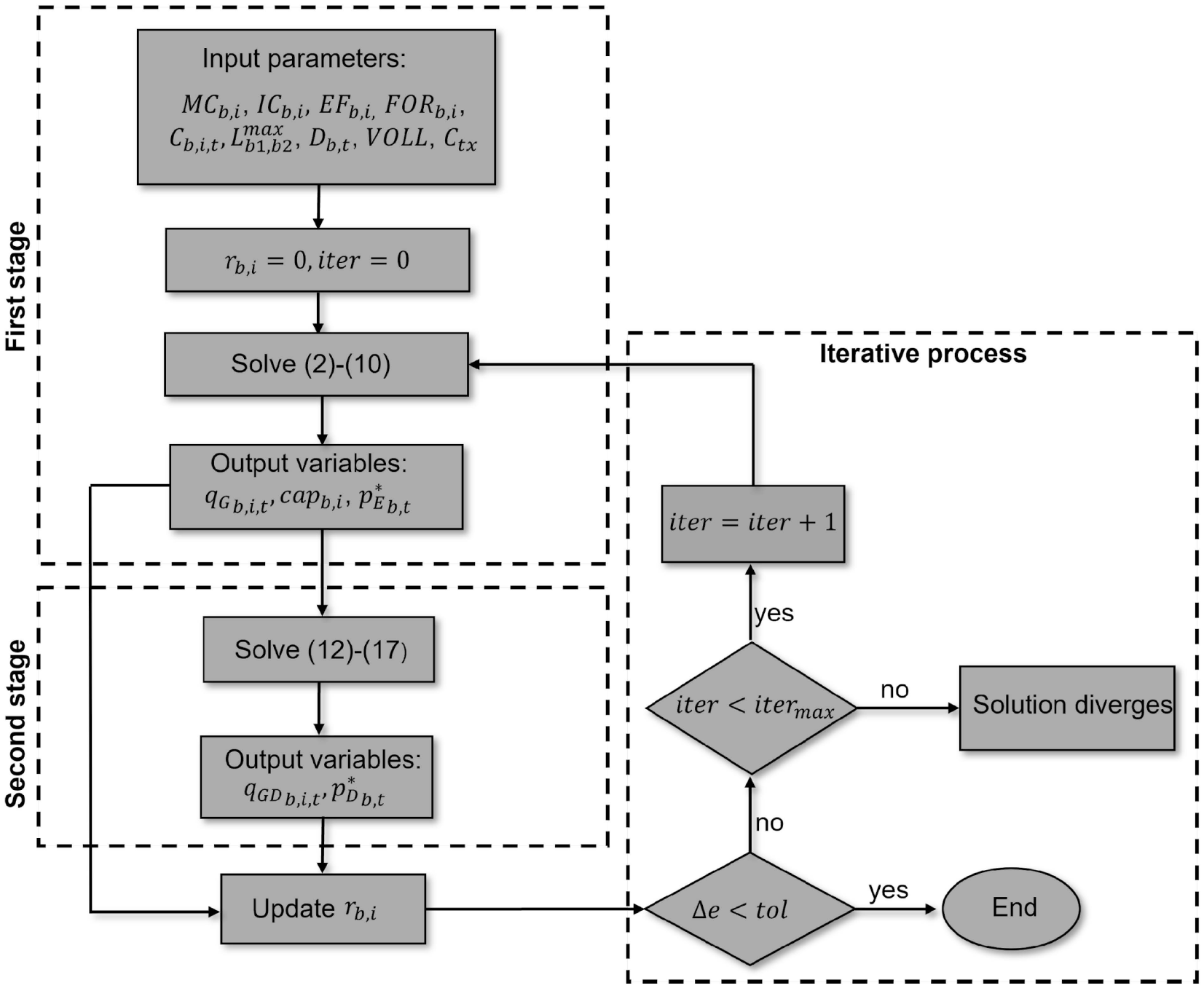
Block diagram of the two-stage model proposed in this paper
The second stage allows obtaining the power dispatch
The iterative process updates the variables of each stage at each iteration, until convergence is attained when the changes in the variables defined as
The described model for assessing the interactions between price controls and standard carbon taxes is a general model applicable to power systems with any number of nodes. A single node representation per country, considering the interconnection of Chile and Argentina, can be found in Appendix A.1.
H. Price Control and Cap-and-trade Programs
Cap-and-trade is an alternative to standard carbon taxes. It places a cap on the quantity of greenhouse gas emissions that generation units can emit. Usually, governments set this cap by giving or selling allowances or permits to generation firms. Thus, while a carbon tax provides certainty to firms and individuals on the cost of their CO2 emissions, cap-and-trade provides governments with certainty about the total amount of emissions. The carbon price here is determined by the market for permits, hence prices can vary significantly if demand for permits fluctuates.
The interaction between an energy price control and a cap-and-trade program can be modeled using a two-stage approach similar to the one previously discussed. The two stages of the model can be written as described next.
1) First stage: The first stage of the equilibrium model is based on the following linear programming formulation:

subject to:

and constraints (3)–(10).
Herein, the constraint in (19) establishes the maximum emission level that generation firms can emit
2) Second stage: The second stage of this equilibrium model has the same formulation as (12)–(17), but removing the term
Notice that the block diagram previously shown in Figure 4 also applies for the price control & cap-and-trade program model by replacing the equations needed in each stage as previously discussed.
A single node representation per country of the above model, considering the interconnection between Chile and Argentina, can be found in Appendix A.2.
I. Centralized model & standard carbon tax
A typical centralized model with a standard carbon tax is used in this paper as a benchmark. The objective function of this model can be written as:

This objective function is subject to constraints (3)–(10). Since no price control is considered in this unregulated model, the revenue reduction associated with the price control rule
III. Case studies, simulation results and discussion
A. Case studies
Five case studies are analyzed in this paper, considering a single node representation per country (e.g., Chile and Argentina) as described below:
I. Case A: Centralized model & standard carbon tax
The typical centralized expansion model described in Section II.I is utilized as benchmark for comparison purposes.
ii. Case B: Price controls & standard carbon tax model
In the second case study, the interaction between the cross-border price control and a standard carbon tax is assessed by using the model described in Section II.G, according to the single node representation detailed in Appendix A.1. For this, a carbon tax of $5/tCO2 and $10/tCO2 are used for Chile and Argentina, respectively, as per their current regulations. This case study allows assessing to what extent a standard carbon tax can help to mitigate the potential undesirable outcome of price controls of discouraging investments in RES. In addition, the effect of a standard carbon tax with price controls on generation firms’ revenues and consumers’ costs is investigated.
iii. Case C: Price control & cap-and-trade-program model
In the third case study, a cap-and-trade-program is studied together with the cross-border price control rule according to the model described in Section II.H, using the single node representation detailed in Appendix A.2. Herein, for comparison purposes, the caps on the quantity of CO2 emissions for Chile and Argentina are set according to the total emissions obtained for each country from Case A. This case study allows assessing to what extent a cap-and-trade-program can help to mitigate the potential undesirable outcome of price controls of discouraging investments in RES. In addition, this case study allows the assessment of the effect of a cap-and-trade-program with price controls on generation firms’ revenues and consumers’ costs.
iv. Case D: Sensitivity against carbon tax of the price control & standard carbon tax model
The value of a carbon tax could influence generation expansion decisions. Thus, in this case study, the extent of this is investigated under a standard carbon tax with the price control rule as per the model described in Appendix A.1.
In all the above case studies, the transmission interconnection between Chile and Argentina is assumed to have a 5 GW nominal rating, and transmission investment costs are neglected. In addition, hourly capacity factors for wind and solar power, and the demand profile for Chile and Argentina corresponding to year 2030 are obtained from (Energy Exemplar, 2016). Since Chile and Argentina are in different time zones, the hourly power demand and capacity factors, taken from (Energy Exemplar, 2016), already consider this time zone difference and use a common time base. A greenfield expansion scenario is assumed for Chile, whereas only existing generation capacity is considered for Argentina (without further expansion). These assumptions allow analyzing the capacity expansion incentives of the exporter country alone, due to the combined effect of the imposed price control and the carbon policy, which is the objective of this paper.
v. Case E: Greenfield scenario for Chile and Argentina
In Case E, the interactions of the price control and carbon policies are assessed considering green field scenarios for both, Chile and Argentina. This case study allows analyzing generation capacity incentives as well as the impact on electricity prices and emissions in both countries. Similar to Cases A, B, and C, transmission capacity investments are neglected.
B. Results and discussion
Numerical results are presented and discussed in this Section. We split the results in subsections that refer to the main research questions of the paper and sensitivity analyses.
i. Results that show the combined effect of price controls, jointly with standard carbon taxes and cap-and-trade programs, on RES investments
Figure 5 depicts the resulting capacity expansion decisions for Cases A, B and C. The model considering the price control rule together with the standard carbon tax yields roughly a 10% lower RES capacity than the centralized model & standard carbon tax. This is because RES supplies a large portion of the domestic demand of the exporter country and thus these technologies bear more revenue reductions than fossil-fuel technologies with the price control. As a result, RES investments are disincentivized in this case. Although the carbon tax promotes RES investments, the price control weakens this incentive, reducing the effectiveness of the standard carbon tax.
Results also show that the efficiency of the cap-and-trade program in terms of promoting low emitting generation capacity investments is almost not affected by the cross-border trade price control. Thus, the effect of the price control rule of discouraging RES investments can be countered by means of a cap-and-trade program. In fact, the price control & cap-and-trade program model results in similar RES capacity levels to the centralized & standard carbon tax model. This is due to the emission cap associated with the cap-and-trade program. This is an important contribution of this work, regarding the assessment of the combined effect of price controls in cross-border trade of electricity jointly with standard carbon taxes and cap-and-trade programs. In particular, our results confirm that, up to some extent, undesirable outcomes of price controls related to discouraging investments in RES can be mitigated by carbon policies.
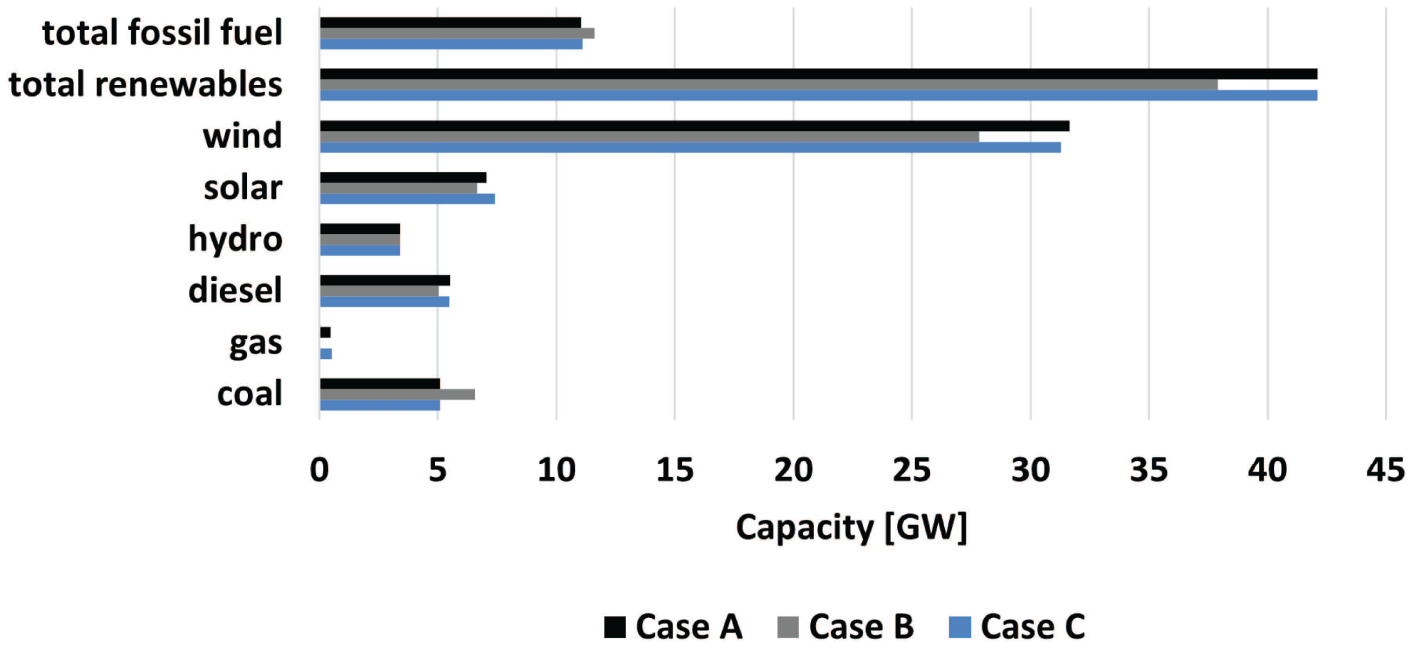
Capacity expansion decisions for Case A, Case B, and Case C
ii. Results that show the combined effect of price controls, jointly with standard carbon taxes and cap-and-trade programs, on generation firms’ revenues and consumers’ costs
As shown in Figure 6, the price control & cap-and-trade program model leads to the lowest domestic energy costs, as here approximately 94% of the domestic demand is supplied by cheap RES power generation, compared to an 88% for the price control & standard carbon tax model case. Since most of the expensive fossil fuel generation supplies the exports, the difference between the domestic and export energy prices leads to considerable revenue reductions for RES, for both, the price control & cap-and-trade program model and the price control & standard carbon tax model. These revenue reductions are 52% for the price control & standard carbon tax model and 76% for the price control & cap-and-trade program model. The higher revenue reduction of the price control & cap-and-trade program can be attributed to the higher contribution of cheap RES supplying the domestic demand, as compared with the case of the price control & standard carbon tax model. This reduction in the revenue of the generation firms translates into a benefit for consumers, who reduce their electricity costs. By contrast, the higher electricity costs, observed in the centralized model with standard carbon tax, translates into a higher merchandising surplus for generation firms. In this sense, another important contribution of this paper is the assessment of the effect of the carbon policies together with price controls on generation firms’ revenues and consumers’ costs.
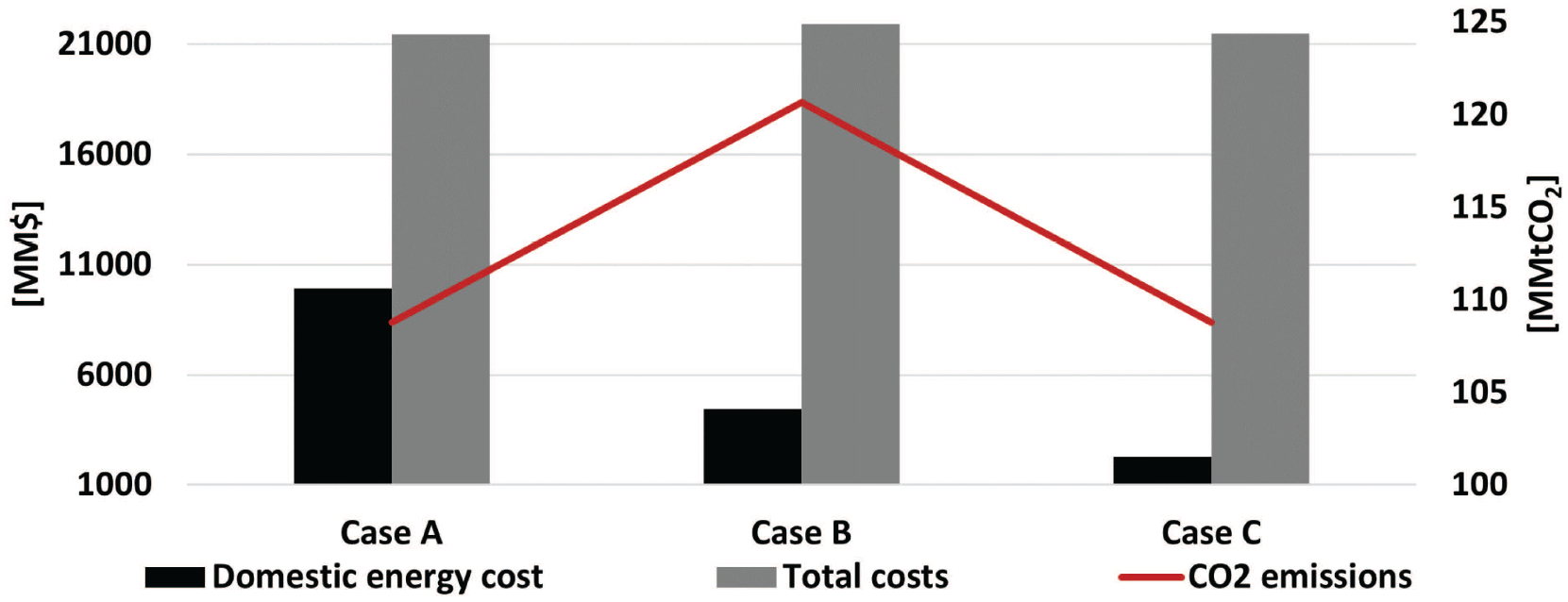
Total costs and emissions for Case A, Case B, and Case C
Also, the price control & cap-and-trade program model leads to lower CO2 emission levels than the price control & standard carbon tax model. One way of explaining this is computing an equivalent tax value of the cap-and-trade program (which corresponds to the dual variable of the carbon constraint in Eq. (19)). This dual variable yields to an equivalent tax value of $13.4/tCO2. This equivalent tax value is larger than the carbon taxes used for Chile and Argentina of $5/tCO2 and $10/tCO2, respectively, which explains the differences in the results.
iii. Sensitivity analysis against carbon tax variations under price controls and standard carbon taxes
Figure 7 depicts the sensitivity analysis of the generation investment decisions against a change in the carbon tax for values as high as $150/tCO2. Although this is a considerably higher carbon tax (as compared with typical values seen in most countries), the deterrent effect of the price control on RES investments is still quite strong as compared to the case of the centralized model. Thus, a general conclusion is that, under the price control, generation firms are prone to pay the extra costs of the carbon tax rather than investing in low emitting technologies. This is mainly due to the revenue reduction faced by those low emitting generators that mostly supply the domestic demand due to the price control rule. This revenue reduction is enough to reduce the efficiency of a carbon tax to promote investments in low emitting generation technologies. Also, notice that, as the carbon tax increases, carbon costs start being significant as compared to the revenue reductions associated with the price control, and thus, more RES capacity is promoted.
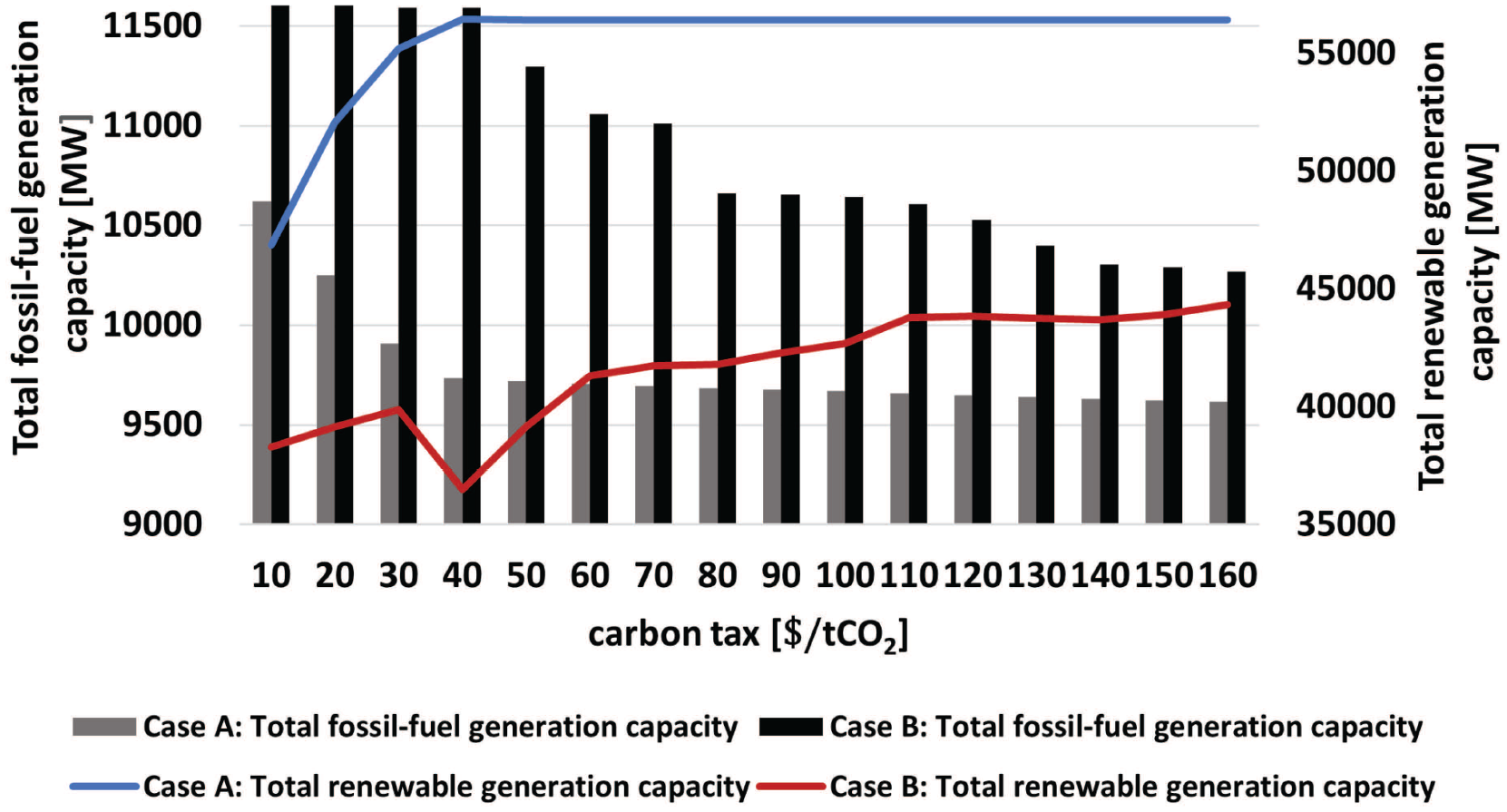
Sensitivity of capacity investment decisions against carbon tax for Case A and Case B
We found a non-monotonic behavior in investment decisions given the non-linear nature of the problem solved here. The proposed models not only optimize capacity investment decisions, but also export and dispatch levels. As a result, the differences between export and domestic prices obtained for each carbon tax, as well as the dominant generation technologies supplying the domestic demand, lead to different levels of revenue reductions for each technology. This can be appreciated, for instance, in the non-monotonicity of investment decisions in Figure 7.
In general, as RES capacity in the system increases, the likelihood of RES being at the margin also increases. This reduces the number of hours when domestic and export prices are different, and thus, reduces the inefficiencies attributed to the price control.
Figure 8 depicts annual CO2 emission quantities of the exporter country as the carbon tax increases. The reduction of the efficiency of a carbon tax under the price control is more evident for low levels of carbon taxes, especially from 10 up to $40/tCO2. In this range, carbon emission costs incurred by polluting generation technologies do not effectively offset the revenue reductions associated with the price control for low emitting base load generation. From 40 to $60/tCO2, carbon emission costs start being significant as compared to the revenue reductions, and thus, emissions are reduced more efficiently. However, for carbon taxes above $60/tCO2, again, emissions are not reduced further. This is because at this level, carbon emission costs are not sufficient to counteract the revenue reductions of the relatively high RES capacity that supplies the domestic demand. Therefore, the attractiveness of RES is not further increased, and capacity investment decisions remain relatively constant. For carbon taxes as high as $80000/tCO2, the effect of the price control is negligible, and thus the curves reach convergence.
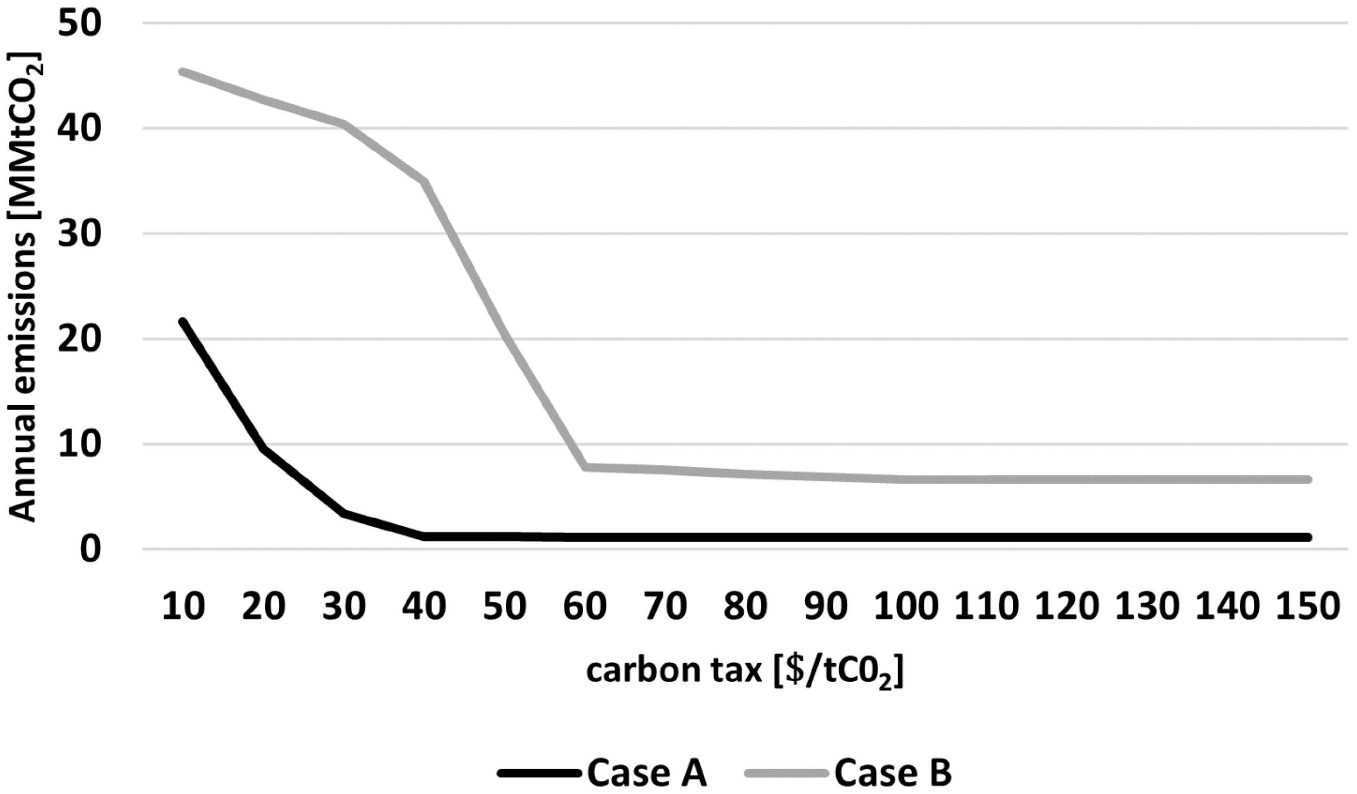
Annual CO2 emissions sensitivity against carbon tax variation for Case A and Case B
Iv. Results that show the combined effect of price controls, jointly with standard carbon taxes and cap-and-trade programs, considering green field scenarios for both countries
Finally, Figure 9 depicts the capacity resulting from the investment decisions in Chile and Argentina for case E, considering the central model & standard carbon tax, the price control & standard carbon tax model, and the price control & cap-and-trade program model. Likewise the previously analyzed case studies, the price control & cap-and-trade program yields similar capacity investment incentives as the central model & standard carbon tax for both countries. The equivalent tax value (called implicit carbon tax) is $5.3/ tCO2 and $270/tCO2 for Chile and Argentina, respectively. Again, these equivalent tax values are larger than those assumed for the standard carbon tax based models, which explains the observed larger incentives in RES capacity investments. In term of emissions, the price control & standard carbon tax model yields a 47% increase in CO2 emission in Chile, and roughly 24% increase in Argentina with respect to the central model & standard carbon tax. Also, domestic consumers in Chile gain the benefits of the price control rule, with a 37 % reduction in the mean domestic electricity price obtained with the price control & standard carbon tax model, and a 42% reduction obtained with the price control & cap-and-trade program. These electricity price reductions are proportional to the revenue reductions of the generation firms in Chile. In the case of Argentina, the electricity price reduction is modest, being 6% for the price control & standard carbon tax model and 1% for the price control & cap-and-trade model.
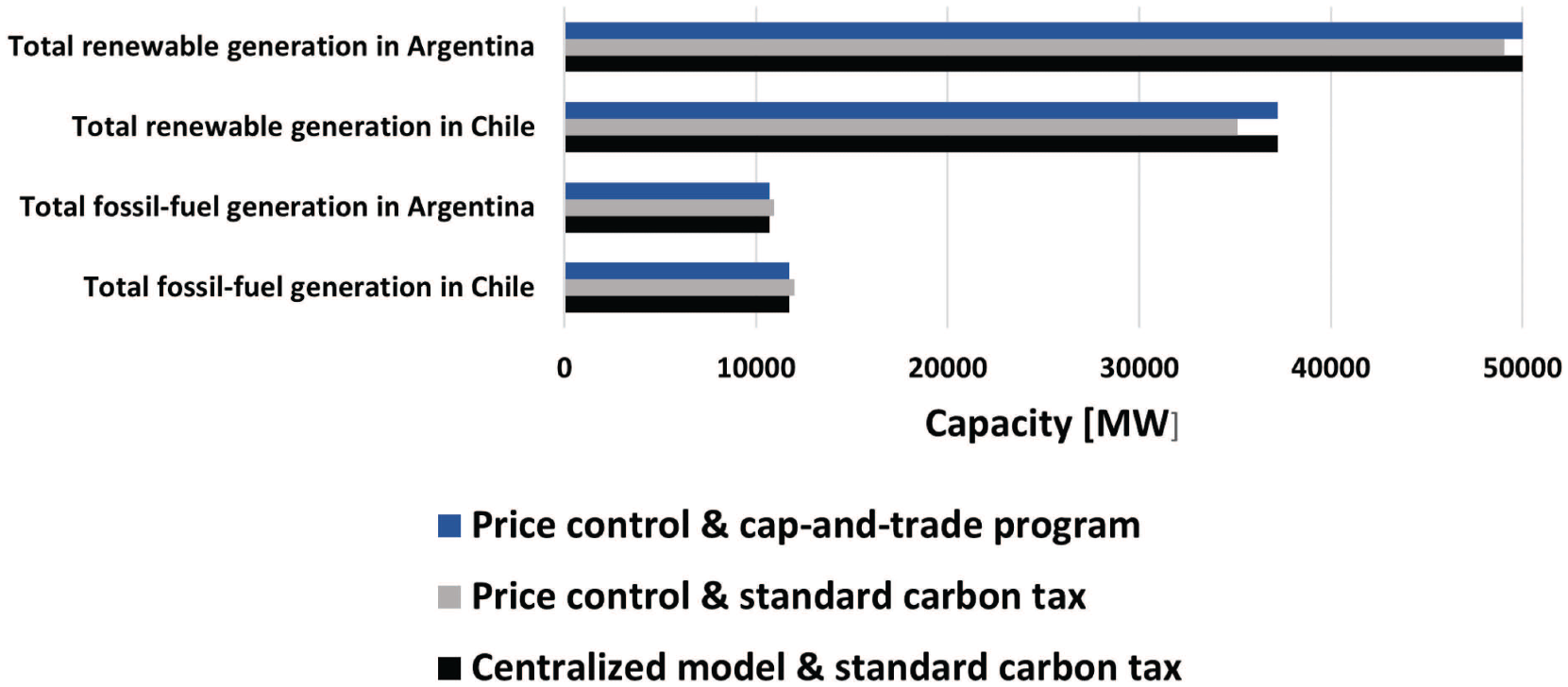
Capacity expansion decisions for Case E
IV. Conclusions
Cap-and-trade-programs are effective carbon policies to offset the reduction in long-term RES investments that may arise as a result of government price controls in cross-border trade of electricity. However, generation units supplying domestic demands bear higher revenue reductions in cap-and-trade programs than under standard carbon tax policies.
Although increasing carbon taxes does benefit RES investments under price controls, the price control effect of disincentivizing RES is still dominant—even for very high taxes—as compared to the centralized model with standard carbon taxes. Therefore, standard carbon tax policies are less effective than cap-and-trade programs to promote investments in RES when interacting with cross-border trade price control.
In this sense, this work made two important contributions to the literature: on the one hand, we develop a framework for the assessment of the combined effect of price controls in cross-border trade of electricity jointly with standard carbon taxes and cap-and-trade programs. This assessment is useful to determine the efficiency of carbon policies to promote RES investments under such a price control policy and to determine up to what extent the potential undesirable outcome of price controls of discouraging investments in RES can be mitigated by the carbon policies. On the other hand, another important contribution of this work is the assessment of the effect of the carbon policies together with price controls on generation firms’ revenues and consumers’ costs. These contributions provide insights to policy makers on the tradeoffs and effectiveness of the interactions between policy interventions.
The findings and conclusions in this paper are restricted to single node models, neglecting transmission planning expansion, and considering unidirectional power flow from the exporter to the importer country. For future research, it would be interesting to consider bi-directional cross-border trade of electricity, as well as detailed meshed networks for the interconnected countries, which would provide more intuition of the way the different policies interact.
The iterative approach proposed in this paper was found to be suitable to assess the interactions between the concerned policies and price controls. As an alternative to this approach, a Mixed Complementarity Problem formulation, modeling both imports and exports, is possible. While this formulation may solve the interaction between carbon policies and price controls in cross-border trade of electricity in a single shot, it would introduce additional nonlinearity to the model, making more complex its resolution. We left this challenge for future research.
Supplemental Material
sj-pdf-1-enj-10.5547_01956574.45.1.jmun – Supplemental material for Effect of Combining Carbon Policies and Price Controls in Cross-Border Trade of Energy on Renewable Generation Investments
Supplemental material, sj-pdf-1-enj-10.5547_01956574.45.1.jmun for Effect of Combining Carbon Policies and Price Controls in Cross-Border Trade of Energy on Renewable Generation Investments by Juan Carlos Muñoz, Sebastian Oliva H. and Enzo Sauma in The Energy Journal
Footnotes
Appendix A.1 Price control and standard carbon tax: single node model representation
First stage:
Subject to:
Second stage:
Subject to:
A.2) price control and cap-and-trade programs: single node model representation
First stage:
Subject to:
And constraints (A.2)–(A.13)
Second stage:
Subject to:
Acknowledgements
The work reported in this paper was partially funded by ANID through ANID/FONDECYT-Iniciación/11201052 grant, ANID/FONDECYT-Regular/1220439, ANID/FONDEF/ID21I10119, ANID/Millennium Scientific Initiative of the Ministry of Science, Technology, Knowledge, and Innovation-MIGA/ICN2021_023, and ANID/FONDAP-SERC-Chile/15110019 grant.
References
Supplementary Material
Please find the following supplemental material available below.
For Open Access articles published under a Creative Commons License, all supplemental material carries the same license as the article it is associated with.
For non-Open Access articles published, all supplemental material carries a non-exclusive license, and permission requests for re-use of supplemental material or any part of supplemental material shall be sent directly to the copyright owner as specified in the copyright notice associated with the article.
