




Abstract
Background and objective
An increasing number of investigations are drawing attention to the relationship between polymorphisms in the HOTAIR gene and the risk of cancers, but the results obtained so far have been controversial and inconclusive. We performed an up-to-date meta-analysis to obtain a more precise estimate of the possible associations.
Methods
Crude odds ratios (ORs) and 95% confidence intervals (CIs) were calculated to evaluate the strength of the associations.
Results
Nine publications including 26 case-control studies comprising 37,900 individuals were enrolled for the 5 polymorphisms in HOTAIR. The overall analyses identified a significant association between the rs920778 polymorphism and increased susceptibility to cancer in homozygous and recessive models. We conducted a stratification analysis by cancer type and identified a significantly increased susceptibility to esophageal squamous cell carcinoma in all the genetic models and to gastric cancer in the dominant model. For the rs7958904 polymorphism we detected a significantly decreased susceptibility to overall cancer in all 5 genetic models rather than the heterogeneous model. However, no significant association was identified between the rs874945, rs4759314 and rs1899663 polymorphisms and cancer susceptibility.
Conclusions
Our results demonstrate that the HOTAIR rs920778 polymorphism may represent a risk factor for cancer, whereas the rs7958904 polymorphism may play a protective role.
Introduction
Recently, a new type of long non-coding RNA (lncRNA) has attracted the attention of researchers for its comprehensive and systematic regulatory functions (1). The structure of lncRNAs comprises more than 200 nucleotides (2). Previous publications have demonstrated that lncRNAs may play diverse and critical roles in tumorigenesis through regulating cancer-associated genes in transcription, post-transcription and epigenesis (3). Recently, several lncRNAs have been found to be associated with diseases; for example, lncRNA MALAT1 has been identified in bronchogenic carcinoma as a negative predictor of clinical outcome (4), whereas lncRNA DD3 has been shown to be a positive factor in prostate carcinogenesis (5) and lncRNA HOTAIR presented a relationship between polymorphisms and susceptibility of gastric cancer (GC) (6).
Hox transcript antisense intergenic RNA (HOTAIR), one of the lncRNAs produced in the developmental HOXC locus, is located on chromosome 12q13.13. Chromatin organization can be reprogrammed by the interaction between HOTAIR and polycomb repressive complex 2 (PRC2) (7). In recent studies, overexpression of HOTAIR has been shown to be significantly associated with metastasis and poor prognosis in some carcinomas such as liver cancer (8), colon cancer (7), lung cancer (9), breast cancer (BC) (10), pancreatic cancer (11), laryngeal cancer (12) and nasopharyngeal cancer (13).
Several polymorphisms in the HOTAIR gene have been discovered that may affect its transcriptional activity; some of these polymorphisms are thought to be genetic susceptibility factors for cancers (6, 14). Zhang et al (14) examined the relationship between 3 polymorphisms of HOTAIR and susceptibility to esophageal squamous cell carcinoma (ESCC) and concluded that, compared with the rs920778 CC genotype, the TT genotype played a positive role in the susceptibility to ESCC among a Chinese population. Du et al (6) noted that the rs4759314 polymorphism was significantly associated with increased susceptibility to GC. Their functional experiments revealed allele-specific effects on HOTAIR and HOXC11 expression in GC tissues, and the expression of HOTAIR and HOXC11 was much higher in individuals carrying the AG genotype than those with the AA genotype. However, most studies examining the relationship between polymorphisms in HOTAIR and cancer susceptibility are limited by the small sample size. To assess the real association between the 5 HOTAIR polymorphisms (rs920778, rs874945, rs7958904, rs1899663 and rs4759314) and cancer susceptibility, we accumulated all various single case-control studies and conducted a comprehensive meta-analysis for the first time.
Methods
Literature search
A comprehensive literature retrieval was performed in the PubMed, Embase and Science Direct databases up to May 1, 2016 by applying the following search items: “HOTAIR OR HOX antisense intergenic RNA” AND “polymorphism OR SNP OR mutation OR variant OR allele OR genotype” AND “cancer OR tumor OR malignancy OR carcinoma OR neoplasm OR leukemia OR lymphoma”. In addition, 2 authors devoted themselves to a novel data extracting process by hand-searching the references of all of the eligible publications.
Inclusion and exclusion criteria
To be eligible for the present meta-analysis, publications had to meet the following criteria: assessment of the relationship between HOTAIR polymorphisms and cancer susceptibility; case-control design; provision of sufficient data, including the genotype frequencies of cases and controls. Reviews, comments, abstracts, case-only studies, case reports and duplicate publications were excluded.
Data extraction
To guarantee the precision of the extracted data, 2 authors (Yating Ge and Runze Jiang) gathered the following information: name of the first author, ethnicity of study population, source of control subjects, year of publication, genotype frequencies, tumor type, p value of Hardy-Weinberg equilibrium (HWE), and genotyping methods. Moreover, if a publication focused on more than 1 topic and contained duplicate samples, the largest sample with the most informative and complete data was included.
Statistics
We assessed the relationship between HOTAIR gene polymorphisms and cancer susceptibility (OR: odds ratio [OR] and 95% confidence interval [CI]) by determining the genotype and allele frequencies of all cases and controls. To summarize the ORs of the 5 polymorphisms we applied 5 genetic models: allele contrast, homozygous, heterogeneous, dominant and recessive models (AA, homozygotes for the common allele; AB, heterozygotes; BB, homozygotes for the rare allele). A Z-test was performed to assess the significance of the pooled ORs (p<0.05 was regarded as significant). In addition, multiple test adjustment was performed referring to the Bonferroni correction method (15).
When the enrolled case-control studies were homogeneous (p>0.05), a fixed-effects model (Mantel-Haenszel method) was used to calculate the summary ORs; otherwise, a random-effects model (DerSimonian-Laird) was used (16). The Cochran Q-statistic was calculated to assess between-study heterogeneity. Begg's funnel plots and visual inspection of Egger's test were performed to reveal potential publication bias (17). A goodness-of-fit chi-square test was performed to calculate HWE in the control groups (18). We also carried out sensitivity analysis to verify the effectiveness of the combined data (19). We adopted the Newcastle-Ottawa scale (NOS) to assess the quality of the enrolled studies. All calculations were done with Stata 12.0 (StataCorp LP).
Results
Study identification
The publication selection process is presented in Figure 1, and the main characteristics of the enrolled studies are shown in Table I. A total of 257 publications were identified based on the search items. Then, 239 publications were discarded after viewing the title and abstract. Nine publications were further excluded because they were meta-analyses or studies investigating HOTAIR's roles in tumor cell lines, etc. Finally, 9 articles including 26 case-control studies comprising 17,273 cases and 20,627 controls were included for further calculations (6, 14, 20–26). For the rs920778 polymorphism, a total of 8 case-control studies comprising 3,600 cases and 4,585 controls were included. For the rs4759314 polymorphism, 7 case-control studies involving 5,503 cases and 6,570 controls were included. For the rs7958904 and rs874945 polymorphisms, 4 case-control studies comprising 7,179 cases and 5,957 controls were included. For the rs1899663 polymorphism, 3 case-control studies comprising 2,002 cases and 2,504 controls were included. Of the 26 case-control studies, 9 focused on GC, 5 on ESCC, 5 on osteosarcoma, 4 on BC, and 3 on colorectal cancer. Only 2 of the 26 case-control studies were conducted in Caucasians; the other studies were conducted in Asians. The controls of these studies were hospital-based groups. The distribution of genotype frequencies among the control groups was consistent with HWE in all but 5 case-control studies (23).
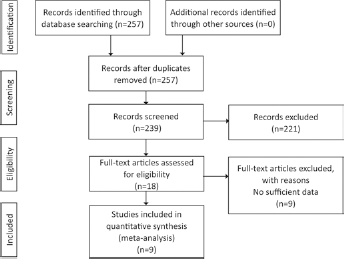
Flow diagram of the inclusion and exclusion of studies.
Characteristics of studies on HOTAIR polymorphisms and cancer patients
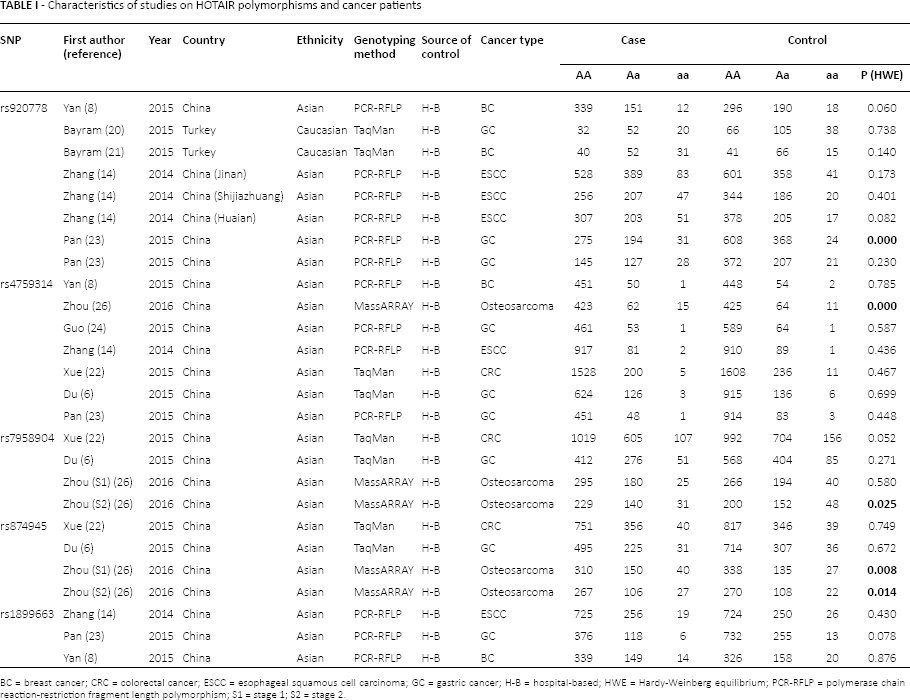
BC = breast cancer; CRC = colorectal cancer; ESCC = esophageal squamous cell carcinoma; GC = gastric cancer; H-B = hospital-based; HWE = Hardy-Weinberg equilibrium; PCR-RFLP = polymerase chain reaction-restriction fragment length polymorphism; S1 = stage 1; S2 = stage 2.
Quantitative analysis
Table II shows the ORs and 95% CIs for all 5 genetic models tested in the present analysis. The overall analyses identified significant statistical evidence between the rs920778 polymorphism and increased cancer susceptibility in the homozygous model (BB vs. AA: OR = 2.166, 95% CI 1.477-3.175, p = 0.000, Fig. 2A) and recessive model (BB vs. BA + AA: OR = 2.064, 95% CI 1.476-2.886, p = 0.000, Fig. 2B). For the rs7958904 polymorphism, we detected a significantly decreased susceptibility to overall cancer in all 5 genetic models rather than the heterogeneous model (B vs. A: OR = 0.831, 95% CI 0.771-0.896, p = 0.000,; BA + BB vs. AA: OR = 0.824, 95% CI 0.750-0.904, p = 0.000; BB vs. AA: OR = 0.673, 95% CI 0.561-0.809, p = 0.000; BB vs. BA + AA: OR = 0.716, 95% CI 0.599-0.856, p = 0.000). However, no significant association was identified for the rs874945, rs4759314 and rs1899663 polymorphisms and cancer susceptibility.
Results of meta-analysis between HOTAIR polymorphisms and cancer susceptibility
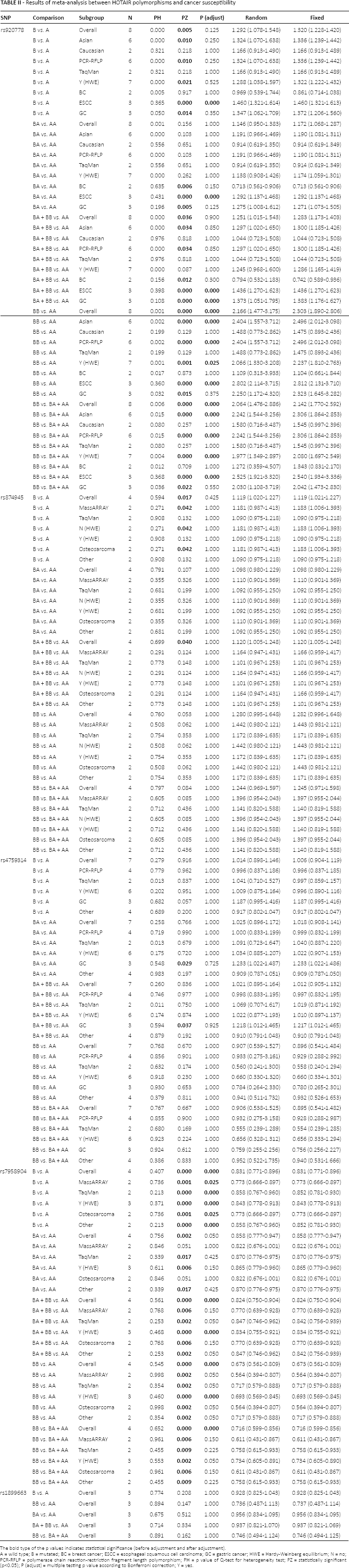
The bold type of the p values indicates statistical significance (before adjustment and after adjustment).
A = wild type; B = mutated; BC = breast cancer; ESCC = esophageal squamous cell carcinoma; GC = gastric cancer; HWE = Hardy-Weinberg equilibrium; N = no; PCR-RFLP = polymerase chain reaction-restriction fragment length polymorphism; PH = p value of Q-test for heterogeneity test; PZ = statistically significant (p<0.05); P (adjust) = multiple testing p value according to Bonferroni correction; Y = yes.
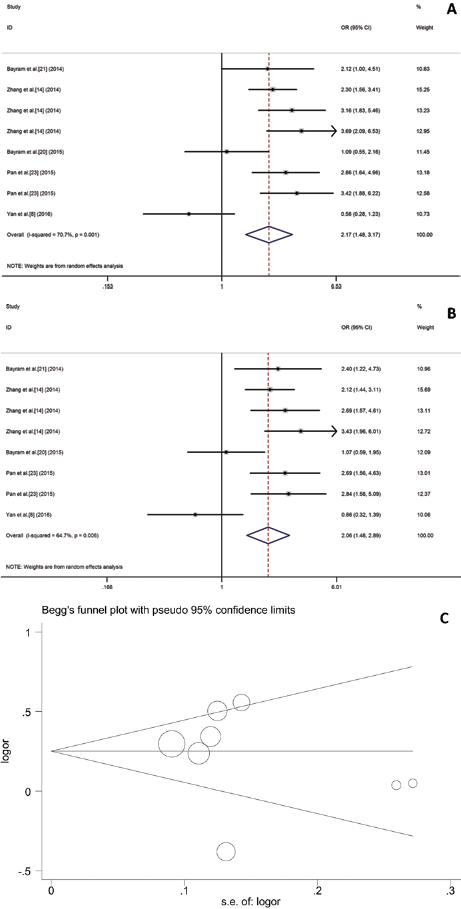
(A and B) Forest plot of the association between HOTAIR rs920778 polymorphism and cancer risk (BB vs. AA). The size of the squares represents the weight of the included studies. OR = odds ratio; CI = confidence interval. (C) Begg's funnel plots to examine publication bias of HOTAIR rs920778 polymorphism (BB vs. BA + AA).
Subgroup analysis
For the rs920778 polymorphism, we conducted a stratification analysis based on cancer type and we identified a significantly increased susceptibility to ESCC in all genetic models and to GC in the dominant model (BA + BB vs. AA: OR = 1.383, 95% CI 1.176-1.627, p = 0.000). In the subgroup analysis by ethnicity, a significantly increased susceptibility to cancer in the Asian population was uncovered in the homozygous and recessive models (BB vs. AA: OR = 2.404, 95% CI 1.557-3.712, p = 0.000; BB vs. BA + AA: OR = 2.242, 95% CI 1.544-3.256, p = 0.000). In addition, when stratification analysis was performed by HWE status and genotyping method, we also found a significantly increased susceptibility to cancer in the recessive and homozygous models (Tab. II).
For the rs7958904 polymorphism, in the stratification analysis by genotyping method, HWE status and cancer type, a significantly decreased susceptibility to cancer was also identified for MassARRAY, TaqMan, HWE (Y) and osteosarcoma in the specific genetic models (Tab. II). The results of the subgroup analyses for the other polymorphisms are also presented in Table II.
Publication bias and sensitivity analysis
Sensitivity analysis to predict whether variations in individual studies could influence the pooled ORs by removing single case-control studies in sequence was performed. The analysis indicated that the results of the 5 polymorphisms were statistically robust and reliable. In addition, referring to Egger's regression test and Begg's funnel plots, no significant publication bias was detected for any of the genetic polymorphisms (rs920778 polymorphism: BB vs. BA + AA, p> |t| = 0.396; Fig. 2C). Moreover, referring to the NOS table, we assessed the quality of the enrolled studies, as shown in Table III.
Methodological quality of the included studies according to the Newcastle-Ottawa scale
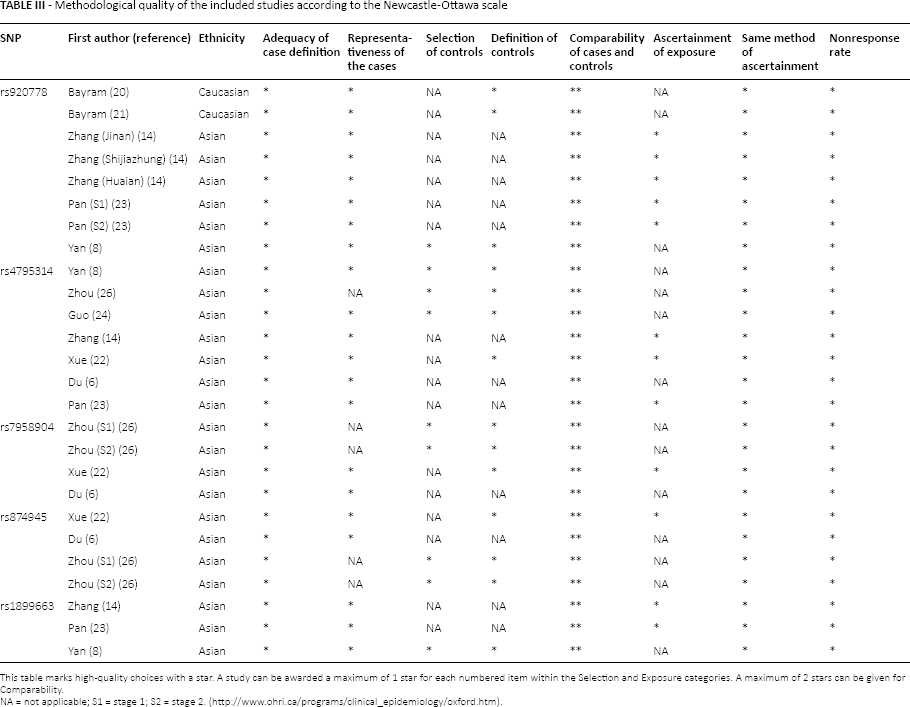
This table marks high-quality choices with a star. A study can be awarded a maximum of 1 star for each numbered item within the Selection and Exposure categories. A maximum of 2 stars can be given for Comparability.
NA = not applicable; S1 = stage 1; S2 = stage 2. (http://www.ohri.ca/programs/clinical_epidemiology/oxford.htm).
Discussion
Emerging evidence has shown that HOTAIR can act as an oncogene in diverse tumors, and its overexpression may contribute to the malignant transformation of normal cells (27). Gupta et al (28) first uncovered the overexpression of HOTAIR in BC tissues, and the high expression of HOTAIR was related to poor metastasis-free and overall survival. In the paper by Łuczak et al (29), the authors suggest that HOTAIR expression could serve as an independent prognostic factor in endometrial cancer. Similar results were also seen in other solid tumors. Recently, several studies have explored the genetic influence of HOTAIR polymorphisms on cancer susceptibility. Zhang et al (14) initially identified 3 polymorphisms (rs920778, rs1899663 and rs4759314) in HOTAIR and assessed their influence on ESCC susceptibility; they determined that the rs920778 polymorphism was significantly related to increased susceptibility to ESCC, and an allele-specific influence on the intronic enhancer activity of HOTAIR was uncovered by a later functional study (23). Subsequently, Guo et al (24) evaluated the association between HOTAIR polymorphisms and susceptibility to gastric cardia adenocarcinoma (GCA). The study revealed that the rs12826786 polymorphism was not only related to increased GCA susceptibility but also had a genotype-specific influence on the expression of HOTAIR.
Because individual studies may have inadequate statistical power to precisely evaluate the influence of HOTAIR polymorphisms on cancer susceptibility, in the present work we performed a meta-analysis, which is a quantitative method to maximize the overall identification power with the objective of offering compelling evidence for the relationship between polymorphisms and cancer susceptibility. We identified significant statistical evidence between the rs920778 polymorphism and increased cancer susceptibility, a result consistent with previous studies (20, 21, 23, 24). In the stratification analysis by cancer type, a significantly increased susceptibility to ESCC and GC was uncovered. We also determined that the rs7958904 polymorphism was associated with a significantly decreased susceptibility to cancer in all 5 genetic models rather than the heterogeneous model. However, no significant association was found for the rs874945, rs4759314 and rs1899663 polymorphisms and cancer susceptibility. All these data suggest a critical role of the HOTAIR rs920778 polymorphism in cancer susceptibility, particularly for cancer of the digestive system (GC and ESCC).
Several meta-analyses had been conducted previously, but with some limitations compared with the present one (summarized in Tab. IV). In the study by Qi et al (30), the authors identified similar increased susceptibility to ESCC, especially in Asians, for the rs920778 polymorphism by combining 8 relevant studies. However, in the work by Tian et al (31) no significant association between the HOTAIR polymorphisms rs920778, rs4759314 and rs1899663 and cancer risk was found. In addition, when compared to the latest article, published in June 2016 (32), Zhang and his colleagues analyzed more polymorphisms in HOTAIR, which seems to have adequate statistical evidence to evaluate the influence of HOTAIR polymorphisms on cancer susceptibility. One of the biggest problems of these is that their results were not strengthened by adopting rectifying inspection, which is a critical step in genome-wide association studies, aiming to decrease the false positive results (30–32). Hence, although the enrolled studies are the same, the results are diversified.
Comparison between publications concerning HOTAIR polymorphisms and cancer risk
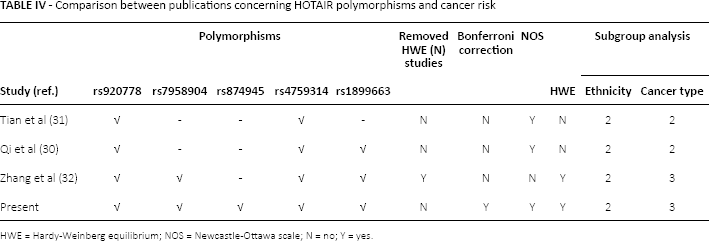
HWE = Hardy-Weinberg equilibrium; NOS = Newcastle-Ottawa scale; N = no; Y = yes.
We have conducted a comprehensive up-to-date retrieval of all the eligible studies and polymorphisms and obtained positive evidence that the genetic polymorphisms in HOTAIR may be cancer genetic susceptibility biomarkers. Nevertheless, there are several remaining limitations that should be noted. First, our results were dependent on unadjusted estimates, and more precise outcomes would be obtained based on adjustments for other confounding factors such as gender, age, body mass index, lifestyle, etc. Second, the language of the eligible publications was restricted to English and Chinese, which may lead to a latent language bias. Third, the studies included in the present analysis were limited, particularly when the stratification analyses were conducted. If there are a number of case-control studies related to a variety of cancer types or different ethnicities in future publications, subgroup analyses should be performed. Fourth, because of the absence of original data, we cannot evaluate the intergene or gene-environment interactions. Fifth, our study focused mostly on Chinese populations; the effects of the polymorphisms in other ethnicities such as African and Caucasian populations should be further investigated. Finally, the controls of all of the enrolled case-control studies were hospital based, which may result in potential bias. Conversely, some advantages should also be highlighted. We have systematically and comprehensively shed light on the associations between the HOTAIR rs920778, rs874945, rs7958904, rs1899663 and rs4759314 polymorphisms and cancer susceptibility, particularly for the Chinese population, and obtained positive results. In addition, because of the large sample size, the power and reliability of the conclusions of our meta-analysis were improved compared to previous individual studies. Finally, the studies included in the present meta-analysis were quite recent (published between 2014 and 2015).
In summary, our results demonstrate that the HOTAIR rs920778 polymorphism may represent a risk factor for cancer, particularly in the Chinese population, whereas the rs7958904 polymorphism may be a protective factor. Further well-designed prospective studies with adequate sample sizes for each cancer type are necessary to verify our findings.
Footnotes
Abbreviations
Financial support: This work was supported by the Clinical Key Subjects Program of the Ministry of Public Health (Urology) and National Natural Science Foundation of China (81370856).
Conflict of interest: The authors have no conflict of interest to disclose.