




Abstract
Background
Genome-wide association studies (GWAS) have determined a new single nucleotide polymorphism (SNP) called VTI1A (rs7086803) that induces lung cancer susceptibility in nonsmoking women in Asia. This study aimed to evaluate the association between the VTI1A gene and the susceptibility of Chinese patients to lung cancer; it was also conducted to investigate the relationship between VTI1A SNP and adiponectin receptor 1 expression.
Methods
A total of 887 subjects were enrolled in this study. VTI1A (rs7086803) genotypes were determined by genotyping. Overall survival (OS) was evaluated using Kaplan-Meier analysis with a log-rank test.
Results
Multivariate regression analysis results indicated that the AA genotype of VTI1A (rs7086803) polymorphism was associated with an increased risk of developing non-small cell lung carcinoma (NSCLC) compared with the GG genotype (AA vs. GG: odds ratio [OR] = 2.020; 95% confidence interval [95% CI], 1.033-3.949, p = 0.037). The AA genotype of VTI1A (rs7086803) in smokers predicted significantly shorter OS (median survival time [MST]: AA 9.8 months, AG 19.3 months, GG 12.2 months, p = 0.017). Adiponectin receptor 1 expression in tumor tissues with the AA genotype was significantly lower than that for other genotypes (mean rank: AA 18.55, AG 25, GG 45.76, p = 0.001).
Conclusions
The presence of the allele A of VTI1A (rs7086803) may be the allele contributing to the risk of lung cancer susceptibility in Chinese population. Smoking lung cancer patients with the AA genotype of VTI1A gene (rs7086803) had a poor survival rate. Adiponectin receptor 1 expression may be correlated with the susceptibility of the allele A of VTI1A.
Introduction
Lung cancer is one of the most common malignancies worldwide (1). In China, lung cancer is a major health problem and has a high mortality rate in both men and women (2, 3). The 5-year survival rate of lung cancer patients in China is only 15%, which has not improved for several decades (4). Genetic factors may also play an important role in determining susceptibility to lung cancer (3). Genome-wide association studies (GWAS) (5) have determined a new single nucleotide polymorphism (SNP) called VTI1A loci at 10q25.2 (rs7086803) that induces lung cancer susceptibility in nonsmoking women in Asia.
Yeast soluble NSF attachment protein receptors (SNAREs) are classified into subgroups (Qa-, Qb-, Qc- and R-SNARE) based on amino acid sequences of the SNARE motif (6). Vps10p tail interacting 1a (VTI1A) is a mammalian homolog of the yeast Q-SNARE vti1p, which is involved in transport between an endosome and the trans-Golgi network (TGN) (7). The present results suggest that a SNARE complex containing vesicle-associated membrane protein 7 (VAMP7) and VTI1A defines a novel traffic pathway to the cell surface in neuronal and non-neuronal cells (8). In vitro experiments (9) have shown distinct functions of VTI1A, in which the subcellular localization of endogenous VTI1A has been compared by immunofluorescence and immunoelectron microscopy. Both proteins exhibit a distinct but overlapping localization. VTI1A is found predominantly in the Golgi apparatus and TGN. GWAS proposed VTI1A may be a susceptible factor in nonsmoking women getting lung cancer. However, the current studies into VTI1A, in connection to lung cancer, are scarce - especially studies to do with immunohistochemistry. In other studies (7-9-10), some genes such as VTI1A were positioned within the intracellular localization, and different locations seemed to be associated with different prognoses. Drawing lessons from these studies, we tried to further determine the relationship between VTI1A and lung cancer, and determine whether prognosis is related to the positioning of VTI1A or not.
Yamauchi et al (11) initially cloned adiponectin receptor 1 (AdipoR1), which encodes 7 transmembrane domain proteins. Other studies have also indicated that AdipoR1 is an integral membrane protein containing an internal N terminus and an external C terminus; this structure is found on the opposite site of the topology of reported G-protein coupled receptor (GPCR) families (12-14). AdipoR1 is a high-affinity receptor of globular adiponectin but a very low-affinity receptor of full-length adiponectin. AdipoR1 is unlikely paired with G protein but activates unique sets of signaling molecules, such as PPAR-a, AMPK and p38 MAPK. Thus, adiponectin receptors may constitute a new receptor family, which encodes receptors of globular and full-length adiponectin.
Further studies should be conducted to determine whether or not VTI1A, AdipoR1 and adiponectin inhibit tumor cell growth via peroxisome proliferator-activated receptor (PPAR). Functional AdipoR1 is normally expressed in lung epithelial cells (15). However, AdipoR1 expression in tissues and the corresponding correlation with lung carcinoma remain controversial. This study aimed to evaluate the association between SNPs in the VTI1A gene and the susceptibility of Chinese patients to lung cancer. This study also aimed to investigate the relationship between VTI1A SNPs and AdipoR1 expression.
Materials and Methods
Patient Selection and Specimens
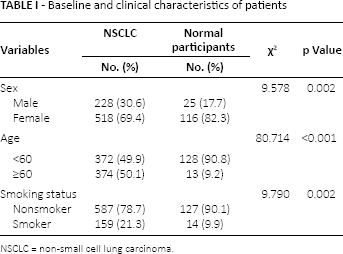
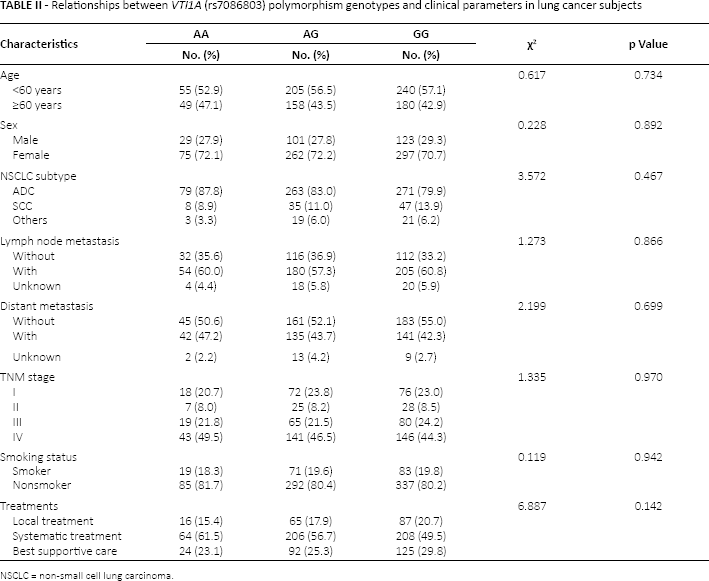
A population-based case-control study of patients with non-small cell lung carcinoma (NSCLC) and normal subjects was conducted in Guangdong General Hospital. A total of 518 female cases and 116 control subjects were enrolled in this GWAS. Our study was approved by the ethics committee of Guangdong General Hospital (No. 201053). In addition, 228 male cases and 25 male control subjects were randomly selected (Tab. I). Each patient with NSCLC was classified on the basis of the tumor-node-metastasis (TNM) classification of the International Union against Cancer (16). The remaining clinical and pathological characteristics are shown in Table II. Our study protocol was approved by the ethics committee of Guangdong General Hospital. A written informed consent was obtained from all of the subjects involved in this study.
Baseline and clinical characteristics of patients
NSCLC = non-small cell lung carcinoma.
Relationships between VTI1A (rs7086803) polymorphism genotypes and clinical parameters in lung cancer subjects
NSCLC = non-small cell lung carcinoma.
Patients with other tumors and unclear pathological diagnosis were excluded. The subjects were chosen without age, sex or disease stage restrictions. Clinical data were collected from the case histories of the patients in the hospital. Nonsmokers were defined as patients who smoked fewer than 100 cigarettes in their lifetime. Smokers were defined as patients who smoked more than 100 cigarettes in their lifetime. The follow-up of the patients was done via telephone calls or reexamination of their records by our hospital follow-up group. Overall survival (OS) was defined as the time from the first day of diagnosis to the date of death or the date when patients were last known to be alive.
DNA Extraction and Genotyping
To study the tagSNP of VTI1A (rs7086803), we isolated genomic DNA from 1 mL of peripheral blood of patients and healthy individuals and extracted genomic DNA from white blood cells within a week after sample was collected, by proteinase K digestion, as previously described (17). TagSNP rs7086803 was genotyped using the dsDNA dye LC Green in combination with high-resolution melt (HRM) analysis. Polymerase chain reaction (PCR) primers were designed using LightScanner primer design software (Idaho Technology; primer: TTCTTATAAGACTGTTGAGTTTACA
Immunohistochemistry
Archived formalin-fixed and paraffin-embedded (FFPE) tumor tissues were obtained from 71 patients with NSCLC who had undergone surgery at the Guangdong Lung Cancer Institute in China. Paraffin sections (3 µm) were dewaxed in xylene and rehydrated in graded ethanol solutions. Antigen was completely submerged in citrate solution (10 mmol/L, pH 6.0) at 100°C for 30 minutes. Sections were cooled and incubated in 0.3% H2O2 solution for 15 minutes to block endogenous peroxidase activity. Afterward, the sections were rinsed thrice with phosphate-buffered saline (PBS; pH 7.4) for 5 minutes each and then incubated overnight with AdipoR1 antibody (1:200 dilution, Catolog no. 5512-1; Epitomics, CA, USA) in a humid chamber at 4°C. Negative controls were prepared without a primary antibody. The sections were rinsed thrice with PBS (pH 7.4) for 5 minutes each and incubated with a secondary antibody (Dako REAL EnVision/HRP, Rabbit/Mouse; Dako, Glostrup, Denmark) at room temperature for 30 minutes. Afterward, the sections were washed with PBS, stained with 3,3’-diaminobenzidine, counterstained with hematoxylin and differentiated with 0.1% hydrochloric acid alcohol. The sections were dehydrated, cleared and mounted. Staining results were evaluated and scored according to individual intensity separate of membranous and cytoplasmic distribution in a scale from 0 to +++, corresponding to negative (-), weak (+), moderate (++), and strong (+++) immunoreactivity. Immunohistochemical findings were analyzed by 2 independent investigators, who were unaware of the clinical data.
Statistical Analysis
Statistical analyses were performed using SPSS, version 13.0. Differences in demographic characteristic distribution and genotype frequencies between cases and control subjects were evaluated using the chi-square test and Fisher's exact test where appropriate. NSCLC risk associated with VTI1A SNPs was estimated by odds ratios (ORs) and 95% confidence intervals (CIs). Survival analysis was conducted by Kaplan-Meier analysis with a log-rank test. Multivariate analyses were conducted using Cox's proportional hazards model (Backward: LR; p = 0.05, entry; p = 0.10, removal) adjusted for age, sex, tumor subtype and TNM stage wherever appropriate. AdipoR1 expressions with different VTI1A SNPs were evaluated and compared using the nonparametric counting method for independent samples. A 2-tailed p value <0.05 was considered statistically significant.
Results
Patient Characteristics
The baseline characteristics of cases and controls are outlined in Table I. A total of 887 eligible subjects were enrolled. The specimens of these patients were stored in the hospital tumor bank from 2003 to 2011. A significant difference was observed between cases and control subjects in terms of sex, age and smoking status (p = 0.002, p<0.001 and p = 0.002, respectively).
Frequency of the Genotypes of VTI1A (rs7086803) Polymorphism and their Relationships with Clinical Parameters
The clinicopathological characteristics of 746 NSCLC cases are summarized in Table II. We analyzed the correlations between the genotypes of rs7086803 polymorphism and the patients’ clinical parameters, namely, age, sex, tumor subtype, lymph node metastasis, distant metastasis, TNM stage and smoking status. No significant association between VTI1A (rs7086803) genotypes and clinical parameters was observed, although our test sample size was small.
Stratification Analysis of rs7086803 Genotypes and Lung Cancer Risk
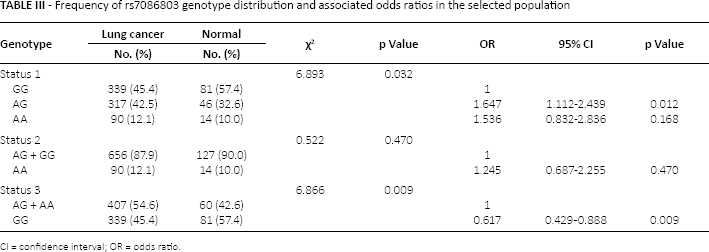
Among the cases, the genotype frequencies of VTI1A (rs7086803) were 45.4%, 42.5% and 12.1% for the GG, AG and AA genotypes, respectively (Tab. III). Among the control subjects, the genotype frequencies of VTI1A were 57.4%, 32.6% and 10.0% for the GG, AG and AA genotypes, respectively (Tab. III). The difference between cases and control subjects was statistically significant (p = 0.032). Moreover, the combined AG/AA genotype frequency was higher among the cases than the controls (54.6% vs. 42.6%, p = 0.009). Using the GG genotype as reference, we found that variant genotypes (AG and AA) were associated with an increased risk of A allele (AG vs. GG: OR = 1.647; 95% CI, 1.112-2.439; p = 0.012). Using the combined AG/AA genotype as reference, we observed that the GG genotype was a putative protective factor for lung cancer (GG vs. AG/AA: OR = 0.617; 95% CI, 0.429-0.888; p = 0.009). This data indicated that the AA genotype was associated with genetic susceptibility to lung cancer.
Frequency of rs7086803 genotype distribution and associated odds ratios in the selected population
CI = confidence interval; OR = odds ratio.
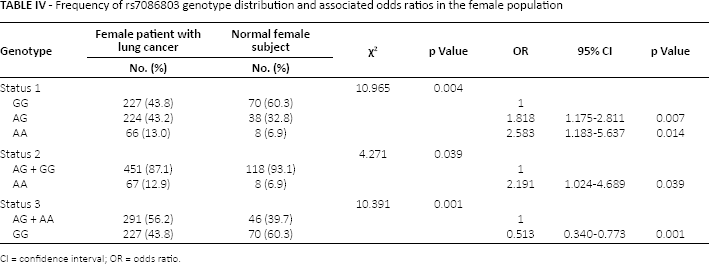
After our data were stratified by sex, the frequency of distribution of VTI1A (rs7086803) polymorphism in the case and control groups was determined (Tabs. IV and V, respectively). The risk of NSCLC was associated with the AA genotype in the female population (AA vs. GG: OR = 2.583; 95% CI, 1.183-5.637; p = 0.014) but not in the male population (p = 0.113). Using combined AG/AA genotype as reference, we found that allele A was a risk factor for female lung cancer patients (AA vs. AG/GG: OR = 2.191; 95% CI = 1.024-4.689; p = 0.039; GG vs. AG/AA: OR = 0.513; 95% CI, 0.340-0.773; p = 0.001). Hence, allele A of VTI1A (rs7086803) may be a risk allele of lung cancer susceptibility in the female population.
Frequency of rs7086803 genotype distribution and associated odds ratios in the female population
CI = confidence interval; OR = odds ratio.
Frequency of rs7086803 genotype distribution and associated odds ratios in the male population
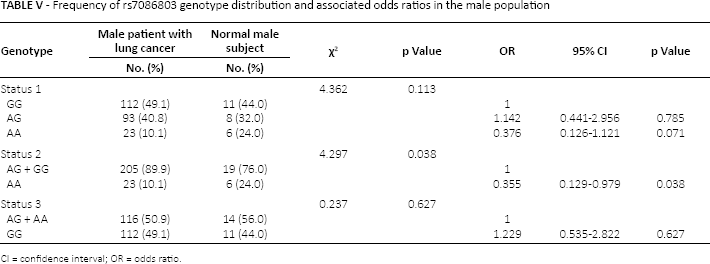
CI = confidence interval; OR = odds ratio.
VTI1A (rs7086803) Polymorphism and Survival of Lung Cancer Patients by Smoking Status
Smoking is a well-established risk factor leading to lung cancer; thus, stratification by smoking status was performed to investigate the association of rs7086803 polymorphism variant with the survival time of NSCLC. Table II shows that there were no statistically significant differences observed between different treatments and VTI1A (rs7086803) polymorphism genotypes (p<0.05). Figure 1 shows that the AA genotype of VTI1A (rs7086803) in smokers predicted a significantly shorter OS (median survival time [MST]: AA 9.8 months, AG 19.3 months, GG 9.8 months, p = 0.017). We analyzed the interaction between smoking status and rs7086803 polymorphism variant by using the GG genotype as reference; we found that AA carriers exhibited an increased risk of NSCLC with an OR of 1.708 (95% CI, 0.862-3.387). A worse survival rate was observed for MST in AA genotype carriers than in combined AG/GG genotype carriers (MST: AA 9.8 months, AG/GG 16.5 months; p = 0.006). Using the AA genotype as reference, we observed that combined AG/GG genotypes exhibited a decreased risk of NSCLC with an OR of 0.497 (95% CI, 0.263-0.939). However, no statistically significant association between rs7086803 genotypes and OS was evident in nonsmoking lung cancer patients (Fig. 2).
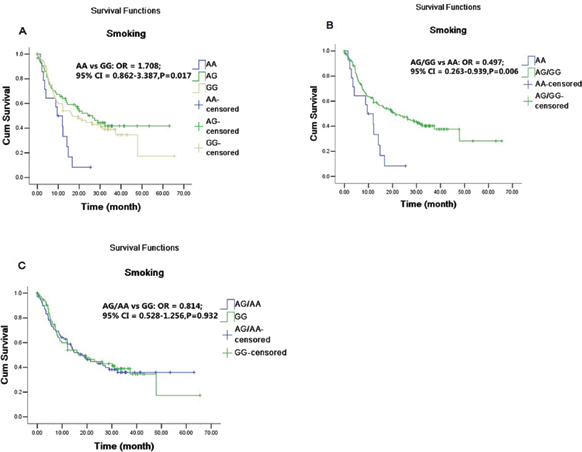
Association of rs7086803 genotypes with overall survival (OS) in smoking lung cancer patients. Individuals with the AA genotype exhibited a significantly increased risk of death compared with those carrying the (A) GG genotype and (B) combined AG/GG genotype. C) Combined genotype AG/AA did not show significant association with GG genotype in survival outcomes; odds ratios (ORs) and 95% confidence intervals (95% CIs) were estimated using a multivariate Cox regression model. Statistical differences between the 2 survival curves were assessed using the log-rank test.
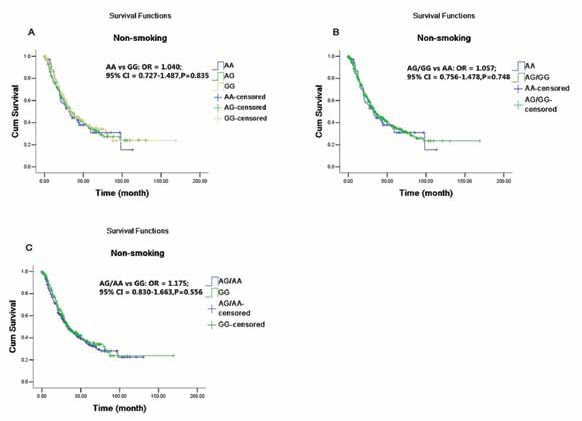
Association of rs7086803 genotypes with overall survival (OS) in nonsmoking lung cancer patients. A-C) No statistically significant association was found between each rs7086803 genotype and OS in nonsmoking lung cancer patients. Odds ratios (ORs) and 95% confidence intervals (95% CIs) were estimated using a multivariate Cox regression model. Statistical differences between the 2 survival curves were assessed using the log-rank test.
Association between AdipoR1 expression and VTI1A (rs7086803) polymorphism in NSCLC and adjacent nontumor tissues
AdipoR1 expression in tumor tissues with the AA genotype was significantly lower than that for other genotypes (mean rank: AA 18.55, AG 25, GG 45.76, p = 0.001). In adjacent nontumor tissues, no statistically significant differences were observed between AdipoR1 expression and VTI1A (rs7086803) polymorphism (mean rank: AA 37.45, AG 32.8, GG 37.98, p = 0.544; Fig. 3).
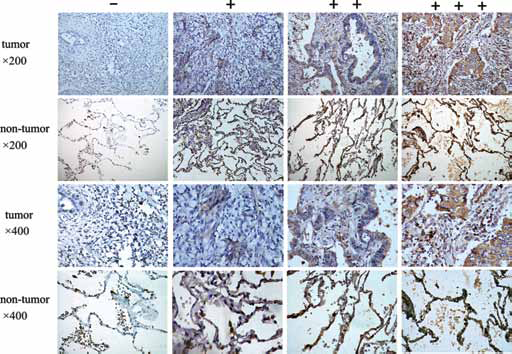
Immunohistochemical AdipoR1 expression in tumor and nontumor tissues. Positive staining signal of AdipoR1 was observed in tumor and nontumor tissues at 2 magnifications (×200 and ×400), respectively. AdipoR1 expression in tumor tissues with the AA genotype was significantly lower than that for other genotypes (mean rank: AA 18.55, AG 25, GG 45.76, p = 0.001). In the adjacent nontumor tissues, no statistically significant differences were observed between AdipoR1 expression and VTI1A (rs7086803) polymorphism (mean rank: AA 37.45, AG 32.8, GG 37.98, p = 0.544).
Discussion
In this study, subjects carrying rs7086803 AA or combined AG/AA genotypes exhibited significantly increased lung cancer risk compared with individuals with the GG genotype. This observation indicated that allele A is a risk effect potentially exhibited by this tagSNP for the entire population, particularly in the female population. VTI1A is enriched with small synaptic vesicles (18) and localized in the Golgi, as revealed by immunofluorescence microscopy (19). Different genotypes of VTI1A (rs7086803) are associated with a high risk of lung cancer. To the best of our knowledge, this study is the first to describe the genetic variants in VTI1A (rs7086803) genes and simultaneously demonstrate lung cancer susceptibility between both male and female populations.
Our study further elucidated the relationship between rs7086803 SNPs and mortality for different smoking statuses. Conducting stratification analysis, we systematically investigated the association between rs7086803 SNP and OS in terms of the smoking status of lung cancer patients. Our findings revealed that the rs7086803 SNP of the AA genotype exhibited significantly shorter OS time than that carrying variant genotypes (AG/GG). The worse survival of NSCLC was associated with allele A carriers in smokers but not in nonsmokers. This result suggested that allele A is a smoking-modifying poor prognosis factor of NSCLC and rs7086803 SNP may only elicit its genetic effect on populations of smokers. Previous studies have suggested that tobacco smoking elicits immunosuppressive effects on local tissues by inducing proinflammatory cytokines and chemokines and by suppressing antigen recognition and response (20, 21). Tobacco smoking is also associated with all-cause mortality of patients with lung cancer. Immunosuppression results in increased susceptibility to infections targeting the lungs, and this condition is a common cause of death among lung cancer patients (22). So we can infer that VTI1A (rs7086803) induces worse survival in smoking patients maybe because of the immunosuppression. To our knowledge, this study is the first to describe the association between VTI1A (rs7086803) polymorphism and lung cancer survival. Our study was unique in that it revealed that SNPs in VTI1A (rs7086803) were associated with risk of, and poor prognosis for, lung cancer. These results revealed that SNPs in VTI1A (rs7086803) were involved in tumorigenesis, suggesting that variants in rs7086803 may be valuable biomarkers to predict cancer risk.
A previous study determined that VTI1A is involved in Acrp30-containing vesicles in adipocytes, and low amounts of VTI1A in cultured adipocytes can inhibit adiponectin secretion (23). VTI1A may regulate insulin-stimulated Acrp30 secretion in 3T3-L1 adipocytes (23). Low amounts of adiponectin have been associated with advanced lung cancer (23, 24). So we can infer that rs7086803 at 10q25.2, a new and strong association signal, maps to intron 7 of the VTI1A gene, which has been implicated in lung carcinogenesis. However, whether the genetic variants of VTI1A combined with adiponectin and AdipoR1 are related to the risk of lung cancer remains unknown. Thus far, studies have yet to be conducted to demonstrate the association of adiponectin, AdipoR1 and SNP in the VTI1A gene with susceptibility to lung cancer.
To understand further why AA genotypes of VTI1A (rs7086803) confer the susceptibility to lung cancer, we determined the correlation between VTI1A (rs7086803) and AdipoR1. The present study was the first to investigate the relationship between VTI1A (rs7086803) and AdipoR1. Our results showed that the protein expression of AdipoR1 in tumor tissues with AA genotype was significantly lower than that with other genotypes. In general, our assays provided additional evidence demonstrating that the AA genotype is associated with decreased AdipoR1 expression in lung cancer tissues. This finding suggests that AdipoR1 may regulate adiponectin expression, thereby contributing to AA genotype susceptibility. This study also described the expression pattern of AdipoR1 in Chinese patients with NSCLC with regard to evaluating its potential clinical relevance. The present study was the first to investigate the relationship between VTI1A (rs7086803) and AdipoR1.
Several limitations in our study should be acknowledged. Firstly, several limitations are unavoidable (e.g., selection bias) because this study is a retrospective study of Han Chinese population. Secondly, these findings are only seen at the immunohistochemical level and should be confirmed at serum and cellular levels. Presently, we are conducting the serum and cellular trial to validate our findings.
Conclusions
In summary, our results indicated that allele A of VTI1A (rs7086803) may be a risk allele for lung cancer susceptibility in the Chinese population. In smoking lung cancer patients, the AA genotype of the VTI1A gene (rs7086803) predicted poor survival rates. Our study further suggested that AdipoR1 expression may be correlated with the susceptibility of allele A of VTI1A. Our findings also showed that the VTI1A gene (rs7086803) is a promising biomarker to evaluate populations susceptible to lung cancer. Further studies should be conducted to explore VTI1A gene (rs7086803) polymorphisms associated with AdipoR1 protein expression and lung cancer pathogenesis.
Footnotes
Abbreviations
Authors’ contributions
Wen-Mei Su drafted the article. Zhi-Hong Chen, Jian Su, Zhi Xie, Wei-Bang Guo and Shi-Liang Chen conducted genotyping of VTI1A. Xu-Chao Zhang, Hong-Hong Yan, Jin-Ji Yang, Hua-Jun Chen, Qing Zhou and Wen-Zhao Zhong collected clinical data and analyzed the data. Yi-Long Wu contributed the research plan and approved the data.
Financial support: This work was supported by the National Natural Science Foundation of China (grant no. 81272618).
Conflicts of interest: The authors have no conflict of interest.