




Abstract
Background
Sodium copper chlorophyllin (SCC), as one of the derivatives of chlorophyll – with its inherent green features; good stability for heat, light, acids and alkalies; unique antimicrobial capability; and particular deodorization performance – is widely applied in some fields such as the food industry, medicine and health care, daily cosmetic industry etc. SCC, as one of the metal porphyrins, has attracted much attention because of its unique electronic band structure and photon conversion performance. To promote the application of SCC in materials science; energy research and photonics, such as fast optical communications; and its use in nonlinear optical materials, solar photovoltaic cells, all-optical switches, optical limiters and saturable absorbers, great efforts should be dedicated to studying its nonlinear optical (NLO) properties.
Methods
In this study, the absorption spectra and NLO properties of SCC in aqueous solution at different concentrations were measured. The Z-scan technique was used to determine NLO properties.
Results
The results indicated that the absorption spectra of SCC exhibit 2 characteristic absorption peaks located at the wavelengths 405 and 630 nm, and the values of the peaks increase with increasing SCC concentration. The results also showed that SCC exhibits reverse saturation absorption and negative nonlinear refraction (self-defocusing).
Conclusions
It can be seen that SCC has good optical nonlinearity which will be convenient for applications in materials science, energy research and photonics.
Introduction
Underwater laser communication (1–2–3–4–5–6), underwater laser imaging (7–8–9–10) and deep-sea exploration (11–12–13–14–15) and precision underwater positioning systems (16) have attracted much attention, along with the development of blue and green laser technology. Seawater is a very complex multicomponent aqueous solution. There are abundant dissolved ions in seawater such as sodium, chloride, magnesium, sulfate and calcium. Along with the increasing of coastal area developments, chlorophyll-a concentration is usually used as an important parameter in evaluating water quality, nutrition status and extent of organic pollution. Awad (17) performed sea water chlorophyll measurements in a coastal area using Hyperion satellite hyperspectral images. The vertical variability of chlorophyll-a in the Kara Sea regions in autumn was studied by Demidov and Mosharov (18). Wang et al (19) and Fu et al (20) investigated temporospatial distribution variations of chlorophyll in the South China Sea and China Bohai Sea, respectively. The distributions of chlorophyll concentration in the Japan Sea (21), the Adriatic Sea (22), the Red Sea (23) and Chukchi Sea (24) have been estimated by others.
Chlorophyll absorbs light most strongly in the blue portion of the electromagnetic spectrum, followed by the red portion. Conversely, it is a poor absorber of green and near-green portions of the spectrum, which it reflects. The maximum absorption peak of an aqueous solution is obtained to make clear the attenuation mechanism of laser beam propagation in underwater blue-green laser communication systems.
At the same time, liquid laser has received considerable attention owing to its high damage threshold and low stress birefringence. Among the various liquid laser solvents, most of the inorganic solvents are difficult to use due to their high toxicity and strong corrosiveness, while organic solvents are of great interest due to their nontoxicity and low cost. Sodium copper chlorophyllin (SCC) is a class of organic solvents. SCC, as one of the derivatives of chlorophyll – with its inherent green features; good stability for heat, light, acids and alkalies, unique antimicrobial capability, and particular deodorization performance – is widely applied in some fields such as the food industry (25, 26), medicine and health care (27, 28), daily cosmetic industry (29), etc. SCC is used as a green dye for food, toothpaste, detergents and cosmetics, and it is applicable to luminescence chemistry and spectrophotometric analysis as well as to organic synthesis and as a polymerization catalyst. SCC, as one of metal porphyrins, has attracted much attention because of its unique electronic band structure and photon conversion performance. To promote the application of SCC in materials science, energy research and photonics, such as fast optical communications, and its use in nonlinear optical materials (30–31–32), solar photovoltaic cells (33, 34), all-optical switches, optical limiters and saturable absorbers, great efforts should be dedicated to studying its nonlinear optical (NLO) properties.
At present, 4-wave mixing, elliptic polarization, nonlinear interferometry, self-diffraction, beam distortion and the Z-scan technique are available for investigating NLO properties. The Z-scan technique has been used as a convenient and effective method to explore the properties of NLO, as proposed by Sheik-Bahae in 1989. It is a simple, highly sensitive method that is widely used to determine NLO properties.
In this study, the absorption properties of an SCC aqueous solution in the light wavelengths of 300 to 800 nm were measured. Meanwhile, NLO properties of SCC in aqueous solution were studied. We used the Z-scan method to measure the NLO properties of SCC in aqueous solution with a laser irradiation at a wavelength of 355 nm.
Methods
SCC is a highly stable and water-soluble derivative of chlorophyll; its chemical formula is C34H31CuN4Na3O6 (Fig. 1). It is formed by replacing the central magnesium atom by a copper atom and is then saponified by dissolving in ethanol containing NaOH. SCC was chosen for our study (Chemical Abstracts Service [CAS] number: 11006-34-1, pH 9.5∼10.7). It was provided by Shanghai Jinsui Biological Technology Co. Ltd. and prepared by dissolving it in pure water (resistivity of 18 MΩ × cm at a temperature of 25°C). Eight samples (Tab. I) of different concentrations of SCC solution were prepared. Each concentration was measured 3 times, and the measurement data were averaged to reduce experimental error.
Different concentrations of sodium copper chlorophyllin solution

ppm = parts per million.
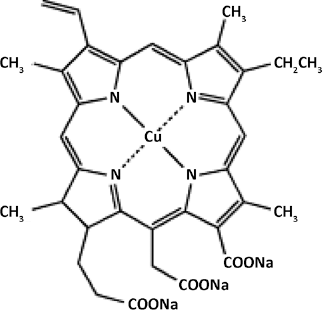
Sodium copper chlorophyllin chemical structure.
Absorption spectra of the different concentrations in the range from 300 to 800 nm were recorded using a Cary 5000 spectrophotometer of the Australian (maximum absorbance: 8 Abs, photometric range: 175-3,300 nm; Agilent Scientific Technology Co. Ltd).
A schematic diagram of the experimental setup used for the Z-scan measurements is shown in Figure 2. The excitation laser source was a pulsed Nd:YAG laser with Gaussian beam profile at a wavelength of 355 nm. The beam splitters BS1 and BS2 were used to reflect part of the incident and transmitted laser beam onto the detectors D1 and D2. The laser input power was measured by the detector D1, while the transmitted laser power and the transmitted laser power through the aperture were measured by the detectors D2 and D3, respectively. The sample was a 10-mm quartz cell containing the SCC solution. The experiment was implemented by scanning the sample across the focus of the lens along the z-axis direction using a translation stage. Because all of the power transmitted through the sample was collected by D2, D2/D1 is called the open-aperture Z-scan. Because a part of the laser beam transmitted through the aperture was obtained by D3, D3/D1 is called the closed-aperture Z-scan.
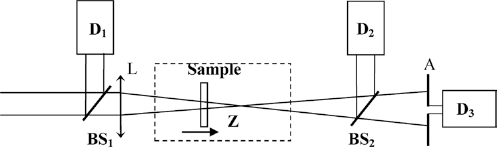
Z-scan experimental setup. BS1 and BS2 are the beam splitters; L indicates the lens; A, the aperture; and D1, D2 and D3 are the detectors.
Figure 3A B shows the experimental setup for detecting optical power limiting behavior. Two 450-nm and 532-nm semiconductor lasers were pump and detector, respectively. The laser beam was focused by a convex lens of focal length 5 cm and passed through the sample, which was a 100-mm quartz cell containing SCC solution. The experiment was carried out with a modular multifunction grating spectrometer (WGD-8) provided by Tianjin Gangdong Scientific Technology Co. Ltd. An optical variable attenuator of the rotary-vane type was placed behind the sample. A Charge Coupled Device (CCD) (LS-2000 laser beam analyzer) provided by Beijing Wuke Photoelectric Technology Co. Ltd was used to measure the laser spot. A natrium lamp was used to calibrate the setup.
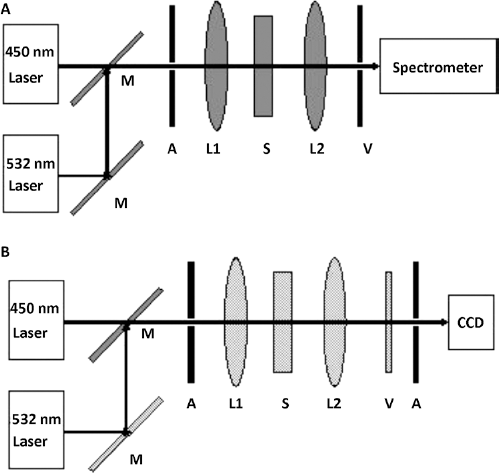
(
Results and discussion
Structural characteristics
With the aim of determining a complete list of the interplanar spacing for SCC, the crystalline structural characteristics were measured. The X-ray diffraction (XRD) patterns of the SCC are shown in Figure 4. The SCC lattice interplanar spacing was d = 2.82386 Å at 31.750° and d = 1.99533 Å at 45.482°.
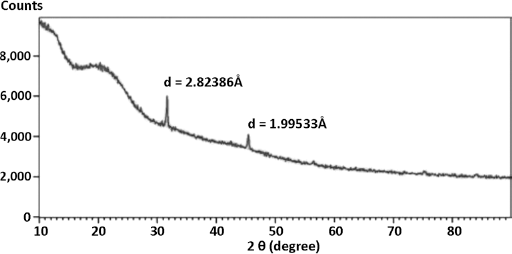
X-ray diffraction (XRD) of sodium copper chlorophyllin (SCC).
Absorption properties
Absorption spectra of SCC in aqueous solution for different concentrations are shown in Figure 5. The figure shows that the absorption spectra of SCC exhibited 2 characteristic absorption peaks, which were located at wavelengths of 405 and 630 nm. Judging from the figure, we can also see that the values of the peaks increase with increasing SCC concentration.
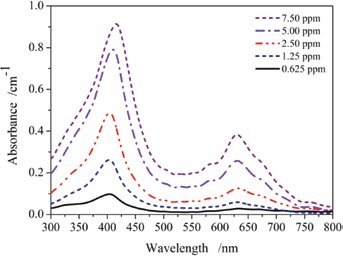
Absorption spectra of the different concentrations of sodium copper chlorophyllin (SCC) solution; ppm = parts per million.
In the case of the visible range, the transitions which result in the absorption of electromagnetic radiation in this region of the spectrum are transitions between electronic energy levels. All samples showed absorption spectra characterized by the presence of both Soret and Q peaks. The highly conjugated nature of the SCC macrocycle shows intense absorption in the Soret band (B), which appeared in the wavelength range of 360-490 nm, and the Q-band in the range 500-720 nm. The peaks in visible range have generally been interpreted in terms of a π–π* transition type from the highest occupied molecular orbital (HOMO) to the excited lowest unoccupied molecular orbital (LUMO).
Nonlinear optical effect
The open-aperture and closed-aperture Z-scan transmittance curves of SCC in aqueous solution at different concentrations were measured and are shown in Figure 6A and B respectively. The open-aperture Z-scan normalized transmittance curve was characterized by a valley that indicated nonlinear absorption (reverse saturable absorption). The closed-aperture Z-scan normalized transmittance curve was characterized by a peak followed by a valley. This means that the sign of the nonlinear refractive index of the SCC was negative (n2<0) – namely, a self-defocusing effect. This was due to the thermal lensing effect – i.e., the sample acted as a lens, leading to the variation of its refractive index (n) with temperature (T). The open-aperture Z-scan data show nonlinear absorption, while the closed-aperture Z-scan data show both nonlinear absorption and nonlinear refraction. Therefore, the closed-aperture Z-scan transmittance data were divided by the open-aperture Z-scan transmittance data. The pure nonlinear refraction Z-scan normalized transmittance curves for SCC in aqueous solution at different concentrations were thus obtained, and these are shown in Figure 6C.
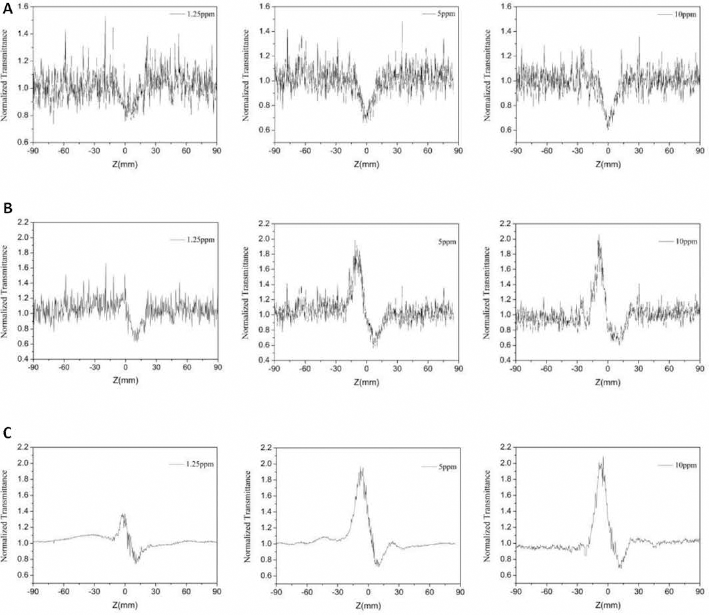
Normalized transmittance curves for sodium copper chlorophyllin (SCC) solution at different concentrations. (
Optical power limiting behavior
Figure 7A and B shows the optical power limiting behavior of different concentrations SCC. The laser transmittance and spot radius, respectively, were plotted as a function of the laser input luminous intensity, varying over the range 0-4.5 × 10⁶ w/cm2. It can clearly be seen that the transmittance varied in a linear fashion with increasing laser input luminous intensity (at low concentrations). The transmittance initially varied linearly with increasing laser input luminous intensity (at low luminous intensity), but the transmittance started to diminish at high luminous intensity (at high concentrations). Spot radius was just the opposite.
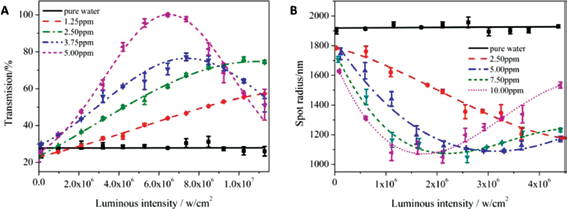
(
The optical power limiting behavior, based on the nonlinear refraction (self-defocusing) of the sample (SCC), evidently depended on the concentrations of the SCC and increased with increasing SCC concentrations.
Conclusion
We studied the absorption spectra and the NLO properties of SCC in aqueous solution at different concentrations. It was demonstrated that absorption features of SCC in the visible range included 2 absorbance peaks and 1 transmission band, which were molecular properties and were invariant with concentration. We used the Z-scan technique to measure NLO properties. We found that the absorption spectra of SCC exhibited 2 characteristic absorption peaks, which were located at wavelengths of 405 and 630 nm, and the values of the peaks increased with increasing SCC concentration. The experimental results showed that SCC was characterized by reverse saturation absorption and negative nonlinear refraction (self-defocusing). The values of the optical parameters increased in a linear fashion as SCC concentration increased. It could be seen that SCC has good optical nonlinearity and is a promising material for potential applications in nonlinear optical devices.
Footnotes
Financial support: The authors would like to acknowledge support from the National Natural Science Foundation of China (grant 61077037), the Foundation and Advanced Technology Research Project of Henan Province (102300413214) and the Key Scientific and Technological Research Project of Henan Province (122102310032).
Conflict of interest: None of the authors has any financial interest related to this study to disclose.