




Abstract
Background
This work presents a sustainable approach for the stabilization of polylactic acid (PLA) against thermo-oxidative aging.
Methods
Naturally occurring phenolic and polyphenolic compounds, such as ferulic acid (FerAc), vanillic acid (VanAc), quercetin (Querc) and vitamin E (VitE), were introduced into PLA.
Results
The preliminary characterization of the systems formulated containing different amounts of natural stabilizers showed that all compounds used acted as plasticizers, leading to a decrease in rheological functions with respect to neat PLA, without significantly modifying the crystallinity of the raw material. The study of the thermo-oxidative behavior of neat PLA and PLA/natural compound systems, performed by spectrometric and thermal analyses, indicated that all stabilizers considered were able to exert a remarkable antioxidant action against thermo-oxidative phenomena.
Conclusions
All natural compounds considered are thus proposed as ecofriendly stabilizers, to get fully bio-based polymer systems with enhanced thermo-oxidative stability, suitable for biomedical applications.
Keywords
Introduction
The application of biodegradable polymers in the industrial field is a challenging issue that can help to resolve the ecological concerns related to the massive use of nonbiodegradable, fossil fuel–derived polymers (1, 2). Polylactic acid (PLA), due to its interesting physical properties, is one of the most appealing biodegradable polymers, and it is considered a key biopolymer for potential substitution for common polyesters and polyolefins in several fields, including food packaging, medical devices and agriculture (3–4–5). However, to make PLA really competitive with fossil fuel–based polymers and to enlarge its fields of application, several strategies have been pursued, such as copolymerization (6), blending (7, 8), formulation of composites (9) and nanocomposites (10).
Similar to many conventional nonbiodegradable polymers, PLA is subject to degradation processes triggered by several aging mechanisms, including thermal decomposition, hydrolysis, photo- and thermo-oxidation (11–12–13–14–15). As reported in the literature, the random chain scission is the main mechanism involved in both photodegradation and thermal decomposition of PLA (16), although the 2 degradation pathways significantly differ. Indeed, in the course of photo-oxidation, the macromolecular cleavage is due to a radical mechanism involving hydroperoxide decomposition with formation of anhydrides (17), while in the case of thermal decomposition at high temperatures, a mechanism involving nonradical intramolecular reactions needs to be taken into account (18).
Since the degradative phenomena directly affect PLA's physical properties, the addition of antioxidants and/or light stabilizers is imperative to ensure PLA's performance during its service life. In the field of developing completely bio-based polymer systems, biocompatible additives are required to enhance PLA's durability and resistance against aging processes. Recent studies demonstrated that several natural compounds with different chemical characteristics are efficient stabilizers in polymers, and specifically in biopolyesters (19–20–21). For instance, Agustin-Salazar et al (22) investigated the potential of resveratrol as a stabilizer in PLA-based formulations, showing that this natural polyphenol is capable of inhibiting the thermally and UV-light catalyzed oxidation of polymer matrix. Among polyphenols, flavonols, such as quercetin, are very effective in protecting polyolefins against oxidation, since they are able to prevent the formation of long chain branches in polyethylene, already at very low concentrations (23).
In this work, several naturally occurring phenolic and polyphenolic compounds were introduced into PLA with the aim of formulating fully renewable polymer-based systems with enhanced thermo-oxidative resistance, potentially applicable for the formulation of biomedical devices. Indeed, many key components of implantable medical devices are made from PLA, including, for instance, materials for structural support, electrical insulation and protection of other materials from the environment of the body (24, 25). For such specific applications, the maintenance of PLA stability and integrity is a crucial factor, also considering that for most of these functions, stability over time is imperative. Preliminary characterization of PLA/natural compound systems has shown that all natural stabilizers act as plasticizers, causing a decrease of the rheological functions with respect to raw material, without significantly affecting the PLA crystallinity. Spectrometric and thermal analyses have been performed to characterize the thermo-oxidative process of PLA at temperatures below its melting temperature, and to investigate the protective action of natural compounds used.
Methods
Materials
Polylactic acid (PLA) 2002D was purchased from NatureWorks LLC (molecular weight = 204,456 g/mol; melting point = 150°C-160°C; glass transition temperature = 58°C; melt index [260°C/2.16 kg] = 5.0-7.0). 4-Hydroxy-3-methoxycinnamic acid was purchased from Sigma-Aldrich, referred to as ferulic acid (FerAc; molecular weight = 194.18). Also from Sigma-Aldrich were 4-hydroxy-3-methoxybenzoic acid, also known as vanillic acid (VanAc; molecular weight = 168.15); 2-(3,4-dihydroxyphenyl)-3,5,7-trihydroxy-4H-1-benzopyran-4-1 hydrate known as quercetin (Querc; molecular weight = 302.24 [anhydrous basis]); and 2,5,7,8-tetramethyl-2-(4’,8’,12’-trimethyltridecyl)-6-chromanol,5,7,8-trimethyltocol – i.e., vitamin E (VitE; molecular weight = 430.71).
Processing
The preparation of PLA/natural compound samples was carried out using a Brabender mixer at T = 170°C and mixing speed 50 rpm for 5 minutes. The stabilizers were added at 0.1 and 0.5 wt%. Neat PLA films were developed adopting the previously described processing conditions.
Characterization
Rheological tests were performed using a strain-controlled rheometer (model ARES G2; TA Instruments) in parallel-plate geometry (plate diameter 25 mm). The complex viscosity (η*) was measured performing time sweep experiments, at ω = 1 rad/s and T = 170°C. The strain amplitude was γ = 2%, which preliminary strain sweep experiments proved to be low enough to be in the linear viscoelastic regime. The reported results are the means of 3 independent measurements.
The scanning electron microscopy (SEM) analysis was performed on cryogenically fractured and gold-sputtered surfaces of thin compression molded samples using a Philips ESEM XL30 scanning electron microscope(Philips, The Netherlands).
The X-ray diffraction (XRD) analysis of PLA and PLA/natural compound films was performed using an Empyrean Series 2 X-Ray diffractometer (Panalytical): the spectra of the sample films were recorded in the range 3-30 deg (step size = 0.025, scanning rate = 60 s/step) and Cu-Kα radiation at wavelength λ = 0.1542 nm. The reported results are the mean of 3 independent measurements.
The calorimetric data were evaluated by differential scanning calorimetry (DSC) using a Perkin-Elmer DSC7 calorimeter. All experiments were performed under dry N2 on samples of around 10 mg in 40-μL sealed aluminum pans. Four calorimetric scans (2 heating: 30°C-220°C and 2 cooling: 220°C-30°C) were performed for each sample at a scanning heating to cooling rate of 5°C/min.
The degree of crystallinity (Xc) was calculated using the formula:

where ΔHm is the melting heat of the sample, ΔHcc corresponds to the heat of cold crystallization and ΔH° is the heat of fusion for 100% crystalline PLA (93 J/g) (26). The reported results are the mean of 3 independent measurements.
Fourier transform infrared (FTIR) spectroscopy was performed on thermo-oxidized films for different exposure times. The spectra were collected by performing 16 scans between 4,000 and 400 cm−1. The spectra were normalized using as internal standard the peak at 2,995 cm−1, which corresponds to the asymmetric stretching of CH3 groups (14).
Thermo-oxidative tests were carried out in an air-ventilated oven at 120°C for a time of up to 1,500 hours. The evolution of thermo-oxidative degradation was followed through infrared spectroscopy FTIR and calorimetric DSC analysis.
Statistical Analysis
Statistical analysis of the data was performed through ANOVA using GraphPad Prism version 6 software (GraphPad Software Inc., La Jolla, CA, USA). Significant differences among mean values, where applicable, were determined by the means of ANOVA and by Tukey's HSD post hoc test for multiple comparisons. In all cases, a p value of <0.05 was considered statistically significant (27).
Results and discussion
Preliminary characterization of PLA/natural compound systems
First of all, to verify if any structural modifications occurred in PLA and PLA/natural compound systems, the rheological behavior was evaluated, considering dynamic time sweep measurements. In Figure 1, the complex viscosity (η*) as a function of time, recorded at ω = 1 rad/s, is plotted. Neat PLA exhibited almost constant complex viscosity up to about 600 seconds, and a significant reduction in viscosity for longer times. According to reports in the literature (28), the viscosity decrease corresponds to a loss of molecular weight; therefore, the trend of η* as a function of time for raw material suggests the occurrence of chain scission reactions during the test, leading to a reduction of molecular mass, due to degradation processes in the melt. The adding of each kind of natural stabiliziers brings about a decrease of the complex viscosity values with respect to PLA, in all of the time intervals investigated. This issue indicates a well-pronounced plasticizing action of the natural compounds used, due to their low molecular weight. Moreover, the presence of all of the natural stabilizers considered did not significantly modify the trends of complex viscosity over time, indicating that the naturally occurring compounds that were considered were not able to exert any protective action against degradation phenomena in the melt.
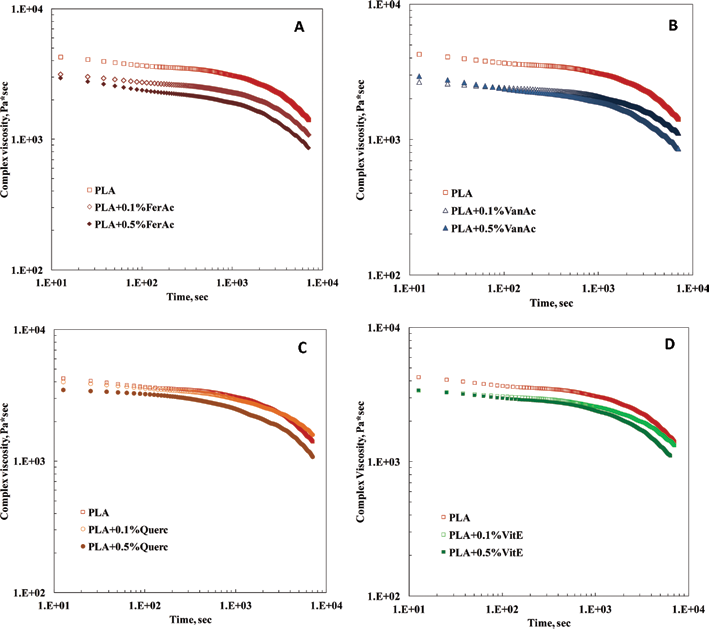
Complex viscosity as a function of time for neat polylactic acid (PLA) and all stabilized systems. FerAc = ferulic acid; Querc = quercetin; VanAc = vanillic acid; VitE = vitamin E.
To evaluate the morphology of PLA and PLA/natural compound systems, SEM observation and XRD analysis were performed. In Figure 2, representative SEM micrographs of all investigated systems are reported. The morphology of all PLA/natural compound systems appeared to be regular, and no agglomerates or aggregates could be detected, indicating a uniform dispersion of the stabilizers used and their good solubility in PLA (29). Furthermore, in Figure 3, the XRD patterns for PLA and PLA/natural compound systems containing 0.5 wt% of natural stabilizers are reported. The XRD pattern of PLA exhibited a broad diffraction peak centered at 2θ ≈ 15°, indicating that the structure of this sample was predominantly amorphous. The adding of 0.5 wt% of natural compounds did not modify the XRD pattern of PLA, highlighting the fact that the natural compounds used had a negligible effect on the matrix morphology.
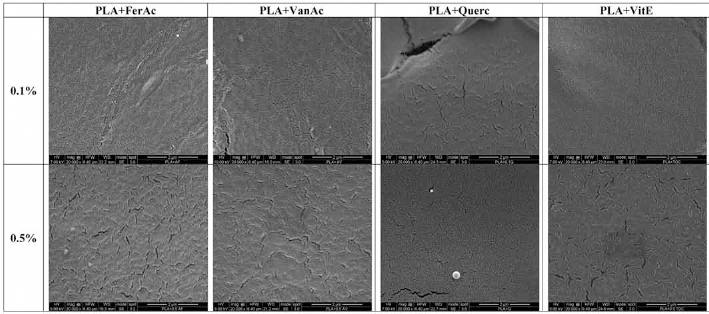
SEM micrographs for neat polylactic acid (PLA) and all systems investigated. FerAc = ferulic acid; Querc = quercetin; VanAc = vanillic acid; VitE = vitamin E.
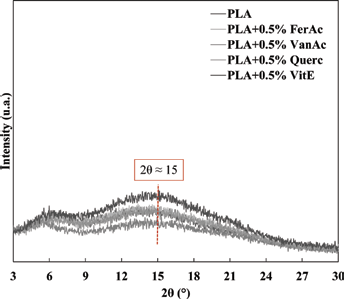
X-ray diffraction (XRD) patterns for systems containing neat polylactic acid (PLA) or 0.5 wt% natural stabilizers. FerAc = ferulic acid; Querc = quercetin; VanAc = vanillic acid; VitE = vitamin E.
Results from the XRD analysis were corroborated by the degree of crystallinity of the PLA/natural compound systems, estimated through thermal analyses (Tab. I). The crystalline content of PLA was about 10%, showing that the structure of the raw material was almost amorphous. The adding of all natural stabilizers did not significantly affect both the melting and glass transition temperatures, while the effect on the crystallinity by the natural compounds’ incorporation was different depending on their characteristics. In particular, the degree of crystallinity decreased with the addition of FerAc and VanAc, and increased in the presence of Querc and VitE, which can be explained by taking into account the 2 different and contrasting phenomena that natural stabilizers can exert: specifically, plasticizing or nucleating. The first effect leads to a decrease of the degree of crystallinity, as the increase of the system free volume causes an increase of the cold crystallization enthalpy. In contrast, the nucleating effect leads to an increase of the degree of crystallinity of the overall system. In systems containing FerAc or VanAc, the plasticizing effect is predominant, resulting in a lower degree of crystallinity than in the neat PLA matrix, while Querc- and VitE-based samples exhibit preponderantly a nucleating effect.
Thermal properties of neat PLA and all investigated systems evaluated during the second heating scan
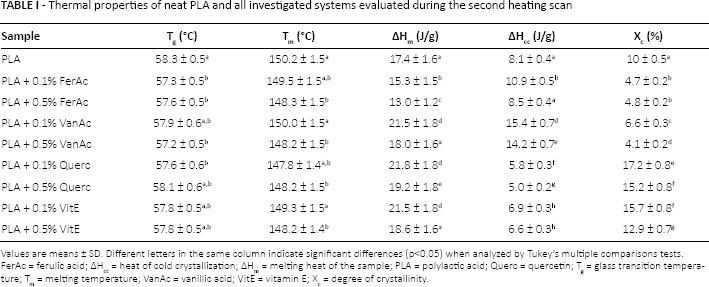
Values are means ± SD. Different letters in the same column indicate significant differences (p<0.05) when analyzed by Tukey's multiple comparisons tests.
FerAc = ferulic acid; ΔHcc = heat of cold crystallization; ΔHm = melting heat of the sample; PLA = polylactic acid; Querc = quercetin; Tg = glass transition temperature; Tm = melting temperature; VanAc = vanillic acid; VitE = vitamin E; Χc = degree of crystallinity.
Thermo-oxidative stability of PLA/natural compound systems
As has been shown in literature, the thermo-oxidative degradation of PLA in the solid state occurs mainly by random chain scission reactions (15). In particular, the degradation pathway of PLA (Fig. 4A) includes hydrogen abstraction on the polymer backbone, with subsequent formation of macroradicals that react with oxygen, forming peroxy radicals and hydroperoxides. The last decompose with the formation of alkoxy radicals that, in turn, decompose by 3 different β-scissions, leading to the generation of anhydrides. The thermo-oxidative stability of PLA and PLA/natural compound systems containing different naturally occurring stabilizers has been assessed through exposure of films of about 100-µm thickness, at 120°C, in an air oven, for up to 1,500 hour (about 63 days) of aging. In Figure 4B, the FTIR spectra for PLA, collected at different aging times during thermo-oxidative treatment, are reported. As a function of the thermo-oxidation time, only slight changes were observed in the FTIR spectra, which can be attributed to a secondary crystallization process occurring during the thermal aging. As shown in Figure 4B, the absorption band assigned to anhydride function (1,845 cm−1) was not detectable, probably because the amount of anhydride species, arising from degradative pathways (no. 1) and (no. 2) in Figure 4A, was too low. The formation of carbonyl species arising from chain scission during thermo-oxidation (see pathway no. 3 in Fig. 4A), could not be detected by FTIR, because of the overlap with the intrinsic PLA carbonyl band, located in the 1,700-1,800 cm−1 range.
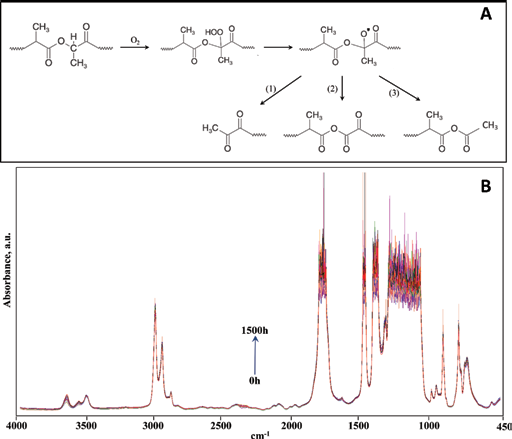
(A) Polylactic acid (PLA) oxidation mechanism, involving β-scission of alkoxy radicals, according to (15, 17); and (
Nevertheless, the thermo-oxidation of PLA in the solid state, occurring mainly by chain scission, brings about a decrease of molar mass. Rasselet et al (15) showed that PLA, during oxidative degradation in the solid state, experiences a decrease of glass transition temperature (Tg) according to the Fox-Flory theory. For this reason, the thermo-oxidation of PLA and PLA/natural compound systems was followed by calorimetric characterization, considering that a reduction of the molecular weight significantly affects the PLA thermal properties. In Figure 5, the variation of Tg as a function of the thermo-oxidation time for PLA and all stabilized systems is plotted. The reported data have been normalized with respect to the Tg value before thermo-oxidation (T0g values, reported in the labels for Fig. 5) for each sample; in this way, the plasticizing effect exerted by each stabilizer was not taken into account. Analyzing the DSC data, it can be observed that the Tg shifted toward lower temperatures as a function of the aging time, for all investigated systems. The linear decrease of Tg at the beginning of the thermal treatment (0-250 hours) suggests that chain scission occurred at the early stage of thermo-oxidative treatment, and no induction period could be detected. The decrease of the Tg values as a function of thermo-oxidative aging time is less pronounced for all PLA/natural compound systems, indicating a remarkable protective action of all naturally occurring compounds against the thermo-oxidation. This protective action is well pronounced especially at long aging times (>1,000 hours, or about 42 days). Unstabilized PLA showed a significant decrease of Tg along the investigated aging period, indicating a pronounced reduction of its molecular mass. In contrast, the stabilized systems showed a less pronounced decay of Tg, highlighting, for long exposure times, a less pronounced reduction of the molecular mass than in the raw material. The slight difference between the Tg trends of PLA/natural compound systems containing low and high content of each stabilizer, seems to suggest that the protective effect of all naturally occurring compounds is almost independent from their content.
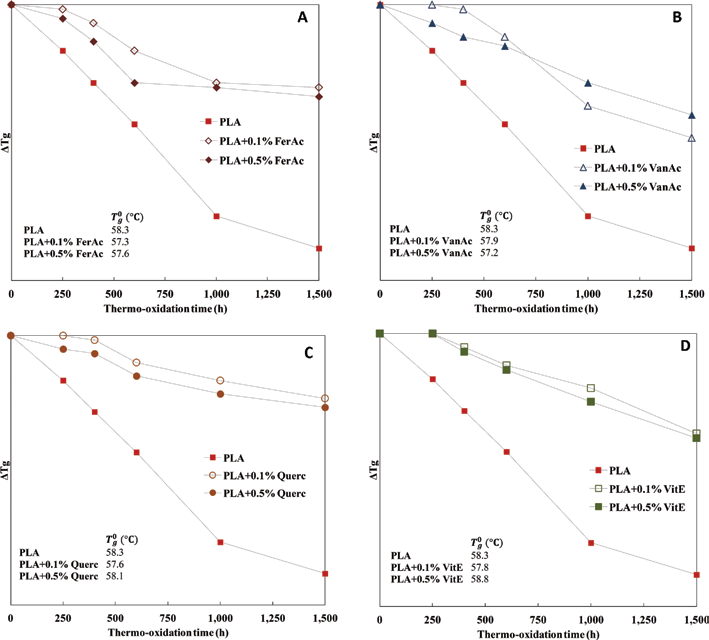
Variation of glass transition temperature (Tg) as a function of thermo-oxidation time for neat polylactic acid (PLA) and all systems investigated. Values are expressed as means ± SD. FerAc = ferulic acid; Querc = quercetin; VanAc = vanillic acid; VitE = vitamin E.
Conclusions
Several naturally occurring phenolic and polyphenolic compounds, such as ferulic acid, vanillic acid, quercetin and vitamin E, were introduced into PLA to probe their potential as stabilizers against thermo-oxidative degradation. Morphological and rheological characterizations of the formulated systems showed that the natural compounds considered were well dispersed in PLA, and due to their low molecular weight, they acted as plasticizers, causing a decrease of PLA complex viscosity. Spectrometric and thermal analyses performed to characterize the thermo-oxidation of PLA/natural compound systems indicated that all of the stabilizers used were effective in protecting the raw material. In particular, the protective action was confirmed by measurements of the systems’ glass temperature in the course of thermo-oxidative treatment, given that the oxidative degradation of PLA proceeds via random chain scission, responsible for a decrease in the molecular weight that, in turn, affects the glass temperature. Overall, our results demonstrate that all natural compounds considered were efficient in the enhancement of PLA thermo-oxidative stability, opening new avenues in the formulation of fully renewable polymer-based systems suitable for applications in the biomedical field.
Footnotes
Financial support: No grants or funding have been received for this study.
Conflict of interest: None of the authors has any financial interest related to this study to disclose.