




Abstract
This paper establishes a density gradient model along the thickness direction of a circular plate made of foamed material. Based on the first shear deformation plate theory, the result is deduced that the foamed metal circular plate with graded density along thickness direction yields axisymmetric bending problem under the action of uniformly distributed load, and the analytical solution is obtained by solving the governing equation directly. The analyses on two constraint conditions of edge radial clamping and simply supported show that the density gradient index and external load may affect the axisymmetric bending behavior of the plate. Then, based on the classical plate theory, the paper analyzes the behavior of axisymmetric buckling under radial pressure applied on the circular plate. Shooting method is used to obtain the critical load, and the effects of gradient nature of material properties and boundary conditions on the critical load of the plate are analyzed.
Introduction
As one of the porous metal materials, foamed metal material is considered to be the most promising new-generation functional material. In 1997, Neubrand (1) prepared foamed copper with continuous change in density by electrochemical method, and pointed out that the porosity, the electrode surface area, and the conductive coefficient of electrolyte will affect the density gradient of the sample. In 2006, Brothers and Dunand (2) realized the preparation of foamed metal material with density gradient, and pointed out that the foam density was uniformly continuous and can be controlled in its gradient. Matsumoto and other scholars (3) adopted chemical dissolution method and took the foamed metal with uniform density as the substrate, prepared foamed metal with continuous density change. Alinejad and Zakeri (4) prepared functionally graded hot-pressing aluminum foam with controllable porosity and more excellent mechanical properties. Chen et al (5) in 2011, using different anode combinations, adopted secondary electrodeposition on nickel foam and prepared the foamed nickel with density gradient sedimentation. Ajdari and other researchers (6) studied the overall effective elastic modulus and structural yield strength of the foamed material by using finite element method; Cui et al (7) analyzed the energy absorption behavior of a plate with graded density along the thickness direction under impact loading by using the finite element numerical simulation method. This paper builds the density gradient model along the thickness direction and studies the linear mechanical behavior of the circular plate made of foamed metal.
Mathematics model of the problem
Taking into account a density-graded foamed circular plate with radius b and thickness h, its mathematical model is shown in Figure 1. The plate is applied with pressure q and transverse load p, assuming that the material elastic modulus E changes along the plate thickness direction.
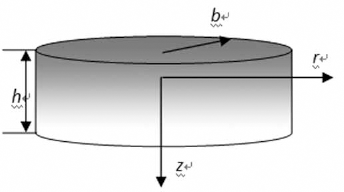
Mathematical models.
Basic formula
According to the first shear deformation plate theory, the displacement function of any point in the plate is described as follows:


where u and w represent the radial and lateral displacement of the point, respectively. φ represents the rotational angle of middle surface. Equilibrium equations can be deduced by geometrical equations, constitutive equations and the variational principle.
Equilibrium equations and boundary conditions
Equilibrium equations:
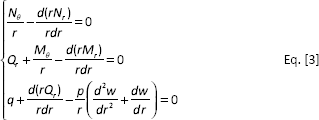
Boundary conditions: Nr = 0, Mr = 0
where Nr, Nθ are radial internal forces; Mr and Mθ are the bending moments; Qr is the shear force.
Analytical solution of bending deflection for axisymmetric bending
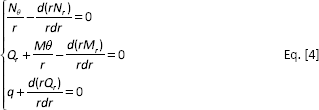
Taking into account the bending of a circular plate with graded foam density and ignoring the radial pressure p, only the uniformly distributed load q is considered and the equilibrium equation of bending can be obtained from [3]:
1. Degraded to the classical results
As long as the lateral shear stiffness is infinite, that means there is no transverse shear deformation. Equation [5] becomes the following results in classic theory:
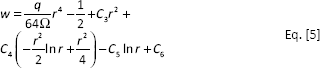
Ci (i = 1, 2, …) is integration constant.
2. Degraded to the homogeneous material plate (n = 0, Ω = D)
Taking into account the surrounding clamped circular plate, its boundary conditions are as follows:
when r = b, w = w′ = 0
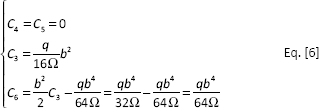
r = 0, w′ = 0, w & w′ are limited, it can be obtained that
and

The result is exactly the same with the reference (8).
Numerical results and discussions
Graded foamed circular plate of bending deflection
Properties of graded foamed metal employ the model appointed by Tang HP, Zhang ZD (9).

In above formula, Ef is the elastic modulus (usually a function of each point location in the material); Es is the elastic modulus of the hole wall material (usually a function of each point location in the material); ρf is the density of graded foamed metal; ρs is the density of the hole wall structure (the density of corresponding solid material); α is a geometric ratio constant.
In order to simplify the calculation process, set α = 1, m = 2, and assuming Poisson's ratio remains the same, that is

It is a symmetric plate with the same relative density on both upper and lower surfaces, called mode I; the density distribution pattern is

It is an asymmetric plate with different relative density of upper electrode, called mode II; the density distribution patter is

It can be seen from Figure 2 that the gradient index n has an obvious effect on circular plate bending deformation, and the maximum deflection decreases with the increase of n; with the decrease of the thickness ratio h/b, deflection increases. That is because the plate becomes thicker, the effective stiffness becomes greater; therefore, it is not easy to deform.
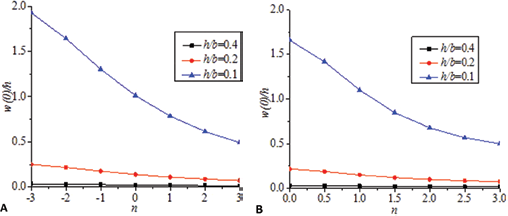
The relation curve of the maximum deflection and density gradient index within different thickness ratio (
It can be concluded from Figure 3 that with the change n from -3 to 3, the deflection of plate center is gradually reduced. It is obvious that the plate stiffness increases, and the center deflection of the plate has a linear relationship with external load. There is a similar trend in Type 1 and Type 2.
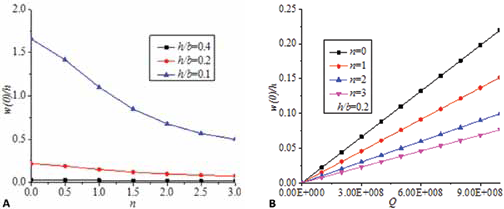
Relationship curves of external load and deflection (
Figure 4 shows the bending of circular plate configuration in the case of model I and model II. It is shown that density gradient n has significant effect on the configuration of plate from the above diagram.
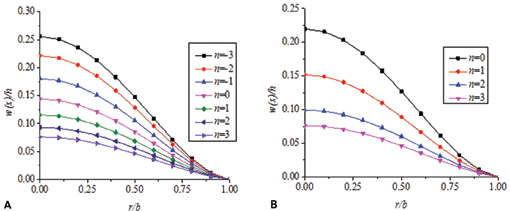
Bending configuration (
For radial fixed simply supported circular plate edges, the boundary conditions are as follows:


Therefore, the integral constant can be obtained as follows:
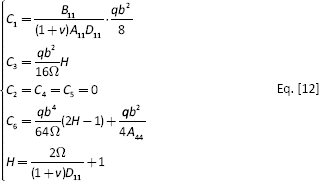
The analytical solution of displacement field of the circular plate is as follows:

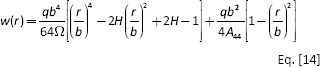
to [14] dimensionless,
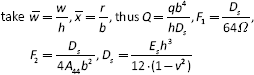
thus:

It can be seen from Figure 5 that gradient index n has an obvious effect on the bending deformation of the circular plate, and the maximum deflection decreases with the increase of gradient index n; with the decrease of the thickness ratio h/b, deflection increases. That is because the plate becomes thicker, and the effective stiffness becomes greater. Therefore, it is not easy to deform.
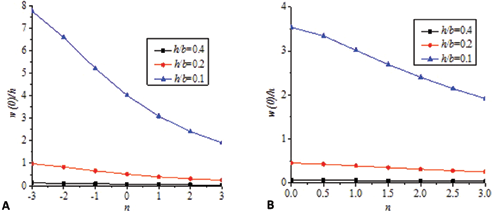
The relation curve of the maximum deflection and density gradient index within different thickness ratio (
It can be seen in Figure 6, along with the increase of the density gradient, the rigidity of the materials is also increased, but the maximum deflection is reduced (10). The trend of the Type 1 and Type 2 is similar. However, in different boundary conditions, the maximum deflection of simply supported plate is much greater than a fixed one.
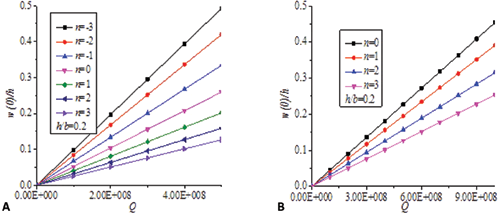
Relationship curves of external load and deflection (
It can be seen from Figure 7 that the density gradient n has a significant effect on the configuration of plate. Under different boundary conditions, there is also a certain difference in deflection.
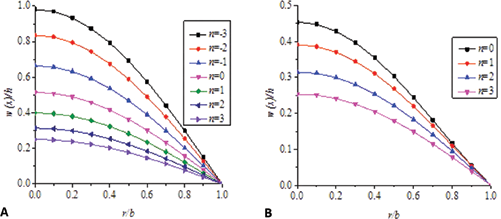
Bending configuration (
Conclusions
Based on the first shear deformation theory, the paper derived the formula of bending control equation of an axisymmetric circular plate under in-plane uniform load and the results show that
(1) Gradient index n has a significant influence on the bending deformation of the circular plate, and the maximum deflection decreases with n; it shows that with the increase of density gradient, the effective stiffness of material is also increased.
(2) The deflection increases with the decrease of the thickness ratio h/b: the thicker the plate, the less is its deflection. Under different boundary conditions, the maximum deflection of simply supported plate is much greater than fixed plate.
Footnotes
Financial support: This work was supported by the National Natural Science Foundation of China with grant NO.11472123.
Conflict of interest: None of the authors has financial interest related to this study to disclose.