




Abstract
Purpose
To determine the effect of different individual, laboratory and professional cleaning methods on the surface-roughness (SR) and surface free energy (SFE) of polyetheretherketone (PEEK), PMMA-based (PMMA) and composite (COMP) materials.
Methods
330 specimens of PEEK, PMMA and COMP (N = 990) were prepared and divided into the following cleaning protocols (n = 30/group): (i) individual prophylaxis using (ST) soft, (MT) medium-hard and (SOT) sonic toothbrushes, (ii) in-lab cleaning protocols consisting of (SY) Sympro cleaning system, (SS) SunSparkle, (UB) ultrasonic bath and (AP) Al2O3-powder device and (iii) professional prophylaxis applying (PS) Perio Soft-Scaler, (SO) Sonicsys, (AFC) Air Flow Comfort, and (AFP) Air Flow Plus. After each protocol SR (profilometer), SFE (contact angle devise) and surface topography (SEM) were measured. Data were analyzed using multivariate analysis, Kruskal-Wallis-H- and Mann-Whitney-U-test (p<0.05).
Results
No impact of material on SR was observed (p = 0.443). Cleaning using conventional air-abrasion and powders (AP), followed by AFC produced higher SR values than the remaining methods (p<0.001). Within SFE, the cleaning method exerted the highest influence on SFE values (p<0.001, ηP2 = 0.246), closely followed by the polymer material (p<0.001, ηP2 = 0.136). PMMA and PEEK presented after cleaning lower SFE than COMP. PS, UB and SO showed lower SFE than specimens cleaned using SS, ST and SY. Cleaning using SY led to the highest SFE.
Conclusions
With regard to SR, all methods – with exception of conventional air-abrasion – can be recommended to clean PEEK. According to the SFE, PEEK may be an acceptable material providing even lower plaque accumulation rates than COMP. The field for more research is now open for scrutiny.
Introduction
After a long search for substitutes of dental restoration materials such as ceramics or composites, polyetheretherketone (PEEK) has gained significant attention as a suitable alternative in recent years (1). Belonging to the family of high-temperature thermoplastic polymers, PEEK unites various positive aspects: it works as a tooth-colored and biocompatiblerestoration material (2) and is free of residual monomer, which is a great advantage when compared to other denture resins. PEEK is dimensionally stable and consists of connected aromatic benzene molecules by alternating functional ether or ketone groups (3–4). Early studies examined the influence of different media on the surface properties of PEEK like artificial saliva (5), but investigations regarding surface changes after laboratory and patient/dentist specific cleaning protocols are still scarce.
A prerequisite for the long-term clinical success of any dental restoration with minimal susceptibility to secondary caries formation and onset of periodontal problems is to incorporate adequately finished and polished work pieces and to ensure the initial quality by using effective cleaning methods later on, based on individual and professional prophylaxis tools. Concerning laboratory cleaning methods, technicians have the choice between 2 main cleaning versions: dry cleaning, like corundum blasting, or the wet version, like ultrasonic bath or needle cleaning devices in combination with either tap water or specially created cleaning liquids.
The individual prophylaxis can be divided into 3 main groups: mechanical cleaning methods, chemical cleaning methods, or a combination of both (6). Along with the usual use of commercially available manual toothbrushes, there are various other methods for cleaning teeth, like electric toothbrushes or the use of floss and interdental brushes. In combination with a suitable toothpaste, patients are encouraged to brush their teeth twice a day according to several clinical trials (7–8). The advantage of electric toothbrushes compared to manual ones has been shown in various studies. They are more effective in removing plaque and thus in preventing periodontal disease (9–10). Although dentists are in favor of more efficient cleaning methods than patients are, there is the problem of solely intraoral use compared with labside cleaning methods. The professional cleaning spectrum of dentists includes both hand instruments (e.g., scalers and curettes) and mechanical ones like ultrasonic scalers and powder jet devices (air-abrasion).
To the best of our knowledge, to date there are no studies available comparing the cleaning properties of PEEK. Changes in surface properties like surface roughness (SR) and surface free energy (SFE) seem to be ideal surrogate parameters to study the consequential scratch damage and surface roughening potential of any given cleaning method. Previous studies showed that both SR and SFE have an influence on supragingival plaque formation and that the restoration material itself represented a predilection for bacterial adherence (11–12–13). It was determined that a high SR will lead to biofilm formation and growth, while a high SFE supports strongly and densely packed plaque with a certain bacterial selection (14). In this context, it can be hypothesized that more invasive cleaning methods probably exceed the SR threshold value of 0.2 µm, which was correlated with a higher adhesion of bacteria (15). In principle, Hahnel et al were able to demonstrate that there are nonfavorable conditions for biofilm transformation on PEEK compared with other implant materials, such as titanium (16). However, the dependence of material sensitivities and their surface properties, such as hardness, water absorption and filler degree, should be revised. Materials with low hardness surface profiles in particular, like PEEK, are more vulnerable for cleaning methods using high force and pressure, resulting in surface changes and mechanical fatigue (17).
This investigation examined the impact of 11 different cleaning protocols (3 individual prophylaxes, 4 laboratory cleaning and 4 professional prophylaxes) on the surface roughness (SR) and surface free energy (SFE) of PEEK and compared these results with 2 conventional polymer materials, namely a cold-curing denture polymethylmethacrylate (PMMA) and a veneering resin composite (COMP). The null hypothesis tested was therefore that PEEK shows similar SR and SFE values compared to the conventional PMMA-based and composite materials and that all tested cleaning methods indicate similar surface properties.
Material and methods
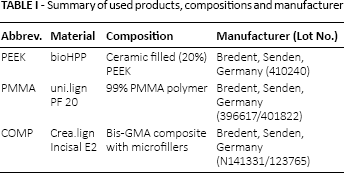
The following materials were used in this study: PEEK (bioHPP; Bredent), a cold-curing denture polymethylmethacrylate (PMMA) (uni.lign PF 20; Bredent) and a veneering resin composite (COMP) (crea.lign; Bredent). Details of the 3 materials are presented in Table I.
Summary of used products, compositions and manufacturer
Specimen preparation
A total of 330 disc-shaped specimens with a diameter of 15 mm and a thickness of 3 mm were made from PEEK and were directly provided by the manufacturer. This standardized specimen size ensured that there was enough space for subsequent surface measurements. Standardized silicone models were individually fabricated (15 × 3 mm) and used as templates for the production of PMMA (n = 330) and COMP (n = 330) specimens.
A PMMA mixture consisting of powder (13 g) and liquid (9 mL) was filled in the molds of the silicone model and polymerized in a pressure pot (Palamat Elite®; Heraeus Kulzer) for 20 minutes, 4.5 bar and at 55°C according to the manufacturer's instructions. COMP specimens were prepared by filling the veneering resin composite material into the molds with a layer thickness of approximately 1 mm per increment. Each layer was light cured for 180 seconds as recommended by the manufacturer at a wavelength of 370 to 500 nm (bre. Lux Power Unit; Bredent).
Before grinding specimens with a series of silicone carbide abrasive papers up to P4000, they were checked for the same thickness (± 0.05 mm). All specimens were polished with a laboratory polishing machine (Abramin; Struers) in the following order: P1200 (3 bar) for 1 minute, P4000 (3 bar) for 4 minutes and P4000 (5 bar) for 4 minutes under constant water cooling.
Cleaning protocols
Individual prophylaxis (PPx)
A toothpaste slurry was made using toothpaste (Blend a Med Complete; Procter & Gamble) mixed with tap water at a ratio of 1:2. The pH values were set and controlled by pH measuring (Voltcraft PH-100 ATC; Conrad Electronic) at a pH value of 7.58. The specimens were cleaned for 4 minutes with rotary movements.
The following brushes were used (Tab. II):
Manufacturers and cleaning products used
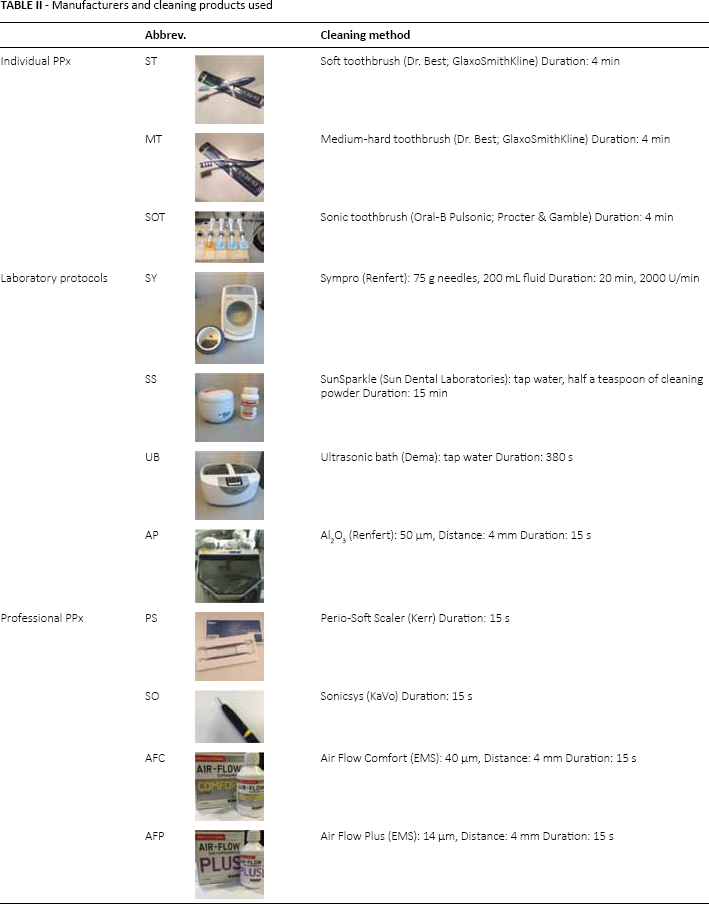
(ST) A soft toothbrush (Dr. Best, GlaxoSmithKline)
(MT) A medium-hard toothbrush (Dr. Best, GlaxoSmithKline)
(SOT) A sonic toothbrush (Oral-B Pulsonic, Procter & Gamble)
In order to standardize contact pressure and surface distance, 6 sonic toothbrushes were connected in series. Specimens were fixed in special devices (custom-made device at the Ludwig-Maximilians University of Munich) and cleaned by vibrating toothbrush heads.
Laboratory protocols
(SY) Sympro (Renfert): A high-performance cleaning unit for dentures and orthodontic appliances was used with 75 g of needles and 200 mL Symprofluid (Renfert) for 20 minutes at a rotation speed of 2,000 U/min.
(SS) SunSparkle (Sun Dental Laboratories): A dental cleaning system, was tested with tap water and half a teaspoon of SunSparkle cleaning powder (Sun Dental Laboratories) for 15 minutes, respectively.
(UB) An ultrasonic bath (USR2200; Dema) was filled with tap water and specimens were cleaned for 380 seconds.
(AP) Aluminum oxide blasting (50 µm) (Renfert): Specimens were cleaned for 15 seconds at a distance of 4 mm.
Professional prophylaxis (PPx)
(PS) Perio Soft-Scaler (Kerr): Specimens were cleaned for 15 seconds, applying a reaming motion.
(SO) Sonicsys (KaVo Sonicflex): A contra-angle piece (KaVo) was used for 15 seconds with rotary movements.
(AFC) Air Flow Comfort (EMS): The powder was applied in a PROPHYflex 3 (KaVo). The supragingival sodium bicarbonate air polishing powder (40 µm) was used for 15 seconds at a distance of 4 mm in moving circles.
(AFP) Air Flow Plus (EMS): The powder was applied in a PROPHYflex 3 (KaVo). The powder, which is suitable for supra- and subgingival polishing (14 µm), was tested similarly to AFC.
To reduce the outcome variability to a minimum, all preparations, cleaning methods and evaluations were performed by the same person (SH).
Surface roughness measurements
The surface quality surface roughness (SR) was measured for each specimen by a contact profilometer, applying a load of 0.7 mN (Perthometer SD 26; Mahr). Six readings with a track length of 6 mm were recorded with a distance of 0.25 mm between the lines. SR was analyzed twice: before storage in the different media and after final cleaning. The performance of the profilometer was periodically controlled using a calibration block (length of the profiles 1.75 mm, resolution of 0.01 µm).
Surface free energy measurements
SFE was investigated after cleaning by measuring the contact angle (Easy Pearl; Kruess) of water (polar) and diiodomethane (dipolar) at different locations. Data were analyzed by DSA4 software (Kruess). The surface free energy was calculated.
Surface topography
For scanning electron microscopy (SEM), a representative PEEK specimen of each cleaning group was selected. Specimens were gold-sputtered (SC7620 Sputter Coater; Quorum technologies) and visualized (SUPRA 55VP; Carl Zeiss) operating at 10 kV with a working distance of 6 mm using 68-, 300- and 600-x magnifications.
Statistical methods
Multivariate analysis was used to assess the effects of the independent parameters of each cleaning protocol and material group and the effect of their interaction on SR and SFE results (dependent parameter). Normality of data distribution was tested using the Kolmogorov-Smirnov test. Nonparametric descriptive statistics, such as minimum, median and maximum, for all cleaning and material groups were calculated. Kruskal-Wallis-H and Mann-Whitney-U tests were used to analyze the effect of the cleaning protocols and materials. The results of statistical analyses with p values less than 0.05 were interpreted as statistically significant. Data were analyzed using the statistical software SPSS Version 23.
Results
The Kolmogorov-Smirnov test indicated a violation of the assumption of normality. Therefore, nonparametric tests were used. After cleaning, a statistically significant impact of the different cleaning protocols on the SR values was observed (p<0.001). Cleaning using conventional air-abrasion and powders (AP), followed by AFC produced higher SR than the remaining cleaning methods. In contrast, the different materials showed no effect on the SR values (p = 0.443). The descriptive statistics are presented in Table III. When considering the differences of SR values (Fig. 1) between the cleaning procedure and polishing, the significant differences in the values mentioned above regarding SR after cleaning could be confirmed (Tab. III).
Overview of median, minimum and maximum SR/ΔSR values after different cleaning procedures divided into the different materials (PEEK, PMMA, COMP)
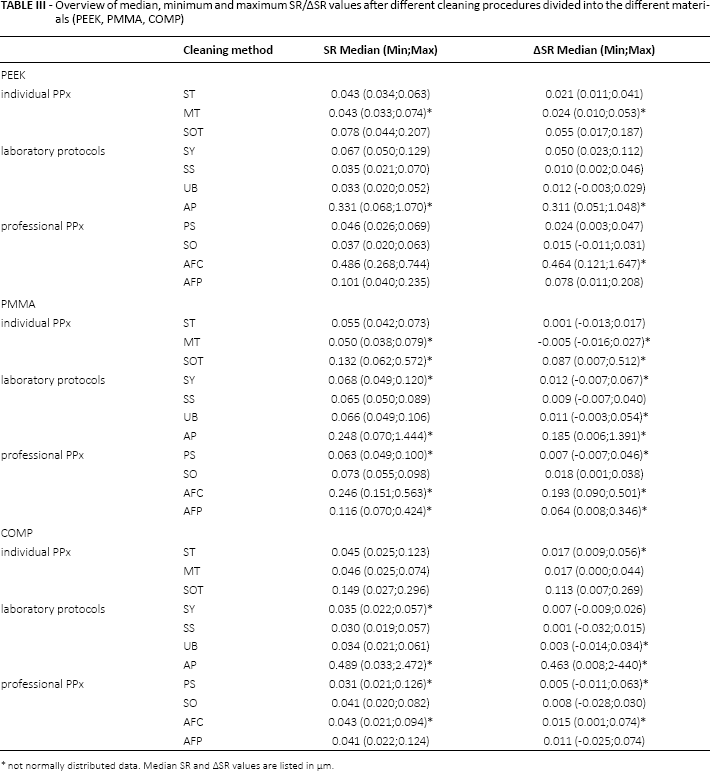
not normally distributed data. Median SR and ΔSR values are listed in µm.
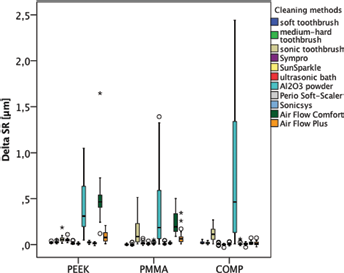
Boxplots for the SR differences between the cleaning procedure and polishing for each cleaning method and material separately.
With respect to the SFE values, the cleaning method exerted the highest influence on the SFE values (p<0.001, partial eta squared ηP2 = 0.246), closely followed by polymer material (p<0.001, ηP2 = 0.136). PMMA and PEEK presented after cleaning significantly lower SFE values than COMP (Fig. 2). Comparing the cleaning methods, PS, UB and SO showed significantly lower SFE than specimens cleaned using SS, ST and SY. In general, cleaning using SY led to the highest SFE (Tab. IV).
Median, minimum and maximum SFE values after different cleaning protocols
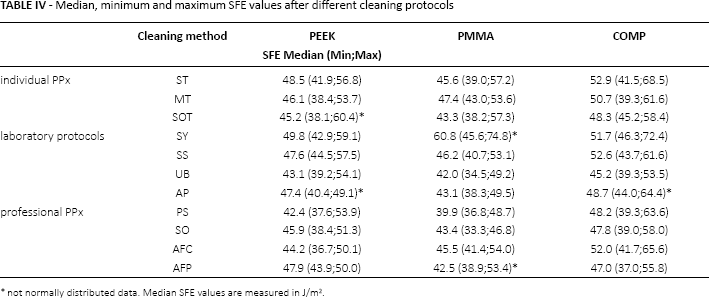
not normally distributed data. Median SFE values are measured in J/m2.
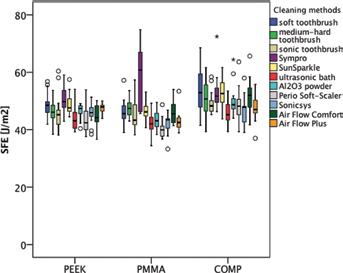
Boxplots for the SFE values for each cleaning method and material separately.
Figure 3 presents representative SEM images of differently cleaned PEEK surfaces for visualizing particular surface topographies. As can be seen, PEEK surfaces cleaned by SY and AP show clear dents caused by needles as well as by Al2O3 powder. Surface impressions of AFC and AFP are also clearly observable when seen through SEM.
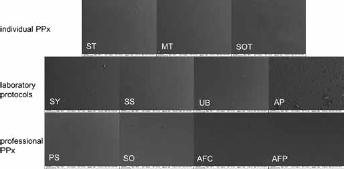
Representative SEM images of the cleaned PEEK surface at a magnification of 600:1: (1) individual prophylaxis (ST), (MT), (SOT), (2) laboratory protocols (SY), (SS), (UB) and (3) (AP); and professional prophylaxis (PS), (SO), (AFC), (AFP).
Discussion
This study was motivated by the fact that there are currently no reliable data regarding the cleaning methods of PEEK and their impact on surface properties like SR and SFE. Each intraoral inserted dental restoration material was subjected to wear and biofilm formation. The speed of plaque development depends on the initial quality of the polished surface, the material properties of a given restoration and the patients’ compliance. Patients usually brush their teeth twice a day using a toothpaste; thus, they are thought to be able to reduce the newly build plaque to a minimum. Numerous studies have examined the differences between manual and electric toothbrushes. Zimmer and coworkers showed that after a period of 8 weeks, plaque (PI) and gingivitis (PBI) could be significantly reduced by the use of sonic toothbrushes compared to manual ones (18). On the other hand, it was shown that the use of electric toothbrushes leads to significantly higher abrasion of enamel than brushing with manual toothbrushes (19). In particular, patients who have a high consumption of erosive foods or acid indigestion should not use electric cleaning devices. As far as individual prophylaxis protocols are concerned, there are no significant differences in SR between manual and electric brushing, although SR values of sonic toothbrushes were higher. Because of the short investigation period it is difficult to say whether the SR values of power devices develop proportionally to the period of their application or not. Therefore, additional studies need to be conducted to give clear guidelines and clarify the question of why SFE values go in the opposite direction to SR values.
The laboratory protocols are comparing wet cleaning options with dry ones. In the present study it was noticeable that the wet cleaning methods like Sympro, SunSparkle and ultrasonic bath lead to significantly lower SR values than the dry method (Al2O3 powder). The main application of alumina air-abrasion is to condition restoration materials to reach a high bonding strength (20). Highly sharpened corundum particles are accelerated and hit the material surface, where they cause a release of energy. Dents formed like grain impacts could be seen on the surfaces of cleaned PEEK specimens. According to this, surface roughening is higher than when using wet cleaning methods, which do not affect material surfaces directly. In the latter case, water or liquid serve as a protective barrier helping to prevent deep scratches and notches. The Sympro cleaning method contains needles beside cleaning liquid, whereas SunSparkle and ultrasonic bath require no additional cleaning devices. Surfaces of treated PEEK specimens examined with SEM showed needle-shaped dents.
A final look at the professional prophylaxis protocols reveals that using AFC leads to significantly higher SR values than the other cleaning protocols. The average grain size of AFC is 40 µm and according to the manufacturer, it is suitable exclusively for supra-gingival application. In this way, periodontal damages should be avoided. To allow a subgingival application, the manufacturer reduces the average grain size to 14 µm (AFP). Thus, SR values could be significantly decreased, but are nevertheless more comparable to the other chairside methods. This effect of prophylactic powders of increasing SR on the enamel was also observed in another study (21). SEM analysis in the present study gives credence to this hypothesis.
The study of Eliades et al (22) also confirmed that remaining and attaching bicarbonate particles could be found on specimen surfaces. It has not yet been definitively determined if the resting bicarbonate influences surfaces negatively or has an antibacterial effect by neutralizing bacterial metabolism products. Using sodium bicarbonate as a toothpaste ingredient showed positive clinical results in terms of plaque building and dental health (23), but further studies have to follow. It has to be mentioned that after using air-abrasion devices, a final polishing is recommended by the manufacturer, which is a current clinical standard to prevent the problems listed above and current clinical standards to prevent the problems listed above.
In general, all cleaning methods showed the same impact on the tested materials. Therefore, the hypothesis that PEEK shows similar SR values compared to the conventional PMMA-based and composite materials can be accepted, while the hypothesis that all tested cleaning methods indicate similar surface properties was rejected. These statements concerning similar surface conditions of polymethylmethacrylate denture base materials in terms of surface roughness were demonstrated by Zafar and coworkers (24). In conclusion, over all the highest changes in SR were detected in AFC, AP and AFP, which can be explained with surface roughening by grains used in wet and dry conditions.
Regarding SFE values, SY showed the highest ones followed by ST, SS, AFP and AP. This can be explained by the fact that impacting needles combined with cleaning liquid affect the material surface by its increase, which correlates with higher surface free energy. In terms of AP and AFP, a similar effect is detectable. A previous study investigating different chairside cleaning methods confirmed this fact according to air-polishing protocols (25). In contrast, material behavior in terms of SFE and cleaning by ST and SS has to be discussed. The unique ingredients of SunSparkle cleaning system powder remain a company secret. It may be concluded that liquid used in combination with vibrations causes surface changes leading to an increase in SFE.
A noteworthy aspect is that patients usually use individual prophylaxis devices twice a day for an average time of 2 to 4 minutes, whereas professional prophylaxis is applied 1 up to 4 times per year. Therefore, it can be assumed that the postcleaning surface changes with regard to individual prophylaxis are more pronounced than for professional or laboratory cleaning devices.
As mentioned at the beginning, both SR and SFE influence bacterial adhesion and biofilm formation on dental restoration materials. On PEEK surfaces, a reproducible growth of plaque pellicle was achieved in various studies (26). Quyrinen et al showed that surfaces with lower SFE values accumulate less bacterial colonies than high-energy ones (14), which was confirmed in further studies (27). Therefore it can be concluded that the use of cleaning methods strongly impacting surface properties (SR and SFE) should be avoided in daily clinical practice. Due to the fact that the present study was a laboratory study, limitations concerning the correlation between plaque formation and surface properties are fulfilled. Further studies need to be conducted in order to evaluate the cleaning efficacy of different methods and a proper balance needs to be struck between surface roughening and removing plaque and discolorations.
Conclusions
Within the limitations of this in vitro study, we conclude that PEEK showed lower SFE values compared to COMP and thus lower biofilm formation (27). Concerning individual prophylaxis methods, all tested toothbrushes can be recommended depending on the patient's intraoral starting conditions, such as tooth abrasion. According to laboratory protocols, Al2O3 powder should be avoided because it causes high SR and SFE values. For dentists, instruments like PS and SS should be preferred, whereas air-abrasion devices like AFC and AFP should be avoided without final polishing.
Footnotes
Financial support: Bredent GmbH & Co. KG provided the materials and financial support.
Conflict of interest: The authors declare no conflict of interest.