Circulating Tumor Markers: A Guide to Their Appropriate Clinical Use: Comparative Summary of Recommendations from Clinical Practice Guidelines (PART 2)
Free accessResearch articleFirst published online January, 2017
Circulating Tumor Markers: A Guide to Their Appropriate Clinical Use: Comparative Summary of Recommendations from Clinical Practice Guidelines (PART 2)
AGENAS National Agency for Regional Health Services, Rome, Italy
Regional Center for Biomarkers, Azienda ULSS 12 Veneziana, Venice, Italy
On behalf of and in collaboration with
Regione del Veneto, IOV - Istituto Oncologico Veneto - I.R.C.C.S., AIOM (Associazione Italiana di Oncologia Medica), SIBioC - Medicina di Laboratorio (Società Italiana di Biochimica Clinica e Biologia Molecolare Clinica), AIRO (Associazione Italiana di Radioterapia Oncologica), ELAS-Italia (European Ligand Assay Society Italia), FADOI (Federazione delle Associazioni dei Dirigenti Ospedalieri Internisti), SICO (Società Italiana di Chirurgia Oncologica), SIGO (Società Italiana di Ginecologia e Ostetricia), SIMG (Società Italiana di Medicina Generale), SIUrO (Società Italiana di Urologia Oncologica), AVAPO Venezia Onlus (Associazione Volontari per l'Assistenza di Pazienti Oncologici)
Steering Committee
Mario Braga, Massimo Gion, Carmine Pinto, Bruno Rusticali, Holger Schünemann, Tommaso Trenti
For complete contributors' affiliations see end of article (pp. e49-e52)
Scientific Committee
Aline S.C. Fabricio, Evaristo Maiello, Anne W.S. Rutjes, Valter Torri, Quinto Tozzi, Chiara Trevisiol
For complete contributors' affiliations see end of article (pp. e49-e52)
Multidisciplinary panel of experts
Salvatore Alfieri(5), Emiliano Aroasio(3,5), Alessandro Bertaccini(3,5), Francesco Boccardo(3,5), Roberto Buzzoni(3,5), Maurizio Cancian(5), Ettore D. Capoluongo(5), Elisabetta Cariani(5), Vanna Chiarion Sileni(3,5), Michela Cinquini(1,3,5), Giuseppe Civardi(5), Renzo Colombo(3,5), Mario Correale(3,5), Gaetano D'Ambrosio(5), Bruno Daniele(3,5), Marco Danova(3,5), Giovanna Del Vecchio Blanco(3,5), Francesca Di Fabio(3,5), Massimo Di Maio(3,5), Ruggero Dittadi(3,5), Massimo Falconi(3,5), Andrea Fandella(3,5), Tommaso Fasano(5), Simona Ferraro(3,5), Antonio Fortunato(3,5), Bruno Franco Novelletto(5), Angiolo Gadducci(3,5), Luca Germagnoli(3,5), Maria Grazia Ghi(3,5), Davide Giavarina(3,5), Marién González Lorenzo(2,5), Stefania Gori(3,5), Fiorella Guadagni(3,5), Cinzia Iotti(3,5), Tiziana Latiano(1,3,5), Lisa Licitra(3,5), Tiziano Maggino(5), Gianluca Masi(5), Paolo Morandi(3,5), Maria Teresa Muratore(3,5), Gianmauro Numico(5), Valentina Pecoraro(2,5), Paola Pezzati(3,5), Silvia Pregno(5), Giulia Rainato(4), Stefano Rapi(3,5), Francesco Ricci(3,5), Lorena Fabiola Rojas Llimpe(3,5), Laura Roli(1,5), Giovanni Rost(3,5), Tiziana Rubeca(3,5), Giuseppina Ruggeri(5), Gian Luca Salvagno(5), Maria Teresa Sandri(5), Giovanni Scambia(3,5), Mario Scartozzi(3,5), Vincenzo Scattoni(3,5), Giuseppe Sica(3,5), Alessandro Terreni(3,5), Marcello Tiseo(3,5), Paolo Zola(5) For complete contributors' affiliations see end of article (pp. e49-e52)
Contributions of panel members
(1) Search and selection of guidelines
(2) Appraisal of guidelines through the AGREE II tool
(3) Assessment of the rate of utilization of a subset of guidance documents in clinical practice
(4) Synthesis of recommendations and other information concerning tumor markers into summary tables
(5) Assessment of correctness and completeness of the information summarized in the tables
External validation
Interregional Biomarkers Working Group, instituted by the Health Commission of the Italian Permanent Conference for Relations between State, Regions and the Autonomous Provinces of Trento and Bolzano. Antonino Iaria (Calabria), Vincenzo Montesarchio (Campania), Tommaso Trenti (Emilia Romagna), Laura Conti (Lazio), Luigina Bonelli and Gabriella Paoli (Liguria), Mario Cassani (Lombardia), Lucia Di Furia (Marche), Emiliano C. Aroasio (Piemonte), Mario Brandi (Puglia), Marcello Ciaccio and Antonio Russo (Sicilia), Gianni Amunni (Toscana), Emanuela Toffalori (P.A. Trento), Basilio Ubaldo Passamonti (Umbria), Claudio Pilerci and Francesca Russo (Veneto), Annarosa Del Mistro (IOV IRCCS, Veneto)
Executive secretary
Ornella Scattolin
Funding
AGENAS Agenzia Nazionale per i Servizi Sanitari Regionali
Azienda ULSS 12 Veneziana
IOV - Istituto Oncologico Veneto - I.R.C.C.S.
AIOM (Associazione Italiana di Oncologia Medica)
SIBioC - Medicina di Laboratorio (Società Italiana di Biochimica Clinica e Biologia Molecolare Clinica)
ELAS-Italia (European Ligand Assay Society Italia)
SIUrO (Società Italiana di Urologia Oncologica)
AVAPO Venezia Onlus (Associazione Volontari per l'Assistenza di Pazienti Oncologici)
This study was helpful in the exploration of unmet needs in tumor marker application in the frame of an AIRC 5x1000 research project, from which it was partially supported (Italian Association for Research on Cancer - AIRC; Grant Special Program Molecular Clinical Oncology, 5x1000, No. 12214).
The authors would like to thank the following cultural associations in Venice for their support
Associazione “Un amico a Venezia”, “Chiostro Tintorettiano di Venezia”, “I ragazzi di don Bepi”, SKÅL International Venezia for their support.
Acknowledgments
The authors would like to thank the following researchers for their collaboration: Mauro Antimi (Roma), Alessandro Battaggia (Padova), Nicola L. Bragazzi (Genova), Massimo Brunetti (Modena), Michele Cannone (Canosa di Puglia), Antonette E. Leon (Venezia).
This guide is published in Italian as:
Gion M, Trevisiol C, Rainato G, Fabricio ASC. Marcatori circolanti in oncologia: guida all'uso clinico appropriato. I Quaderni di Monitor. Roma, IT: AGENAS, Agenzia Nazionale per i Servizi Sanitari Regionali, 2016.
Contents
Introduction e4
Take-home messages
Users' instructions e5
Bladder cancer e6
Breast cancer e8
Cervical cancer e10
Endometrial cancer e11
Ovarian cancer e12
Prostate cancer e15
Renal cancer e20
Testicular cancer e22
Detailed summary tables
Users' instructions e24
Bladder cancer e25
Breast cancer e27
Cervical cancer e28
Endometrial cancer e29
Ovarian cancer e30
Prostate cancer e34
Renal cancer e39
Testicular cancer e40
Selected guidelines (by cancer site) e44
Contributors e49
Acronyms
Abbreviations of tumor markers cited in the present article
AFP
Alpha- FetoProtein
CA125
Cancer Antigen 125
CA15.3
Cancer Antigen 15.3
CA19.9
Cancer Antigen 19.9
CA27.29
Cancer Antigen 27-29
CEA
CarcinoEmbryonic Antigen
hCG
human Chorionic Gonadotropin
HE4
Human Epididymis protein 4
LDH
Lactate DeHydrogenase
MCM5
MiniChromosome Maintenance 5
NMP22
Nuclear Matrix Protein number 22
PCA3
Prostate Cancer Associated 3
PHI
Prostate Health Index
PSA
Prostate-Specific Antigen
PSADT
Prostate-Specific Antigen Doubling Time
SCC
Squamous Cell Carcinoma antigen
Introduction
This is the second of 3 parts of a guide to the appropriate clinical use of circulating tumor markers (TMs). The full document was published in Italy in October 2016 by the Italian National Agency for Regional Health Services (AGENAS) on behalf of and in collaboration with 9 Italian scientific societies representative of a range of stakeholders (1). The publication of the document in English was planned in 3 parts; the first, concerning malignancies of the gastrointestinal tract, was published in December 2016 (2); the second, appearing in the present issue, refers to urogenital tract malignancies and breast cancer.
Rationale
The number of TMs requested is considerably higher than expected based on the cancer prevalence, and this shows the low compliance of clinicians to clinical practice guidelines (CPGs). Barriers preventing clinicians from adherence to CPG recommendations include discrepancies between the cautious position of CPGs and the encouraging results of primary studies. In fact, the evidence provided by primary studies tends to focus on the diagnostic accuracy of the tests rather than on patient outcomes, the latter being a prerequisite for good-level evidence in guideline development. While awaiting the distillation of higher quality evidence into comprehensive guidelines, efforts should be made to improve the adherence to existing CPGs. A project was developed to summarize recommendations on circulating TMs offered by available CPGs on solid tumors, in order to provide all possible evidence-based choices concerning TMs for anyone facing a clinical question in which the use of a TM could be considered.
Methods
The structured and rigorous methodology adopted for the extraction and synthesis of relevant information from selected guidelines has been previously described in detail (2). In brief, a systematic search for CPGs was performed and a standardized set of selection criteria was used to identify potentially relevant publications. Only documents containing recommendations for clinical practice were included. A total of 1,181 potentially relevant documents were selected from 8,266 identified records. Full-text reports were obtained for 559 guidelines concerning 20 different malignancies. The selected documents were further appraised for adherence to the standards of the Institute of Medicine (IOM), which require guidelines to be based on systematic review of existing evidence (3), and clustered into 2 groups: 127 documents in which recommendations were generated through systematic review (CPGs) and 432 guidance documents without evidence of systematic review (other guidance documents – OGDs). CPGs were further assessed with the Appraisal of Guidelines for Research & Evaluation (AGREE II) tool in order to facilitate comparison of the quality of the summarized CPGs. OGDs produced by authoritative institutions or medical societies are currently used by clinicians in their daily practice. All OGDs were therefore presented to the panel members with a request to indicate those actually used in clinical practice. When 25% or more of the panel members declared that a given guidance document was used in clinical practice, it was retained. In all, 111 of 432 OGDs qualified for inclusion. Circulating biomarkers measured in body fluids (serum or plasma/urine) were considered.
Results
The tabulation of the information was structured by individual malignancies; within each malignancy, the information was clustered according to a set of clinical questions established as being common to all malignancies. All information extracted from the guidance documents was synthesized in 4 rounds (levels) of increasing simplification. The last 2 levels of synthesis are the Take-Home Messages and Detailed Summary Tables. The former are intended for use by health care providers in their clinical practice with the goal of improving the appropriateness of TM use; the Detailed Summary Tables are addressed to both policy makers for potential adaptation to their own context and educators to design teaching programs consistent with the available evidence.
The implicit goal of the present guidance document is to “stimulate extensive discussion and promote commentaries and debate, with the ultimate ambition of improving the appropriate use of TMs but also optimizing the proposed model of comparative summary of the available evidence to facilitate extensive dissemination and consultation of the guidance provided” (4).
Take-home messages
Users' instructions
Definition and target audience
Take-Home Messages are presented in table format for every tumor type, summarizing essential information to support decision-making in clinical practice. They are intended for use by health care providers.
Agree Evaluation
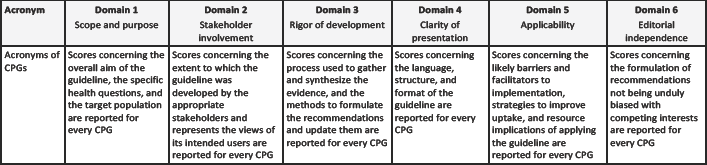
CPGs concerning every malignancy were also assessed with the Appraisal of Guidelines for Research & Evaluation (AGREE II) tool. A higher score equals a better quality of the domain. The results are reported after the Take-Home Message tables.
Acronym
Domain 1 Scope and purpose
Domain 2 Stakeholder involvement
Domain 3 Rigor of development
Domain 4 Clarity of presentation
Domain 5 Applicability
Domain 6 Editorial independence
Acronyms of CPGs
Scores concerning the overall aim of the guideline, the specific health questions, and the target population are reported for every CPG
Scores concerning the extent to which the guideline was developed by the appropriate stakeholders and represents the views of its intended users are reported for every CPG
Scores concerning the process used to gather and synthesize the evidence, and the methods to formulate the recommendations and update them are reported for every CPG
Scores concerning the language, structure, and format of the guideline are reported for every CPG
Scores concerning the likely barriers and facilitators to implementation, strategies to improve uptake, and resource implications of applying the guideline are reported for every CPG
Scores concerning the formulation of recommendations not being unduly biased with competing interests are reported for every CPG
The scores of the 6 domains were subdivided into quartiles and marked in different colors as shown in the following table:
Additional notes
Take-Home Messages are reported in alphabetical order.
Information from OGDs on a specific clinical question were only reported in the Take-Home Messages if the clinical question was considered by CPGs. Descriptions regarding these OGDs can, however, be found in the Detailed Summary Tables.
References concerning both CPGs and OGDs are reported after the Detailed Summary Tables, divided by type of malignancy and cited with the acronyms used in the Tables.
Detailed summary tables
Users' instructions
Definition and target audience
Take-Home Messages are presented in table format for every tumor type, summarizing essential information to support decision-making in clinical practice. They are intended for use by health care providers.
Selected guidelines (by cancer site)
Bladder cancer
AHS 2013-MI. Alberta Provincial Genitourinary Tumour Team. Muscle invasive and locally advanced/metastatic bladder cancer. Edmonton, Alberta: CancerControl Alberta; 2013.
AIOM 2015. Associazione Italiana di Oncologia Medica (AIOM). Carcinoma della vescica. Milan: AIOM; 2015.
AURO 2010. Puppo P, Conti G, Francesca F, Mandressi A, Naselli A; AURO.it guideline committee. New Italian guidelines on bladder cancer, based on the World Health Organization 2004 classification. BJU Int. 2010; 106(2):168-79. doi: 10.1111/j.1464-410X.2010.09324.x.
CUA 2013. Kapoor A, Allard CB, Black P, Kassouf W, Morash C, Rendon R. Canadian guidelines for postoperative surveillance of upper urinary tract urothelial carcinoma. Can Urol Assoc J. 2013;7(9-10):306-11. doi: 10.5489/cuaj.1578.
EAU 2015-MI. Witjes LA, Compérat E, Cowan NC, et al. Guidelines on muscle-invasive and metastatic bladder cancer. Arnhem, Netherlands: European Association of Urology; 2015.
EAU 2015-NM. Babjuk M, Böhle A, Burger M, et al. Guidelines on non-muscle-invasive bladder Cancer (Ta, T1 and CIS). Arnhem, Netherlands: European Association of Urology; 2015.
EAU 2015-UR. Gakis G, Witjes JA, Compérat E, et al. Guidelines on primary urethral carcinoma. Arnhem, Netherlands: European Association of Urology; 2015.
EAU 2015-UT. Rouprêt M, Babjuk M, Böhle A, et al. Guidelines on urothelial carcinomas of the upper urinary tract. Arnhem, Netherlands: European Association of Urology; 2015.
ESMO 2014. Bellmunt J, Orsola A, Leow JJ, et al. Bladder cancer: ESMO practice guidelines for diagnosis, treatment and follow-up. Ann Oncol. 2014; 25 (Suppl 3):iii40-8. doi: 10.1093/annonc/mdu223.
NCCN 2015. National Comprehensive Cancer Network (NCCN). Clinical practice guidelines in oncology. Bladder cancer, version 1.2015. Fort Washington, PA: National Comprehensive Cancer Network; 2015.
NICE 2015-SC. National Collaborating Centre for Cancer. Suspected cancer: recognition and referral. London, UK: National Institute for Health and Care Excellence; 2015. https://www.nice.org.uk/guidance/ng12.
NICE 2015-BC. National Collaborating Centre for Cancer. Bladder cancer: diagnosis and management. NICE guideline NG2. London, UK: National Institute for Health and Care Excellence; 2015. https://www.nice.org.uk/guidance/ng2.
USPSTF 2011. Moyer VA; U.S. Preventive Services Task Force. Screening for bladder cancer: U.S. Preventive Services Task Force recommendation statement. Ann Intern Med. 2011;155(4):246-51. doi: 10.7326/0003-4819-155-4-201108160-00008.
Breast cancer
AHS 2012-BB. Alberta Provincial Breast Tumour Team. Staging investigations for asymptomatic and newly diagnosed breast cancer. Edmonton, Alberta: Alberta Health Services, Cancer Care; 2012.
AHS 2013-FU. Alberta Provincial Breast Tumour Team. Follow-up care for early-stage breast cancer. Edmonton, Alberta: CancerControl Alberta; 2013.
AIOM 2015. Associazione Italiana di Oncologia Medica (AIOM). Neoplasie della mammella. Milan, Italy: Associazione Italiana di Oncologia Medica (AIOM); 2015.
ASCO 2012-FU. Khatcheressian JL, Hurley P, Bantug E, et al. Breast cancer follow-up and management after primary treatment: American Society of Clinical Oncology clinical practice guideline update. J Clin Oncol. 2013; 31(7):961-5. doi: 10.1200/JCO.2012.45.9859.
ASCO 2015-M+. Van Poznak C, Somerfield MR, Bast RC, et al. Use of biomarkers to guide decisions on systemic therapy for women with metastatic breast cancer: American Society of Clinical Oncology clinical practice guideline. J Clin Oncol. 2015; 33(24):2695-704. doi: 10.1200/JCO.2015.61.1459.
CECOG 2009. Beslija S, Bonneterre J, Burstein HJ, et al. Third consensus on medical treatment of metastatic breast cancer. Ann Oncol. 2009; 20(11):1771-85. doi: 10.1093/annonc/mdp261.
ESMO 2013-EarlyBC. Senkus E, Kyriakides S, Penault-Llorca F, et al. Primary breast cancer: ESMO clinical practice guidelines for diagnosis, treatment and follow-up. Ann Oncol. 2013; 24 (Suppl 6):vi7-23. doi: 10.1093/annonc/mdt284.
ESMO 2014-ABC. Cardoso F, Costa A, Norton L, et al. ESO-ESMO 2nd international consensus guidelines for advanced breast cancer (ABC2). Ann Oncol. 2014;25(10):1871-88. doi: 10.1093/annonc/mdu385.
EUSOMA 2014-Young. Partridge AH, Pagani O, Abulkhair O, et al. First international consensus guidelines for breast cancer in young women (BCY1). Breast. 2014;23(3):209-20. doi: 10.1016/j.breast.2014.03.011.
NCCN 2014-Diagn. National Comprehensive Cancer Network (NCCN). Clinical Practice Guidelines in Oncology. Breast cancer screening and diagnosis, version 1.2015. Fort Washington, PA: National Comprehensive Cancer Network; 2015.
NCCN 2015. National Comprehensive Cancer Network (NCCN). Clinical Practice Guidelines in Oncology. Breast cancer, version 1.2016. Fort Washington, PA: National Comprehensive Cancer Network; 2015.
NICE 2012-EarlyBC. National Collaborating Centre for Cancer. Early and locally advanced breast cancer. Diagnosis and treatment. London, UK: National Institute for Health and Clinical Excellence (NICE); 2009. https://www.nice.org.uk/guidance/cg80. Validity verification: 2012.
NICE 2014-M+. National Collaborating Centre for Cancer. Advanced breast cancer: diagnosis and treatment. London, UK: National Institute for Health and Clinical Excellence (NICE); 2009. https://www.nice.org.uk/guidance/cg81. Validity verification: 2014.
NICE 2015-SC. National Collaborating Centre for Cancer. Suspected cancer: recognition and referral. London, UK: National Institute for Health and Care Excellence; 2015. https://www.nice.org.uk/guidance/ng12.
Cervical cancer
AHS 2013. Alberta Provincial Gynecologic Oncology Team. Cancer of the uterine cervix. Edmonton, Alberta: CancerControl Alberta; 2013.
AIOM 2015. Associazione Italiana di Oncologia Medica (AIOM). Neoplasie dell'utero: endometrio e cervice. Milan, Italy: Associazione Italiana di Oncologia Medica (AIOM); 2015.
CCO 2015. Elit L, Fyles A, Fung-Kee-Fung M, Oliver T; Gynecology Cancer Disease Site Group. Follow-up for women after treatment for cervical cancer. Toronto, ON: Cancer Care Ontario; 2009. Validity verification: 2015.
ESMO 2012. Colombo N, Carinelli S, Colombo A, Marini C, Rollo D, Sessa C; ESMO Guidelines Working Group. Cervical cancer: ESMO clinical practice guidelines for diagnosis, treatment and follow-up. Ann Oncol. 2012; 23 (Suppl 7):vii27-32.
NACB 2010. Sturgeon CM, Duffy MJ, Hofmann BR, et al. National Academy of Clinical Biochemistry laboratory medicine practice guidelines for use of tumor markers in liver, bladder, cervical, and gastric cancers. Clin Chem. 2010;56(6):e1-48. doi: 10.1373/clinchem.2009.133124.
NCCN 2015. National Comprehensive Cancer Network (NCCN). Clinical Practice Guidelines in Oncology. Cervical cancer, version 2.2015. Fort Washington, PA: National Comprehensive Cancer Network; 2015.
NICE 2015. National Collaborating Centre for Cancer. Suspected cancer: recognition and referral. London, UK: National Institute for Health and Care Excellence; 2015. https://www.nice.org.uk/guidance/ng12.
AHS 2013. Alberta Provincial Gynecologic Oncology Tumour Team. Endometrial cancer. Edmonton, Alberta: Cancer Control Alberta; 2013.
AIOM 2015. Associazione Italiana di Oncologia Medica (AIOM). Neoplasie dell'utero: endometrio e cervice. Milan, Italy: Associazione Italiana di Oncologia Medica (AIOM); 2015.
ESMO 2013. Colombo N, Preti E, Landoni F, et al. Endometrial cancer: ESMO clinical practice guidelines for diagnosis, treatment and follow-up. Ann Oncol. 2013; 24 (Suppl 6):vi33-8. doi: 10.1093/annonc/mdt353.
NCCN 2015. National Comprehensive Cancer Network (NCCN). Clinical Practice Guidelines in Oncology. Uterine neoplasms, version 2.2015. Fort Washington, PA: National Comprehensive Cancer Network; 2015.
NICE 2015. National Collaborating Centre for Cancer. Suspected cancer: recognition and referral. London, UK: National Institute for Health and Care Excellence; 2015. https://www.nice.org.uk/guidance/ng12.
SGO 2014 (a). SGO Clinical Practice Endometrial Cancer Working Group, Burke WM, Orr J, Leitao M, et al. Endometrial cancer: a review and current management strategies: part I. Gynecol Oncol. 2014; 134(2):385-92. doi: 10.1016/j.ygyno.2014.05.018.
SGO 2014 (b). SGO Clinical Practice Endometrial Cancer Working Group, Burke WM, Orr J, Leitao M, et al. Endometrial cancer: a review and current management strategies: part II. Gynecol Oncol. 2014; 134(2):393-402. doi: 10.1016/j.ygyno.2014.06.003.
Ovarian cancer
ACOG 2009-HR. American College of Obstetricians and Gynecologists; ACOG Committee on Practice Bulletins–Gynecology; ACOG Committee on Genetics; Society of Gynecologic Oncologists. ACOG Practice Bulletin No. 103: Hereditary breast and ovarian cancer syndrome. Obstet Gynecol. 2009;113(4):957-66. doi: 10.1097/AOG.0b013e3181a106d4.
ACOG 2011-EC. American College of Obstetricians and Gynecologists Committee on Gynecologic Practice. Committee Opinion No. 477: the role of the obstetrician-gynecologist in the early detection of epithelial ovarian cancer. Obstet Gynecol. 2011; 117(3):742-6. doi: 10.1097/AOG.0b013e31821477db.
ACOG 2013-AM. American College of Obstetricians and Gynecologists. ACOG Practice Bulletin. Management of adnexal masses. Obstet Gynecol. 2007; 110(1):201-14. Validity verification: 2013.
AHS 2011-HR. Alberta Provincial Breast Tumour Team. Risk reduction and surveillance strategies for individuals at high genetic risk for breast and ovarian cancer. Edmonton, Alberta: Alberta Health Services, Cancer Care; 2011.
AHS 2013-EC. Alberta Provincial Gynecologic Oncology Tumour Team. Epithelial ovarian, fallopian tube, and primary peritoneal cancer. Edmonton, Alberta: CancerControl Alberta; 2013.
AHS 2013-GCT. Alberta Provincial Gynecologic Oncology Tumour Team. Ovarian germ cell tumours. Edmonton, Alberta: CancerControl Alberta; 2013.
AIOM 2015. Associazione Italiana di Oncologia Medica (AIOM). Tumori dell'ovaio. Milan, Italy: Associazione Italiana di Oncologia Medica (AIOM); 2015.
BSGE 2011. Royal College of Obstetricians and Gynaecologists (RCOG), British Society of Gynaecological Endoscopy (BSGE). Management of suspected ovarian masses in premenopausal women. London, UK: Royal College of Obstetricians and Gynaecologists; 2011. https://www.rcog.org.uk/en/guidelines-research-services/guidelines/gtg62/.
CCO 2011. Fung Kee Fung M, Kennedy E, Francis J, Mackay H; Gynecologic Cancer Disease Site Group. Optimal chemotherapy for recurrent ovarian cancer. Toronto, ON: Cancer Care Ontario; 2011.
CCO 2011-AM. Dodge J, Covens A, Lacchetti C, et al. Management of a suspicious adnexal mass. Toronto, ON: Cancer Care Ontario; 2011.
ESGO 2011. Morice P, Denschlag D, Rodolakis A, et al. Recommendations of the Fertility Task Force of the European Society of Gynecologic Oncology about the conservative management of ovarian malignant tumors. Int J Gynecol Cancer. 2011; 21(5):951-63. doi: 10.1097/IGC.0b013e31821bec6b.
ESGO 2012-FU. Verheijen RH, Cibula D, Zola P, Reed N; Council of the European Society of Gynaecologic Oncology. Cancer antigen 125: lost to follow-up?: a European Society of Gynaecological Oncology consensus statement. Int J Gynecol Cancer. 2012; 22(1):170-4. doi: 10.1097/IGC.0b013e318226c636.
ESMO 2012-GCT. Colombo N, Peiretti M, Garbi A, et al. Non-epithelial ovarian cancer: ESMO clinical practice guidelines for diagnosis, treatment and follow-up. Ann Oncol. 2012; 23 (Suppl 7):vii20-6.
ESMO 2013-EC. Ledermann JA, Raja FA, Fotopoulou C, et al. Newly diagnosed and relapsed epithelial ovarian carcinoma: ESMO clinical practice guidelines for diagnosis, treatment and follow-up. Ann Oncol. 2013; 24 (Suppl 6):vi24-32. doi: 10.1093/annonc/mdt333.
NCCN 2015. National Comprehensive Cancer Network (NCCN). Clinical Practice Guidelines in Oncology. Ovarian cancer. Version 1.2015. Fort Washington, PA: National Comprehensive Cancer Network (NCCN); 2015.
NCCN 2015-HR. National Comprehensive Cancer Network (NCCN). Clinical Practice Guidelines in Oncology. Genetic/familial high-risk assessment: breast and ovarian, version 1.2015. Fort Washington, PA: National Comprehensive Cancer Network; 2015.
NICE 2011-EC. National Collaborating Centre for Cancer. Ovarian cancer. The recognition and initial management of ovarian cancer. London, UK: National Institute for Health and Clinical Excellence (NICE); 2011. http://www.nice.org.uk/guidance/cg122.
NICE 2015. National Collaborating Centre for Cancer. Suspected cancer: recognition and referral. London, UK: National Institute for Health and Care Excellence; 2015. https://www.nice.org.uk/guidance/ng12.
SIGN 2013-EC. Scottish Intercollegiate Guidelines Network (SIGN). Management of epithelial ovarian cancer. A national clinical guideline. Edinburgh, Scotland: Scottish Intercollegiate Guidelines Network (SIGN); 2013.
USPSTF 2012. Moyer VA; U.S. Preventive Services Task Force. Screening for ovarian cancer: U.S. Preventive Services Task Force reaffirmation recommendation statement. Ann Intern Med. 2012; 157(12):900-4. doi:10.7326/0003-4819-157-11-201212040-00539.
Prostate cancer
ACS 2014. Skolarus TA, Wolf AM, Erb NL, et al. American Cancer Society prostate cancer survivorship care guidelines. CA Cancer J Clin. 2014; 64(4):225-49. doi: 10.3322/caac.21234.
AHS 2013. Alberta Provincial Genitourinary Tumour Team. Prostate cancer. Edmonton, Alberta: CancerControl Alberta; 2013.
AIOM 2015. Associazione Italiana di Oncologia Medica (AIOM). Linee guida carcinoma della prostata. Milan: AIOM; 2015.
APC 2015. Gillessen S, Omlin A, Attard G, et al. Management of patients with advanced prostate cancer: recommendations of the St Gallen Advanced Prostate Cancer Consensus Conference (APCCC) 2015. Ann Oncol. 2015; 26(8):1589-604. doi: 10.1093/annonc/mdv257.
ASCO 2012. Basch E, Oliver TK, Vickers A, et al. Screening for prostate cancer with prostate-specific antigen testing: American Society of Clinical Oncology provisional clinical opinion. J Clin Oncol. 2012; 30(24):3020-5. doi: 10.1200/JCO.2012.43.3441.
ASCO 2014. Freedland SJ, Rumble RB, Finelli A, et al. Adjuvant and salvage radiotherapy after prostatectomy: American Society of Clinical Oncology clinical practice guideline endorsement. J Clin Oncol. 2014; 32(34):3892-8. doi: 10.1200/JCO.2014.58.8525.
ASCO 2015. Resnick MJ, Lacchetti C, Bergman J, et al. Prostate cancer survivorship care guideline: American Society of Clinical Oncology clinical practice guideline endorsement. J Clin Oncol. 2015; 33(9):1078-85. doi: 10.1200/JCO.2014.60.2557.
ASCO-CCO 2014. Basch E, Loblaw DA, Oliver TK, et al. Systemic therapy in men with metastatic castration-resistant prostate cancer: American Society of Clinical Oncology and Cancer Care Ontario clinical practice guideline. J Clin Oncol. 2014; 32(30):3436-48. doi: 10.1200/JCO.2013.54.8404.
AUA 2011. Thompson I, Thrasher JB, Aus G, et al. Guideline for the management of clinically localized prostate cancer: 2007 update. Linthicum, MD: American Urological Association Education and Research, Inc.; 2007. http://www.auanet.org/educaton/guidelines/prostate-cancer.cfm. Validity verification: 2011.
AUA 2013. Carroll P, Albertsen PC, Greene K, et al. PSA testing for the pretreatment staging and posttreatment management of prostate cancer: 2013 revision of 2009 best practice statement. Linthicum, MD: American Urological Association Education and Research, Inc.; 2013.
AUA-ASTRO 2013. Thompson IM, Valicenti RK, Albertsen P, et al. Adjuvant and salvage radiotherapy after prostatectomy: AUA/ASTRO Guideline. J Urol. 2013; 190(2):441-9. doi: 10.1016/j.juro.2013.05.032.
CCO 2010. Chin J, Srigley J, Mayhew LA, et al. Guideline for optimization of surgical and pathological quality performance for radical prostatectomy in prostate cancer management. Toronto, ON: Cancer Care Ontario; 2008. https://www.cancercare.on.ca/common/pages/UserFile.aspx?fileId=13952. Validity verification: 2010.
CCO 2012-BT. Rodrigues G, Yao X, Loblaw A, Brundage M, Chin J, Genitourinary Cancer Disease Site Group. Low-dose rate brachytherapy for patients with low- or intermediate-risk prostate cancer. Toronto, ON: Cancer Care Ontario; 2012.
CCO 2014-AS. Morash C, Tey R, Agbassi C, et al. Active surveillance for the management of localized prostate cancer. Toronto, ON: Cancer Care Ontario; 2014.
CCO 2015. Young S, Bansal P, Vella E, et al. Referral of suspected prostate cancer by family physicians and other primary care providers. Program in Evidence-Based Care Evidence-Based Guideline No. 24-3. Toronto, ON: Cancer Care Ontario; 2012. Validity verification: 2015.
CTFPHC 2014. Canadian Task Force on Preventive Health Care, Bell N, Connor Gorber S, Shane A, et al. Recommendations on screening for prostate cancer with the prostate-specific antigen test. CMAJ. 2014; 186(16):1225-34. doi: 10.1503/cmaj.140703.
CUA 2011. Izawa JI, Klotz L, Siemens DR, et al. Prostate cancer screening: Canadian guidelines 2011. Can Urol Assoc J. 2011; 5(4):235-40. doi: 10.5489/cuaj.11134.
EAU 2015. Mottet N, Bellmunt J, Briers E, et al. Guidelines on prostate cancer. Arnhem, Netherlands: European Association of Urology; 2015.
EGAPP 2014. Evaluation of Genomic Applications in Practice and Prevention (EGAPP) Working Group. Recommendations from the EGAPP Working Group: does PCA3 testing for the diagnosis and management of prostate cancer improve patient health outcomes? Genet Med. 2014; 16(4):338-46. doi: 10.1038/gim.2013.141.
ESMO 2013. Horwich A, Parker C, de Reijke T, Kataja V; ESMO Guidelines Working Group. Prostate cancer: ESMO clinical practice guidelines for diagnosis, treatment and follow-up. Ann Oncol. 2013; 24 (Suppl 6):vi106-14. doi: 10.1093/annonc/mdt208.
GEC-ESTRO 2013. Hoskin PJ, Colombo A, Henry A, et al. GEC/ESTRO recommendations on high dose rate afterloading brachytherapy for localised prostate cancer: an update. Radiother Oncol. 2013; 107(3):325-32. doi: 10.1016/j.radonc.2013.05.002.
NCCN 2014. National Comprehensive Cancer Network (NCCN). Clinical Practice Guidelines in Oncology. Prostate cancer early detection, version 1.2014. Fort Washington, PA: National Comprehensive Cancer Network; 2014.
NCCN 2015. National Comprehensive Cancer Network (NCCN). Clinical Practice Guidelines in Oncology. Prostate Cancer. Fort Washington, PA: National Comprehensive Cancer Network; 2015.
NICE 2014. National Collaborating Centre for Cancer. Prostate cancer: diagnosis and treatment. London, UK: National Institute for Health and Care Excellence (NICE); 2014. http://www.nice.org.uk/guidance/cg175.
NICE 2015. National Collaborating Centre for Cancer. Suspected cancer: recognition and referral. NICE guideline NG12. London, UK: National Institute for Health and Care Excellence; 2015. https://www.nice.org.uk/guidance/ng12.
NICE 2015-PCA3. National Institute for Health and Care Excellence (NICE). Diagnosing prostate cancer: PROGENSA PCA3 assay and Prostate Health Index. London, UK: National Institute for Health and Care Excellence (NICE); 2015. https://www.nice.org.uk/guidance/dg17.
SIOG 2014. Droz JP, Aapro M, Balducci L, et al. Management of prostate cancer in older patients: updated recommendations of a working group of the International Society of Geriatric Oncology. Lancet Oncol. 2014; 15(9):e404-14. doi: 10.1016/S1470-2045(14)70018-X.
SOGUG 2012. Climent MA, Piulats JM, Sánchez-Hernández A, et al. Recommendations from the Spanish Oncology Genitourinary Group for the treatment of patients with metastatic castration-resistant prostate cancer. Crit Rev Oncol Hematol. 2012; 83(3):341-52. doi: 10.1016/j.critrevonc.2012.01.002.
USPSTF 2012. Moyer VA; U.S. Preventive Services Task Force. Screening for prostate cancer: U.S. Preventive Services Task Force recommendation statement. Ann Intern Med. 2012; 157(2):120-34. doi: 10.7326/0003-4819-157-2-201207170-00459.
Renal cancer
ACCC 2012. Urological Tumours National Working Group. Renal cell carcinoma - Version: 2.0. Utrecht, Netherlands: Association of Comprehensive Cancer Centres; 2010. http://www.oncoline.nl/renal-cell-carcinoma. Validity verification: 2012.
AHS 2012. Alberta Provincial Genitourinary Tumour Team. Renal cell carcinoma. Edmonton, Alberta: Alberta Health Services, Cancer Care; 2012.
AIOM 2015. Associazione Italiana di Oncologia Medica (AIOM). Tumori del rene. Milan, Italy: Associazione Italiana di Oncologia Medica (AIOM); 2015.
AUA 2013. Donat SM, Diaz M, Bishoff JT, et al. Follow-up for clinically localized renal neoplasms: AUA guideline. Linthicum, MD: American Urological Association Education and Research, Inc.; 2013.
EAU 2015. Ljungberg B, Bensalah K, Bex A, et al. Guidelines on renal cell carcinoma. Arnhem, Netherlands: European Association of Urology; 2015.
ESMO 2014. Escudier B, Porta C, Schmidinger M, et al. Renal cell carcinoma: ESMO clinical practice guidelines for diagnosis, treatment and follow-up. Ann Oncol. 2014 Sep;25 (Suppl 3):iii49-56. doi: 10.1093/annonc/mdu259.
ICUD-EAU 2011. Kirkali Z, Mulders P. Kidney Cancer Edition 2011: 1st EAU-ICUD International Consultation on Kidney Cancer Barcelona–2010. Paris, France: Edition 21; 2011. http://www.icud.info/kidneycancer.html.
NCCN 2015. National Comprehensive Cancer Network (NCCN). Clinical Practice Guidelines in Oncology. Kidney cancer, version 3.2015. Fort Washington, PA: National Comprehensive Cancer Network; 2015.
NICE 2015. National Collaborating Centre for Cancer. Suspected cancer: recognition and referral. London, UK: National Institute for Health and Care Excellence; 2015. https://www.nice.org.uk/guidance/ng12.
SOGUG 2014. García Del Muro X, Gallardo E, García Carbonero I, et al. Recommendations from the Spanish Oncology Genitourinary Group for the treatment of patients with renal cell carcinoma. Cancer Chemother Pharmacol. 2014;73(6):1095-107. doi: 10.1007/s00280-014-2413-0.
Testicular cancer
AHS 2013. Alberta Provincial Genitourinary Tumour Team. Testicular germ cell tumours. Edmonton, Alberta: CancerControl Alberta; 2013.
AIOM 2015. Associazione Italiana di Oncologia Medica (AIOM). Tumore del testicolo. Milan, Italy: Associazione Italiana di Oncologia Medica (AIOM); 2015.
ASCO 2010. Gilligan TD, Seidenfeld J, Basch EM, et al. American Society of Clinical Oncology clinical practice guideline on uses of serum tumor markers in adult males with germ cell tumors. J Clin Oncol. 2010; 28(20):3388-404. doi: 10.1200/JCO.2009.26.4481.
CCO 2014. Chung P, Mayhew LA, Warde P, Winquist E, Lukka H; members of the Genitourinary Cancer Disease Site Group. Management of stage I seminoma. Lock M and Brown J, reviewers. Toronto, ON: Cancer Care Ontario; 2008. Validity verification: 2014.
EAU 2015. Albers P, Albrecht W, Algaba F, et al. Guidelines on testicular cancer. Arnhem, Netherlands: European Association of Urology; 2015.
EGCCCG 2013. Beyer J, Albers P, Altena R, et al. Maintaining success, reducing treatment burden, focusing on survivorship: highlights from the third European Consensus Conference on Diagnosis and Treatment of Germ-Cell Cancer. Ann Oncol. 2013; 24(4):878-88. doi: 10.1093/annonc/mds579.
ESMO 2013. Oldenburg J, Fosså SD, Nuver J, et al. Testicular seminoma and non-seminoma: ESMO clinical practice guidelines for diagnosis, treatment and follow-up. Ann Oncol. 2013; 24 (Suppl 6):vi125-32. doi: 10.1093/annonc/mdt304.
NCCN 2015. National Comprehensive Cancer Network (NCCN). Clinical Practice Guidelines in Oncology. Testicular cancer, version 1.2015. Fort Washington, PA: National Comprehensive Cancer Network; 2015.
NICE 2015. National Collaborating Centre for Cancer. Suspected cancer: recognition and referral. London, UK: National Institute for Health and Care Excellence; 2015. https://www.nice.org.uk/guidance/ng12.
SIGN 2011. Scottish Intercollegiate Guidelines Network. Management of adult testicular germ cell tumours. A national clinical guideline. Edinburgh, Scotland: Scottish Intercollegiate Guidelines Network; 2011. http://www.sign.ac.uk/guidelines/fulltext/124/index.html.
SIU-ICUD-UICC 2011. Stephenson AJ, Aprikian AG, Gilligan TD, et al. Management of low-stage nonseminomatous germ cell tumors of testis: SIU/ICUD Consensus Meeting on Germ Cell Tumors (GCT), Shanghai 2009. Urology. 2011;78(4 Suppl):S444-55. doi: 10.1016/j.urology.2011.02.030.
USPSTF 2011. U.S. Preventive Services Task Force. Screening for testicular cancer: U.S. Preventive Services Task Force reaffirmation recommendation statement. Ann Intern Med. 2011; 154(7):483-6. doi: 10.7326/0003-4819-154-7-201104050-00006.
Contributors
Salvatore Alfieri
SC Oncologia Medica 3 Tumori Testa e Collo
Fondazione IRCCS Istituto Nazionale dei Tumori
Milano - Italy
Emiliano Aroasio
Dipartimento di Scienze Cliniche e Biologiche
Azienda Ospedaliero-Universitaria San Luigi Gonzaga
Orbassano (Torino) - Italy
Alessandro Bertaccini
Clinica Urologica
Azienda Ospedaliero-Universitaria di Bologna Policlinico S.
Orsola-Malpighi
Bologna - Italy
Francesco Boccardo
UOC Clinica di Oncologia Medica
IRCCS AOU San Martino IST - Istituto Nazionale per la Ricerca sul Cancro
Università degli Studi
Genova - Italy
Mario Braga
Sistema Monitoraggio Nazionale (Area Monitoraggio Spesa Sanitaria e LEA)
Agenzia Nazionale per i Servizi Sanitari Regionali (AGENAS)
Roma - Italy
Roberto Buzzoni
SC Day Hospital e Terapia Ambulatoriale Oncologica
Fondazione IRCCS Istituto Nazionale dei Tumori
Milano - Italy
Maurizio Cancian
Società Italiana di Medicina Generale SIMG
Scuola Veneta di Medicina Generale SVeMG
Conegliano Veneto (Treviso) - Italy
Ettore D. Capoluongo
UOS Diagnostica Molecolare Clinica e Personalizzata, Dipartimento di Medicina Laboratorio
Centro e Programma Regionale Biomarcatori Diagnostici, Prognostici e Predittivi
Azienda ULSS 12 Veneziana
AVAPO Venezia Onlus
Venezia - Italy
Vincenzo Scattoni
UO Urologia
IRCCS Ospedale San Raffaele
Università Vita-Salute San Raffaele
Milano - Italy
Holger Schünemann
Department of Clinical Epidemiology & Biostatistics
McMaster University Health Sciences Centre
Hamilton - Canada
Giuseppe Sica
UOC Chirurgia Generale A, Dipartimento di Chirurgia
Fondazione PTV Policlinico Universitario Tor Vergata
Università Roma-Tor Vergata
Roma - Italy
Alessandro Terreni
SOD Laboratorio Generale
AOUC Azienda Ospedaliero-Universitaria Careggi
Firenze - Italy
Marcello Tiseo
SC Oncologia Medica
Azienda Ospedaliero-Universitaria
Parma - Italy
Valter Torri
Laboratorio Metodologia per la Ricerca Biomedica, Dipartimento Oncologia
IRCCS Istituto di Ricerche Farmacologiche “Mario Negri”
Milano - Italy
Quinto Tozzi
Ricerca e Studio Rischio Clinico
Agenzia Nazionale per i Servizi Sanitari Regionali (AGENAS)
Roma - Italy
Tommaso Trenti
Dipartimento Integrato Interaziendale di Medicina di Laboratorio ed Anatomia Patologica
Azienda Ospedaliera Universitaria e Azienda USL di Modena
Modena - Italy
Chiara Trevisiol
Centro e Programma Regionale Biomarcatori Diagnostici, Prognostici e Predittivi
Azienda ULSS 12 Veneziana
Istituto Oncologico Veneto IOV – IRCCS
Padova - Italy
Paolo Zola
Dipartimento Scienze Chirurgiche
AOU Città della Salute e della Scienza
Università degli Studi
Torino - Italy
References
1.
GionM., TrevisiolC., RainatoG., FabricioA.S.C.. Marcatori circolanti in oncologia: guida all'uso clinico appropriato. I Quaderni di Monitor.Roma: AGENAS, Agenzia Nazionale per i Servizi Sanitari Regionali2016.
2.
GionM., TrevisiolC., RutjesA.W.S., RainatoG., FabricioA.S.C.. Circulating tumor markers: a guide to their appropriate clinical use. Comparative summary of recommendations from clinical practice guidelines (Part 1).Int J Biol Markers.2016; 31: e332–e367.
3.
IOM (Institute of Medicine).Clinical practice guidelines we can trust.Washington, DC: The National Academies Press2011.
4.
GionM.. Need for knowledge translation to improve tumor marker application.Int J Biol Markers.2016; 31: e331.