




Abstract
Early subsidence >1.5 mm is considered to be a predictive factor for later aseptic loosening of the femoral component following total hip arthroplasty (THA). The aim of this study was to assess five-year subsidence rates of the cementless hydroxyapatite-coated twinSys® stem (Mathys Ltd., Bettlach, Switzerland).
This prospective single-surgeon series examined consecutive patients receiving a twinSys® stem at Maria Middelares Hospital, Belgium. Patients aged >85 years or unable to come to follow-up were excluded. Subsidence was assessed using Ein Bild Roentgen Analyse – Femoral Component Analysis (EBRA-FCA). Additional clinical and radiographic assessments were performed. Follow-ups were prospectively scheduled at two, five, 12, 24, and 60 months.
In total, 218 THA (211 patients) were included. At five years, mean subsidence was 0.66 mm (95% CI: 0.43-0.90). Of the 211 patients, 95.2% had an excellent or good Harris Hip Score. There were few radiological changes. Kaplan-Meier analysis indicated five-year stem survival to be 98.4% (95% CI: 97.6-100%).
Subsidence levels of the twinSys® femoral stem throughout the five years of follow-up were substantially lower than the 1.5 mm level predictive of aseptic loosening. This was reflected in the high five-year survival rate.
Introduction
Total hip arthroplasty (THA) has become a common procedure. Every year, around one million patients worldwide receive a THA (1). However, surgeons are currently faced with a wide range of prostheses alongside a lack of reliable and comparable long-term clinical data required to make an informed choice (2).
As revision of loose prostheses can be surgically demanding, costly, and is associated with considerable patient morbidity (3), proven long-term survival of the implant is of critical importance. UK guidelines (4) recommend a revision rate of ≤10% at 10 years as the current benchmark level. As cemented prostheses have been used for longer than cementless ones, they have a greater long-term evidence base. Indeed, in the year 2000, it was estimated that 90-95% of prostheses used in the UK were cemented (4). However, similar survival rates between cemented and cementless implants have now been reported (5, 6).
There are many different types of cementless prosthesis; however, these are not all equally effective. A recent review of cementless prostheses by Zwartele et al (7) stated that inferior implant designs were blamed for hip failures in all reviewed studies, rather than the quality of bone or fixation. The importance of implant design is further underlined by the finding that modifications to a single femoral stem (Furlong HAC stem) considerably increased subsidence in the first two years following implantation (8). Naturally, there is considerable interest in early markers that are predictive of implant failure in order to stop using poorer designs before long-term outcome data becomes available.
Many studies have reported stem migration in the distal direction, i.e. subsidence, to be a predictive factor for early loosening (9–10–11–12–13–14–15). Two-year subsidence rates of 1.2 mm [as measured by roentgen stereophotogrammetric analysis (RSA) (12)], ≥1.5 mm [as measured by EBRA (16)], or ≥2 mm [as measured using a digitising table and software (13, 15)] are associated with an increased probability of later aseptic loosening of the stem. Using EBRA, similar observations over a five-year period allow long-term outcome to be predicted with an accuracy level of 91% (16).
The aim of this study was to evaluate early subsidence of the cementless hydroxyapatite (HA)-coated twinSys® femoral stem (Mathys Ltd., Bettlach, Switzerland). The data presented are the first mid-term (five-year) subsidence and survival data for this stem. To measure subsidence, the Ein Bild Roentgen Analyse – Femoral Component Analysis (EBRA-FCA) technique was used. Additional radiographic and clinical findings are also reported.
Methods
This was a prospective radiological and clinical follow-up study on the twinSys® cementless stem. Particular emphasis was placed upon measuring early subsidence using EBRA-FCA. The Ethics Committee of the Maria Middelares Hospital, Gent, Belgium, granted approval for this study.
Patients
We examined a consecutive series of patients receiving primary THA with the cementless twinSys® stem. All stems were implanted by the same surgeon (MG) at the Maria Middelares Hospital between 1 November 2003 and 15 April 2005. In all cases, a direct lateral Hardinge approach was used, with the patient in a supine position. Patients were assessed preoperatively. Follow-ups were prospectively scheduled at two, five, 12, 24, and 60 months.
Our exclusion criteria were: 1) age >85 years; 2) unable or unwilling to come to the follow-up consultations.
Implants
Patients received either the twinSys® standard or lateral cementless stem combined with various types of cup and bearings. The twinSys® triple-tapered femoral stem is made of TiAl6V4 and has a plasma-sprayed HA coating. Details on the bearing surface material and head diameter are presented in Table I.
Baseline Characteristics
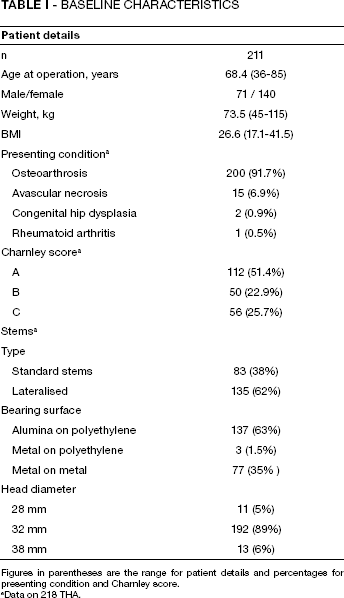
Figures in parentheses are the range for patient details and percentages for presenting condition and Charnley score.
Data on 218 THA.
Clinical assessment
The patients were prospectively assessed using the Harris Hip Score (17) and Merle d'Aubigné Score (18).
Radiological assessment
The x-rays were evaluated by an independent orthopaedic surgeon (MC) who was not involved in the surgeries.
Radiographs were examined for:
osteolysis, defined as an area of localised progressive bone resorption or endosteal erosion (19); radiolucent lines (20); bone hypertrophy, defined as a thickening of the periprosthetic bone (19) and allocated to the Gruen zones (21); subsidence, evaluated by comparing the pre- and post-surgery distances between the tip of the trochanter minor and the proximal shoulder of the prosthesis (22). pedestal formation, defined as shelf of endosteal new bone at the stem tip partially or completely bridging the intramedullary canal (23); heterotopic ossifications (24); resorption of the calcar (rounding of the medial femoral neck); only second, third- and fourth-degree stress shielding with resorption of cortical bone medially, anteriorly or laterally was regarded as stress shielding (19).
EBRA measurement
EBRA-FCA is a non-invasive method that utilises single radiographs from different time points to analyse subsidence (16, 25, 26). The inherent measurement error is reduced by estimating the mean subsidence profile based on well-defined reference lines. In addition, EBRA-FCA uses three parameters (measurements) to assess the comparability of pairs of radiographs, and accepts only pairs within chosen limits (25). EBRA-FCA has shown good agreement with the reference standard RSA, and measurement accuracy is very good (<1.5 mm) (25).
All images were processed by the same technician. Measurement errors showing apparent upward movement were not altered, as such errors would also occur in the other direction. To be included in the analysis, each THA required a minimum of four comparable x-rays.
Statistical analysis
Survival of the stem was calculated according to Kaplan-Meier. To determine the monthly subsidence rate, a linear random effects regression model of subsidence against time since operation was calculated. To account for the curvilinear trend, both a linear and a quadratic term were specified. The SAS software procedure ‘Mixed’ was used for this purpose, with patients treated as block variable, i.e. a compound symmetry covariance structure was specified to handle the correlation among patients. Quantile-quantile plots and graphs plotting residuals against predicted values (also known as a Tukey-Anscombe plot) were used to judge the assumptions of the model.
Results
Patients
We examined 218 THA (211 patients) performed using the twinSys® cementless stem. For baseline characteristics, see Table I.
Of the 218 THA, 28 prostheses were implanted in patients who died of causes unrelated to THA, and 23 prostheses were implanted in patients who were lost to follow-up as they were either too old or too disabled to come to follow-up visits. All twinSys® prostheses were still in situ at the last point of contact. There were five revisions. Consequently, 162 THA (74.3%) remained at five-year follow-up. A detailed breakdown of patient flow is presented in Figure 1.
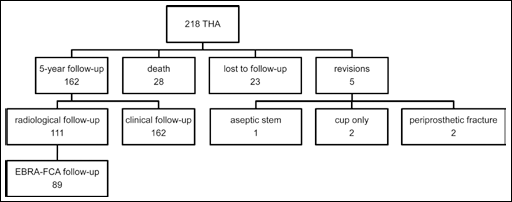
Study flowchart: 28 patients (28 THA) were lost due to death from unrelated causes and 23 patients (23 THA) were lost to follow-up (4 bedridden patients; 16 patients who could not be traced or contacted; 3 dissatisfied patients unwilling to present for follow-up). The 3 dissatisfied patients all had metal-on-metal implants, which are now recognised to carry a higher risk of failure (33).
Clinical and radiological assessments
At five years, 95.2% of the patients had an excellent or a good Harris Hip Score (mean: 96.1, range: 35-100). The mean Merle d'Aubigné Score reached 17.0 points (range: 9-18). Full clinical and radiological data are displayed in Table II.
Radiological and Clinical Follow-Ups
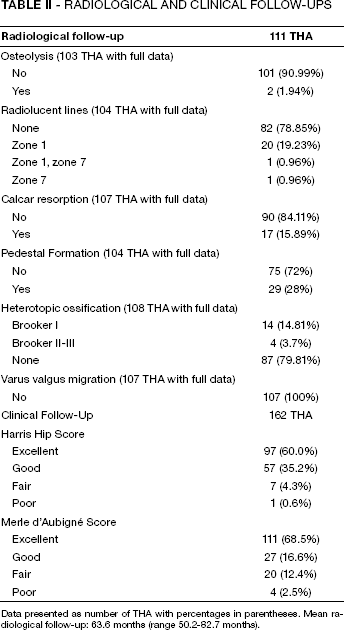
Data presented as number of THA with percentages in parentheses. Mean radiological follow-up: 63.6 months (range 50.2-82.7 months).
Stem survival
A Kaplan-Meier analysis with stem revision as the endpoint revealed a 98.4% (95% CI: 97.6-100%) survival rate at 5 years (Fig. 2). At five years, there had been two cup revisions and three stem revisions recorded. The causes of stem revision were aseptic loosening (n = 1) and periprosthetic fractures (n = 2).
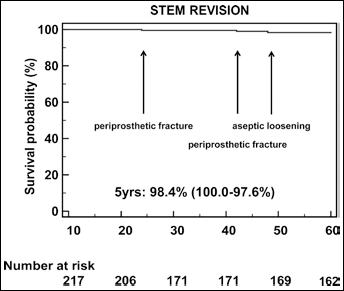
Kaplan-Meier survival curve for stem revision.
EBRA Measurement
Subsidence at two years
At two years, 162 THA had complete radiological follow-up (856 radiographs). The EBRA algorithm excluded 30 incomparable radiographs (12 THA). This left 150 THA for analysis, with an average of 4.65 (range 3-7) radiographs per THA. The mean subsidence was 0.69 mm (95% CI: 0.53-0.84 mm).
Subsidence at five years
At five years, 111 THA had complete radiological follow-up (508 radiographs). The EBRA algorithm excluded 28 incomparable radiographs. This left 89 THA for analysis with a mean of 5.1 radiographs (range 3-7) per THA. The mean subsidence was 0.66 mm (95% CI: 0.43-0.90 mm). Of note, the greater 95% confidence limit does not surpass the measurement error of the EBRA method (±1 mm) (26). The linear random effects regression model of subsidence against time is displayed in Figure 3. Example radiographs are presented in Figure 4.
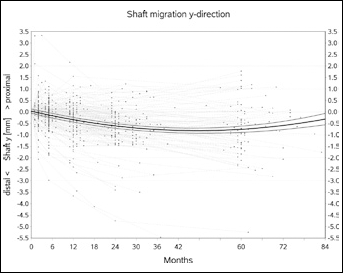
Shaft subsidence (Y direction) over time with estimated regression line.
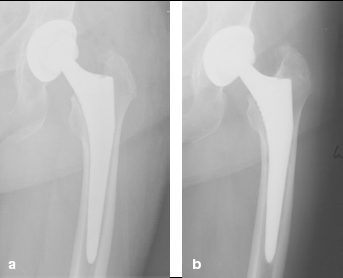
Example radiographs from a 77-year-old female patient taken: (a) postoperatively; and (b) at 5 years; (The subsidence level was 5.5 mm at 2 years).
Subsidence at last recorded follow-up
Data from the last recorded follow-up [mean ± SD: 46.48 ± 18.42 months; median (interquartile range): 57 (28.5-60) months] were available for 164 THA (114 THA in women; 50 THA in men). The mean subsidence was 0.75 mm (95% CI: 0.58-0.92 mm), 16 (9.8%) showed subsidence values of >2 mm. There was no significant difference in subsidence between genders, as later confirmed in the regression model, although the non-parametric test pointed to a borderline significant effect with females showing smaller subsidence (p = 0.044, Wilcoxon test).
Discussion
HA coatings are used in some cementless stems to ensure rapid osseointegration and long-term stability. The survival rates of fully HA-coated stems have proven to be outstanding. In the Norwegian Arthroplasty Register 1987-2004 (6), <1% revisions were recorded at 4.5 years, 2.4% revisions at 10 years, and 4.9% revisions at 15 years on a total number of 5,130 fully HA-coated stems. The 15-year survival rate (95.1%) was comparable to the best of the cemented stems examined (6).
Subsidence levels of the twinSys® femoral stem throughout the 5 years of follow-up were substantially lower than the 1.5 mm level predictive of later aseptic loosening (16).
In their study on the Accolade cementless stem, White et al (27) reviewed the available literature on femoral stem subsidence measured by EBRA-FCA. They presented two-year results from eight studies, including their own, showing a range of mean 2-year subsidence values from 0.29 mm to 4.2 ± 1.5 mm. Thus, the twinSys® subsidence values (0.69 mm at two years) are at the lower end of this range.
Our findings on femoral subsidence are broadly in line with those reported in studies on successful cementless stems analysed using RSA. Campbell et al 2011 (28) reported subsidence of 0.58 mm at two years for the Corail® stem. Interestingly, these authors reported subsidence to be confined to the first six months following implantation. This finding was not replicated here, although it was found that the rate of subsidence decreased after 12 months.
The data from this study support the relationship between low levels of initial subsidence and improved implant survival. Of the 218 THA, there was a single case of stem revision for aseptic loosening (without subsidence) at five years. The UK National Institute for Clinical Excellence (4) recommends a revision rate of ≤10% at 10 years as the current benchmark level for prosthesis selection for THA. A prosthesis with a revision rate at three years’ follow-up that is consistent with this benchmark could also be recommended (4).
The five-year survival rate reported here (98.4%) is comparable to those reported for other cementless stems, such as the five-year survival rate of 98% reported for the Link MP (29) and the high survival rate for the CLS® Spotorno (6, 19, 30, 31) and Corail® (5, 6, 28) stem.
In addition to the encouraging data on subsidence and survival, clinical outcome matched expectations for such a procedure (excellent in 60% of patients and good or excellent in 95% of patients).
This study has some key strengths and limitations. The radiological data were assessed by an independent surgeon, eliminating any potential bias. Moreover, EBRA-FCA is a highly objective and repeatable method of measuring subsidence. The skill and experience of the surgeon and the surgical approach used are both known to have a large impact upon treatment outcome. Our single-centre study using just one approach eliminated these potential confounders. Furthermore, single-surgeon series have been shown to produce superior results to multi-surgeon series (32). Therefore future studies are required in other centres before the findings presented here can be generalised. The main limitation to this study was the relatively high number of patients who were lost to follow-up.
In conclusion, the twinSys® stem appears to display the excellent survival and subsidence results previously reported for HA-coated cementless femoral stems. Further study is now required in other centres to ensure these results can be replicated.
Footnotes
Acknowledgements
Medical writing support was provided by archimed medical communication ag, Zofingen, Switzerland.