






Abstract
Purpose
Finite element analysis has been used extensively in the study of biomechanical modeling of the breast. However, issues regarding the complexity of material models and the influences of geometric boundary conditions on the accuracy of a breast Finite Element (FE) model are still under debate. This work demonstrates the importance of material modeling in FE models of the breast.
Methods
A simple hemispherical geometry is used to model the shape of a human breast. Different material models are being investigated to accurately model changes in terms of displacement, stress, and reaction forces distribution.
Results
The results obtained using nonlinear material models are compared with those obtained employing their linear approximation. Results have shown that differences, in terms of displacement, ranging between 20% and more than 80%, may occur and that large differences are present in terms of maximum principal stresses when the displacement is correctly approximated.
Conclusions
This study clearly shows that, in a FE model, simulating large deformations material modeling strongly influences the accuracy of the solution.
Introduction
In the biomechanical research domain Finite Element Methods (FEMs) are used to determine deformations or stresses in the human structures such as bones (1), tendons (2), muscles (3), and breasts (4). FEM is applied for a better understanding of the mechanical behavior of the human body or interaction of its organs while it performs specific tasks. FEMs coupled with imaging registration algorithms can predict large deformations in soft tissues where non-rigid deformation are required to track the complex motion of the organ under study (5). Indeed, recent developments regarding multi-modal imaging techniques, such as Positron Emission Tomography (PET) and Computerized Tomography (CT), or time-dependent breast image analysis, including co-registration, used biomechanical models and finite element modeling to predict the deformation under gravity loading, mammographic compression, and guided breast biopsy/surgery by applying the laws of continuum mechanics (6,7).
For the description and modeling of the mechanical behavior of the breast or soft tissues in general, different solutions have been proposed in the literature. Ruiter et al. (8), Bakik et al. (9), and Wellman et al. (10) used exponential models, Samani et al. (11) used a polynomial model for the breast ex-vivo material characterization, Tanner et al. (6) and Kellner et al. (12) implemented linear elastic models, Chung et al. (13) employed hyperelastic constitutive laws assuming the mechanical properties of the breast fitting Money-Rivlin or neo-Hookean models (14). Each author provides different data depending on the technique adopted to obtain the material parameters necessary to implement the appropriate mechanical constitutive law. For example, regarding the determination of the Young's modulus of fat and fibroglandular tissue of the breast, Samani et al. (11) propose lower values (≈3.25 kPa for fat tissue and fibroglandular tissue), than the ones proposed by Wellman et al. (10) (17.8 kPa for the fat tissue and 271.8 kPa for the fibroglandular tissue). The reason behind this discrepancy might be strongly related to the different testing methods. Therefore, changes in the material parameters can be reported as inter- and intra-dependent. In fact, these parameters could be dissimilar for different subjects or for the same subject during various stages in life. For example, Whitehouse et al. (15) and Biesterfeldt et al. (16) identified differences, respectively, in the breast volume and the breast parenchyma elasticity value during the menstrual cycle. Actually, Tanner et al. (6) and Whiteley et al. (17) implemented sensitivity studies to understand the impact of the errors because of material modeling of soft biological tissues in FE analysis. Different conclusions have been drawn about the material modeling of the human breast. Tanner et al. (6) assessed the factors that influence the breast model accuracy in a controlled clinical situation where the organ boundaries are reasonably accurately known but some uncertainty exists about the tissue's mechanical properties. Whiteley et al. (17) compared linear elastic and pseudo-nonlinear modeling approaches for a full nonlinear elastic tissue problem that has an exponential stress-strain relationship. Both studies dealt with FE modeling of human breast tissue but the conclusions drawn are largely different. Tanner et al. (6) stated that material properties do not affect the accuracy of a biomechanical breast model FE based. Conversely, Whiteley et al. (17) assessed that simple material models are not appropriate even in the case of modeling deformations of the human breast under gravity. These studies are not conclusive. Indeed, ambiguity remains on how to use the correct weighting factor influencing the accuracy of a FE model of an organ characterized by a soft tissue such as the human breast. The aim of this study is to clarify the role of material properties in FE modeling of the human breast.
From the above discussion, it is clear that human breast is a complex heterogeneous soft tissue characterized by adipose tissue (fat) and a fibroglandular part. Stresses and strains values in fat and fibroglandular structures may drastically change in presence of pathologic abnormalities such as tumors. Hence, accurately determining stresses and strains in soft biological tissues is of extreme importance for clinical diagnosis.
This study compares different material model approximations for finite element simulations of the human breast. Simple linear constitutive material models as well as nonlinear ones are compared. We argue that approximations of hyperelastic constitutive laws could not be sufficient to model the mechanical behavior of the human breast under the effect of a distributed load such as gravity. Finally, our results demonstrate that approximations of a strongly nonlinear material lead to limitations in the attempt to accurately estimate the mechanical behavior of the human breast.
Materials and Methods
Constitutive laws
This section summarizes the mathematical formulations related to the implemented material models. In this study linear, pseudo-nonlinear, and nonlinear (Neo-Hookean and Mooney-Rivlin) material models are investigated. Some assumptions have been introduced to model the complex mechanical behavior of the breast. In fact, the materials employed are supposed to be: homogenous, isotropic, and incompressible. The following related constitutive laws include the above three assumptions in their formulations.
Linear elastic material model - A linear elastic model is
implemented. Working in a three-dimensional stress state it is written according
to the Cauchy generalized Hooke's law (18),

where σ is the Cauchy stress tensor, C is the stiffness or elastic tensor, and ∊ is the strain tensor.
Pseudo-nonlinear Material Models - The pseudo-nonlinear models
are in the form (6),

where the Young's modulus EY is defined as the gradient of the stress-strain (σ-∊) curve for uniaxial tension, and an exponential relationship is assumed where ci are constants, and n is the order of the polynomial.
Nonlinear Material Models
Hyperelastic models are modeled according to the Neo-Hookean and the
Polynomial (five parameters) constitutive laws respectively, defined
according to the formulation of the strain energy function,

and
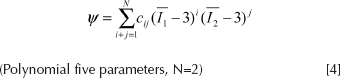
where ψ is the strain energy density function, Ī1 and Ī2 are the first and the second invariants of the deviatoric component of the left-Cauchy-Green deformation tensor (14), and cij are material constants. Eq.(4) is also referred to as the Polynomial of second order (N=2).
Finite element model
As discussed above, several opinions exist about the assessment of the impact of material models complexity on FE breast modeling (5,17), they are because of the constitutive laws (linear, exponential, polynomial or more complex) used to model large deformations. How the complexity of these mathematic formulations influences the accuracy of a FE breast has not yet been fully investigated. To investigate the aforementioned problem, a simplified FE model of a human breast has been implemented (5,17).
Geometry
This study uses the geometric model proposed by Whiteley et al (17). Figure 1 illustrates the model consisting of:
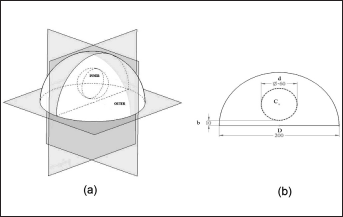
Hemispheric geometry: (a) 3D view (the inner spherical part represents the glandular tissue, the hemispheric portion represents the fat tissue) and (b) central section with quotes in mm.
an OUTER hemispherical part (D = 200 mm);
an INNER spherical inclusion (d = 60 mm) centered in C = 40 mm far from the base (b = 10 mm) of the hemisphere.
Boundary conditions
The implemented FE model is characterized by the same boundary conditions employed by Whiteley et al. (17) where a hemisphere is constrained at its basis in all degrees of freedom and subjected to a homogenous gravity load. Applied boundary conditions can be divided into (Fig. 2):
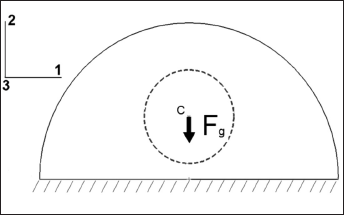
Boundary conditions: the hemisphere is encastred at its basis and a distributed load equal to the gravity force (Fg) is applied. The figure shows the case in which the gravity load is applied in direction U2(0,-1, 0).
Geometric
the basement of the hemisphere is encastred. The degrees of freedom at the basis of the deformable body are equal to zero:

where U is the displacement in translation.
External
an externally distributed load equal to the gravity force in the U2(0,-1,0), U1(1,0,0), and U2(0,1,0) directions alternatively.
Material models
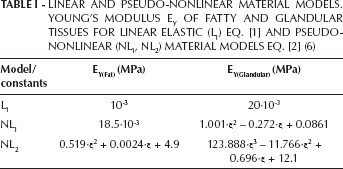
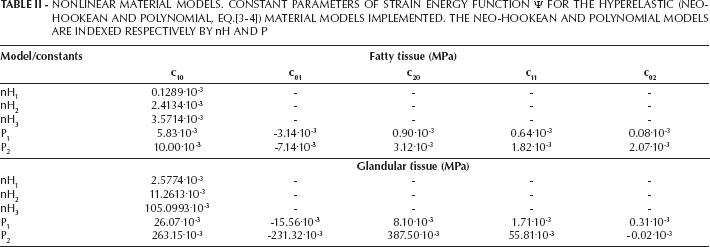
The material models employed are the ones used by Tanner et al. (6). Three different typologies have been analyzed: linear elastic L1 (Eq. [1]), pseudo-nonlinear NL1, NL2, (Eq. [2]) and hyperelastic models. Among the latter mentioned Neo-Hookean nH1, nH2, and nH3 (Eq. [3]) and Polynomial P1, P2 (Eq. [4]) formulations have been implemented. Table I and Table II summarize the material constants of the analyzed material models considered. For the linear elastic and pseudo-nonlinear models Poisson's coefficient is set to 0.4999 to simulate incompressibility.
Mesh
Tetrahedral quadratic elements have been used for the discretization (Fig. 3) (17). The external elements of the spherical inner part (glandular tissues) share their nodes with the internal elements of the hemisphere (fat tissue): no contact interactions have been considered between glandular and fat tissues. The elements used to implement the simulations are tetrahedral quadratic modified hybrid elements, code C3D10MH in ABAQUS, suitable for the analysis of incompressible material behavior and large deformations. They are “mixed formulation” elements, using a mixture of displacement and stress variables with an augmented variational principle to approximate the equilibrium equations and compatibility conditions (19). In the case of mixed (hybrid) formulation elements the displacement field is augmented with a hydrostatic pressure field. In the nearly incompressible case a very small change in displacement produces extremely large changes in pressure so that a purely displacement-based solution is too sensitive to be useful numerically. The hybrid elements remedy the problem of volume strain locking. Figure 4 (the contour plot of the pressure values) shows the effect of volume strain locking which can occur, at values of Poisson's coefficient v=0.4999, when full integrated elements are used. In the case in which full integrated elements are employed (Fig. 4[a]), in fact, a higher difference among some close-set elements (red circles) compared to the case of a mesh built by modified hybrid elements (Fig. 4[b]) is evident. It means that some elements are locked. In conclusion, the choice of modified hybrid elements is because of the fact that incorrect representation of incompressible deformations causes volume strain locking. The pure displacement formulation can behave poorly, for a material response close to incompressibility. Note that, from a numeric point of view, the stiffness matrix is almost singular because the effective bulk modulus of the material is so large compared to its effective shear modulus, thus causing difficulties with the solution of the discretized equilibrium equations.
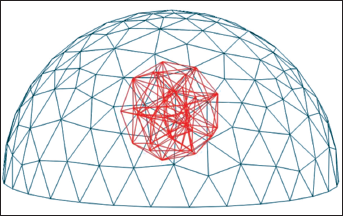
Tetrahedral mesh employed for the simulations. The red spherical part represents the glandular tissue. The total number of elements is 2391.
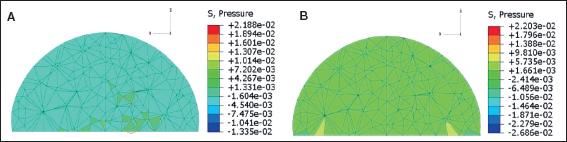
Contour plots of the pressure (MPa) values for the implementation of two different element typologies: (a) full integrated quadratic elements (C3D10) and (b) modified hybrid quadratic elements (C3D10MH) in ABAQUS.
FE model validation
The proposed FE model has been validated and compared to the model proposed
by Whiteley et al. (17) based on Veronda & Westmann's strain energy
density function (20), 
where I1 and I3 are the first and third deviatoric strain invariants and f is a measure of the compressibility of the material (this term is avoided for the assumption of incompressibility). The validation is performed by a comparison with the results provided by (17) for the same FE model. From Table III, one can notice that, in terms of maximum displacement, the two models differs with 3.7% for a gravity load applied in direction U1(1, 0, 0), 7.7% for direction U2(0, 1, 0), and 1.6% for direction U2(0,-1, 0). A sensitivity study, considering a number of elements varying between 340 and 4259, to assess the quality of the mesh showed a good compromise using 2391 elements: the differences measured, considering the strain energy value, are 4.44% with respect to a mesh with 4259 elements and 48.60% with respect to a mesh with 340 elements. The adopted criterion to assess the optimal mesh is the strain energy convergence of Bathe (21).
FINITE ELEMENT MODEL VALIDATION. MAXIMUM DISPLACEMENT VALUES FOR THE VERONDA & WESTMANN MODEL IMPLEMENTED BY WHITELEY ET AL. (17) AND THE ONE IMPLEMENTED IN THIS WORK

Results and Discussion
This work presented a comparison between finite deformation elasticity models for soft biological tissues and their linear or pseudo-nonlinear approximations. The parameter values employed for both fat and fibroglandular tissues were the same already adopted by other authors in literature (6).
FE calculations of a simplified human breast under gravity load demonstrated that least squares based fittings of strain-stress relationships of highly hyperelastic material models with linear or pseudo-nonlinear formulations (6) are not sufficiently accurate.
In more detail, we calculated the displacements relative errors between the Neo-Hookean model nH1 Eq. [3] and its elastic linear approximation L1 Eq. [1], and the pseudo-nonlinear models NL1, NL2 Eq. [2] and their Neo-Hookean nH2, nH3 Eq. [3] and Polynomial, P1 and P2 Eq. [4], approximations in the three loading directions U1(1, 0, 0), U2(0, 1, 0) and U2(0, −1, 0) (Fig. 5), modeling the standing, prone and supine breast positions, respectively.
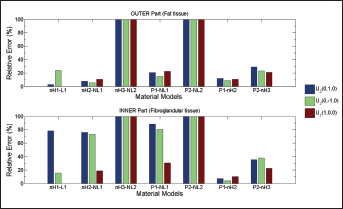
Displacement relative errors (%) were calculated compared to the nonlinear models (nH1, nH2, nH3, P1, and P2). In general, they are bigger for the inner part (glandular tissue). In particular, relative errors between nH3-NL2 and P2-NL2 exceeds 100% (the scale is limited to 100% in the figure) for both parts. This is the worst case study showing that the least squares approximation of a pseudo-nonlinear (NL2) model with a Neo-Hookean (nH3) and a Polynomial (P2) one is unreliable. The best case study is given by P1-nH2: the displacement relative errors for both outer and inner part are below 20%.
The first remarkable result is that the simulations did not converge for the case studies L1 and nH1 considering the gravity load in direction U1(1, 0, 0) (standing position). This is because of the too large deformations that occur for very soft materials: nH1 is characterized by c10 value of ≈1 kPa for fat tissue and ≈20 kPa for fibroglandular tissue. We strongly believe that this is a typical undesired convergence issue because of too large deformations for the adopted approximations. Consequently, one can notice differences between the Neo-Hookean model nH1 and the elastic linear model L1 only for the supine U2(0,-1, 0) and prone U2(0,1,0) breast positions. Taking into account the prone position, relative errors in displacement were almost 40 times bigger for the fibroglandular part. Considering pseudo-nonlinear models, this difference also remained present if the scaling factor was in the range of 4. In the case of prone configuration, large errors between fat and fibroglandular parts are probably because of the presence of bigger displacements compared to other loading set-ups. Comparison nH1-L1 gives an error 10 times bigger than nH2-NL1 (prone position). This is because of the nonlinear nature of both models (nH2 and NL1) that provides a better fitting. The large relative errors measured in all case studies may give an indication of inaccuracy in tracking the displacement of stiffer internal zones present in the breast, adopting a linear or a pseudo-nonlinear approximation of a nonlinear hyperelastic Neo-Hookean material model. Completely unreliable results have been obtained computing displacements using the pseudo-nonlinear model NL2 to approximate the Neo-Hookean model nH3 and the Polynomial model P2. In fact, relative errors are bigger than 100% for case studies nH3-NL2 and P2-NL2.
The trend of the displacement values and the maximum principal stress of seven nodes (Fig. 6) of the hemisphere external layer give an idea of the firmness of the model (Fig. 7) and how it changes using different material models formulations. The trend was the same for all the material models employed with the exception of the pseudo-nonlinear NL1 for all the loading directions (Fig. 7[a]-[c]-[e]). The reason might lie in the material formulation adopted for the fat tissue. In fact, the material model NL1 employed an elastic linear relationship, with a constant Young's modulus, to compute stresses. On the contrary, stress and strain were linked by a nonlinear relationship in model NL2.
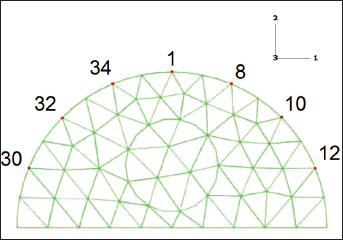
Position of nodes 30, 32, 34, 1, 8, 10, and 12 on the surface layer of the hemisphere.
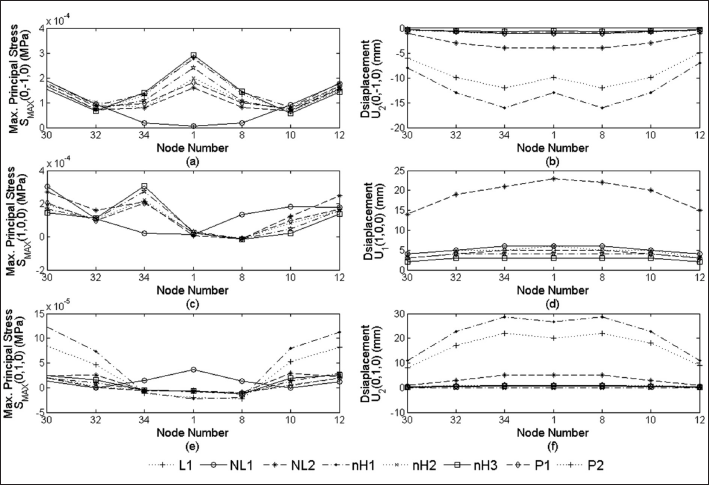
The Max Principal Stress SMAX (MPa) is plotted in (a), (c), and (e). The displacement U (mm) is plotted in (b), (d), and (f). The directions of the applied load are U2(0,-1,0), U1(1,0,0), and U2(0,1,0) respectively. All the values are related to the nodes 30, 32, 34, 1, 8, 10, and 12.
When adopting the hemisphere geometry to model the shape of a human breast and assuming its basis as directly matched with the pectoralis fascia, it could be interesting to assess the magnitude of the reaction forces in that area. Considering the breast fixed to the pectoralis fascia the contour plots in Fig. 8 illustrate the distribution of the reaction forces values, for the application of a gravity load in the direction U2(0,-1, 0) using a Neo-Hookean material model nH1 and its linear elastic approximation L1. The maximum value for the linear model was 523.624E-3 (MPa) (Fig. 8[a]) while for the nonlinear case this was 865.956E-3 (MPa) (Fig. 8[b]). The nonlinear solution differs by 66% from the linear solution.
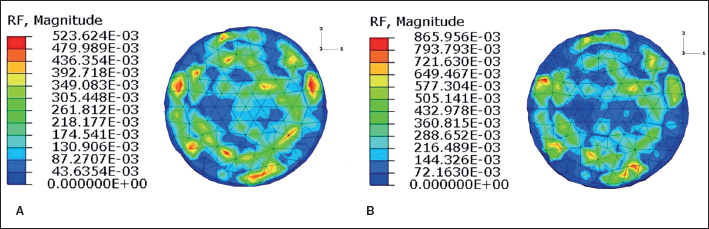
Bottom view of the hemisphere: contour plots of the Reaction Force (RF) values (N) at the basis of the hemisphere for the material models (a) elastic linear Eq.(1) and (b) Neo-Hookean Eq.(3). A gravity load in direction U2(0,-1,0) is applied.
All the case studies assessed show that human breast FE calculations performed using linear or pseudo-nonlinear approximations obtained from least square fitting of stress-strain data of more complex nonlinear material models could be affected by enormous errors. In practice, this could be translated in terms of errors in deriving clinical interpretations. For this reason, simplifications of the material models adopted should be carefully analyzed and assessed.
Conclusions
To conclude, this study assessed the impact of different material models on the FE modeling of a simplified 3D geometric representation of the human breast shape (Fig. I). The model is a hemisphere, representing the fat tissue, surrounding a spherical inclusion, simulating the fibroglandular tissue. The geometric model refers to the study conducted by Whiteley et al. (17) while the implemented material models refer to the work of Tanner et al. (6). The use of the material models of Tanner et al. (6) facilitated understanding the impact of the errors in FE analysis because of material modeling of soft biological tissues. The results confirmed the assumption made by Whiteley et al. (17) that material models are very important for human breast FE material modeling. The approximation of nonlinear material models, such as Neo-Hookean and Polynomial hyperelastic models, with their linear or pseudo-nonlinear approximation is not a suitable solution. The lack of accuracy is very high. In fact, approximating a Neo-Hookean model with its linear expression leads to changes in displacements of at least 20.0% (average), much more than 0.5% stated by other authors (6). Moreover, hyperelastic material models showed differences between them: for example, a Neo-Hookean model (nH2) cannot be a good approximation of a Polynomial model (P2). In conclusion, according to the results provided by this study, innovative techniques for the characterization of biological materials, particularly soft tissues, should be investigated.