



Abstract
Background:
Conventional ventilators (CV) can be powered by heliox (HeO2) gas admixtures to provide clinicians with the ability to deliver mechanical breaths at reduced airway resistance, improved carbon dioxide diffusion, and decreased turbulent flows. High frequency jet ventilation (HFJV) is a time cycled pressure-limited ventilator used to provide less than dead space tidal volumes with transitional gas flows at high rapidity. The aim of this bench study was to discover what effects HeO2 had on measured Servo pressure and tidal volume when used as a driving gas for HFJV and CV.
Methods:
A QuickLung Breather (IngMar Medical, Pittsburgh, PA) test lung model was used to simulate spontaneous respirations while connected to a LifePulse HFJV (Salt Lake City, UT) and a Servo U MV (Getinge, Wayne, NJ). The test lung was attached to a 2.5 mm ETT, set to a resistance of 50 cm H2O/L/s, rate of 42 breaths/min, 25% inspiratory time (0.36 s) with measured exhaled tidal volumes (Vte) of 9-10 mL while using CPAP +8 on MV. A LifePort ETT connected HFJV and CV circuit to the ETT and lung model. A jet rate of 300 breaths/min and I-time 0.02 s, and CPAP +8 were constant throughout the study. HFJV was powered by 50 PSI oxygen and a HeO2 blender (Precision Medical, Northampton, PA) for the bench studies. A HeO2 compensated Servo U was powered by 50 PSI air/O2 gas supply and an H cylinder of HeO2. Peak inspiratory pressure (PIP) on HFJV was increased to 20, 30, and 40 cm H2O on room air, 80/20, 70/30, and 60/40 gas admixtures with HFJV alone, with CV alone, and simultaneously driven HeO2. Dynamic compliance (Cdyn) and Vte were measured with the CV and Servo pressure was recorded on HFJV after achieving a 5-min steady state for changes to HFJV PIP and HeO2 gas admixtures. Graphical representations of the data gathered were compiled to show the effects of HeO2 on each device separately, combined, while using room air, and for the various HFJV PIP settings and HeO2 gas admixtures.
Results:
HFJV driven HeO2 had higher measured Vte and Cdyn when compared to CV driven HeO2 on a lung model. The combination of HFJV and CV driven HeO2 resulted in the highest measured Vte and Cdyn during the experiment.
Conclusions:
Data gathered during this experiment suggests that HFJV driven HeO2 outperforms CV driven HeO2. The direct impact of HeO2 driven HFJV needs further study to decide the implications of its clinical or investigational research usage.
Measured Exhaled Tidal Volume Dynamic Compliance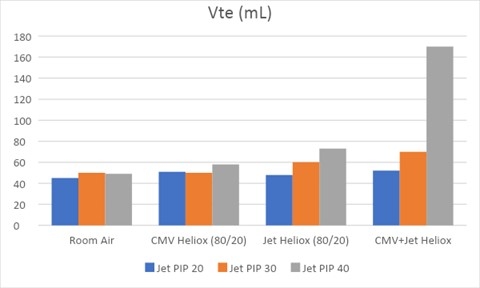

Get full access to this article
View all access options for this article.