



Abstract
Background:
Since 2008, the Ministry of Health and Welfare of Taiwan has provided three-stage clinical training for novice respiratory therapists who are employed in hospitals to care for patients. These three stages are divided into basic stage (3 months to train 18 core courses and operating techniques), advanced stage (9 months to train 19 core courses and operating techniques) and complicated stage (one year to train 26 core courses and operating techniques), novices receive standardized professional training under the guidance of senior clinical teachers, cultivate professional core competencies, and acquire independent caring practice capabilities. Ensure the quality of medical services and patient safety.
Methods:
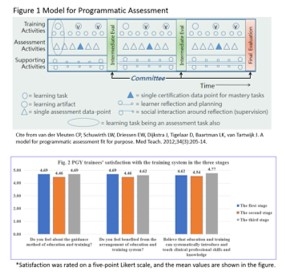
We use the Model for Programmatic Assessment (Figure 1) as the training structure and divide the core courses and technique skills into three stages to train and evaluate students’ teaching effectiveness. A total of 13 PGY trainees have completed the training from 2018 to 2024. These 13 trainees were given three satisfaction evaluations on the training system at the end of each stage using a 5-point Likert scale. The evaluation items include (1) How do you feel about the guidance method of education and training? (2) Do you feel you benefited from the arrangement of education and training system? (3) It is believed that education and training can systematically introduce and teach clinical professional skills and knowledge. The results obtained are represented by narrative statistics to describe the score range and mean, one-way analysis of variation (ANOVA) was used to detect whether there were statistically significant differences between the three stages. This study was approved by the Institutional Review Board of China Medical University (CMUH111-REC-008).
Results:
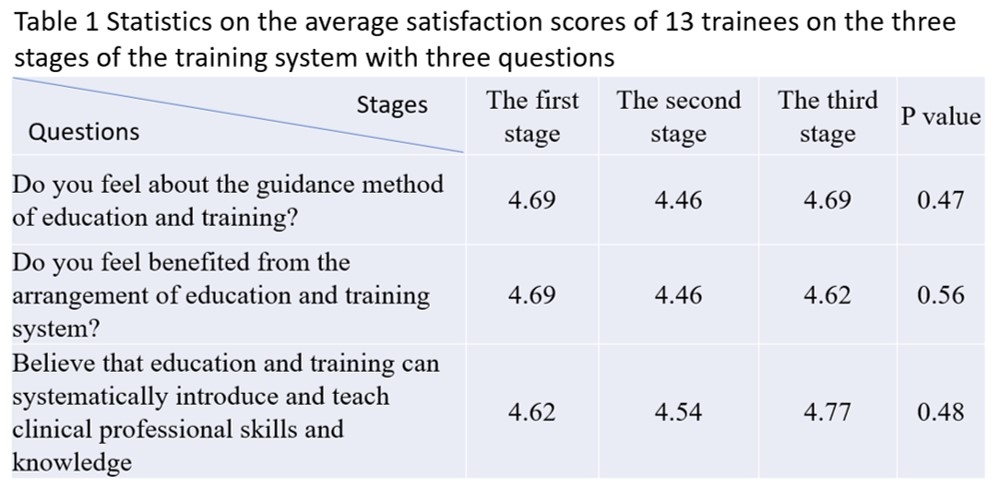
According to the satisfaction analysis of 13 students in the three stages, in question item 1 were 4.69, 4.46, and 4.69, in question item 2 were 4.69, 4.46, and 4.62, and in item 3 were 4.62, 4.54, and 4.77 respectively. The P value between the three stages analyzed by ANOVA was .47, .56, .48 respectively. There was no statistically significant difference in three stages. (Table 1) Although there is no statistically significant difference, the lowest score of satisfaction was 4.46. Therefore, overall, these 13 trainees had a positive attitude toward the training system. (Figure 2)
Conclusions:
This study shows that trainees are all satisfied with these two years of training.
Get full access to this article
View all access options for this article.